


What pension for a €1,600 net salary in France?

Updated on 5 August 2026
On a net salary of €1,600 a month, a realistic retirement pension in France is close to €1,194 net a month, a replacement rate of about 74.6%. That figure adds the basic pension from the general scheme (régime général) to the Agirc-Arrco supplementary pension. This article sets out every step of the calculation, from gross to net, so you can check the result yourself.

- On a net salary of €1,600 a month, expect a realistic pension of about €1,194 net a month, a replacement rate of around 74.6%.
- The detailed basic plus supplementary calculation gives a theoretical maximum of €1,433.73 gross a month, about €1,372.08 net after social levies: an upper bound, not the pension to expect.
- The basic pension comes to €1,038.96 gross a month and the Agirc-Arrco supplementary pension to €394.77 gross a month, on 3,293 points built up over a 43-year career.
- A pension at this level is subject to the CSG and the CRDS (France's social-security levies on income), here at the reduced rate of 4.3%, and is never zero by default.
- A PER (France's retirement savings plan) or company profit-sharing can top this pension up, subject to a risk of capital loss.
How do you calculate your pension on a salary of 1,600 euros net?
The calculation combines two tiers: the basic pension from the general scheme, which depends on the average annual salary and the length of contribution, and the Agirc-Arrco supplementary pension, which runs on points. Both start from gross salary, whereas an employee's own reference point is almost always their net salary.
Basic pension on a salary of 1,600 euros net
A net salary of €1,600 a month corresponds, on the 77% net-to-gross ratio used across this series of articles, to a gross salary of 1,600 / 0.77 = €2,077.92 gross a month, or about €24,935 gross a year. That 77% rate converts salary from gross to net: it must not be confused with the social levies applied further down to the pension itself, at a different rate.
The 2026 PASS (France's annual social security ceiling) stands at €48,060 gross a year, or €4,005 gross a month (the calculation base is itself capped at 50% of the PASS, €2,002.50 gross a month). The gross annual salary of €24,935 therefore stays entirely below the PASS.
For a full career at the full rate (172 quarters of contribution, or 43 years, for generations born from 1965 onwards), the basic pension works out as follows: 2,077.92 × 50% = €1,038.96 gross a month. That is above the 2026 minimum contributif, France's minimum basic pension (€903.93 gross a month), so there is no top-up to the minimum. It also stays below the cap of 50% of the PASS (€2,002.50 gross a month), which therefore does not apply here either.
Supplementary pension on a salary of 1,600 euros net
The Agirc-Arrco supplementary pension runs on points, built up each year using the following formula:
annual points = (gross annual salary up to the PASS × 6.20% + the portion above the PASS × 17%) / 20.1877
Since the gross annual salary of €24,935.06 stays entirely below the PASS, there is no band 2 portion. The calculation gives: (24,935.06 × 0.062 + 0 × 0.17) / 20.1877 = 76.58 points a year. Over a 43-year career, that is 76.58 × 43 = 3,292.94 points, or 3,293 career points.
As of 1 November 2025, the service value of the Agirc-Arrco point is frozen at €1.4386. The annual supplementary pension therefore comes to 3,292.94 × 1.4386 = €4,737.22 gross a year, or 4,737.22 / 12 = €394.77 gross a month.

Goals
Which factors affect the amount of the pension?
Three factors set the final amount of the pension: the length of contribution validated, the average annual salary taken over the 25 best years, and the nature of the career (private sector, public sector, or a special scheme).
Length of contribution
The length of contribution is one of the factors that shape the amount of the pension. In France, the number of quarters of contribution determines whether you qualify for a full-rate pension. Under the rules on the statutory retirement age, workers must contribute a set number of quarters to reach the full rate. The insurance period required varies with year of birth and with family circumstances.
Average salary
The average annual salary (SAM) is another decisive factor in the pension calculation. French social security takes the 25 best years of your career to set the SAM. The higher the average salary, the higher the basic pension.
Career path
The career path also shapes the supplementary pension. The French pension system, and Agirc-Arrco in particular, runs on a points system. The number of points earned over a career depends on gross salary, on the contributions paid and on the value of the point. A long, well-paid career therefore produces a higher supplementary pension.
France's pension schemes
The French pension system rests on several schemes, all meant to provide workers with a pension once they retire. They fall into the general scheme and the special schemes (régimes spéciaux).
The general scheme
The general scheme is France's main pension scheme, and its pension depends chiefly on earned income, on the number of quarters contributed and on the age of retirement. It covers private-sector employees, including anyone on a salary of 1,600 euros net. To estimate the pension under this scheme, you can use a simulator.
Pension contributions are split across two tiers: the basic pension and the supplementary pension. The basic pension is run by l'Assurance retraite, while the supplementary pension comes from the Agirc-Arrco scheme.
Special schemes
Special pension schemes cover specific categories of worker: civil servants, employees of state-owned companies and certain other professions. Each one reflects the specifics of its category. They can offer advantages over the general scheme, such as more favourable retirement conditions or a different pension calculation.
Some special schemes are run by autonomous funds, while others are integrated into the general scheme or into Agirc-Arrco. Each has its own operating rules and its own way of calculating the pension, reflecting the specifics of the profession concerned.
For an employee on a salary of 1,600 euros net who falls under the general scheme, the special schemes do not apply directly. They can still be relevant if the person worked in a profession covered by one of them during their career. In that case the total pension is a combination of the pensions earned under each scheme contributed to.
Pension simulators
To estimate the pension on a salary of 1,600 euros net, use an online simulator. Simulators give an estimate of the pension at different ages, based on the data your basic and supplementary pension funds already hold.
These pension simulations draw on your career statement and cover every scheme you belong to, to produce an estimated pension. For each retirement age considered, you can see the number of quarters accumulated and the estimated pension in gross euros.
The best way to get a precise estimate is to go to the Info Retraite site and log in to your personal account. The estimate is produced automatically from the rights built up over your career. Several possible retirement ages are presented, each with its number of quarters and the matching pension amount.
What can you use to top up your pension?
Three main levers can top up a modest pension: the PER, company profit-sharing, and working while drawing a pension (cumul emploi-retraite). On a salary of 1,600 euros net, savings solutions and other options are worth planning for. One of them is the PER, used to build up a lump sum or an annuity for retirement. The PER offers tax advantages and suits long-term saving. Note that the capital is generally locked until retirement (outside the early-release cases) and that investing carries a risk of capital loss depending on the investment options chosen.
Another route to prepare for retirement is profit-sharing at the company you work for. Profit-sharing allocates part of the company's profits to its employees. The sums received can be paid into a PEE (a French company savings plan) or a collective PER, building up your savings for retirement.
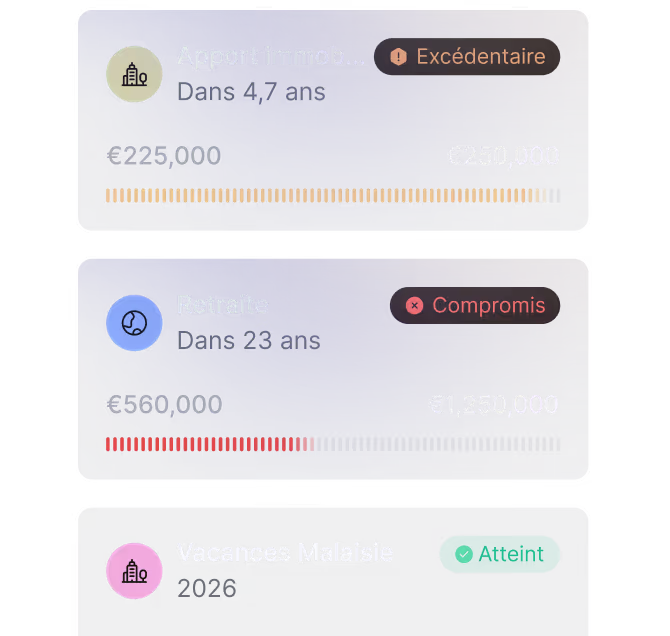
Tools such as Finary let you track how your retirement savings (PER, PEE, profit-sharing) are progressing in one place, alongside the rest of your wealth.
As a private-sector employee, you also contribute compulsorily to the Agirc-Arrco supplementary pension scheme. The contributions paid over your career earn you a supplementary pension when you retire, so it is essential to understand how pension points are awarded.
Employees who want to work while drawing their pension can use the cumul emploi-retraite scheme on the basic pension. Subject to conditions, it allows earned income to be combined with a pension from l'Assurance retraite. This option can also help top up income in retirement.
At what age can you retire on a salary of 1,600 euros net?
The level of salary has no direct bearing on the age of retirement: your year of birth and the number of quarters you have validated set the statutory age. The amount of the pension, for its part, depends on several factors: the age of retirement, the employee's sex and the number of quarters of contribution accumulated.
Since the 2023 French pension reform, the statutory retirement age has been rising gradually from 62 to 64. It stays at 62 for generations born before September 1961. The 2026 French social security financing act has, however, frozen that phase-in for pensions taking effect from 1 September 2026: the statutory age stays at 62 years and 9 months for the 1964 to 1968 generations, and the age of 64 (with 172 quarters) will only apply from the 1969 generation onwards, at least until 1 January 2028. Without all quarters validated, the full rate is still granted automatically at 67, an age the freeze leaves unchanged.
The amount of the pension also depends on the split between the basic pension and the supplementary schemes. The basic pension is calculated from the average annual salary, the 25 best years of pay and the liquidation rate, while the supplementary schemes rest on the number of points accumulated and on the value of the pension point.

People who have reached the statutory retirement age can also choose to carry on working and combine employment with a pension, subject to conditions, which can help improve the amount of their pension. The terms of that combination and the income caps allowed differ from one pension scheme to another.
It is worth following how these rules change and checking your accrued rights and the conditions for a full pension regularly. To estimate the amount of your future pension according to your age, your sex and your situation, you can use online pension simulators such as the Info Retraite simulator.
What levies apply to a pension of 1,600 euros net?
Private-scheme pensions bear social levies: the CSG and the CRDS, to which the CASA levy is sometimes added. The rate depends on the household's reference taxable income (revenu fiscal de référence): from 0% (full exemption) to 9.1% (the standard rate), with an intermediate median rate of 7.4%. On a theoretical maximum of €1,433.73 gross a month for a single person, whose reference taxable income stays low at this level of pension, the reduced rate of 4.3% applies, which gives €1,372.08 net a month.
The net amount of the pension then feeds into income tax according to the household's situation, after the 10% allowance that applies to pensions. The quotient familial, which sets taxable income, is obtained by dividing net taxable income by the household's number of tax shares (parts fiscales).
Older people on modest incomes may also be entitled to social benefits (the allocation de solidarité aux personnes âgées, housing benefit) and, where independence is lost, to the allocation personnalisée d'autonomie.
Frequently asked questions
Is the pension quoted a gross or a net amount?
The basic plus supplementary calculation (€1,038.96 gross + €394.77 gross) produces a theoretical gross maximum of €1,433.73 a month. Social levies, here the CSG and the CRDS at the reduced 4.3% rate, then give the net amount: €1,372.08 net a month for that theoretical maximum. Those levies are never zero by default. The realistic estimate, based on the net replacement rate, is about €1,194 net a month.
What is the difference in pension between the private and the public sector?
The difference in pension between the private and the public sector depends mainly on earned income, the number of quarters of contribution and the age of retirement. In the private sector, the basic pension is calculated from salaries and the number of quarters contributed. A public-sector pension is generally calculated from the final index-linked salary and the number of years of service.
How do contribution years affect my pension?
Contribution years have a direct impact on the amount of your pension. The longer you contribute, the higher your pension. The amount therefore depends on the number of quarters of contribution, the income earned during working periods and the age of retirement. Periods other than work, such as maternity, sick or unemployment leave, can also count as quarters.
Can you retire before the statutory age on this salary?
Yes, subject to conditions. The carrière longue scheme allows early retirement if you started work young and have validated the required number of quarters of contribution. The level of salary plays no part: eligibility rests on the insurance period and the age at which you started working, including during the temporary freeze on the statutory age set by the 2026 French social security financing act.
How can you increase your pension on a salary of 1,600 euros net?
Three main levers: working longer to validate extra quarters of contribution and earn a surcote, building dedicated savings such as a PER, and paying profit-sharing or incentive bonuses into a company savings plan.
Is a retirement pension taxable?
Yes. Retirement pensions are subject to income tax, after a 10% allowance (capped at €4,439 per tax household in 2026). On a theoretical maximum of about €1,433.73 gross (about €1,372.08 net) a month, the tax generally stays moderate depending on your family situation and your other income.
Sources
Service-public.fr, calculating the basic pension and the minimum contributif
Service-public.fr, social levies on retirement pensions
Agirc-Arrco, how supplementary pension points are earned
Agirc-Arrco, service value of the point as of 1 November 2025
Service-public.fr, statutory retirement age
L'Assurance Retraite, pension measures in the 2026 social security financing act
L'Assurance Retraite, calculating the amount of the basic pension
Info Retraite, personalised estimate of the pension amount
Conseil d'orientation des retraites, replacement rates for private-sector employees
DREES, Les retraités et les retraites, 2025 edition
Impots.gouv.fr, taxation of retirement pensions
Regulatory disclaimers: Marketing communication. Investing carries a risk of partial or total capital loss. Past performance is not a reliable indicator of future performance. This article is provided for information and educational purposes only; it does not constitute personalised investment advice, a buy or sell recommendation, or tax advice. Before investing, read the Key Information Document (KID) and, where relevant, consult an authorised adviser. Finary SAS, an investment firm authorised by the ACPR (no. 19283), member of AMAFI. Insurance broker registered with ORIAS (no. 21001279), member of the CNCGP (association approved by the AMF). Crypto-Asset Service Provider (CASP) authorised by the AMF under the MiCA regime, references no. A2026-026 and no. N2026-008.