Which banks offer a Lombard loan in France?

The Lombard loan, long reserved for wealthy clients, is gradually opening up to a wider public in France. It remains a leveraged product with specific risks, however.
BoursoBank now offers this solution from €101,000. Meanwhile, platforms like Pledger are democratizing access with a 15-minute application process. The question is no longer whether you can access a Lombard loan, but which bank matches your wealth strategy.
Understanding the Lombard loan before choosing your financial institution
What is a Lombard loan and how does it work?
A Lombard loan lets you turn the value of your investments into cash without selling your assets. You pledge your financial assets (shares, bonds, funds, life insurance) as collateral, and the bank grants you a credit line.
Your securities stay invested, keep generating income, and you retain control of your strategy.
The bank mainly assesses the quality and liquidity of your assets. The more stable and easy to sell your securities are, the higher the loan-to-value ratio (LTV) will be. For example:
- A portfolio of government bonds can unlock up to 90% of its value.
- More volatile equities are subject to a 30% to 50% haircut.
This balance between risk and opportunity defines the Lombard loan.
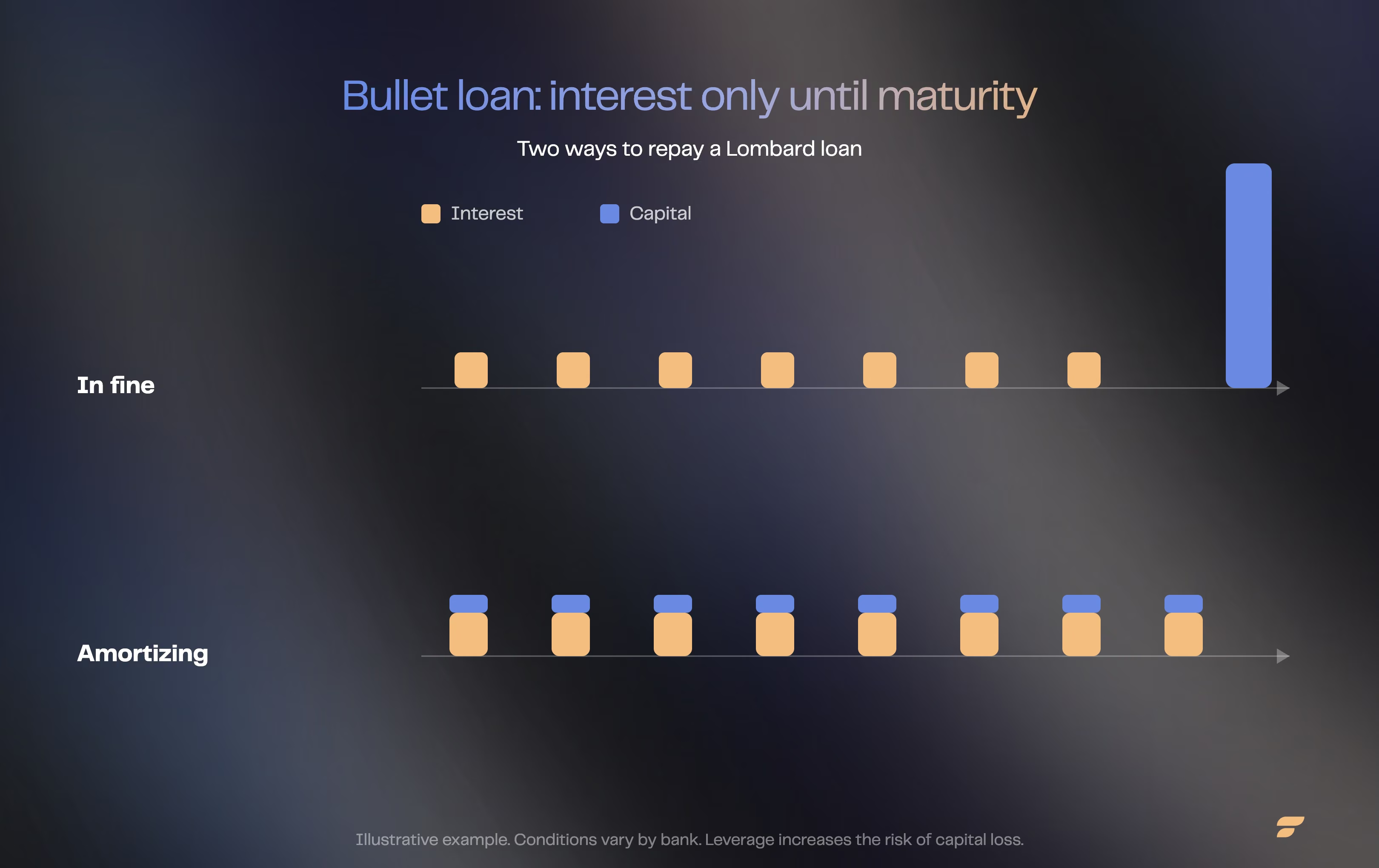
Repayment is usually structured “in fine”: you only pay interest for the life of the loan, with the capital due at maturity. This frees up your cash flow. You can seize an opportunity, fund a project or optimize your taxation, all while keeping your positions.
Why is choosing the right bank essential for optimizing your Lombard loan?
Every bank applies its own criteria to a Lombard loan: risk, eligibility, margins, management. Some prioritize flexibility, others security. The details strongly influence your experience:
- Indexed or fixed interest rate
- Application fees
- Diversity of accepted assets
- Responsiveness in the event of a margin call
These factors can turn a Lombard loan into an effective lever, or a source of constraints.
For example:
- A Swiss private bank often accepts international assets, unlisted securities or artworks as collateral. It offers personalized support, but requires a high entry ticket.
- A digital neobank makes the Lombard loan more accessible, but limits eligible assets and automates the process, at the expense of personalization.
Choosing your bank means choosing a partner who understands your wealth strategy, anticipates your liquidity needs and reacts quickly to market volatility.
Digital banks and neobanks offering the Lombard loan
Finary One: the tailor-made Lombard loan with full flexibility

As part of our private wealth management offer, Finary One, we offer a Lombard loan service, accessible from €250,000 borrowed. This financing solution lets you quickly access liquidity without having to sell your financial assets.
What makes our offer different? Open-ended contracts, offering full flexibility in repayment. You can repay the borrowed capital at your own pace, partially or in full, with no fixed maturity date or penalties. This solution is designed for investors who want to stay fully exposed to the financial markets, while benefiting from an agile source of financing to seize opportunities or cover occasional cash-flow needs.
Thanks to this tailor-made approach, Finary One stands out as a reference solution for modern, liquid and high-performing wealth management.

BoursoBank: the 100% digital, self-service Lombard loan

BoursoBank is modernizing access to the Lombard loan by offering it entirely online since late 2024. This offer is exclusively for BoursoFirst clients, who can get a loan with no appointment and no paperwork.
The platform lets you borrow between €101,000 and €2,000,000, or up to 50% of the value of eligible portfolios held at BoursoBank.
The offer is built on transparency and simplicity. Accepted assets include securities accounts, the PEA (a French tax-advantaged equity savings account) and BoursoVie life insurance. Unlisted securities, PEA-PME (the SME variant of the PEA) and SRD positions, however, are not eligible.
The loan, structured in fine over 5 years, carries quarterly interest and a capital repayment at maturity.
This solution suits self-directed, tech-savvy profiles who want to manage their wealth leverage without an intermediary. It does, however, require rigorous management, as a margin call can occur in the event of market volatility.
BoursoBank therefore targets investors who master their risk and prefer the transparency of an algorithmic platform over personalized support.
Lombard loan: which traditional private banks to approach in France and internationally?
The leading Swiss private banks for a Lombard loan
Swiss private banks dominate the Lombard loan market thanks to their long-standing expertise.

Lombard Odier, whose name reflects the origin of the concept, embodies this tradition. The Lombard loan at Lombard Odier offers great wealth flexibility: clients keep their voting rights and dividends on the securities pledged as collateral. This advantage is crucial for those who want to preserve their influence and income.

UBS France favors personalization. The bank adapts the currency, amount and term of the loan to each client's wealth situation.
For example, an international entrepreneur can borrow in dollars for a deal in New York while pledging a portfolio of European equities as collateral. This ability to handle cross-border transactions appeals to mobile, cosmopolitan profiles.
Major French and European private banks and their Lombard loan offers
In France, the Lombard loan has become mainstream thanks to major private banks.

BNP Paribas Wealth Management offers comprehensive support. This offer can finance various projects, such as a property purchase, funding a family start-up or optimizing cash flow, all while respecting the client's wealth strategy. The pledged portfolio serves as the basis for financing, with no need to sell existing investments.

Société Générale Private Banking offers a wide range of assets accepted as collateral:
- listed shares
- bonds
- funds
- ETFs
- structured products
- private equity
- units of SCPI (a French non-listed real-estate investment fund)
- artworks
This diversity lets atypical profiles, such as collectors, fractional real-estate investors or entrepreneurs in unlisted companies, benefit from a tailor-made Lombard loan. The bank also accepts multiple currencies, which makes cross-border structuring easier.

Rothschild & Co takes an exclusive but transparent approach. The margin applied ranges from 0.60% to 5%, depending on the amount and the quality of the collateral. The bank does not charge processing fees for a standard Lombard loan, which makes the costs easier to understand.
Every private bank adapts the Lombard loan to its own vision, between tradition, innovation and personalization. The choice doesn't depend only on rates or amounts, but on the bank's culture, expertise and the range of assets it accepts. For a savvy investor, the quality of the dialogue and the ability to anticipate future needs often matter more than the loan's mechanics alone.
Regional and specialized banks: alternatives for your Lombard loan
Which French regional banks offer a Lombard loan?
French regional banks take a personalized approach to the Lombard loan. They favor discretion and flexibility, which appeals to demanding clients seeking distance from the bustle of large international institutions.

La Banque Palatine illustrates this approach well. Its Lombard loan starts at €1 million, targeting profiles who want to use their wealth as leverage. The bank focuses on preserving capital and funding ambitious projects without compromising asset performance.
Lombard loan offers from specialized banks in Europe
In Belgium and the Netherlands, some specialized banks have developed the Lombard loan as a private banking and wealth-engineering tool.
Degroof Petercam, for example, offers hybrid structures combining a securities pledge with a mortgage guarantee. This rare solution appeals to entrepreneurs and wealthy families who want to avoid unnecessarily tying up their capital.
At Degroof Petercam, the Lombard loan can finance the purchase of an exceptional asset or the transfer of a family business without liquidating financial assets. This modular approach is for those who see the Lombard loan as a strategic tool, not just a source of liquidity.

ABN AMRO Private Banking focuses on flexibility. With an entry ticket from €200,000, the bank offers securities-backed loans with terms of 1 to 5 years, with a choice between an installment loan or an in fine loan. It adapts its offers to the client's wealth structure, whether individual or corporate. Its teams are skilled in managing currencies, asset types and cross-border financing needs, an asset for mobile or international clients.
These specialized banks reject a one-size-fits-all approach. Every case undergoes an in-depth analysis of risk, asset liquidity and long-term goals. The Lombard loan becomes a precise instrument, designed to support the major milestones of a wealth journey.
Regional and specialized banks show that the Lombard loan goes beyond simple rates or LTV ratios. It rests above all on relationship, listening and ingenuity. For investors seeking tailor-made solutions, these institutions offer a framework where financial creativity meets the rigor of personalized advice.
Beyond banks: where to find other Lombard loan solutions?
The Lombard loan is no longer reserved for private banks. Digital brokers now make this type of financing easier to access. They make this kind of loan as accessible as a personal loan, while still guaranteeing quality advice.

Pledger focuses on speed and simplicity. In 15 minutes, an investor can get a personalized simulation, compare several offers and start the application. This service avoids the administrative hassle and sometimes opaque criteria of traditional banks.
By moving away from traditional banks, these players (brokers, family offices, insurers) are improving the Lombard loan. They turn it into an agile, customizable tool, able to adapt to the complexity of modern wealth.
The market's gradual opening to digital players and individuals is attracting new entrants. Fintechs (like Finary) are already developing innovative solutions to make this type of financing more accessible. Other players will likely follow this trend. For the demanding investor, this tailor-made financing fits naturally into an overall strategy, far from a standardized product.
The Lombard loan through an insurer like Swiss Life: an option worth considering?
Life insurance isn't just a savings product. For savvy investors, it also becomes a source of liquidity through the Lombard loan. Swiss Life, for example, offers Lombard loans backed by life insurance policies or by financial assets held with its private bank.
By moving away from traditional banks, these players (brokers, family offices, insurers) are improving the Lombard loan. They turn it into an agile, customizable tool, able to adapt to the complexity of modern wealth. For the demanding investor, this tailor-made financing fits naturally into an overall strategy, far from a standardized product.
Criteria for choosing a bank for your Lombard loan
Comparing interest rates and the loan-to-value ratio (LTV) of banks for a Lombard loan

The interest rate on a Lombard loan reflects the bank's confidence in your wealth and its risk management. Each rate results from a precise analysis of your profile, the volatility of your assets and your relationship with your advisor.
A 1.2% rate at UBS cannot simply be compared to a 1.5% rate at BNP Paribas Wealth Management. The margin, flexibility, speed of execution and ability to negotiate all strongly influence the real cost of the loan.
The loan-to-value ratio (LTV) reflects the bank's policy. Some institutions, like Swissquote or BoursoBank, lend up to 50% of the value of your securities. Others, more cautious, cap this ratio at 30% on volatile stocks.
This choice reflects not only caution, but also risk management and client-profile selection. A high LTV may seem attractive, but it increases the risk of frequent margin calls in volatile periods. A lower LTV offers more stability and peace of mind.
An experienced investor doesn't just compare headline rates. They also look at:
- the fee structure,
- the transparency of commissions,
- the bank's responsiveness in case of an urgent liquidity need.
Negotiation remains a key factor, especially at private banks or the most flexible digital players.
What types of assets does your bank accept as collateral for a Lombard loan?
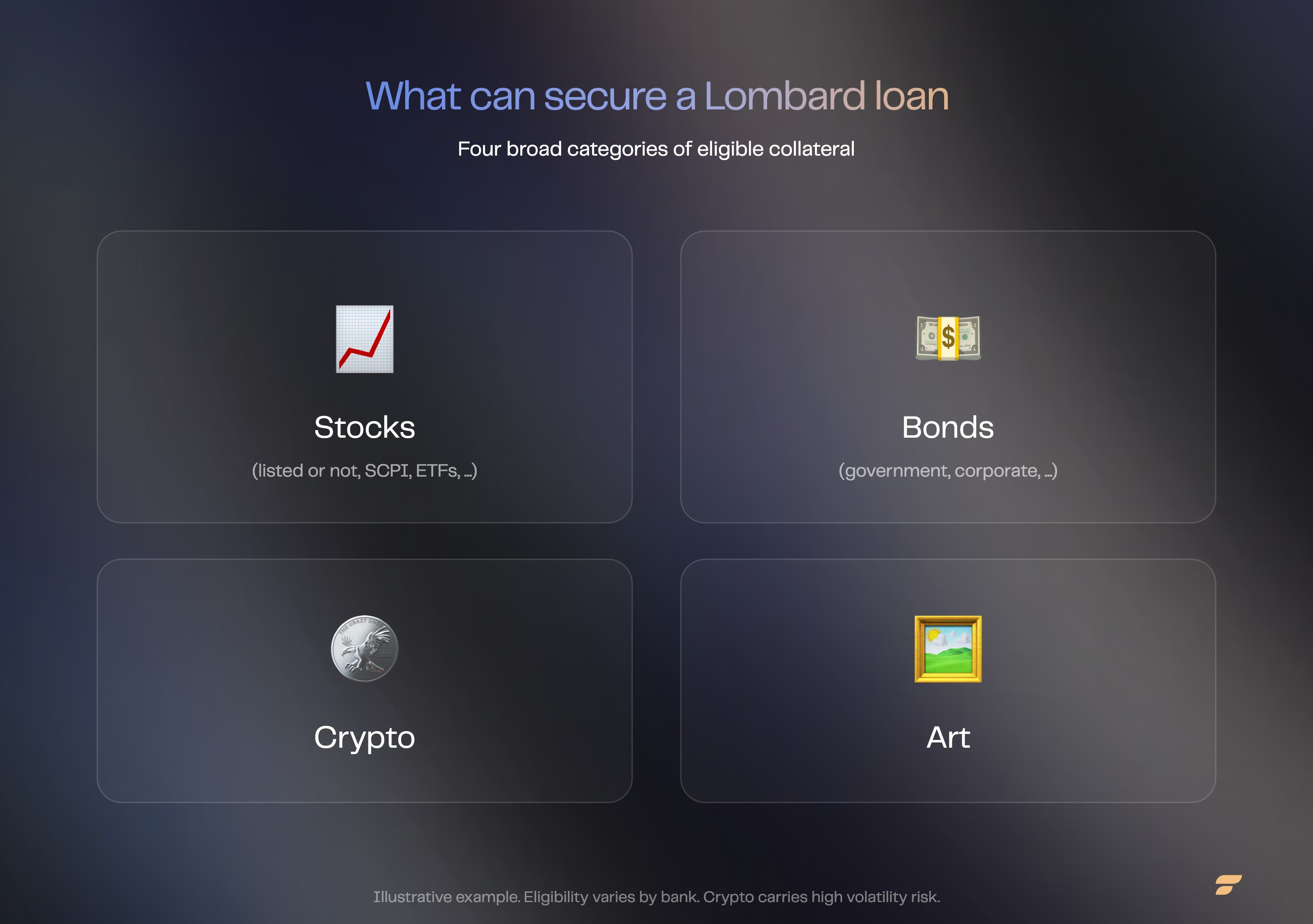
The list of eligible assets evolves with financial innovation, each bank's choices and the complexity of your wealth. Some banks, like Société Générale Private Banking, accept a wide range of assets:
- ETFs,
- SCPI units,
- structured products,
- artworks.
Others, more traditional, focus on listed shares and investment-grade bonds.
Swissquote also accepts certain crypto-assets as collateral (under the MiCA framework, with a high volatility risk), while most French banks do not allow this. This capability reflects real-time liquidity management and asset valuation.
The wider the range of accepted assets, the more room for maneuver you have, bearing in mind that leverage increases the risk of capital loss and margin calls.
Minimum amount, term and flexibility: comparing Lombard loan conditions
The entry ticket varies widely between banks. BoursoBank offers a Lombard loan starting at €101,000, while Banque Palatine or Degroof Petercam target seven-figure amounts.
This difference reflects not only positioning, but also the level of service and personalization. Digital banks prioritize efficiency and speed. Traditional private banks focus on tailor-made support.
The loan term, generally between 1 and 5 years, comes with several options. A 5-year in fine loan, like BoursoBank's, offers visibility on interest costs, but requires the capital to be repaid in one go.
Other institutions offer:
- revolving credit lines,
- term advances,
- authorized overdrafts,
to adapt to your cash-flow needs.
Flexibility isn't limited to term or amount. It also includes the ability to:
- repay early with no penalty,
- adjust the amount borrowed based on asset valuation,
- match the loan currency to your international projects.
Some banks, especially Swiss or digital ones, offer this kind of flexibility.
The importance of expertise and banking advice in choosing your Lombard loan
A Lombard loan is never a standardized product. It's a wealth-strategy tool that requires guidance tailored to your goals.
The quality of the advice can shape how the deal is structured. At Rothschild & Co or Sapians, dialogue with a private banker or family officer places the Lombard loan within an overall vision: taxation, wealth transfer, leverage, risk hedging.
Digital platforms like Ramify or Pledger favor speed and transparency. They also work with experts to handle complex situations.
Expertise goes beyond technical skill. It includes the ability to:
- anticipate market movements,
- structure sophisticated arrangements (Luxembourg life insurance, capitalization contracts),
- defend your interests during negotiations.
A savvy investor doesn't choose a bank based on rate or LTV alone. They look for a partner able to understand their challenges, support them over the long term and react quickly to the unexpected.
In conclusion
Properly managed, the Lombard loan can be a valuable complementary financing tool within a wealth strategy. The choice of bank for your Lombard loan shapes both the terms and the management of your wealth strategy.
Between BoursoBank's accessible digital solutions, the tailor-made expertise of Swiss private banks, or the personalized support of family offices, different investor profiles can find the institution that matches their goals.
This gradual democratization of the Lombard loan, driven by technological innovation and a wider range of providers, is turning a tool once reserved for the wealthiest into a wealth solution accessible to a broader clientele.

Regulatory disclaimers:
Marketing communication. Investing carries a risk of partial or total capital loss. Past performance is not a reliable indicator of future performance. This article is provided for information and educational purposes only; it does not constitute personalised investment advice, a buy or sell recommendation, or tax advice.
Using borrowed funds amplifies both losses and gains, and can result in a loss greater than the capital invested (you remain liable for the loan). Complex, high-risk product.
Before investing, read the Key Information Document (KID) and, where relevant, consult an authorised adviser.
Finary SAS, an investment firm authorised by the ACPR (no. 19283), member of AMAFI. Insurance broker registered with ORIAS (no. 21001279), member of the CNCGP (association approved by the AMF). Crypto-Asset Service Provider (CASP) authorised by the AMF under the MiCA regime, references no. A2026-026 and no. N2026-008.