


Using Your Money to Be Happier

Updated on 3 August 2026
We rarely know why we're pursuing a financial goal. To use your money to be happier, start from the life you want to make possible, not from a number: what makes you happy in the long run is gaining time, living experiences and feeling secure.
Here is how to check that your goal is truly your own.

- A financial goal is not a destination: its only value lies in the concrete life it makes possible.
- Goals built around status make people less happy than goals built around what money lets you do.
- According to Odermatt and Stutzer (2022), the 839 German buyers they tracked overestimated the satisfaction gain from their purchase.
- The ordinary-Tuesday test is enough: if you can't describe the life your goal makes possible, you're chasing a number.
- The SENS method, French for “meaning,” checks the goal's Source, the Envie (desire) behind the number, what it Nourrit (feeds), and your Seuil (threshold).
What are you really looking for behind the number?
What you're almost always looking for is what the number represents: freedom, control, autonomy, sometimes recognition. A number is convenient because it lets you avoid naming what you're actually after.
Take the goal of a million euros. What people want isn't the million itself: it's what it represents. “I want to be a millionaire” is no longer a need, it's a solution. And the mistake is forgetting the original problem.
Economist Charles Goodhart put it best: when a measure becomes a target, it ceases to be a good measure.
Chase a goal long enough, and you eventually forget what you hoped to find by reaching it. And what if the real risk wasn't failing to reach your goal… but succeeding at the wrong one?
Real estate is the perfect illustration. Becoming a homeowner is today one of the most pursued financial goals. Yet in 2022, two economists at the University of Basel, Reto Odermatt and Alois Stutzer, tracked 839 prospective German homeowners. Their goal: to compare the satisfaction level these people anticipated before buying with the one they actually felt once they owned their home.
The result: becoming a homeowner made them significantly less happy than they had anticipated. According to Reto Odermatt and Alois Stutzer, buyers “are on average too optimistic about the long-term consequences of homeownership.” The purchase did increase their satisfaction, but far less than expected, and that gain faded faster than they imagined. (Note: the study doesn't say you shouldn't buy; it invites you to better articulate what the purchase truly represents.)
We end up confusing the goal with its promise.
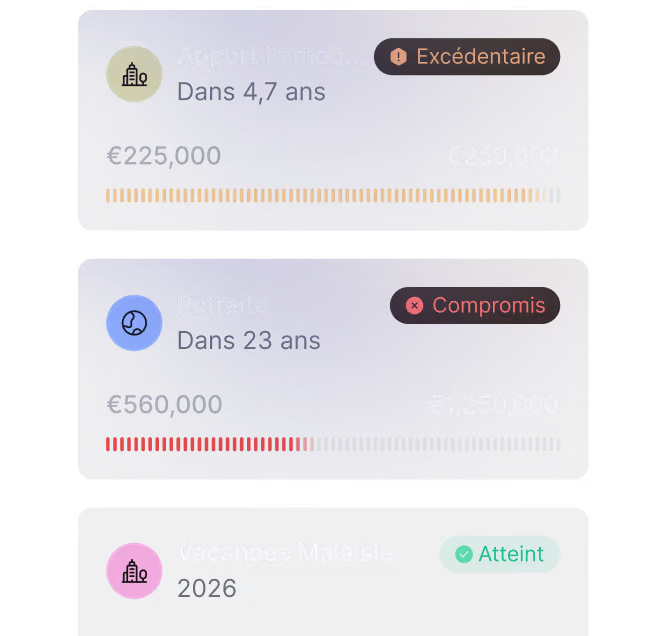
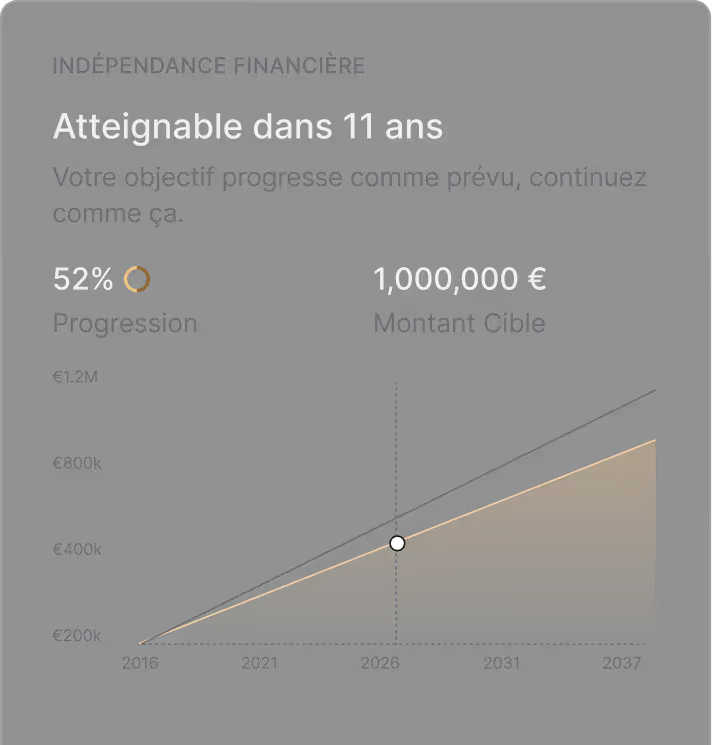
This is exactly why we built Goals
Most people start from a number, then try to build their life around it. The Goals feature does the opposite: it starts from the life you want to build, then works back to the number.
In practice, you define a project, retirement, financial independence or buying a home, and Goals translates it into a financial target.
Because if what you want is to travel, your net worth only matters if it lets you travel more often. And if what you want is time, it's only useful if it lets you get some back. A financial goal is never the destination: it's a means. And there is never just one means.
But first you need to know what you're really trying to get. Because even when we think we know, we're often very bad at predicting what will make us happy.
Psychologist Dan Gilbert showed this in Stumbling on Happiness: we're bad at predicting what will make us happy, and we adapt to what we get far faster than expected. The moment a goal is reached, it stops being a promise and becomes the norm, and the next number has already taken its place.
Researcher Tal Ben-Shahar calls this the arrival fallacy: the belief that arriving will produce lasting happiness. The danger goes deeper than a simple prediction error: it means organising your whole existence around a conditional future. “After the million,” “after the purchase,” “after retirement”… This is what's called deferred life.
Yet the right answer isn't always to earn more. Sometimes it's to change something now. But first you need to understand where what you think you're after actually comes from.
Where does your goal come from?
There are goals we inherit. Goals we defend. And goals we truly choose.
The inherited goal
We like to believe our goals belong to us. Yet they're often shaped by the people we admire, imitate or take as role models. We often desire what others desire, what philosopher René Girard calls mimetic desire.
Behind many financial goals hides a desire for recognition: to be seen differently, respected, considered legitimate. It's a signal of competence as much as belonging. The problem is that the “top 10%” only exists because 90% of people stay behind it, yet we reason as if we would naturally be part of it.
The real question to ask: who handed me this map? An inherited goal isn't necessarily a bad goal. It can be perfectly healthy, provided you chose it, rather than simply absorbing it.
The defensive goal
Not every goal comes from the outside. Some come from fear. “I never want to go without again.” “I don't want to depend on my employer anymore.”
Since the work of Kahneman and Tversky in 1979, we've known that losing €100 hurts roughly twice as much as gaining €100 feels good. There is nothing wrong with a defensive motive in itself.
This is the idea behind the Safety Net
One of the functions of our financial goals is simply to reassure us. Before aiming for the million or financial independence, the Safety Net, one of the goals on offer, answers a much simpler question:
“If something goes wrong tomorrow, have I put a safety net in place?”
Because it's hard to build calmly without this foundation, and because skipping this step is one of the most common saving mistakes.
Fear becomes a problem only when it stops being a starting point and becomes the sole destination. The question to ask: what happens in my life if I never reach this goal? If the answer worries you, it may be a form of protection more than an aspiration.
Goals
The authentic goal
What is inherited looks around. What is defensive looks behind. The authentic goal looks ahead.
Psychologists Tim Kasser and Richard Ryan have studied this distinction for more than 30 years. As early as the 1990s, their work revealed two very different ways of pursuing money:
- Extrinsic goals use money to gain status or recognition.
- Intrinsic goals focus on what money lets you do.
People driven by extrinsic goals report being less happy and more anxious. It makes sense: if your goal depends on how others see you, it can never truly be reached. That gaze keeps shifting, and always demands more.
When psychologists Edward Deci and Richard Ryan dug deeper into the question, they found the same underlying drivers in people with very different life paths. Forty years later, their work still feeds into psychology, education and sport. They identified three fundamental, universal needs:
- Autonomy: being able to say no to a job that doesn't suit you.
- Competence: having the means to develop your project.
- Belonging: being able to help loved ones when they need it.
What's striking is that none of these desires looks anything like a paradise beach.
“I really don't want to go and live on a desert island, far from everything. To me, that's hell.”
- Man-on-the-street interview
Yet the image of financial happiness sold to us most often is exactly that: free time, fewer obligations, more lightness. Hungarian psychologist Mihály Csíkszentmihályi spent his career studying what really makes people happy. His conclusion: it isn't rest, but total engagement in something difficult. He calls this state flow, the state where you lose track of time because you're so absorbed.
A good financial goal doesn't free you from everything. It frees you for something.
How do you know if a financial goal is healthy?
A financial goal is healthy if it passes three tests: it's consistent with your life, it's oriented toward a specific use, and it sets a threshold beyond which it's enough.
Criterion 1 - Consistent and aligned
First question, the simplest one: is this really your goal?
Money doesn't create meaning. If your life already has direction, it can give it more scale. If it doesn't, money won't fill that gap. A healthy financial goal is consistent with the life it's trying to make possible.
The most revealing test is often the most mundane one: describe the ordinary Tuesday that follows the goal. Not the day you reach it; the Tuesdays after. What does your day look like? If you struggle to describe the life it makes possible, you may be chasing the number more than what it represents.
Criterion 2 - Oriented toward use
Second question: what constraint is this goal supposed to remove?
A healthy financial goal doesn't stop at a number: it describes a change in your life. That's what Ashley Whillans, Elizabeth Dunn and Michael Norton showed in 2017: what predicts well-being isn't the amount spent, but the nature of the spending. People are happiest when they use their money to buy back time. And experiences bring more lasting satisfaction than material goods, because they create memories, strengthen relationships and become part of our identity.
The question is no longer “how much?” but “what for?” What will you do more of? What will you do less of? The more precise the answer, the more useful the goal is likely to be. This is also what makes a monthly budget useful: it translates the goal into concrete trade-offs.
Criterion 3 - Sufficient
Last question, the hardest one: from what point is it enough?
We often talk about the return on a financial goal; almost never about its cost. Every ambitious goal has a price, in attention, energy, stress, sacrificed relationships. The real return on investment of a goal isn't just what it delivers once reached: it's what it will have cost you to get there.
Herbert Simon was interested in a simple question: how do you know when to stop looking for better? He called this satisficing. Barry Schwartz showed the flip side: more options don't make you freer. They paralyse, exhaust, and keep pushing the finish line further away.
A good financial goal doesn't just define where to go. It also defines when to stop. In other words, it sets a threshold. Without a threshold, the goal keeps moving back as you approach it. With one, the problem can finally be considered solved.
How do you put your financial goal to the test?
Put your goal to the test with three questions: why this one, why wait, and why still? A financial goal is a hypothesis about the life you want to make possible, and every hypothesis needs to be tested. Because we change, because our constraints change, because what made sense at 25 doesn't necessarily make sense at 45.
We spend an enormous amount of time optimising our portfolios, and very little checking that our goals still fit who we are.
Why this one?
Take the goal that occupies your mind the most, the one taking up the most mental space. Ask yourself: why this one? Then: and then what? Then again: and then what? Keep going until the answer is no longer financial.
Why wait?
Suppose you never reach this goal. What would you miss the most? Does that thing really depend on the number, or on a decision? What are you denying yourself today while waiting to reach it? And what would happen if you started, even just a little, right now? A simple split like the 50/30/20 rule is often enough to unlock that first step.
Why still?
Does this goal match the person you're becoming, or the one you used to be?
Psychologist Jordi Quoidbach documented what he calls the end of history illusion: we know we've changed in the past, but we believe we'll change little in the future. The data say the opposite: at every age, people systematically underestimate how much they will change over the next ten years.
So this financial goal is also a bet on your future self. Does it still excite you, or has it simply become your plan? Are you pursuing it because it draws you, or because you've already put a lot of time into it? Years already invested are a reason to think it over, not a reason to keep going.
The real-life test: Candice's story
We asked Candice, an economics writer at Finary, to run the exercise on herself.
My starting financial goal was clear: earn a good living. Working on this piece, I realised it was an inherited goal. In my family, the first question was always: “How much will you be paid?”
So I asked myself the famous “and then what?” Having some breathing room, no longer counting pennies for a restaurant, a trip, a concert. And then what? Peace of mind. Not having to think about it anymore.
I did the Tuesday-morning test: the ideal Tuesday morning my goal is supposed to make possible. For me, it was obvious: a run, a coffee, a pastry, writing a film scene. And that's when it clicked: that Tuesday morning already exists. My goal isn't to build that life; it's to protect it.
Then I asked myself: from what point would it be enough? I had a number in mind, a net worth to reach, without really knowing where it came from. Thinking it through, I realised what I really want is an income that lets me live without thinking about it. Because you reach a net worth once; you live an income every month.
I could have spent years chasing an answer before even understanding the question. What surprised me most is that I had never once questioned this goal since I first set it.
Goals
The SENS method
Before pursuing a financial goal, check that it has SENS:
- S - its Source. Where does this goal come from? Is it inherited, defensive, or truly yours?
- E - the Envie (desire) behind the number. What are you really looking for? Ask yourself “and then what?” until the answer is no longer financial.
- N - what it Nourrit (feeds) in you. What Tuesday morning does it make possible? Describe it concretely. If you can't, you may be chasing the number rather than the life it's supposed to make possible.
- S - your Seuil (threshold). From what point is it enough? Without a threshold, the goal keeps moving further away.
Once you've found your goal, Finary can help you build the path to reach it.
How much do you really need?
The Goals feature starts from your lifestyle, your spending and your plans to answer a simple question:
How much do you really need to live the life you want?
If you're starting from scratch, a budgeting app will first help you measure your real spending.
Otherwise, you may keep searching for the right answer… to the wrong question.
Frequently asked questions
Does money make you happy?
Money increases well-being mainly when it removes a constraint. The work of Whillans, Dunn and Norton (2017) shows that what matters isn't the amount spent but how it's used: buying time brings more lasting satisfaction than buying a material good.
What financial goal should you set?
Set the goal that describes a specific change in your daily life, not a round number. A good financial goal names the constraint it removes, from time regained to security restored, and comes with a threshold at which it's reached.
Why am I not happier after reaching my goal?
Because we quickly get used to what we obtain. Researcher Tal Ben-Shahar calls this the arrival fallacy: arriving disappoints, and the next number immediately takes the place of the last one. The fix is to define a threshold before you start.
How do you know if your financial goal is really your own?
Ask yourself who passed this goal on to you. If it comes from a social comparison or a family expectation, it's inherited. An inherited goal can remain healthy, provided it's owned: the test is to describe precisely the life it makes possible.
How much do you need to be financially free?
There's no universal amount: the threshold depends on your annual spending, not a round number like a million euros. Start from your lifestyle, then work back to the capital or income needed to fund it sustainably.
Sources
Econometrica, Kahneman and Tversky (1979), prospect theory and loss aversion
Center for Self-Determination Theory, Deci and Ryan, the three fundamental psychological needs
PNAS, Whillans, Dunn and Norton (2017), buying time increases well-being
Science, Quoidbach, Gilbert and Wilson (2013), the end of history illusion
Regulatory disclaimers: Marketing communication. Investing carries a risk of partial or total capital loss. Past performance is not a reliable indicator of future performance. This article is provided for information and educational purposes only; it does not constitute personalised investment advice, a buy or sell recommendation, or tax advice. Before investing, read the Key Information Document (KID) and, where relevant, consult an authorised adviser. Finary SAS, an investment firm authorised by the ACPR (no. 19283), member of AMAFI. Insurance broker registered with ORIAS (no. 21001279), member of the CNCGP (association approved by the AMF). Crypto-Asset Service Provider (CASP) authorised by the AMF under the MiCA regime, references no. A2026-026 and no. N2026-008.