


Account aggregator: which one should you choose?

Updated on 3 August 2026
The best account aggregator is the one that centralises your entire wealth, not just your bank accounts, without reselling your data, relying on a provider approved by the ACPR under DSP2, the European payment services directive (Powens, Bridge or Plaid). In 2026, four criteria let you compare the options on the market, including Finary, Bankin' and Linxo: security, coverage, features and business model.

- An aggregator's security rests on the DSP2 licence the ACPR grants to its technical provider, such as Powens, Bridge or Plaid.
- Coverage varies widely: from a few hundred French banks to more than 20,000 institutions for the most complete aggregators.
- Free aggregators often fund their service by reselling data or showing ads, unlike paid, independent offerings.
- Beyond bank accounts, the best aggregators also track the PEA (a French tax-advantaged equity savings account), life insurance, crypto and property for a complete view of your wealth.
What is an account aggregator?
An account aggregator is a platform that lets you bring together accounts held at several institutions (or in several countries) on a single dashboard. At a glance, you can see the balances of your various accounts, build your budget or track how your investments are performing. And as we will see, some account aggregators go far beyond bank accounts alone.
There are two broad categories: account aggregators and wealth aggregators. The latter, such as Finary, cover bank accounts but also handle the rest of your wealth, which saves you from running several platforms side by side.
Account aggregation became possible thanks to open banking and the European DSP2 directive (the European payment services directive), which took effect on 13 January 2018. That ambitious directive had one goal: to let people who bank with several institutions use their data freely and securely. Banks are now required to let you aggregate your payment accounts (current account, credit card) on a third-party website or app. This breaks their monopoly on their customers' personal data and encourages innovation in financial services, not least through the rise of many fintechs.
| Criterion | Traditional bank aggregator (e.g. Bankin', Linxo) | Wealth aggregator (e.g. Finary) |
|---|---|---|
| Coverage | Mainly bank accounts | More than 20,000 banks, brokers and investment platforms |
| Asset classes tracked | Current accounts, cards, sometimes loans | Bank accounts, PEA, life insurance, crypto, property, precious metals |
| Business model | Often free, with data resale or advertising | Paid subscription (Finary Lite, Plus, Pro), no data resale |
| DSP2 licence | Via Bridge or Powens depending on the provider | Via Powens and Plaid |

Whether on mobile (iOS, Android) or on the web, there are now plenty of account aggregation solutions. The best known are Bankin', Finary and Linxo. Some banks, such as Boursorama and Hello Bank, also let their customers connect accounts held elsewhere from their online area. Their quality varies, but they all aim to make life easier by giving the user full visibility over their accounts.
Good to know : According to a Square study published in January 2020, 42% of French bank customers hold accounts at more than one bank, and 35% are customers of two banks. The rise of online banks only pushes that figure up. For many of them, using a bank aggregator is an obvious move. To get a complete view of your wealth, favour platforms that go beyond simple bank aggregation and also cover property, life insurance, the PEA and employee savings plans, as well as crypto. How does an account aggregator work?
Since the DSP2 directive, account aggregation has been strictly regulated to protect users. Thanks to open banking, you can connect your various accounts securely. The process runs in several steps:
- You want to connect a bank to an account aggregator
- You enter your username and password in a secure window. Only the bank can see those credentials.
- You approve the request with two-factor authentication. Most of the time you confirm the connection in your bank's app or on its website
- Your bank is now connected. You can revoke the authorisation at any time.
Only companies holding the DSP2 licence can connect to bank accounts and therefore aggregate an account. They are supervised by the ACPR and the Banque de France. The French leaders in this field are Powens and Bridge, while the global leader is Plaid. Platforms such as Finary then work through providers of this kind to offer account aggregation to their users. To check whether a provider really holds an ACPR licence, consult the Regafi database.
Good to know : Using an aggregator is designed to be secure: the platform never has access to your banking username or password. The aggregator only has read access and cannot carry out any operation on your accounts. So even in the very rare event of a data leak at the aggregator, your banking credentials stay protected The features of an account aggregator
The starting point of a bank aggregator is to give you visibility and clarity over your finances. You cannot improve what you do not measure. Here are the main features the market leaders offer.
Tracking your account balances
An aggregator lets you follow the balances of all your bank accounts on a single platform, in real time. No more logging into each bank's online area: you see every balance at a glance. That saves time and spares you the websites and apps of your banks.
The other benefit is avoiding overdrafts, which can prove expensive. A good account aggregator warns you by email or mobile notification when one of your accounts goes negative, which helps you avoid overdraft interest and the other charges banks apply in those cases.
Tracking your loans
Property is the favourite asset class in France, and property means borrowing. Here again, an account aggregator brings all your outstanding loans together so you have a clear view of your liabilities:
- Total capital still owed
- Average interest rate
- Leverage used
- Rate type (fixed or variable)
Better still, some account aggregators let you link your loans to specific properties so you can follow repayment progress and your net ownership share.
Budget tracking
Historically, the account aggregator was a budgeting tool. Aggregating one or more accounts was above all a way to track spending. Many platforms focus on transaction history and monthly spending, and let you categorise it. You can then see where your money goes each month: restaurants, travel, loan repayments, health, and so on. This feature also helps you stay alert.
Some platforms flag subscriptions such as Netflix or Spotify so you can check you are not paying for services you no longer use.
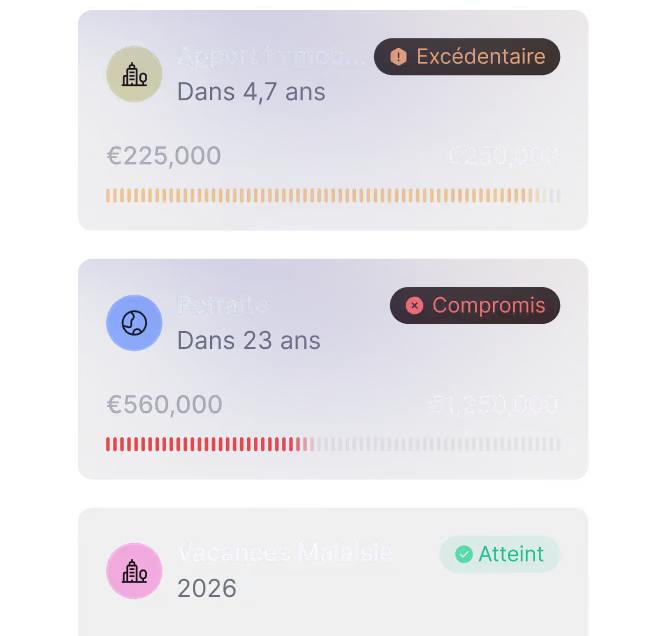
Goals
Advanced indicators
Access to your banking data, loans included, lets a good bank account aggregator compute some very useful indicators:
- Remaining borrowing capacity: the amount in euros you could in theory repay each month. If it is positive, you could in theory borrow to invest in assets such as property.
- the debt-to-income ratio: France's Haut Conseil de Stabilité Financière (HCSF) caps it at 35%. If you are below that, you still have savings capacity available.
- the safety net: money held in capital-guaranteed, quickly available products such as the Livret A. Depending on your risk appetite, the usual recommendation is 3 to 6 months.
Handling other asset classes
Account aggregators often stop at bank accounts, which limits how useful they are. Some innovative platforms have gone further and cover the whole balance sheet: property (held directly or through SCPI, a French non-listed real-estate investment fund comparable to a REIT), investment accounts (PEA, life insurance, securities account), crypto, precious metals and crowdfunding. Their aim: a complete view of the overall value of your wealth, so you can steer your investments better.
How secure are account aggregators?
Using an account aggregator means sharing banking credentials. That can look risky at first sight, but the DSP2 rules regulate it tightly.
The bank aggregator never sees your banking credentials
When you connect your accounts to an aggregator, it never sees your username or password. The bank and the technical provider regulated by the ACPR handle that part. The connection is encrypted and must be approved with two-factor authentication, usually in the bank's mobile app or on its website.
It also means the account aggregator cannot carry out operations such as transfers on your bank accounts. It only has read access, enough to show you your balances and other useful information.
Account aggregators must comply with the GDPR
Every platform operating in Europe must comply with the GDPR (General Data Protection Regulation) in full. It must publish its privacy policy and give users access to all their personal data on request. You also have the right to ask for your account to be closed and all your data erased at any time.
What happens to your personal data
An account aggregator ends up holding a lot of data about you and your habits. Check what it does with your personal data before you sign up. Many free bank aggregators in fact resell your data to other companies, or show you ads to sell you financial services.
Many aggregators are also backed by banking groups today: Linxo was bought by Crédit Agricole in 2020 (the group has held more than 85% of its capital since), and Bankin' has been through several changes of ownership: the brand originally belonged to Perspecteev SAS, in which the Casino group holds a minority stake (48.53% according to the latest published accounts), while Bridge, its B2B subsidiary, raised €20 million from Truffle Capital and Groupe BPCE.
The question is this: are you willing to use a free service that sells your data, or would you rather pay for one that guarantees your data will never be resold or shared with third parties?
Good to know : At Finary we made two strong choices: no data resale and no ads. Instead we offer a free basic platform, with advanced features available through the Finary Lite, Plus and Pro subscriptions. Those plans keep us independent from banks and other third parties. Our only customer is you, the user. Finary: a new-generation account aggregator?
Yes: Finary is a full wealth aggregator, going beyond bank accounts to bring together all of a user's assets and liabilities. Here is a factual overview of the platform and its features.
Finary is a French fintech founded in late 2020 by Mounir Laggoune and Julien Blancher. As an independent company, we put technology at the service of retail investors. With Finary, they can track their entire wealth online and in real time for the first time. We do not run ads and we do not sell financial products. Our business model rests on the Finary Lite, Plus and Pro subscriptions, which unlock the advanced wealth-tracking features.
An extended account aggregator covering more than 20,000 banks and investment platforms
Finary was built for modern investors. That is why we did not stop at French banks: we cover the vast majority of European, American and Canadian banks. So you can connect Boursorama, HSBC or JP Morgan without trouble.
We went further still by supporting all the major investment platforms: Boursorama, Bourse Direct, Fortuneo, DEGIRO and many more. You can sync those accounts securely to follow your PEA or your life insurance in Finary.
For bank aggregation, we work with the French leader (Powens) and the global leader (Plaid) to guarantee the quality of the integrations and the security of the data.
Tracking your entire wealth
Tracking your bank accounts is good. But imagine you could also track your entire wealth. With Finary you can. Our platform covers every one of the most popular asset classes, and some very exotic ones.
Here is a non-exhaustive list of the assets we handle:
- Property: main home, second home, rental properties and SCPI
- Listed assets: life insurance, PEA, securities accounts, PER (France's retirement savings plan), company savings plans, with thousands of automatic integrations
- Bank accounts and savings accounts: French banks, foreign banks, neobanks
- Cryptocurrency: secure connections to Binance, Coinbase, Kraken, Bitstamp, Bitpanda and Crypto.com, Ethereum and Bitcoin wallet syncing, 6,000+ cryptos
- Start-ups & SMEs: BSPCE (French start-up employee share warrants), equity crowdfunding, business angel investments, unlisted securities
- Precious metals: every gold, silver, platinum and palladium reference
- Exotic assets: other asset classes such as watches, classic cars, property crowdfunding, art and sneakers.
Beyond assets, you can also track your liabilities (your loans) in Finary. Add them by syncing your bank accounts in a few clicks. You then see the real cost of the loan, your monthly payments and the capital still owed.
Good to know : We add new features regularly and build our roadmap around what our users ask for. Our roadmap is public and can be viewed here. Follow your performance in real time
An account aggregator as powerful as Finary lets you follow your gains and losses in real time. Bitcoin soaring? The Nasdaq diving? Those moves show up in your wealth immediately.
On top of real-time prices, we surface unique Insights: the hidden fees you pay, your risk profile, your debt-to-income ratio, your safety net, and how you rank against other people in France. Those indicators move as your wealth rises or falls.
Analysing your fees
Fees are the enemy of your wealth. Most of them hide inside financial products such as investment funds and weigh heavily on your performance. Our technology identifies every unnecessary fee in your investment wrappers (life insurance, PEA, securities account). We show you the long-term impact of those fees on your investments and suggest potentially cheaper alternatives. Only a company independent from the big banking groups can offer that kind of analysis.

Join a community of passionate investors
Knowledge is power, so let us share it. That is the idea behind the Finary community. It is a space to talk with other investors and ask any question you like. No salesperson will try to sell you a tax-break product here: it is a place to exchange and to learn.
Alongside the community, we also run the Finary Talk. These free conferences are a chance to hear experienced investors share their methods. We also set aside time for the community to ask questions.
Frequently asked questions
Which is the best account aggregator?
The best aggregator is the one that handles your entire wealth, not just your bank accounts, and guarantees your data will not be resold to third parties. Finary combines both commitments, and more than 1 million users rely on it to steer their wealth.
Should you use your own bank's account aggregator?
Not necessarily. An independent account aggregator saves you from sharing all your data with a single bank. That can limit how much of your data sits with one player.
What is an account aggregator?
An account aggregator is a website or app that brings together all the accounts you hold at several institutions (or in several countries) on a single dashboard. At a glance you can see the balances of your various accounts, review your spending and even track your investments.
Is an account aggregator free?
Some account aggregators are free, but they often fund the service by reselling data or by showing ads. Others, such as Finary, offer a limited free version and then paid subscriptions (Finary Lite, Plus and Pro) that guarantee independence from banks and advertisers.
Sources
Directive (EU) 2015/2366 on payment services (DSP2), eur-lex.europa.eu
Regafi, the register of financial agents, Banque de France / ACPR
Study on account aggregation and PFM, Square Management, January 2020
Crédit Agricole Group takes a majority stake in Linxo Group, official press release, 30 January 2020
Bridge raises €20 million from Truffle Capital and Groupe BPCE, Groupe BPCE press release
White list of Crypto-Asset Service Providers (PSCA), Finary SAS, AMF
Regulatory disclaimers: Marketing communication. Investing carries a risk of partial or total capital loss. Past performance is not a reliable indicator of future performance. This article is provided for information and educational purposes only; it does not constitute personalised investment advice, a buy or sell recommendation, or tax advice. Before investing, read the Key Information Document (KID) and, where relevant, consult an authorised adviser. Finary SAS, an investment firm authorised by the ACPR (no. 19283), member of AMAFI. Insurance broker registered with ORIAS (no. 21001279), member of the CNCGP (association approved by the AMF). Crypto-Asset Service Provider (CASP) authorised by the AMF under the MiCA regime, references no. A2026-026 and no. N2026-008.