


75/15/10 rule: control your budget

Updated on 5 August 2026
The 75/15/10 rule is a budgeting method that splits net income into three shares: 75% for spending and pleasures, 15% for investments and 10% for savings. Simple and flexible, it helps balance daily life with long-term financial goals.

- The rule applies to monthly net income, once tax has already been deducted at source.
- Unlike the 50/30/20 rule, it leaves a larger share for everyday spending and clearly separates investments from savings.
- On a net income of €2,000, that means €1,500 for spending, €300 for investments and €200 for savings.
- The percentages are indicative: they can be adjusted if essential spending exceeds the planned 75% share.
- Apps like Finary can automate tracking of these three categories and adjust the split every month.
What is the 75/15/10 rule?
The 75/15/10 rule is a budgeting method designed to balance spending by categorising monthly income.

Income breakdown: 75% needs and wants, 15% investments, 10% savings
- 75% – Needs, wants and pleasures: housing, bills, food, transport, leisure and outings.
- 15% – Investments: financial investments and projects aimed at growing your wealth.
- 10% – Savings: a safety reserve and future plans, to handle the unexpected.
75% for needs, wants and pleasures: This share of the budget covers unavoidable expenses such as housing, bills, food and transport, as well as personal pleasures. It includes not only day-to-day essentials but also leisure, outings and other purchases that contribute to well-being and personal fulfilment. It is the largest part of the budget, combining necessity and pleasure.
15% for investments: This share goes to financial investments or to personal or professional projects. It means allocating resources to generate returns over the long term, contributing to the growth of your wealth and the security of your financial future.
10% for savings: Savings, an essential part of financial management, are meant to prepare for the future and build a reserve for emergencies or long-term projects. This allocation guards against the unexpected and allows future goals, whether personal or professional, to be planned with a stable financial footing.

How to put the 75/15/10 rule into practice?
Putting the 75/15/10 rule into practice requires precise organisation of your finances. The percentages reflect the shares of after-tax income to allocate respectively to spending, savings and investments.
For a step-by-step method covering each spending category, see our full guide on how to manage a budget.

With Finary, you can set up automatic budget management.
Draw up a summary of your income and expenses
It is essential to know the exact amount of your monthly net income, that is, the money available after tax. Once you have that figure, list all your monthly expenses, from the most necessary to the most discretionary, to get a clear picture of how your finances are currently split.
Categorise spending and adapt the rule to your situation
Spending should then be categorised: essential, such as rent or groceries, and non-essential, such as outings or unnecessary subscriptions. If essential spending turns out to exceed 75% of net income, the percentages will need adjusting to reflect financial reality while still respecting the spirit of the rule.
A concrete example with a monthly income
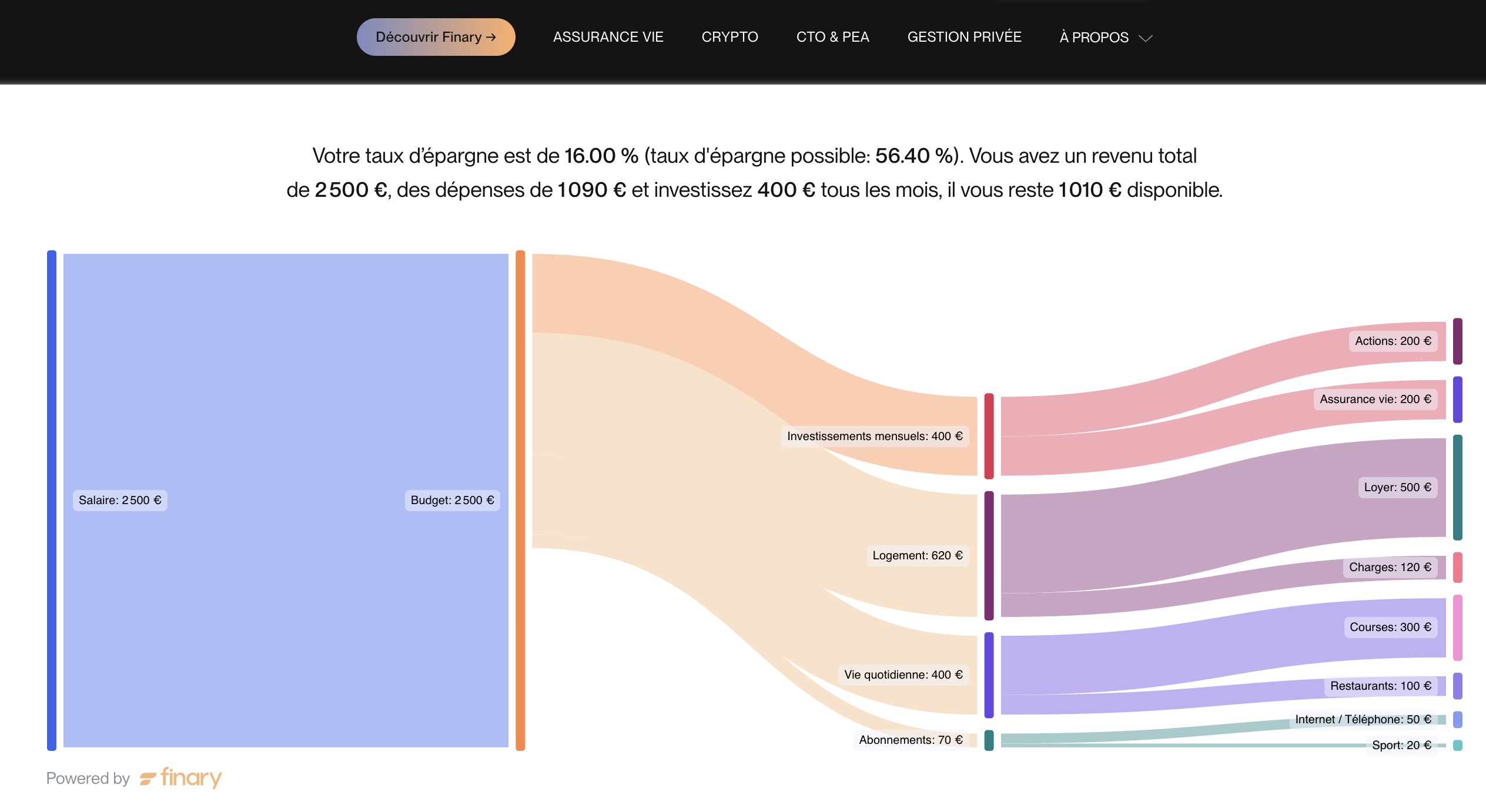
Take the example of someone with a net monthly income of €2,000. Under the 75/15/10 rule, spending should not exceed €1,500, investments would be €300 and savings €200. This model helps prioritise financial allocations while favouring savings and long-term wealth building.
Strategies for effective saving with the 75/15/10 rule
Investment ideas for your savings
To structure your savings under the 75/15/10 rule, options worth considering include savings accounts or life insurance policies, whose returns vary with market conditions. Exploring euro funds or retirement savings plans can help grow capital over the long term, bearing in mind that every investment carries a risk of capital loss (except for euro funds guaranteed by the insurer). It is essential to set short- and long-term savings goals, including building an emergency fund for unexpected situations.
As a reference point, the household savings rate in France stood at 17.9% of gross disposable income in the fourth quarter of 2025, against 18.3% for the full year, according to INSEE.
Tips for automating savings and adjusting the split
To maintain financial discipline, it is best to set up automatic monthly transfers from your current account to various savings vehicles. This makes building savings regular and effortless. It is also worth periodically reassessing and adjusting the split of percentages, especially after significant changes in your financial or personal life, to keep your income allocation aligned with evolving financial goals.
To avoid the most common pitfalls, see our article on 5 mistakes that stop you from saving.
Limits and flexibility of the 75/15/10 rule
While the 75/15/10 rule is a useful guide for organising a budget, it has limits and may need adjusting to better reflect individual financial realities.
Difficulty classifying expenses
Classifying spending into fixed categories under the 75/15/10 rule can be complex. The line between necessities (75%), investments (15%) and savings (10%) is not always clear. Discretionary spending can sometimes sit in a grey area, as how it is perceived varies with each person's financial and personal context.
Personalising the rule to individual needs
Adaptability is essential for effective financial planning with the 75/15/10 rule. Depending on financial circumstances, it may be necessary to adjust the proportions allocated to each category to support financial stability and reach wealth-building goals. Adjustments can be built in with a budget planner to meet specific needs such as unexpected expenses or bigger savings ambitions. The flexibility of the 75/15/10 method lets people adjust it to life's changes, making this budgeting tool dynamic and personalised.
This personalisation is especially useful for a family budget, which needs to account for extra spending linked to children or shared housing. See our guide on family budgets to go further.
Tools and resources for applying the 75/15/10 rule
The 75/15/10 rule is a personal budgeting method where 75% of income goes to everyday spending, 15% to investments and 10% to savings. Various tools and resources exist to apply it effectively.
Where does your income go each month?
Non-contractual document for promotional purposes. Indicative estimate based on the amounts you enter. The savings rate corresponds to the share of your income invested each month. This tool does not constitute investment advice; investing carries a risk of capital loss. Finary SAS, 58 rue de Monceau 75380 Paris 8, ORIAS no. 21001279 (COA).
Budgeting apps and online calculators
Budgeting apps: Apps like Finary, Bankin' or Linxo offer features that make it easier to track spending and categorise it automatically, letting users apply the 75/15/10 rule. These apps, often powered by smart algorithms, let you see your spending breakdown at a glance. They can connect directly to bank accounts, automatically classify transactions and display charts illustrating financial flows.
Online budget calculators also make it easy to split income according to the 75/15/10 rule, giving a clear view of your financial goals.
Our comparison of the best budgeting apps details their respective features.
Spreadsheets and practical templates
Pre-built spreadsheets make it easier to set up the 75/15/10 rule by structuring spending, savings and investment categories. They allow manual control and can be customised to each user's specific needs. Practical templates, often bundled with office software, also serve as a starting guide for anyone seeking financial education and better budget management.
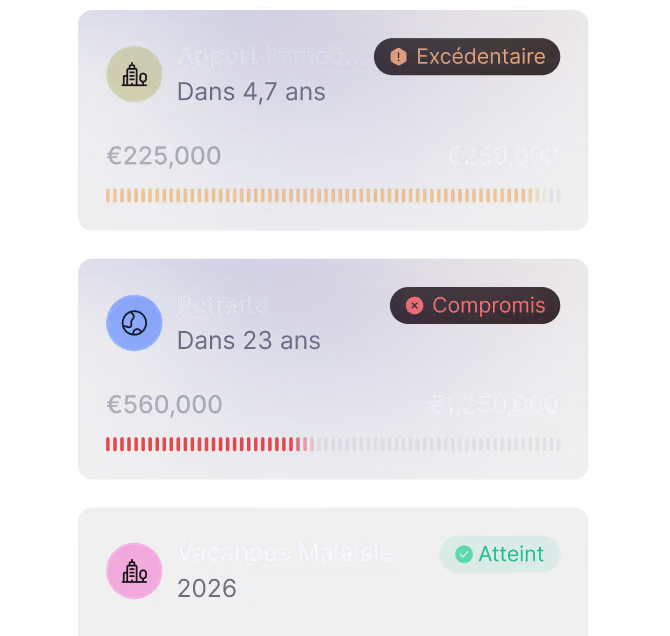
Goals
Frequently asked questions
What is the difference between the 75/15/10 rule and the 50/30/20 rule?
The 50/30/20 rule splits income into 50% needs, 30% wants and 20% savings. The 75/15/10 rule leaves more room for everyday spending (75%) and separates investments (15%) from savings (10%).
What income does the 75/15/10 rule apply to?
To monthly net income, meaning the money actually available once income tax has been deducted via withholding at source. Social security contributions are also already deducted before the 75/15/10 split is applied to the amount received each month.
What if my essential spending exceeds 75% of my income?
Temporarily adjust the percentages to match your budget reality, for example aiming for 85% spending and 15% split between savings and investment. Then gradually cut non-essential spending, category by category, to move closer to the balance the rule aims for.
Does the 75/15/10 rule suit all income levels?
It applies to any income, but its value varies: for a modest income, 15% for investment and 10% for savings represent a limited amount, whereas for a high income, those same shares make it possible to build wealth more quickly without reducing day-to-day comfort.
How can I automate the 75/15/10 rule day to day?
The simplest way is to schedule automatic transfers as soon as your salary arrives: one transfer to a savings vehicle for the 10%, another to an investment account for the 15%. Apps like Finary can also track this split by automatically aggregating all your bank accounts.
Sources
INSEE, In the fourth quarter of 2025, the household savings rate fell again to 17.9%
impots.gouv.fr, Calculating withholding tax at source
Regulatory disclaimers: Marketing communication. Investing carries a risk of partial or total capital loss. Past performance is not a reliable indicator of future performance. This article is provided for information and educational purposes only; it does not constitute personalised investment advice, a buy or sell recommendation, or tax advice. Before investing, read the Key Information Document (KID) and, where relevant, consult an authorised adviser. Finary SAS, an investment firm authorised by the ACPR (no. 19283), member of AMAFI. Insurance broker registered with ORIAS (no. 21001279), member of the CNCGP (association approved by the AMF). Crypto-Asset Service Provider (CASP) authorised by the AMF under the MiCA regime, references no. A2026-026 and no. N2026-008.