


Family budget in France: tips for managing it well

Updated on 5 August 2026
To manage a family budget well in France, add up all the household's income, list your fixed and variable expenses, then set a savings target (often 10 to 20% of net income). Regular tracking, through an app like Finary or a spreadsheet, lets you adjust your spending, avoid unnecessary debt and reach your financial goals.

- Fixed expenses (rent, bills, insurance) come first in the budget, before variable expenses such as food or leisure.
- High-interest debt, such as consumer loans, should be repaid first so that it does not weigh on the budget for years.
- The 50/30/20 and 75/15/10 methods give concrete benchmarks for splitting net income between needs, wants and savings.
- Household income includes net salaries, benefits such as French family allowances (allocations familiales), and any rental or investment income.
- Involving children in managing the family budget helps them tell needs from wants from an early age.
Why create a family budget?
Creating a family budget helps you keep spending under control and structure your savings efficiently, while avoiding overspending. It is an essential tool for households that want to allocate their income optimally between needs and wants.
Financial control and savings
A family budget tracks precisely where money goes each month. By categorising expenses, the family can identify non-essential spending items and cut or remove them. This helps prioritise saving, by setting money aside regularly to build an emergency fund or to reach long-term goals such as the children's education or buying a home.
Teaching children financial responsibility
Encouraging good financial habits in children from an early age is fundamental. Using a family budget often involves every member of the household, which teaches children how important it is to manage money responsibly. They learn the difference between needs and wants and get a better sense of the effort it takes to earn and save money.
What to include in your family budget?
A complete family budget includes fixed expenses (rent, bills, insurance), variable expenses (food, leisure, transport), repayment of high-rate debt and clearly defined savings goals. The aim is to balance day-to-day spending against long-term goals, to keep your finances healthy.
Fixed and variable expenses
Your fixed expenses cover the recurring, unavoidable costs such as rent, mortgage instalments, and the usual bills (water, electricity, gas, internet). They come at the top of the list when preparing the family budget. Alongside them sit your variable expenses covering food shopping, leisure and transport costs. Variable as they are, a precise estimate must be set aside every month for these items.
High-interest debt and savings goals
It is advisable to prioritise repaying high-interest debt because it can quickly weigh on the budget. Debt management covers consumer loans and credit cards. In parallel, every family budget should set clear savings goals , such as an emergency fund, funding the children's studies or retirement. A debt repayment and savings plan must be put in place to reach your financial goals over the medium and long term.

How to manage your family budget effectively?
Managing a family budget effectively rests on five steps: add up your income, list your fixed and variable expenses, work out net income, set a savings target, then review your spending regularly to optimise it.
Managing a family budget calls for strategic planning and the right tools to make the process easier. It means following structured steps and using online resources to create and maintain a budget suited to the family's needs.
Five steps to a solid budget
To build a structured family budget, start by adding up all the household's income. Then note the fixed and variable monthly costs to work out net income. Setting a savings strategy secures future plans, and reviewing spending regularly makes it possible to identify and trim unnecessary cost items.
1 - Add up your income
- Salaries : count the net income of every working member of the household, after tax and social deductions.
- Benefits and allowances : include all government benefits, French family allowances, maintenance payments received, and so on.
- Other sources : factor in extra income such as rent received, investment income, occasional gains, and so on.
2 - Note down your costs
- Fixed expenses : note the regular, unavoidable expenses such as rent or mortgage repayments, insurance, subscriptions (internet, phone), school fees, and so on.
- Variable expenses : list the expenses that can change from one month to the next, such as food, leisure, transport costs (fuel, vehicle servicing), irregular medical care, and so on.
3 - Work out net income
- Calculation : subtract the total of your expenses (fixed and variable) from the total of your income. This gives your net income, that is, what is left for savings or unplanned spending.
4 - Savings strategy
- Savings target : set a percentage of net income to save. That percentage varies with your goals and your financial situation. As an example, a commonly cited benchmark is to save between 10 and 20% of net income, depending on each household's own situation.
- Savings accounts : choose the type of savings or investment account that fits your goals (emergency fund, retirement savings plan, long-term investment, and so on).
5 - Review your spending
- Regular review : go through your monthly expenses to find where you can save. Minor recurring costs sometimes go unnoticed but add up over time.
- Optimisation : look for ways to cut spending, such as switching energy supplier for a better rate, dropping non-essential subscriptions, or choosing cheaper and longer-lasting purchases.
By following these steps, you will better understand and manage your family finances, prepare for the future and handle the unexpected more calmly.
Key strategies for optimising the budget
To manage a budget, it helps to identify and cut unnecessary spending while adopting allocation methods that keep the family budget on track.
Cutting unnecessary spending
The first step towards optimising the family budget is to remove non-essential spending. That requires a careful review of monthly expenses to spot subscriptions or services that are little or never used. It is advisable to cancel underused services and toanalyse consumption habits to avoid impulse buying.
Budget allocation techniques
Effective budget allocation rests on prioritising your spending. You need to rank needs, separating essential expenses such as rent and bills from flexible ones such as leisure. Setting up a forecast budget can help anticipate spending and set clear savings goals for the future.
Two budget allocation strategies stand out in particular:
Tools and resources for the family budget
Various technology tools let families track and manage their budget effectively, including dedicated apps and Excel spreadsheets.
Using budget management apps
Apps for budget management let users track spending and transactions intuitively. Apps such as Bankin', Finary or Linxo connect to multiple bank accounts to give a complete view of personal finances. These tools often provide charts and analyses that show how the monthly family budgetchanges over time.

Using Excel spreadsheets
Excel spreadsheets are a versatile tool for managing a monthly personal budget. Microsoft Office offers customisable budget templates where users can enter their transactions and track their spending. The advantage of spreadsheets is their ability to build custom charts and analyse the data over a given period.
Online calculators
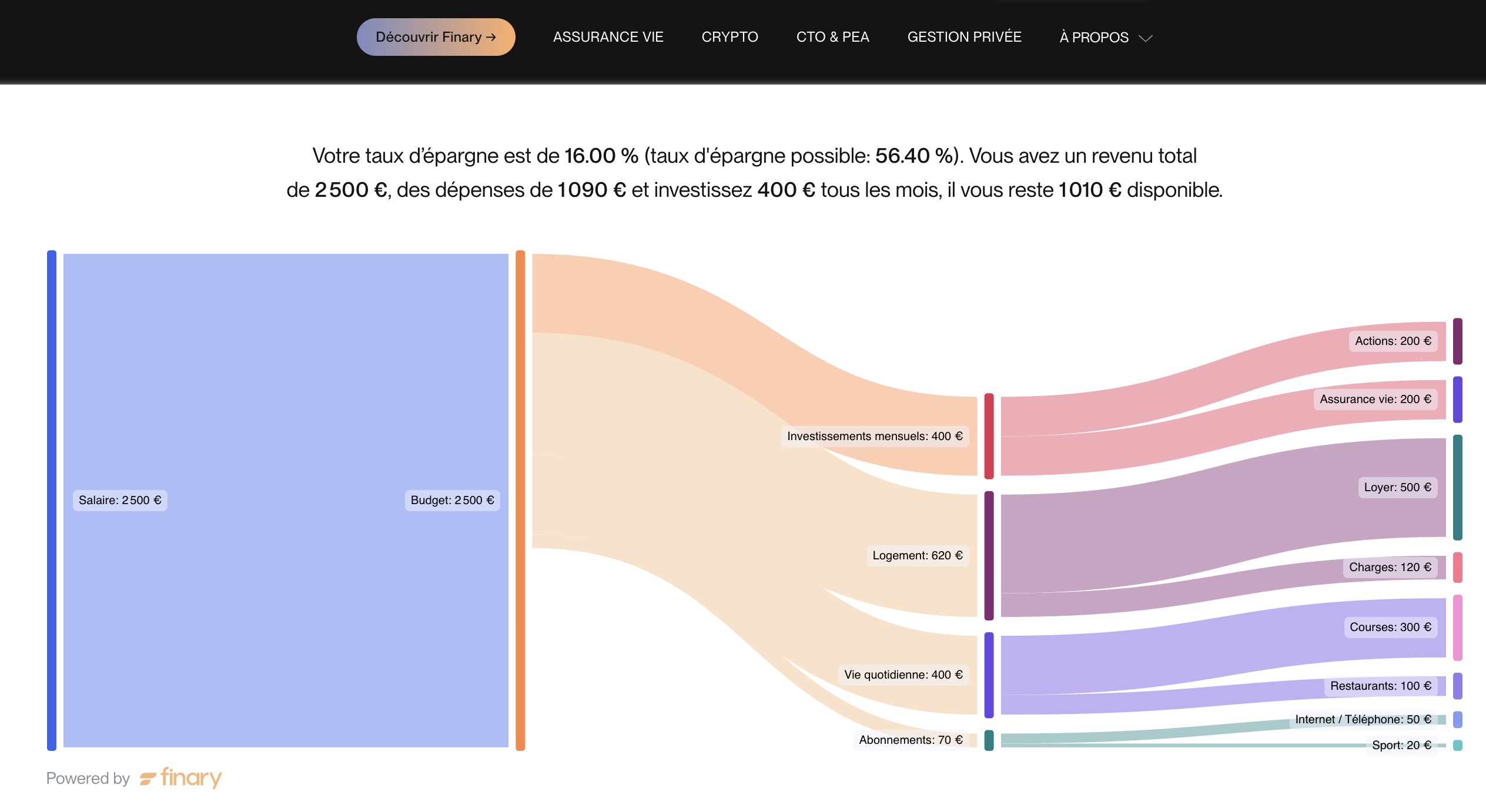
Online budget calculators are a practical alternative to Excel spreadsheets for managing a monthly personal budget. These online tools, like the one below, let users enter their transactions easily and track their spending without needing specific software.
Where does your income go each month?
Non-contractual document for promotional purposes. Indicative estimate. Finary SAS - 58 rue de Monceau 75380 Paris 8 - ORIAS no. 21001279.
Frequently asked questions
What is the average budget for a family?
A household's average budget varies widely with its size and where it lives. According to Insee, final consumption by French households reached €1.5459 trillion in 2025, with food accounting for 9.3% of that total, far behind housing, the largest spending item.
What are the benefits of keeping a family budget?
Keeping a family budget makes it easier to manage spending and optimise savings. It also helps anticipate unexpected costs and plan for the long term, supporting a stable financial situation.
What food budget for a family of 4?
According to various sources, the food budget for a family of four in France is generally estimated at between €450 and €600 per month. That amount can vary with consumption habits and the choice between basic products and more expensive ones.
What are the different types of family budget?
There are several types of family budget, including the forecast budget, which estimates future income and expenses, and the actual budget, which records the spending that took place. Families adjust these budgets to their financial goals and their economic situation.
Should you repay your debts before saving?
It is generally advisable to repay high-interest debt first, such as consumer loans, before stepping up savings. The cost of that interest often exceeds the expected return on an investment, which makes early repayment more advantageous.
Sources
Insee, Household consumption in 2025, Insee Première no. 2110
Service-public.gouv.fr, Family allowances: conditions, amounts and procedures
AMF, whitelist of Crypto-Asset Service Providers (CASP, "PSCA" in French), Finary SAS
Regulatory disclaimers: Marketing communication. Investing carries a risk of partial or total capital loss. Past performance is not a reliable indicator of future performance. This article is provided for information and educational purposes only; it does not constitute personalised investment advice, a buy or sell recommendation, or tax advice. Before investing, read the Key Information Document (KID) and, where relevant, consult an authorised adviser. Finary SAS, an investment firm authorised by the ACPR (no. 19283), member of AMAFI. Insurance broker registered with ORIAS (no. 21001279), member of the CNCGP (association approved by the AMF). Crypto-Asset Service Provider (CASP) authorised by the AMF under the MiCA regime, references no. A2026-026 and no. N2026-008.