


50/30/20 budget: the rule for managing your money

Updated on 5 August 2026
The 50/30/20 budget splits monthly net income into three shares: 50% for essential needs, 30% for wants and 20% for savings. This article explains how to apply it and adjust it to your own situation.

- On a net income of €2,500, the rule allocates €1,250 to needs, €750 to wants and €500 to savings.
- Popularised in 2005 by US senator Elizabeth Warren and her daughter Amelia Warren Tyagi, the method simplifies budgeting without a complex spreadsheet.
- The percentages are not fixed: they adjust to the cost of living, fixed charges or each person's goals.
- Automating the transfer of the 20% savings share as soon as your salary lands stops you spending it by mistake along with the rest of the budget.
What is the 50/30/20 rule?
The 50/30/20 rule is a simplified budgeting framework that allocates after-tax income between essential needs, personal wants and savings goals.
Origin and popularity of the method
The 50/30/20 method was popularised by Elizabeth Warren, then a law professor at Harvard and since a US senator, with her daughter Amelia Warren Tyagi, in their book All Your Worth: The Ultimate Lifetime Money Plan (2005). The authors set out a split of after-tax income into three clear categories, to make spending easier to organise and saving easier to plan.
Splitting income: 50% needs, 30% wants, 20% savings
50% for essential needs: This share of after-tax income covers unavoidable expenses such as housing, food, healthcare and transport.
30% for discretionary wants: This covers leisure, going out, hobbies and non-essential purchases that improve daily life.
20% for savings: Savings and debt repayment. This includes building an emergency fund, preparing for retirement or paying down loans.
How do you put the 50/30/20 rule into practice?
To put the 50/30/20 rule into practice, calculate your monthly net income, then split that amount into three fixed envelopes (needs, wants, savings) before adjusting the percentages to your own situation.
Take stock of your spending and income
Start by listing every monthly income stream precisely. Then track spending carefully for one month. This can be done by hand with a budget spreadsheet, a budget calculator or with a budgeting app. The aim is a clear picture, so spending categories can be distributed according to the rule.
Classify spending and adapt the rule to your situation
Everyday living expenses should be sorted into three categories:
- 50% for essential needs (housing, food, transport, and so on),
- 30% for personal wants,
- and 20% for savings and debt repayment.
Adjust these percentages where needed to match your personal financial situation, as unavoidable expenses vary from one person to the next.

How do you estimate your monthly budget with the 50/30/20 method?
To apply the rule:
- Calculate your total net income after tax.
- Multiply that amount by 0.50, 0.30 and 0.20 to allocate the shares to needs, wants and savings respectively.
- Adjust these figures to fit your own financial situation while keeping the overall proportions.

- Budgeting tools: plan and track spending easily.
- Cash flow overview: understand where your money goes and how to save it.
- Tailored categorisation: automatic categorisation powered by AI, with custom sorting rules you can build around your own needs.
A worked example on a monthly income
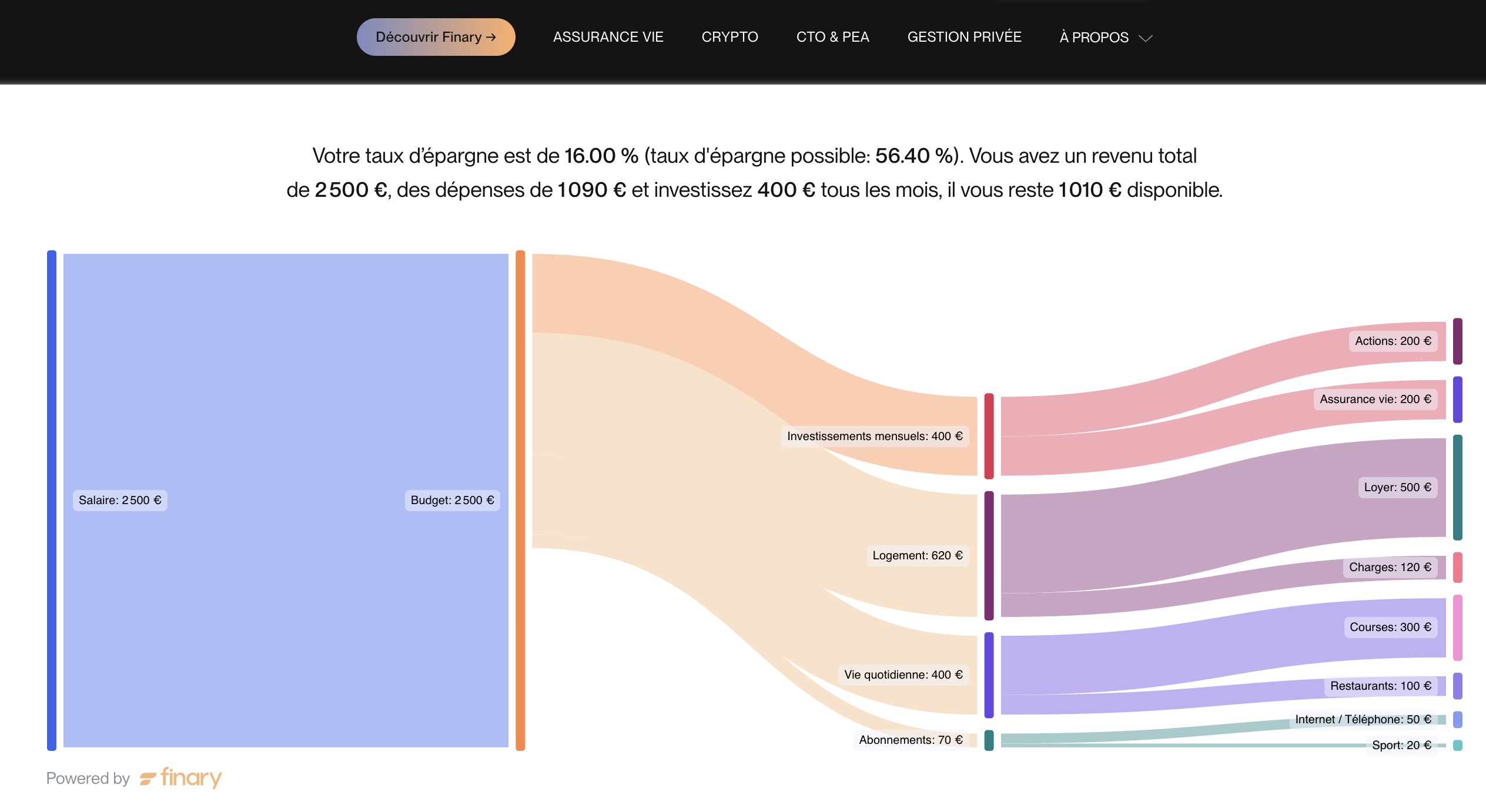
On a monthly net income of €2,500, the monthly budget breaks down as follows: €1,250 for essential needs and €750 for leisure and personal spending. The remaining €500 goes to savings or debt repayment. Using a budget calculator can simplify that split by automating the calculation across spending categories.
Where does your income go each month?
Non-contractual document for promotional purposes. Indicative estimate based on the amounts you enter. The savings rate is the share of your income invested each month. This tool does not constitute investment advice; investing carries a risk of capital loss. Finary SAS, 58 rue de Monceau 75380 Paris 8, ORIAS no. 21001279 (COA).
Strategies for saving effectively with the 50/30/20 rule
Investment ideas for your savings
The 20% earmarked for savings can go into a range of investment options. For short-term savings, such as building an emergency fund, products such as French regulated savings accounts offer easy access and safety for the money. The Livret A and the LEP (Livret d'Épargne Populaire, a means-tested French regulated savings account) are among the regulated options available.
For long-term goals, such as preparing for retirement, the PER (France's retirement savings plan) and life insurance are wrappers offering a specific tax framework. Unit-linked funds carry a risk of capital loss.
Tips to automate saving and adjust the split
Automating the transfer of the 20% into savings accounts, as soon as the salary lands, makes the 50/30/20 rule easier to stick to. It ensures that saving towards financial goals, such as repaying debt or building wealth, is not neglected. Review the split periodically to make sure it stays aligned with changing savings goals and financial circumstances.
Limits and flexibility of the 50/30/20 rule
The 50/30/20 rule offers a basic framework for balancing personal finances. Putting it into practice can run into difficulties classifying expenses and calls for customisation to fit individual financial realities.
The difficulty of classifying expenses
Sorting spending into necessities, discretionary spending and savings under the 50/30/20 model can prove complex. Some charges, such as phone bills or internet bills, count as necessary expenses even though they vary widely from one plan to the next. They sit in a grey area between necessary and discretionary. Inflation can also push up the cost of essential spending, making a strict 50% allocation for needs insufficient at times.
Customising the rule to individual needs
The 50/30/20 rule should be adjusted to each person's financial situation, which gives it essential flexibility. Someone with low mandatory expenses can allocate under 50% to necessities and more to savings or leisure. Conversely, faced with high unavoidable charges, someone may need a bigger share than the 50% the rule suggests to cover their necessary expenses. The value of the 50/30/20 rule lies in how readily it can be changed to match each person's financial reality.
That adaptation is especially useful for a family budget, where housing and childcare costs often weigh more than average.
Tools and resources for applying the 50/30/20 rule
To apply the 50/30/20 rule successfully, you can draw on a range of digital tools and ready-made templates. These resources help split income by percentage across essential needs, personal wants and savings.
For a broader view of day-to-day budgeting, our guide on how to manage your budget details every available method.
Budgeting apps and online calculators
Budgeting apps: Apps such as Finary, Bankin' or Linxo make it easy to track spending and categorise it automatically, so the 50/30/20 rule can be applied efficiently. These apps often run on smart algorithms and show the spending split at a glance.
To compare these solutions in more detail, our pick of the best budgeting apps lists the main options on the market.
Online calculators: Several sites offer calculators built specifically for the 50/30/20 method, working out the exact amount for each spending category.
Spreadsheets and ready-made templates
Customisable spreadsheets, such as those in Microsoft Excel or Google Sheets, are ideal for anyone who prefers a more manual method. You can download 50/30/20 budget templates pre-built with the right categories and formulas to make budget tracking easier. Such templates help you stay organised and track progress over time.
An Excel budget spreadsheet that is ready to use saves time on the formatting step.
Goals
Frequently asked questions
Does the 50/30/20 rule work with a variable income?
Yes, but apply it to an average income calculated over several months, for example the average of the past six months for a freelancer or a self-employed worker. Stronger months then top up savings to offset weaker ones, while keeping the overall proportions of the rule.
Should rent be counted in the 50% for essential needs?
Yes, rent or a mortgage repayment is an essential need, in the same way as food, transport and compulsory insurance. If housing alone eats up a large part of the 50% allocated to needs, the other percentages of the rule may need adjusting.
What if essential spending exceeds 50% of income?
In large cities where housing is expensive, essential needs often exceed 50% of net income. The 50/30/20 rule should then be adjusted downwards on wants and savings, for example to 60/20/20, while keeping the aim of saving a fixed share every month.
Can the 50/30/20 rule be used to repay a consumer loan?
Yes, debt repayment is part of the 20% earmarked for savings in the 50/30/20 rule. With high-interest consumer debt, it is generally advisable to prioritise repayment before building a larger emergency fund.
What is the difference between the 50/30/20 rule and the 75/15/10 rule?
The 75/15/10 rule allocates a bigger share to everyday spending (75%) and cuts savings (10%) and wants (15%), which suits lower incomes or high cost-of-living areas. Which one to pick depends on the level of fixed charges.
Sources
Service-public.fr, Livret d'épargne populaire (LEP): how it works and eligibility
Service-public.fr, Life insurance contract: how it works
Service-public.fr, Individual retirement savings plan (PER)
AMF, whitelist of Crypto-Asset Service Providers (CASP, "PSCA" in French), Finary SAS
Regulatory disclaimers: Marketing communication. Investing carries a risk of partial or total capital loss. Past performance is not a reliable indicator of future performance. This article is provided for information and educational purposes only; it does not constitute personalised investment advice, a buy or sell recommendation, or tax advice.
Before investing, read the Key Information Document (KID) and, where relevant, consult an authorised adviser.
Finary SAS, an investment firm authorised by the ACPR (no. 19283), member of AMAFI. Insurance broker registered with ORIAS (no. 21001279), member of the CNCGP (association approved by the AMF). Crypto-Asset Service Provider (CASP) authorised by the AMF under the MiCA regime, references no. A2026-026 and no. N2026-008.