


Borrowing to invest: how leverage builds wealth

Updated on 28 July 2026
France is the world's fourth country by number of millionaires: about 3 million people hold seven-figure wealth there, according to Les Échos. A country nonetheless known for its high level of taxation. And most of that wealth was not built with its owners' own money.
How? Through credit. This article explains why borrowing to invest can be a powerful wealth-building lever, how leverage works, and why the wealthy use lombard loans to fund their lifestyle. At every step, we also show the flip side: leverage amplifies losses just as much as gains.

- Good debt finances an asset that gains value or generates income; bad debt finances expenses that lose value.
- Leverage means investing with the bank's money by putting down a minimal contribution, which multiplies the return on that contribution.
- For the same €50,000 contribution, the gain reaches €50,000 without credit, versus €410,000 with credit and rental income.
- A lombard loan provides liquidity by pledging a securities portfolio, without selling assets or generating taxable income.
- The trade-off: leverage amplifies losses and can result in a loss greater than the capital invested.
Good debt vs. bad debt: what's the difference?
Credit lets you buy today what you shouldn't otherwise be able to afford. It's a double-edged sword, and to avoid getting cut, you need to tell two families apart.
Good debt makes you richer: it finances the purchase of an asset that gains value or generates income, such as real estate or company shares.
Bad debt makes you poorer: as consumer credit, it finances expenses that generate nothing and lose value immediately, like a new car that depreciates the moment it leaves the dealership. Its high interest quickly becomes a burden at repayment time.
Two reasons make good debt a wealth-building tool: leverage, and a tax mechanism that the wealthy have exploited for a long time.
How does leverage work?
Leverage means investing using credit granted by the bank, while putting down a minimal contribution. Double benefit: investing a larger sum thanks to the bank's money, and multiplying the gains on resale or when collecting rent.
Three scenarios illustrate this, each starting from €50,000 in a checking account, with a house that doubles in value over 20 years:
- Cash purchase of a €50,000 house: resold for €100,000, the gain is €50,000. You doubled your stake.
- Credit purchase: with a €50,000 contribution, the bank lends €200,000 (a 20-year loan at 2%). The €250,000 house is resold for €500,000; after repaying the principal and €80,000 in interest, €220,000 remains, a gain of €170,000: 3.4 times the contribution.
- Credit purchase with rental income at €1,000 a month: the €240,000 in accumulated rent is added to the resale. €460,000 remains after repayment, a gain of €410,000: 8.2 times the contribution.
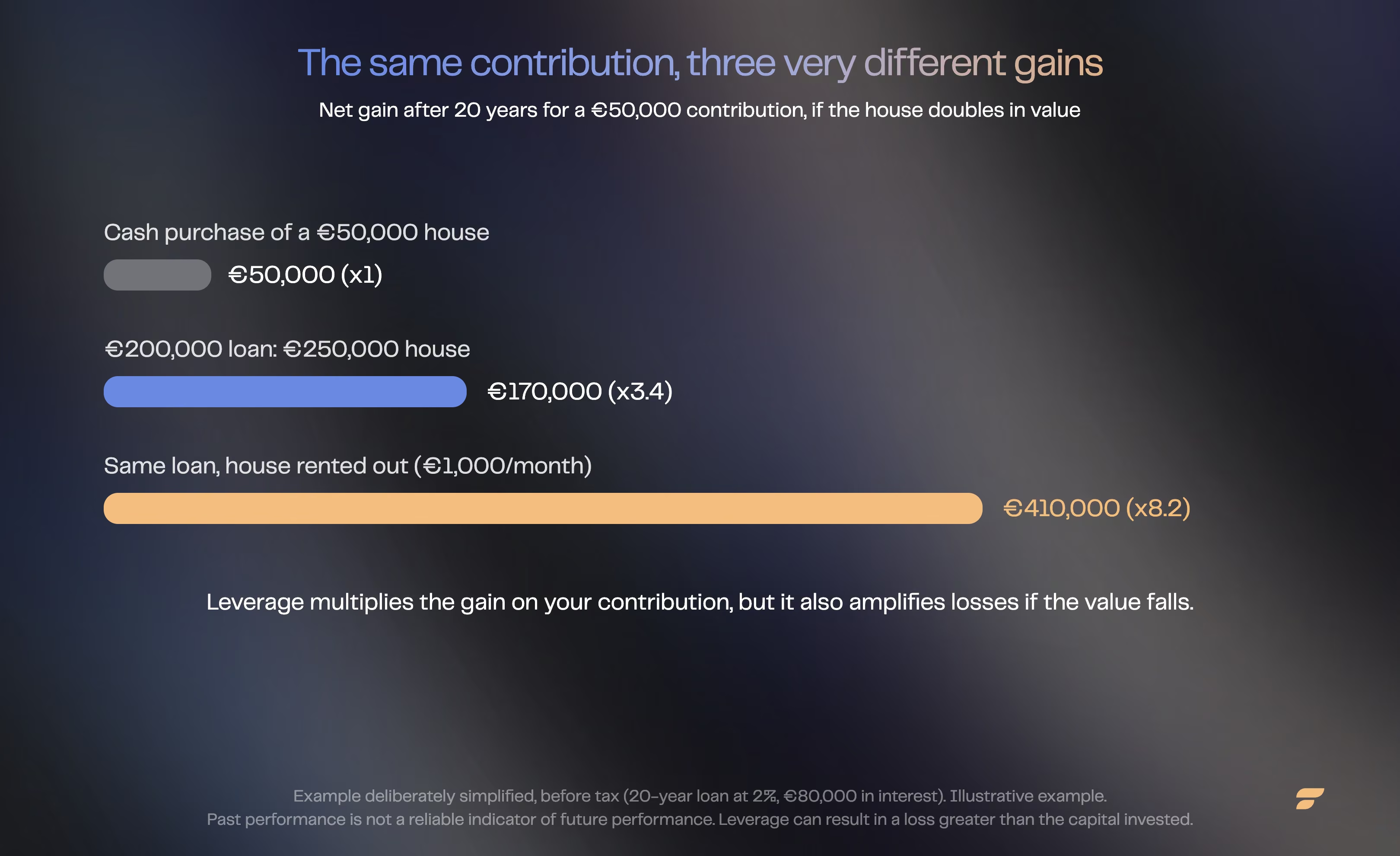
This data is deliberately simplified and does not account for tax, to keep the example clear. The full profitability of a real estate project is calculated using the IRR (internal rate of return). Our rental property investment guide details the method.
The underlying lesson: you rarely get richer by paying cash. Paying cash simply turns your money into an asset, with zero net effect on your wealth. Credit, on the other hand, enriches you immediately, and you repay over time. If the rent covers the monthly payments, you never get poorer again.

How does a lombard loan work?
A lombard loan is a loan granted against a pledged portfolio of assets, a perfectly ordinary vehicle such as life insurance or a securities account. The bank does not profit from the principal it lends, but from the interest; and for those with little income but substantial wealth, the pledge replaces the pay slip.
Take two business owners with €5 million in wealth, each applying for a €1 million lombard loan. The bank requires collateral: they pledge €2 million in listed securities. If the principal is not repaid, the bank seizes the shares, sells them and repays itself.
First use: funding your lifestyle
The first business owner uses the million to live on: leisure, a car, holidays. The appeal is tax-related: a loan is a debt, not income, so it isn't taxed.
While most people work for a salary reduced by income tax, and capital income is hit by the flat tax, someone living on credit triggers no taxation at all. They don't need to pay themselves a salary or dividends, and their company's profits keep compounding.
In practice, a minimal salary is still paid: it covers the interest while keeping tax low, and avoids the PUMa contribution (France's universal health protection), known as the rentiers' tax.
Second use: reinvesting
The second business owner puts the borrowed million into growth assets. A textbook case: a 10% net return against 3% interest required by the bank, on an interest-only loan (principal repaid at maturity). By year end: €100,000 in capital gains minus €30,000 in interest, for a net gain of €70,000. Nothing guarantees such a return: past performance is not a reliable indicator of future performance, and a return below the loan rate reverses the mechanism.
Perpetual refinancing
With an interest-only loan, all you need to do is renew it at maturity. In our example: 5 years later, the €2 million in pledged shares have doubled and are now worth €4 million. The business owner applies for a new €2 million loan, repays the previous €1 million and has a million back in hand. The bank readily agrees: the first loan was repaid, and the new one is secured by assets worth twice as much.
As long as wealth grows faster than the cost of credit, this mechanism keeps going: the capital stays intact, the lifestyle is funded, and no taxable income is generated. That's the difference between those who suffer through debt and those who put it to work. Our guide explains how to get a lombard loan.
What risks come with leverage?
The whole mechanism rests on one condition: wealth must grow faster than the cost of credit. When that's no longer true, leverage works in reverse.
If the value of the pledged assets falls, the bank can demand additional collateral or seize and sell the securities to repay itself. Leverage amplifies losses just as it amplifies gains: a 20% drop on an asset financed 80% by debt wipes out the entire contribution.
Interest-rate conditions matter too: when borrowing rates rise, the gap between expected return and the cost of credit narrows, and the lombard loan loses its appeal. Our overview of the pros and cons of the lombard loan covers these limits in detail.
Finally, bad debt is still bad debt: borrowing to spend with no asset behind it makes you poorer, whatever the rates.

Frequently asked questions
What is leverage in investing?
Investing using a bank loan while putting down a minimal stake. You invest a larger sum than your contribution, and any gain is calculated on the total invested, so it is multiplied relative to your stake. Losses are amplified just as much if the value falls.
What is good debt?
A loan that finances an asset that gains value or generates income: real estate, company shares. Conversely, consumer credit finances expenses that lose value immediately and carry high interest: it makes you poorer.
What is a lombard loan?
A loan granted against a pledged portfolio of financial assets (life insurance, a securities account). It provides liquidity without selling assets. Usually interest-only, the principal is repaid at maturity, which allows for refinancing if the pledged assets have appreciated.
Why do the wealthy live on credit?
Because a loan is a debt, not income: it isn't taxed. By funding their lifestyle with a lombard loan, they avoid selling their assets or generating taxable income, while letting their wealth keep compounding. The mechanism requires wealth to grow faster than the cost of credit.
What are the risks of borrowing to invest?
Leverage amplifies losses as much as gains, and can result in a loss greater than the capital invested. On a lombard loan, a fall in the pledged assets can lead the bank to demand additional collateral or sell the securities. Rising rates also narrow the appeal of the mechanism.
Sources
Service-Public - Qu'est-ce que la protection universelle maladie (Puma) ?
Banque de France - Le crédit à la consommation
AMF - Les Turbos : effet de levier et risque de perte
Regulatory disclaimers: Marketing communication. Investing carries a risk of partial or total capital loss. Past performance is not a reliable indicator of future performance. This article is provided for information and educational purposes only; it does not constitute personalised investment advice, a buy or sell recommendation, or tax advice. Borrowing to invest amplifies losses as much as gains and can result in a loss greater than the capital invested (you remain liable for the loan). Complex, high-risk product. Before investing, read the Key Information Document (KID) and, where relevant, consult an authorised adviser. Finary SAS, an investment firm authorised by the ACPR (no. 19283), member of AMAFI. Insurance broker registered with ORIAS (no. 21001279), member of the CNCGP (association approved by the AMF). Crypto-Asset Service Provider (CASP) authorised by the AMF under the MiCA regime, references no. A2026-026 and no. N2026-008.