Lombard loan 2026: rates, how it works, banks and LTV

Updated on 31 July 2026
A Lombard loan is a loan secured by a pledge over a financial portfolio: it provides cash without selling your assets or triggering capital gains tax. This guide sets out how it works, its rates in 2026, the LTV (loan-to-value) ratios by asset class and the access conditions in private banking.

- The rate combines 3-month Euribor, at 2.459% on 29 July 2026, and a negotiated bank margin of 0.8% to 1.5%.
- The LTV ratio sets how much you can borrow: 80% to 95% on European government bonds, 60% to 70% on blue-chip equities.
- A sharp market fall triggers a margin call, with 48 to 72 hours to restore the cover the bank requires.
- Access remains reserved for large financial portfolios, generally from €500,000 of investable assets in private banking.
- Interest is deductible only if the loan finances an investment generating taxable income, never a PEA or a life insurance policy.
What is a Lombard loan?
A Lombard loan is a credit facility secured by a pledge over a securities portfolio or a life insurance policy: the assets stay in the borrower's name and keep producing income while serving as collateral. It is a common move among large portfolios: according to the UBS Global Wealth Report 2026, France has more than 2 million dollar millionaires, close to 35,000 of whom appeared in 2025 alone.
Definition and historical origin of the Lombard loan
In the 12th century, Italian merchants from Lombardy laid the foundations of modern finance. They turned their assets into cash while keeping their wealth intact. Their innovative method was to lend against pledges, accepting jewellery and goods as collateral. In doing so they created the first asset-backed financing mechanisms.
Today the Lombard loan carries on that tradition in a more sophisticated form. It provides cash by pledging a financial portfolio, without selling the assets. Those assets keep generating income and gaining value while serving as collateral for the loan.
How a Lombard loan works: the pledge and the loan-to-value (LTV) ratio
A Lombard loan rests on a pledge. Equities, bonds or fund units become collateral for the bank. They stay in your name and keep generating income.
How much you can borrow depends on the loan-to-value ratio, which varies with the nature and the risk of the assets. For example:
- A stable euro fund can be financed up to 90-95%.
- CAC 40 equities generally qualify for a ratio of 60% to 70%.
- More volatile securities, such as some US equities, take a larger haircut.
Financial institutions favour this type of credit because it rests on liquid collateral that is easy to value. On default, the bank recovers its claim quickly, without lengthy proceedings.
Managing a Lombard loan day to day demands constant attention. Asset values move, and so does borrowing capacity. After a significant fall, the bank can ask for additional collateral or a partial repayment to keep the loan-to-value ratio in balance.

Asset classes eligible for a Lombard loan
Banks assess each asset class on its liquidity and its volatility. Here are the main categories and their financing ratios:
- European government bonds: stable and liquid, financed at 80-95%.
- Corporate bonds: haircuts adjusted to the quality of the issuer.
- Listed equities (CAC 40, Euro Stoxx): attractive ratios of around 60-70%.
- Mid caps and small caps: larger haircuts, sometimes excluded.
- Diversified investment funds (OPCVM, the French collective investment vehicles equivalent to UCITS, European equities, or ETFs on major indices): ratios of 50-60%.
Asset selection follows a simple principle: the more liquid and predictable an asset, the higher its value as collateral. Cryptocurrencies, by contrast, remain largely excluded from the traditional Lombard loan because of their high volatility.
Securities held in a PEA (a French tax-advantaged equity savings account) can also be pledged: the choice of the bank that holds your PEA therefore partly determines the assets you will be able to offer as collateral.
How does a Lombard loan work?
A Lombard loan works in three stages: the bank values the portfolio and takes a pledge over it, applies an LTV ratio to set the amount available, then monitors the value of the pledged assets continuously. The principal is most often repaid at maturity, and only the interest is paid over the life of the loan.
Repayment structure: interest-only loan and overdraft facility
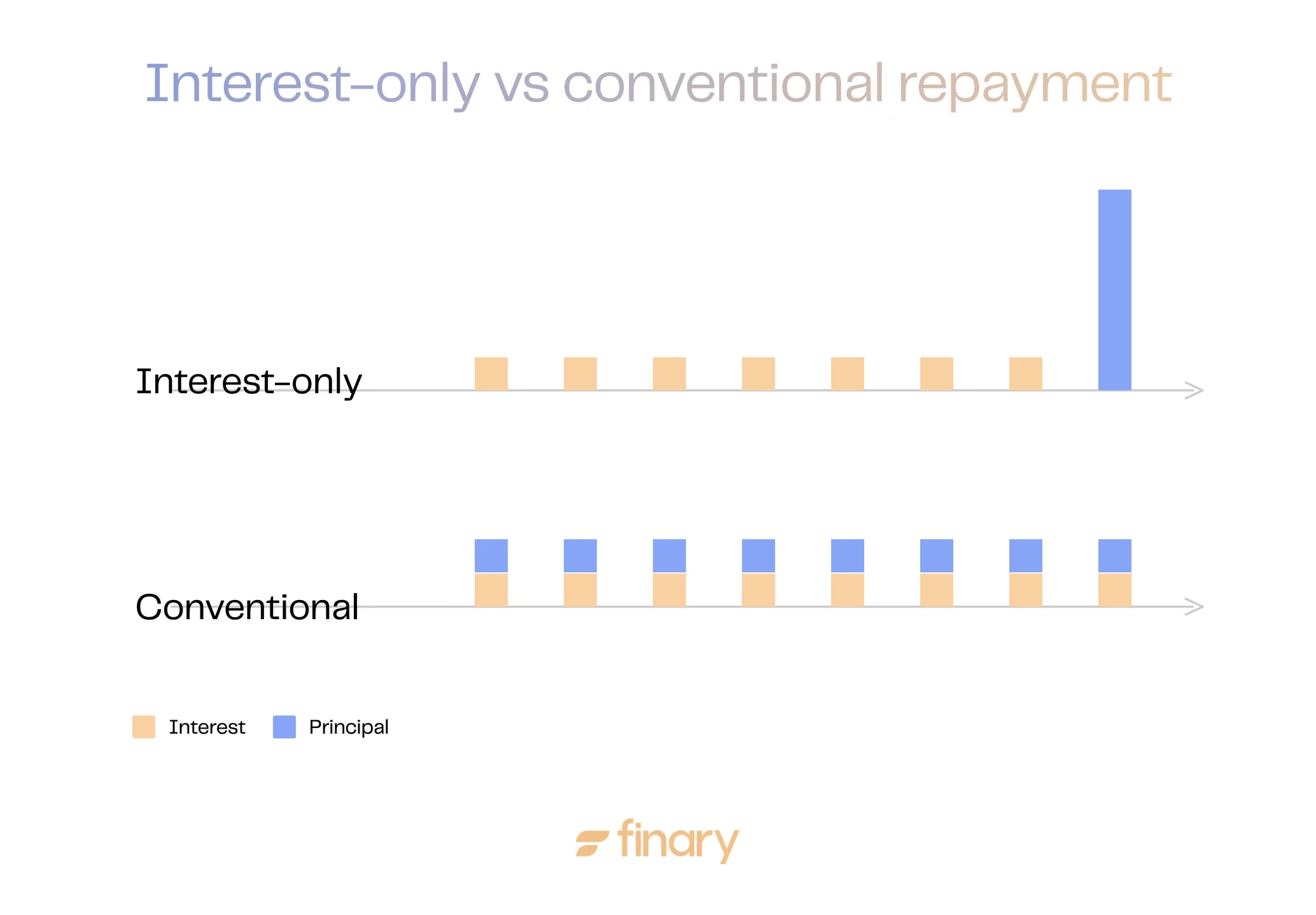
A Lombard loan differs markedly from conventional financing. You pay only the interest for the whole term of the loan. The principal is repaid in a single instalment at maturity. This method preserves your cash and lets you keep growing your investments.
Some banks offer an overdraft arrangement. You then have a credit line you draw on as you need it. For example, you can borrow €100,000 in January for a project, then repay in March if you no longer need it. Interest applies only to the amounts drawn.
This flexibility is sought after by holders of large portfolios, who can seize investment opportunities without liquidating their assets.
Calculating the interest rate and the associated fees
The rate on a Lombard loan is in most cases based on 3-month Euribor, plus a bank margin generally between 0.8% and 1.5%. For example, with 3-month Euribor at 2.3% and a margin of 1.2%, the annual rate reaches 3.5%. That rate can look high next to a mortgage, but it comes with significant advantages: you keep your assets, you keep their performance, and you gain a tax benefit.
Euribor (Euro Interbank Offered Rate) is the rate at which the main European banks lend each other funds in euros on the interbank market. 3-month Euribor, often used to calculate the interest on various financial products such as loans, is the rate for three-month lending.
Ancillary fees remain limited:
- No compulsory death cover
- Low arrangement fees
- Annual management fees on the pledged assets, generally between 0.1% and 0.3% of their value
- Note: if the funds leave the policy, fees may apply.
Negotiation plays a key role. A well-diversified €2 million portfolio, for example, often secures a reduced bank margin.
A diversified, good-quality portfolio can influence the pricing terms negotiated.
The margin call mechanism and managing market swings
A Lombard loan comes with dynamic risk management. The value of the pledged assets moves with the markets. If your portfolio loses significant value, the bank can trigger a margin call.
You then have 48 to 72 hours to restore the cover ratio by:
- Providing new assets
- Repaying part of the principal
- Agreeing to the sale of some of your securities
Experienced investors anticipate these situations by holding a cover ratio above the required minimum. For example, if the bank requires 150%, they aim for 200% to protect themselves against market swings.
This active management calls for rigorous monitoring given the specific risks involved (margin call, liquidation). You track how your positions move and, through some digital platforms, receive automatic alerts when your ratio approaches critical thresholds.
Volatility remains a risk factor to watch at all times. Market corrections sometimes create investment opportunities on favourable terms, which you can seize through your credit line.
What is the Lombard loan rate in 2026?
The rate on a Lombard loan is built from two components: a reference rate (generally 3-month Euribor) and a negotiated bank margin. In 2026, the European Central Bank raised its three key rates by 25 basis points with effect from 17 June 2026: the deposit facility rate moved to 2.25% and the main refinancing rate to 2.40%. 3-month Euribor stood at 2.459% on 29 July 2026 (a daily figure, liable to change). The Lombard loan therefore remains a competitive option for financing projects and investment opportunities, provided the bank margin is well negotiated.
Breaking down the Lombard rate in 2026
For an investor with €500,000 to €2 million of pledged assets, the total rate typically sits between 3.2% and 4.0% in 2026:
- 3-month Euribor: 2.459% on 29 July 2026 (variable rate, reset quarterly)
- Bank margin: 0.8% to 1.5% depending on the quality of the portfolio, the amount borrowed and the relationship with the private bank
- Annual management fees on pledged assets: an additional 0.1% to 0.3%
Above €5 million of pledged assets, margins often drop below 0.8%, and even to 0.5% for the very largest portfolios. That is the main negotiating lever: the larger and more diversified your wealth, the more the bank margin is compressed.
The LTV (loan-to-value) ratio: a key driver of the rate and the amount available
The LTV (loan-to-value) ratio expresses the relationship between the amount borrowed and the value of the pledged assets. It is central to the structure of a Lombard loan: it drives both how much you can borrow and the cost of the credit.
Typical LTV ratios by asset class in 2026:
- Euro funds and European government bonds: LTV 80-95% (very low risk)
- Investment-grade corporate bonds: LTV 70-80%
- Blue-chip equities (CAC 40, Euro Stoxx 50): LTV 60-70%
- Diversified funds and equity ETFs: LTV 50-60%
- Mid caps and small caps: LTV 30-50%, sometimes excluded
- Alternative assets and crypto: generally excluded, or a very low LTV
An investor with a €1 million portfolio made up of 60% blue-chip equities and 40% investment-grade bonds will be able to borrow roughly €650,000 to €750,000 depending on the bank. An investor with €1 million in euro funds will be able to borrow up to €900,000.
Lombard rate vs other financing options in 2026
For a HNWI (high net worth individual) portfolio, the Lombard loan compares favourably with the alternatives:
- Mortgage on a main residence: around 3.3% in summer 2026 (average rate across all terms of 3.26% in June 2026, Observatoire Crédit Logement / CSA), but a long process and a mortgage charge required.
- Lombard loan: 3.2% to 4.0%, set up in 4-6 weeks, with no mortgage charge.
- Broker securities-backed advance: 4% to 6% depending on the broker, faster but more expensive and limited to securities held with that broker.
- Consumer credit: 5% to 7%, accessible but expensive.
To finance a project without liquidating a performing portfolio, the Lombard loan can be a relevant option in 2026 for a substantial financial portfolio. Note that the tax deductibility of the interest, where the loan finances an investment, improves the net cost further.
What are the advantages and disadvantages of a Lombard loan?
The main advantage is obtaining cash within a few weeks without giving up your positions or triggering tax on your capital gains. The main disadvantage is exposure to the margin call: a sharp market fall can force you to provide assets, repay early or sell at the bottom.
Fast access to cash without selling your assets
A Lombard loan provides cash without giving up your positions. For example, if your equity portfolio has doubled, selling to raise cash means giving up its growth potential.
With this mechanism, your equities, bonds or life insurance policies act as dynamic collateral. They keep generating income and gaining value while providing you with the funds your projects need.
Fast set-up is a major advantage. Unlike a mortgage, which can take several months, a Lombard loan is released within a few weeks. The banks already value your assets, which speeds up the process.
One option is to approach the bank that already holds the assets in custody; that is a matter of individual judgement. It generally makes valuing the securities and negotiating the terms easier, since the institution already knows the portfolio.
That responsiveness lets you seize opportunities requiring quick action, whether an investment or a property purchase. A Lombard loan can therefore offer cash-flow flexibility, subject to the associated risks.
Tax benefit: deductible interest and no tax on the cash borrowed
A Lombard loan carries significant tax advantages. Selling shares at a gain means paying a flat tax (PFU) of 31.4% (12.8% income tax and 18.6% social levies since the LFSS 2026, France's social security financing act, up from 30% previously). Borrowing against your assets, by contrast, creates no tax on the cash received, since a loan does not qualify as income.
This favourable tax treatment lets you finance your needs without creating taxable income. For example, a company owner can borrow against their shares rather than pay themselves dividends subject to tax.
Where a Lombard loan finances an investment generating taxable income (rental income under the régime réel, a professional activity taxed as BIC (France's industrial and commercial profits category) or BNC (France's non-commercial profits category), or a structure subject to corporation tax), the interest may be deductible under articles 31, 39 or 212 of the French General Tax Code. Deductibility is not automatic: it does not apply to capitalisation investments (PEA, life insurance, a securities account generating no taxable income), which are nonetheless the majority of Lombard loan use cases.
Some investors use refinancing of their Lombard loan as part of an overall wealth strategy. The strategy does not remove the tax, which is triggered on the final disposal or on transfer depending on the applicable regime, but it does preserve portfolio performance as long as asset growth exceeds the cost of the credit.
Risks tied to market swings and over-indebtedness
A Lombard loan carries risks, particularly if markets fall. If the value of your assets declines, the bank can ask for additional collateral or an immediate partial repayment.
That requirement turns market corrections into emergencies. Even a diversified portfolio can suffer in systemic crises, where several asset classes fall at once.
The risk of over-indebtedness is real too. Borrowing part of the value of your portfolio to reinvest increases your overall market exposure.
For example, an investor holding €1 million in equities who borrows €500,000 to reinvest carries total exposure of €1.5 million. In a 30% fall, the loss reaches €450,000, close to half their initial wealth.
Finally, easy access to cash can create an illusion of immediate wealth. That can encourage excessive spending or ill-considered risk-taking. Caution therefore remains essential to avoid heavy financial consequences.

The Lombard loan at Finary One
Finary One gives access to the Lombard loan to investors with €1,000,000 of investable assets, letting them mobilise their financial wealth without liquidating their positions or triggering the tax attached to a disposal.
- A Lombard loan secured on your financial wealth (Luxembourg life insurance, PEA, securities account) with partner private banks, on negotiated terms for the LTV ratio and the bank margin.
- A dedicated private wealth manager who structures the transaction (amount, interest-only repayment or credit line, term) in line with your overall wealth strategy and your transfer objectives.
- A 360° view of your wealth that monitors cover ratios in real time, anticipates margin calls and factors the Lombard loan into your overall allocation.
Learn more about Finary One → Reserved for investors with €1,000,000 of investable assets. A Lombard loan carries risks, including credit risk and the risk of capital loss.
Practical applications and use cases
Financing personal projects: property, leisure, cash flow
A Lombard loan is an effective solution when selling assets would damage the value of the portfolio. For example, an entrepreneur holding shares in a growing company can finance the purchase of a second home without compromising their investments.
Uses go well beyond property. An art collector can acquire a major work without touching their equity holdings. A company director can settle their annual tax bill without changing their long-term investment strategy. This flexibility makes it easier to seize opportunities without upsetting the balance of the portfolio.
The term of a Lombard loan generally runs between 5 and 10 years depending on the bank, with repayment at maturity (for example 5 years at BoursoBank, 7 to 10 years in private banking), and adapts to one-off cash needs or short-term projects. Unlike mortgages repaid in equal monthly instalments, which run over several decades, it offers a more flexible solution.
Investment strategies using leverage
A Lombard loan makes it possible to run advanced investment strategies, provided the risks are well managed. An experienced investor can diversify their portfolio by using the cash raised to access new markets without selling existing positions.
This strategy proves particularly useful in specific market phases. During a market correction, a Lombard loan allows discounted assets to be bought, strengthening positions on favourable terms. Cover ratios must be watched closely, however.
Timing arbitrage is another application. An investor expecting their assets to be revalued in 18 months can use a Lombard loan to invest elsewhere immediately, adjusting the allocation of their capital.
Stay vigilant: using leverage amplifies both gains and losses. A 20% fall on a portfolio 50% financed by a Lombard loan can trigger a margin call.
Comparison with other financing options: mortgage, securities-backed advance
A Lombard loan stands out for its flexibility and its speed. Where a mortgage requires several months of underwriting, valuations and guarantees, a Lombard loan is obtained within a few weeks thanks to the liquidity and the immediate valuation of financial assets.
The securities-backed advance offered by some brokers has similarities but remains more restrictive. It is generally limited to positions held with that broker and offers less freedom in how the funds are used. A Lombard loan, by contrast, lets you mobilise assets across different vehicles (life insurance, PEA, securities account) and use the cash without constraint.
Cost structures differ too. A mortgage benefits from attractive rates thanks to the mortgage charge.
A Lombard loan, often indexed to Euribor with a margin of 0.8% to 1.5%, costs more, offset by how flexibly it can be used.
Finally, the tax treatment of a Lombard loan can be attractive depending on the situation.
Access conditions and setting up a Lombard loan
Borrower profile and the solvency required
A Lombard loan does not rest on the usual criteria. The strength of your portfolio counts for more than the level of your income.
For example, an entrepreneur holding €2 million in equities will get privileged access to this financing even on a modest monthly income. Conversely, a senior executive with no significant wealth will find it harder.
Banks assess net worth, not salary. This wealth-based approach explains why affluent retirees can obtain large Lombard loans despite limited income. Their life insurance policies or company holdings are solid collateral, far more convincing than a payslip.
Institutions judge solvency by examining the quality and the diversification of the assets rather than cash flows.
Steps to take out a Lombard loan: documents and negotiation
The application differs markedly from a mortgage. You do not need to provide payslips or proof of outgoings. The file rests on a precise valuation of your financial wealth.
Private banks analyse the valuation, the composition, the performance and the volatility of your eligible assets. That review determines the financing ratio applied to each asset class.
The negotiation mainly covers:
- the interest rate
- the loan-to-value ratio
A portfolio made up mostly of European government bonds will secure better terms than one exposed to cryptocurrencies, because of the perceived level of risk.
The timing of the negotiation matters too. After a period of rising markets, the value of your assets is at its peak, which naturally improves your borrowing capacity.
The Lombard loan at the major French banks
The Lombard loan is not a standardised offer: every private bank applies its own entry threshold, LTV ratios, bank margins and universe of eligible assets. Here is an overview of the main players in France in 2026.
Indicative terms based on market estimates. Final terms are negotiated directly with each institution and are not officially published.
The Lombard loan at Crédit Agricole (CA Indosuez Wealth Management)
Crédit Agricole offers the Lombard loan through its private bank CA Indosuez Wealth Management, positioned on the HNWI and UHNWI (ultra high net worth individual) segment from around €1.5 million of assets under management. The Lombard loan is part of an overall wealth management offering with a dedicated private wealth manager.
Typical features at Crédit Agricole Indosuez:
- Entry threshold: from €200,000 of credit, with at least €1.5 million of eligible wealth.
- LTV: applied on the standard market grid (60-80% on a balanced portfolio).
- Bank margin: negotiable, generally 0.9% to 1.4% above 3-month Euribor.
- Asset universe: broad, including bonds, equities, funds, Luxembourg life insurance and securities accounts held within the group.
- Included service: wealth analysis, selection of the pledged assets, monitoring of the cover ratio by the private banker.
The advantage of going through Crédit Agricole Indosuez lies in the depth of the network (subsidiaries in Europe, Asia and the Middle East), which makes cross-border transactions and the portability of the loan easier if you move abroad.
The Lombard loan at BNP Paribas Banque Privée
BNP Paribas offers the Lombard loan through BNP Paribas Banque Privée and BNP Paribas Wealth Management. Very high-end positioning, with recognised expertise in Luxembourg FID vehicles and the Lombard loan secured on a Luxembourg life insurance policy.
Typical features:
- Entry threshold: from €500,000 of assets under management, ideally €1 million or more.
- Bank margin: 0.8% to 1.3% depending on the amount and the relationship.
- Speciality: Lombard loan secured on a Luxembourg life insurance policy, with access to FID (dedicated internal fund) and FAS (specialised insurance fund) vehicles managed by BNPP Asset Management.
The Lombard loan at Société Générale Private Banking
Société Générale Private Banking offers the Lombard loan from around €500,000 to €1 million of financial assets. The offering is built around the private bank, with access through Société Générale Luxembourg for complex structures.
Typical bank margin of 0.9% to 1.5%. Advantage: a broad universe of eligible assets, notably in-house funds and Sogelife's Luxembourg life insurance policies.
The Lombard loan at the independent private banks
The independent private banks (Edmond de Rothschild, Pictet, Lombard Odier, Banque Internationale à Luxembourg) also offer the Lombard loan on terms negotiated case by case. Access thresholds differ from one institution to the next:
- Lombard Odier: from CHF 1 million of liquid assets entrusted, according to the FAQ on its institutional site (lombardodier.com), a threshold that can vary with the services requested and the client's country of residence.
- Pictet: entry threshold estimated at around €5 million from market sources, not officially published.
- Edmond de Rothschild and Banque Internationale à Luxembourg: thresholds estimated between €1 million and €3 million depending on the profile and the complexity of the file.
These institutions stand out for their expertise in complex structures (wealth holding company, split ownership, trust) and their ability to fit the Lombard loan into an overall wealth picture.
Choosing between a major bank and an independent private bank depends on your profile: the universal bank (CA, BNP, SG) makes consolidation with your current accounts and mortgages easier; the independent private bank offers a more bespoke approach but with a higher entry threshold.
Borrowing against your portfolio, without losing sight of it
A Lombard loan buys time: it turns a portfolio into cash with no forced switching and no immediate tax. The price of that time is variable interest indexed to Euribor and a cover ratio to hold in all circumstances.
The dividing line is clear. Used to finance a one-off project with a comfortable safety margin, it is a cash management tool. Used to maximise leverage on an already volatile portfolio, it is a risk position, exposed to capital loss and to a margin call at the worst possible moment.
Goals
Frequently asked questions
What happens if a margin call is not met?
If the borrower provides neither additional assets nor a partial repayment within the allotted time, generally 48 to 72 hours, the bank liquidates part of the pledged securities to restore the cover ratio. The sale is then forced, often into a falling market, and it crystallises the capital gain and the tax on it.
Does a Lombard loan permanently avoid capital gains tax?
No. Borrowing creates no taxable income, but the tax is only deferred: it is triggered on the final disposal of the securities, at the flat tax (PFU) rate of 31.4%, or on transfer depending on the applicable regime. The loan pushes the tax date back, it does not cancel it.
Can a Lombard loan be repaid early?
Yes in most cases. On a credit line, interest accrues only on the amounts actually drawn, and repayment is free. On an interest-only loan, early repayment is generally possible, but the terms and any indemnity are negotiated in the contract.
Can cryptocurrencies serve as collateral for a Lombard loan?
Very rarely in the traditional banking circuit. Private banks most often exclude crypto-assets from the eligible universe, or apply a very low LTV ratio to them, because of their volatility and the difficulty of valuing them continuously as they would a listed security.
How long does it take to set up a Lombard loan?
Generally allow four to six weeks, against several months for a mortgage. The timeline is short because the bank already knows the value of the assets to be pledged: there is no property valuation, no mortgage charge to register and no detailed review of the borrower's income.
Sources
Service-public.gouv.fr, income tax: capital gains on securities and the flat tax (PFU)
Impots.gouv.fr, I have realised a capital gain on securities: how is it taxed?
European Central Bank, key ECB interest rates
Euribor-rates.eu, 3-month Euribor rate: daily values
Observatoire Crédit Logement / CSA, average rate on mortgages to individuals
UBS, Global Wealth Report 2026
Regulatory disclaimers: Marketing communication. Investing carries a risk of partial or total capital loss. Past performance is not a reliable indicator of future performance. This article is provided for information and educational purposes only; it does not constitute personalised investment advice, a buy or sell recommendation, or tax advice. Borrowing amplifies losses as well as gains and can lead to a loss greater than the capital invested (you remain liable for the loan). Complex, high-risk product. Before investing, read the Key Information Document (KID) and, where relevant, consult an authorised adviser. Finary SAS, an investment firm authorised by the ACPR (no. 19283), member of AMAFI. Insurance broker registered with ORIAS (no. 21001279), member of the CNCGP (association approved by the AMF). Crypto-Asset Service Provider (CASP) authorised by the AMF under the MiCA regime, references no. A2026-026 and no. N2026-008.