How does life insurance work in France?

According to data from France Assureurs, life insurance in France is going through a period of record inflows: €19.3 billion in net inflows in the first quarter of 2026, a €5.7 billion increase over the trailing twelve months. In March alone, gross contributions reached €18.3 billion, taking the market's annual growth to +14%. This renewed appeal coincides with the Livret A rate falling to 1.5% in February 2026 (raised to 1.7% from 1 August 2026), which has led many savers to redirect their savings towards potentially higher-yielding products.
With close to €2 trillion in assets under management, life insurance remains one of the most widely used financial products among French households - valued for its flexibility, its tax features and its estate-planning possibilities.
Discover how life insurance works in France and why it continues to attract so many savers.
What are the benefits of life insurance?
Life insurance is an effective way to build and stabilise wealth while benefiting from a specific tax framework. In terms of flexibility and favourable taxation, this savings vehicle is highly attractive.

For cautious savers, holding funds in a euro fund (government bonds, corporate bonds, property, etc.) can suit cautious profiles, while a bolder investor may opt for a multi-vehicle policy, investing in unit-linked funds (equities, funds, etc.). This involves more risk, but also greater potential for capital growth. Learn more about the benefits of multi-vehicle policies.
Life insurance stands out for its flexibility: a policy can be partially or fully withdrawn at any time - funds are generally paid out within a few weeks (statutory maximum: 2 months). Contributions are flexible in amount and frequency, within the minimum thresholds set by the insurer. Finally, taxation on gains eases after 8 years of holding, with an annual tax allowance of €4,600 (or €9,200 for a couple) and a reduced rate of 7.5%. Discover the details of life insurance's tax benefits.
More capital invested

Non-contractual document for promotional purposes. Investment in unit-linked vehicles carries a risk of capital loss, since their value is subject to fluctuation, both upwards and downwards, depending in particular on developments in the financial markets. The insurer guarantees the number of unit-linked units, not their value, which it does not guarantee. The e-vie life insurance policy is an individual life insurance policy, denominated in euros and/or unit-linked vehicles, underwritten by Generali Vie, a company governed by the French Insurance Code. Finary SAS - 58 rue de Monceau 75380 Paris 8 - Investment Firm authorised by the ACPR under no. 19283, ORIAS no. 21001279, member of AMAFI
Diversifying your investment portfolio with life insurance
Life insurance offers a flexible investment wrapper that everyone can manage according to their profile and objectives. The type of policy chosen (single-vehicle or multi-vehicle) greatly influences how investments are allocated.
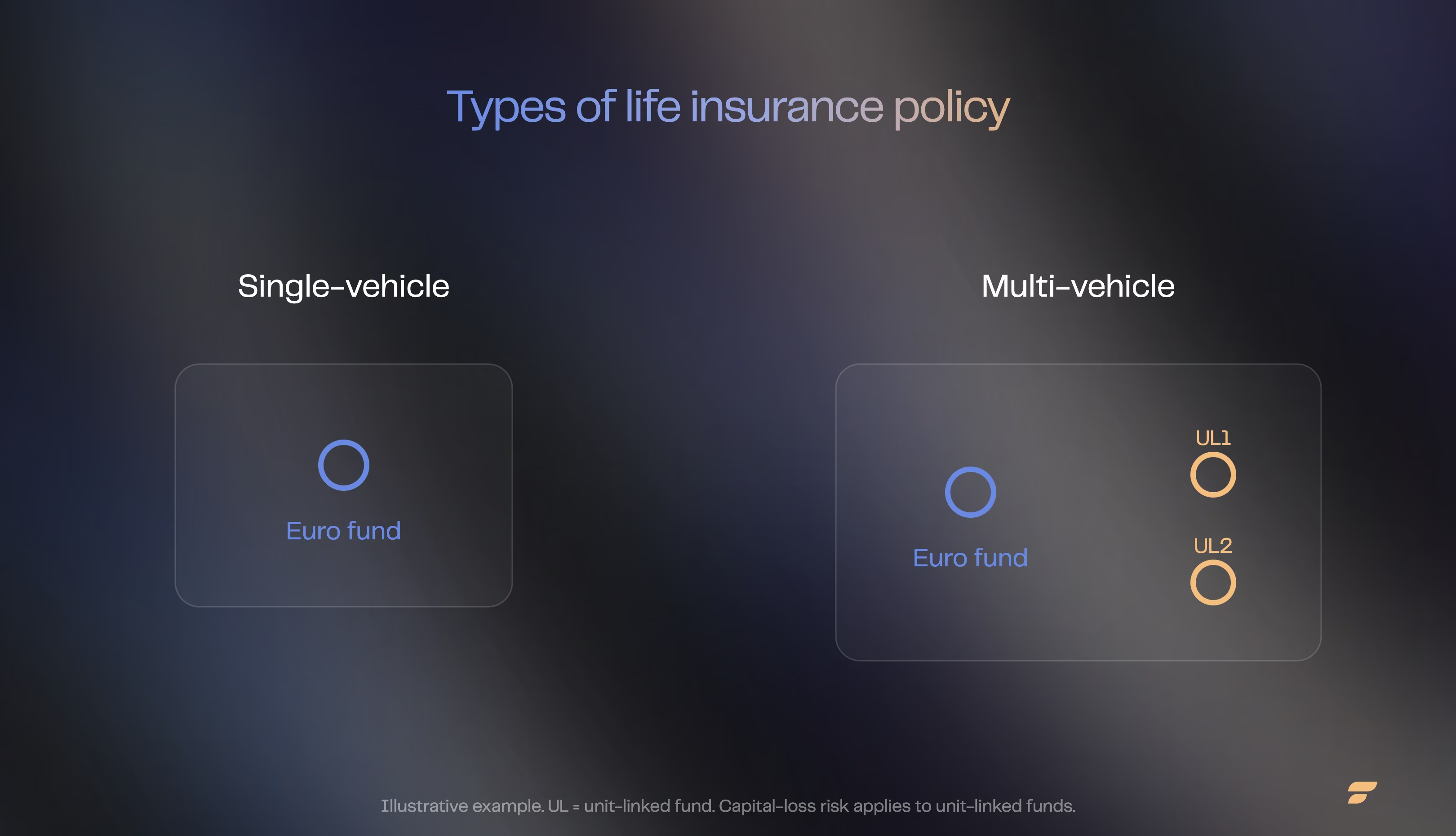
In a single-vehicle policy, the capital is invested exclusively in a euro fund, a vehicle whose capital is guaranteed by the insurer, made up mainly of government bonds. For multi-vehicle policies, diversification comes from investments in equities, ETFs, SCPI, bonds or other funds. Investors can even redirect part of the capital towards less liquid investments such as private equity, offering higher return potential in exchange for illiquidity and an increased risk of capital loss. Learn how to diversify your portfolio with life insurance.
Life insurance and retirement
Preparing for retirement is crucial, and life insurance can play a central role in this. Policyholders save as they see fit, with no set amount, which lets them put aside part of their monthly income throughout their career. By diversifying their portfolio and keeping fees under control, future retirees can initially take on risk with multi-vehicle policies, then move towards lower-risk vehicles as retirement approaches. Discover how to prepare for retirement with life insurance. To estimate how your savings will grow over time, our life insurance simulator can help you project your future capital.

Life insurance and inheritance
Life insurance is an effective tool for passing on wealth, allowing up to €152,500 per beneficiary to be transferred free of inheritance tax for contributions paid before the age of 70. For contributions made after age 70, an overall allowance of €30,500 (shared among all beneficiaries) is applied before inheritance tax is calculated. Capital gains generated by the policy, meanwhile, are exempt from inheritance tax. Learn more about the inheritance benefits of life insurance.

- Life insurance offers favourable taxation on inheritance, with allowances and tax rates that work in your favour, notably for contributions made before age 70 (exemption of up to €152,500 per beneficiary)
- The date the policy was taken out and the policyholder's age at the time of each contribution affect taxation: policies taken out before 20 November 1991 and contributions paid before 13 October 1998 benefit from special tax advantages.
- The precise wording of the beneficiary clause is crucial to optimise wealth transfer, with the option to name second-rank beneficiaries or opt for a split clause (usufruct/bare ownership).
within your reach
Non-contractual document for promotional purposes. Investment in unit-linked vehicles carries a risk of capital loss, since their value is subject to fluctuation, both upwards and downwards, depending in particular on developments in the financial markets. The insurer guarantees the number of unit-linked units, not their value, which it does not guarantee. The e-vie life insurance policy is an individual life insurance policy, denominated in euros and/or unit-linked vehicles, underwritten by Generali Vie, a company governed by the French Insurance Code. Finary SAS - 58 rue de Monceau 75380 Paris 8 - Investment Firm authorised by the ACPR under no. 19283, ORIAS no. 21001279, member of AMAFI
Conclusion
Life insurance can fit into a diversified wealth strategy, thanks to its flexibility, its tax framework and its wealth-transfer possibilities. Taking the time to assess your investor profile makes it possible to match the level of risk to your objectives and investment horizon. Comparing offers on the market - particularly on management fees - remains a key factor over the long term. When in doubt, guidance from an adviser can help refine your choices.
Regulatory disclaimers:
Marketing communication. Investing carries a risk of partial or total capital loss. Past performance is not a reliable indicator of future performance. This article is provided for information and educational purposes only; it does not constitute personalised investment advice, a buy or sell recommendation, or tax advice.
The capital guarantee on euro funds is provided by the insurer and depends on its financial strength. In a severe systemic crisis, the French "Sapin 2" law allows withdrawals to be temporarily restricted (liquidity), without affecting the guaranteed capital. Unit-linked funds are not guaranteed and carry a risk of capital loss.
Before investing, read the Key Information Document (KID) and, where relevant, consult an authorised adviser.
Finary SAS, an investment firm authorised by the ACPR (no. 19283), member of AMAFI. Insurance broker registered with ORIAS (no. 21001279), member of the CNCGP (association approved by the AMF). Crypto-Asset Service Provider (CASP) authorised by the AMF under the MiCA regime, references no. A2026-026 and no. N2026-008.