Life insurance returns in France in 2026: the complete overview!

The return on life insurance in France is drawing strong interest from savers in 2026. Boosted by the rebound in euro funds and inflation back under 2%, French savers' favourite investment is regaining some momentum. Between secure euro funds and more dynamic unit-linked funds, what options are available to savers?
This article covers expected returns, the key selection criteria, and what you need to understand your life insurance policy in 2026.
Types of investment options
Euro funds and unit-linked funds explained
These life insurance policies generally offer two types of investment options:
- Euro funds:
- Capital guaranteed by the insurer (subject to its solvency - the French "Sapin 2" law, FGAP protection up to €70,000)
- Annual declared return, never negative
- Mainly composed of fixed-rate bonds
- Unit-linked funds (UC):
- Invested in a variety of financial assets (equities, bonds, real estate)
- Performance tied to financial market movements
- Fluctuating unit value
Comparing risk and return potential: euro funds vs. unit-linked funds
Euro funds:
- Risk: Low (capital guarantee subject to the insurer's solvency)
- Potential return: Moderate, averaging 2.3-2.5% in 2026
- Advantages: Security, stability
- Drawbacks: Limited performance, sensitivity to interest rates
Unit-linked funds:
- Risk: Varies by investment option, possible capital loss
- Potential return: High, some unit-linked funds posted nearly 20% in 2024 for dynamic profiles (past performance is not a reliable indicator of future performance, risk of capital loss)
- Advantages: Diversification, higher performance potential
- Drawbacks: Volatility, potential for losses
For long-term investments, equity or real-estate funds can offer a different performance potential to euro funds, in exchange for a risk of capital loss. Diversifying across these different options helps optimise the risk/return balance of your life insurance policy.

The split between euro funds and unit-linked funds should be tailored to the investor's profile, investment horizon and risk tolerance. A well-designed asset allocation aims to match expected performance to a risk level the saver can accept.
within reach
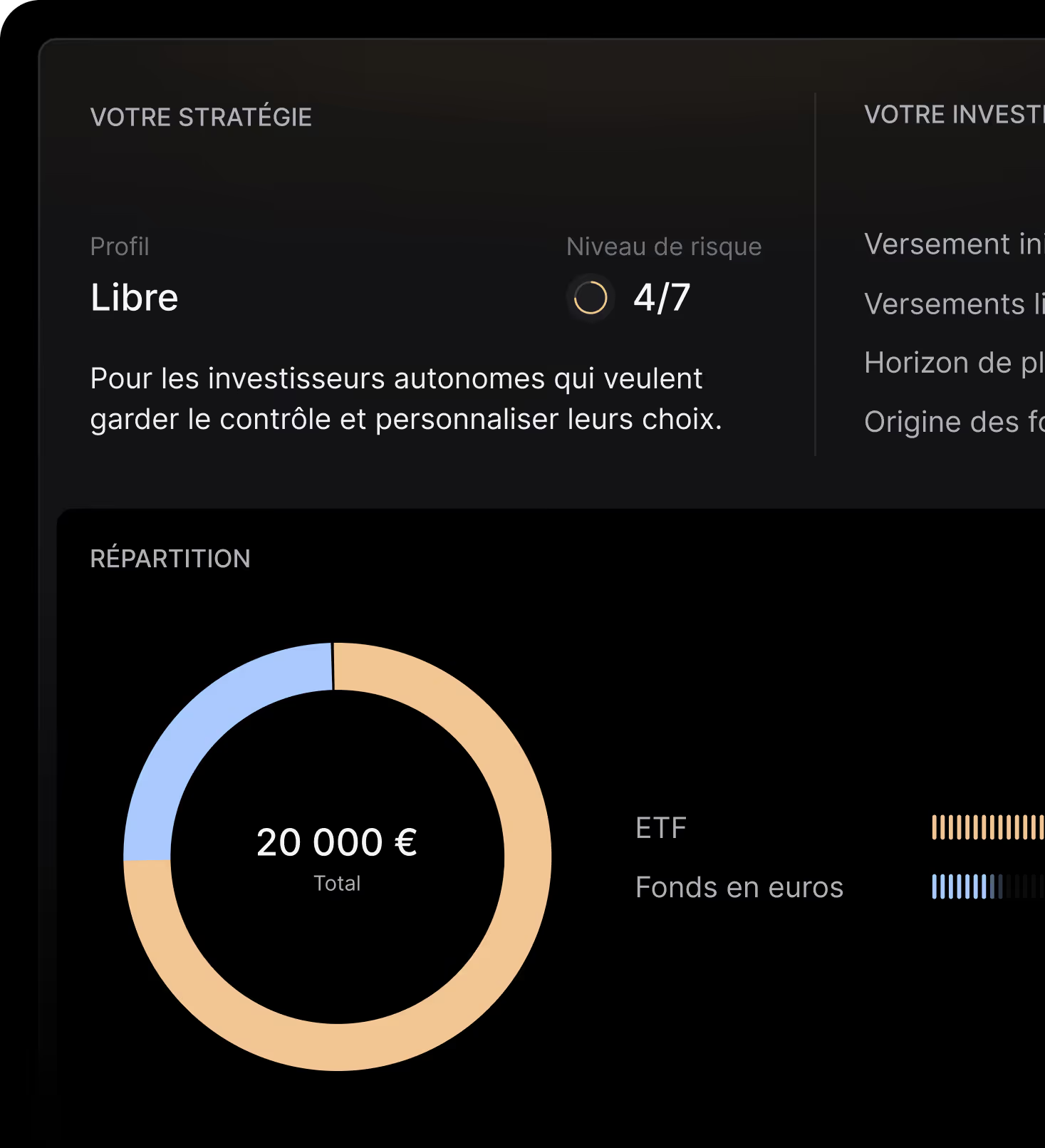
Non-contractual document for promotional purposes. Investing in unit-linked vehicles carries a risk of capital loss, since their value is subject to fluctuation, both upwards and downwards, depending in particular on developments in the financial markets. The insurer commits to the number of unit-linked units, not to their value, which it does not guarantee. This life insurance policy is an individual life insurance policy, denominated in euros and/or unit-linked vehicles, underwritten by Generali Vie, a company governed by the French Insurance Code. Finary SAS - 58 rue de Monceau 75380 Paris 8 - Investment Firm authorised by the ACPR under no. 19283, ORIAS no. 21001279, member of AMAFI
Euro fund returns
Comparing the average return rate of euro funds
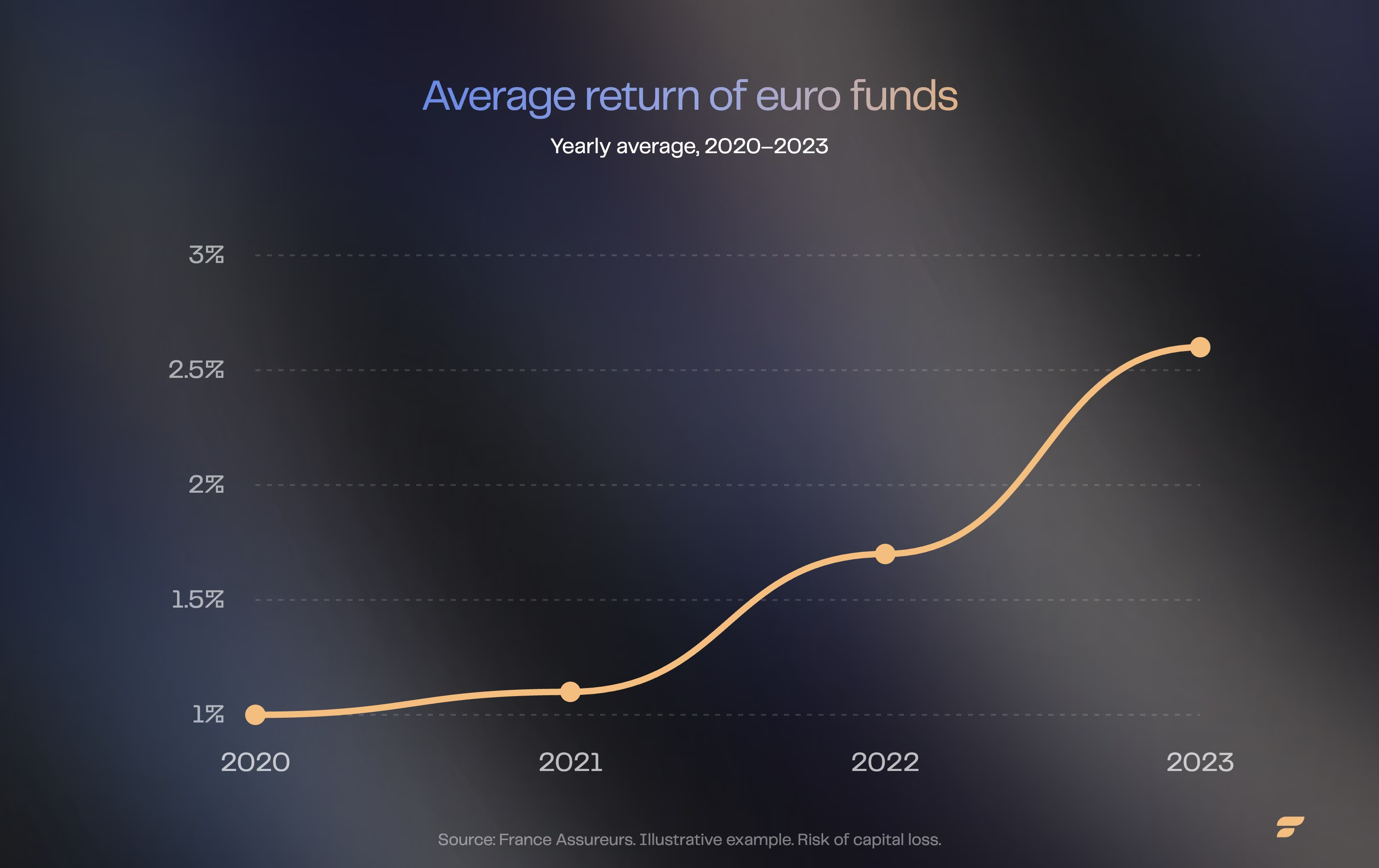
The average return on life insurance policies reached 2.6% in 2025. After a historic low of around 1.3% in 2021, euro funds have gradually rebounded. Policies vary widely, however: some cap out at 1%, while the best performers exceed 4%.
Over several years, the performance of different euro funds shows a clear increase:
The impact of interest rates on life insurance returns
The rise in interest rates between 2022 and 2023 had a positive impact, especially on euro funds. These funds, mainly composed of fixed-rate bonds with maturities of 2 to 15 years, still benefit from the high-yield bonds bought when rates peaked. Funds that raised significant capital during that period have an advantage, as they were able to build a more profitable bond portfolio.
The effect of inflation on life insurance returns in 2025
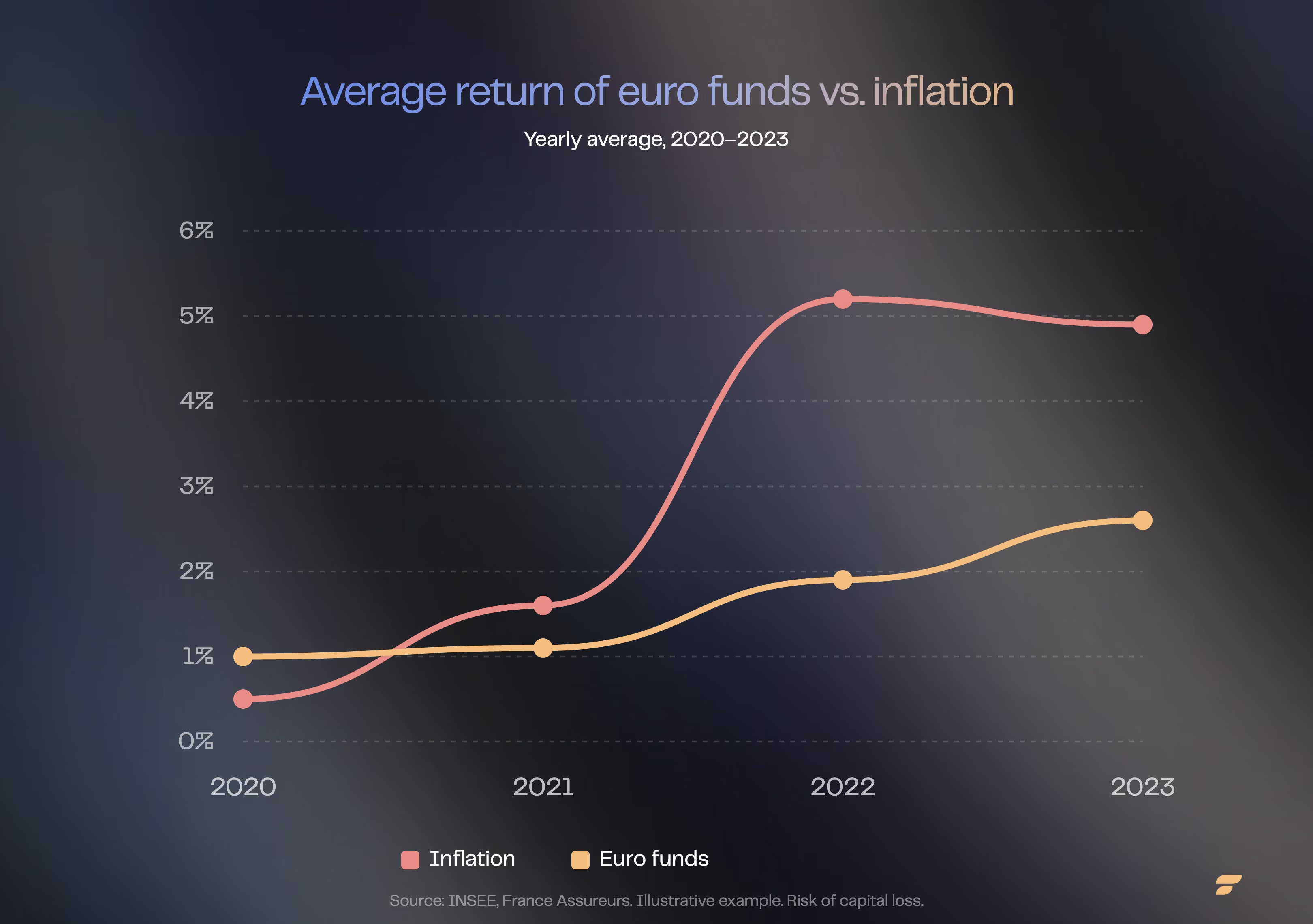
In 2025, French inflation slowed markedly, averaging 0.9% for the year according to INSEE - one of the lowest rates in the eurozone. By year-end, it stood at just 0.8% year-on-year. This disinflation benefited savers: with an average return of 2.6%, euro funds delivered a positive real return of around +1.7% in 2025, regaining their appeal after several difficult years.
In recent years, very high inflation has been shown to erode the real return of most low-risk investments (such as euro funds or savings accounts):

Comparison table of the main life insurance policies
Here is an overview of the returns of some life insurance euro funds in 2025:
| Institution | Policy name | Euro fund | 2025 performance | Fees |
| Finary | Finary Life | Netissima | 3% | 0.75% |
| Ramify | Ramify Vie | APICIL EuroFlex | 1.75% | 1% max |
| Boursorama | BoursoVie | Euro Exclusif | 3% | 0.75% |
| Fortuneo | Fortuneo Vie | Suravenir Rendement | 2.10% | 0.60% |
| Yomoni | Yomoni Vie | Suravenir Rendement | 2.10% | 0.60% |
| LCL | LCL Vie | LCL Vie | 2.55% | 1% |
| Caisse d'Epargne | Millevie Initiale 2 | BPCE Vie | 2.30% | 0.80% |
| La Banque Postale | Cachemire 2 | Cachemire 2 | 2.30% | 0.85% |
| Axa | Arpèges | Global Euro | 2.5% | 0.80% |
| Abeille Assurances | Lucya Abeille | Abeille Actif Garanti | 2.51% | 0.60% |
| Linxea | Spirit 2 | Fonds Euro Nouvelle Génération | 3.08% | 2% |
| Nalo | Nalo | Eurossima | 1.75% | 0.85% |
These figures show the diversity of returns and fees across different life insurance policies. With an average performance of 2.6% in 2025 according to France Assureurs, euro funds comfortably outperform the Livret A, whose rate was cut to 1.5% from 1 February 2026 (raised to 1.7% from 1 August 2026), a gap of more than one percentage point in favour of life insurance.
More capital invested

Non-contractual document for promotional purposes. Investing in unit-linked vehicles carries a risk of capital loss, since their value is subject to fluctuation, both upwards and downwards, depending in particular on developments in the financial markets. The insurer commits to the number of unit-linked units, not to their value, which it does not guarantee. This life insurance policy is an individual life insurance policy, denominated in euros and/or unit-linked vehicles, underwritten by Generali Vie, a company governed by the French Insurance Code. Finary SAS - 58 rue de Monceau 75380 Paris 8 - Investment Firm authorised by the ACPR under no. 19283, ORIAS no. 21001279, member of AMAFI
Selection criteria for a life insurance policy
Factors to consider beyond returns: fees, range of investment options, management styles
Return is only one factor among others to weigh when choosing a life insurance policy. Here are the key criteria to examine:
- Fees:
- Entry fees: some policies apply none
- Management fees: can range from 0.60% to 4% depending on the policy
- Switching fees: some policies offer these free of charge
- Range of investment options:
- Number and variety of funds on offer (ETFs, SCPI (a French non-listed real-estate investment fund, comparable to a REIT), thematic funds)
- Ability to invest in specific assets (private equity, SCPI, structured products)
- Management styles:
- Self-directed management: for hands-on investors
- Managed-portfolio service: an alternative for those who prefer to delegate
- Profiled management: automatic allocation based on risk profile
- Insurer's financial strength:
- Guarantees offered
- Track record
- Quality and availability of digital services:
- Ease of managing the policy online
- Portfolio tracking and analysis tools
The impact of investment horizon on performance
Investment horizon plays a crucial role in a life insurance investment strategy:
- Short term (under 5 years):
- These euro funds can suit their secure profile
- A limited exposure to volatile unit-linked funds may be considered
- Medium term (5 to 10 years):
- A balance between euro funds and unit-linked funds can be considered
- A gradual increase in the unit-linked share is sometimes considered
- Long term (over 10 years):
- These unit-linked funds can be considered for their performance potential (risk of capital loss)
- Benefiting from the smoothing effect on market fluctuations
For long-term investments, equity or real-estate funds can offer a different performance potential to euro funds, in exchange for a risk of capital loss. Some unit-linked funds posted returns close to 20% in 2024 for dynamic profiles. Past performance is not a reliable indicator of future performance, and a risk of capital loss remains.
Investment horizon is also reflected in the favourable taxation of life insurance after 8 years. This includes an annual allowance of €4,600 (€9,200 for a couple) on capital gains, plus optimised inheritance treatment.
By adjusting the asset allocation to the investment horizon, savers can tune the risk/return balance of their life insurance policy while benefiting from long-term tax advantages.
Return outlook going forward
Analysis of future return trends for euro funds
The outlook for euro funds can be summarised as follows in the current context:
- Euro funds still competitive: averaging 2.6% in 2025, euro funds comfortably outperform inflation (0.9%) and the Livret A (1.5% from February 2026, then 1.7% from 1 August 2026). In this environment, they are regaining a genuine anchoring role in a portfolio.
- Advantage for funds that raised capital in 2022-2023: these funds built a bond portfolio when rates peaked, an advantage that will persist for several more years as those bonds reach maturity.
- Unit-linked funds for the long term: beyond euro funds, unit-linked funds remain the performance engine for long horizons, adapting to each investor profile.
The portfolio is mainly composed of fixed-rate bonds with maturities of 2 to 15 years, which provides some visibility on short-term returns.
How to prepare a life insurance portfolio for market fluctuations
To optimise a life insurance policy against market movements:
- Diversification:
- Split investments between euro funds and unit-linked funds
- Vary asset classes within unit-linked funds (equities, bonds, real estate)
- Investment horizon:
- Adapt the unit-linked share to the time available to invest
- Gradually increase unit-linked exposure over the long term
- Watch the fees:
- Favour policies with no entry fees
- Opt for lower-fee options, including ETFs
- Track performance:
- Regularly compare your policy's returns to the market average
- Consider switching to better-performing funds if needed
By adopting these strategies, savers can better position their life insurance portfolio. They will be able to handle market fluctuations while adjusting their strategy to their goals.
In conclusion, life insurance returns in France in 2026 are evolving in a favourable context: averaging 2.6% for euro funds, life insurance now outperforms the Livret A (1.5% from February 2026, then 1.7% from 1 August 2026) and inflation (0.9%). Choosing a strong-performing policy, however, requires a thorough look at fees, the range of investment options and management styles.
Investment horizon remains a key factor in investment strategy, shaping the split between secure euro funds and more dynamic unit-linked funds. Given ongoing economic developments, a diversified approach proves essential.
Goals
Regulatory disclaimers:
Marketing communication. Investing carries a risk of partial or total capital loss. Past performance is not a reliable indicator of future performance. This article is provided for information and educational purposes only; it does not constitute personalised investment advice, a buy or sell recommendation, or tax advice.
The capital guarantee on euro funds is provided by the insurer and depends on its financial strength. In a severe systemic crisis, the French "Sapin 2" law allows withdrawals to be temporarily restricted (liquidity), without affecting the guaranteed capital. Unit-linked funds are not guaranteed and carry a risk of capital loss.
Before investing, read the Key Information Document (KID) and, where relevant, consult an authorised adviser.
Finary SAS, an investment firm authorised by the ACPR (no. 19283), member of AMAFI. Insurance broker registered with ORIAS (no. 21001279), member of the CNCGP (association approved by the AMF). Crypto-Asset Service Provider (CASP) authorised by the AMF under the MiCA regime, references no. A2026-026 and no. N2026-008.