Livret A or Life Insurance in France: Which Should You Choose?

Have you ever felt torn between a Livret A savings account and a life insurance policy in France? You're not alone. In 2023, the French flocked to the Livret A. But does it really match your savings goals?
In this article, we break down these two pillars of French savings, compare their pros and cons, and give you what you need to decide based on your financial goals.
Livret A and Life Insurance: An Overview of Two Savings Options
Definition and key features of the Livret A
The Livret A is a State-regulated savings account offering a State guarantee and full availability of your funds. It allows deposits and withdrawals at any time, with no fees and full tax exemption within the regulatory caps. One caveat: its rate can fall below inflation, eroding the purchasing power of your savings.
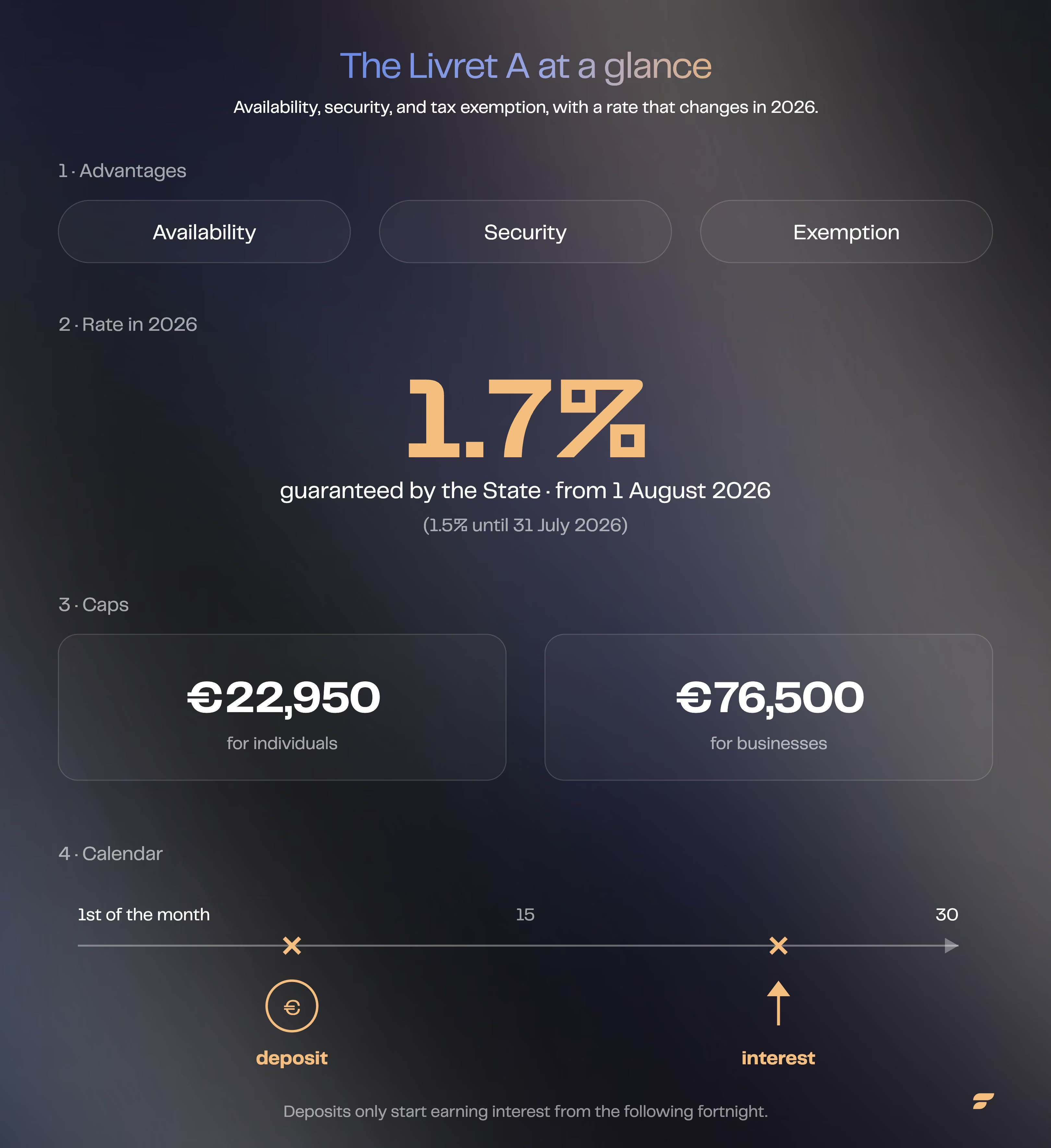
In short, here's what you need to know:
- Deposit cap: €22,950 for individuals
- Interest rate: 1.5% since 1 February 2026, raised to 1.7% from 1 August 2026 (after standing at 3% until January 2025).
- Taxation: fully exempt from income tax and social security contributions
- Availability: withdrawals possible at any time with no penalty
- Opening: one Livret A per person, available from birth
Definition and key features of life insurance
Life insurance is a versatile savings contract. It's an agreement between you and an insurer that lets you save, invest, and plan the transfer of your estate, with its own tax treatment. Depending on the investment options chosen, a risk of capital loss may exist. Unlike the Livret A, life insurance offers a range of investment options, from the secure euro fund to riskier but potentially more rewarding unit-linked funds.
Key points of life insurance:
- No contribution cap
- Variable return depending on the investment options chosen
- Favourable taxation, especially after 8 years
- Flexibility: partial withdrawals possible
- Easier estate transfer: tax advantages for beneficiaries
Comparison table of key features
| Feature | Livret A | Life Insurance |
| Cap | €22,950 | Unlimited |
| Return | 1.5% since February 2026, then 1.7% from 1st August 2026 | Variable (2.1% to 3.08% for euro funds in 2025, potentially higher for unit-linked funds) |
| Taxation | Fully exempt | Favourable after 8 years |
| Risk | Capital guaranteed by the State | Variable depending on the options |
| Fees | None | Variable depending on the contract |
| Estate transfer | Part of the estate | Outside the estate (within certain limits) |
This table highlights the fundamental differences between these two savings products. The Livret A stands out for its simplicity and safety, while life insurance stands out for its flexibility and long-term tax advantages. The choice between the two will depend on your personal goals, your risk appetite, and your investment horizon.
More capital invested

Non-contractual document for promotional purposes. Investment in unit-linked funds carries a risk of capital loss, since their value is subject to fluctuation, both upwards and downwards, depending in particular on developments in the financial markets. The insurer's commitment relates to the number of units, not their value, which it does not guarantee. This life insurance policy is an individual life insurance policy, denominated in euros and/or unit-linked funds, underwritten by Generali Vie, a company governed by the French Insurance Code. Finary SAS - 58 rue de Monceau 75380 Paris 8 - Investment Firm authorised by the ACPR under no. 19283, ORIAS no. 21001279, member of AMAFI
Returns and taxation: Livret A vs life insurance
Livret A's current interest rate and outlook
The Livret A offers an interest rate of 1.5% since 1 February 2026, raised to 1.7% from 1 August 2026 (it stood at 2.4% from February 2025 to January 2026, and at 3% between August 2023 and January 2025). Fully exempt from income tax and social security contributions, this rate is also its real net return.
With inflation at 0.8% in December 2025, the Livret A offers a positive real return of about +0.7 point - but this cushion remains modest for growing capital over the long term.
Life insurance's potential returns (euro funds and unit-linked funds)
Life insurance is a bit like an à la carte menu. You can choose between:
- Euro funds: They returned an average of 2.6% gross in 2025 (source: France Assureurs), or about 2.15% net after social security contributions - and up to 3.08% for the best contracts. The trend has been rising since the historic low of 2022 (~1.3%). For comparison, the average euro-fund return now exceeds the Livret A rate.
- Unit-linked funds: These options carry a different return/risk profile. Invested in equities, bonds, or real estate, they can offer potentially higher returns, but a risk of capital loss exists.
To illustrate, imagine a life insurance policy with 70% in euro funds (2.6% return) and 30% in unit-linked funds (assumed 6% return): (70% × 2.6%) + (30% × 6%) = 1.82% + 1.8% = 3.62% gross
This calculation is purely theoretical and illustrative. Past performance is not a reliable indicator of future performance, and a risk of capital loss exists on the unit-linked portion.
How holding period affects life insurance taxation
The taxation of life insurance improves favourably with the holding period. For contributions made since 27 September 2017 (the flat-tax (PFU) regime), here are the two key thresholds:
- Before 8 years: the flat tax (PFU) of 30% (12.8% income tax + 17.2% social security contributions).
- After 8 years: an annual tax allowance of €4,600 (€9,200 for a couple) on the income-tax base, then a reduced 7.5% income-tax rate up to €150,000 of net contributions made (across all contracts combined), plus 17.2% social security contributions on the full gain in all cases. See our article on the life insurance tax allowance.
To put this in perspective, take the example of a €5,000 gain:
- Before 8 years: €1,500 in deductions (€5,000 × 30%)
- After 8 years (single person): about €890 - social security contributions apply to the full gain (5,000 × 17.2% = €860), and income tax only on the portion above the allowance: (5,000 - 4,600) × 7.5% = €30.
This favourable tax treatment makes life insurance a tool of choice for long-term savings and estate transfer.
Security and availability of funds
Capital guarantee for the Livret A
The Livret A is a State-regulated savings product with guaranteed capital. Your capital is guaranteed by the State up to the legal cap. Even if your bank were to fail (a highly unlikely scenario), your savings would remain intact. It's a State-guaranteed investment generally used as an emergency fund. Note: its rate can fall below inflation.
Potential risks of life insurance
Life insurance, by contrast, works on two fronts:
- Euro funds: They offer a capital guarantee provided by the insurer, with the ratchet effect - interest earned each year is permanently locked in. If the insurer were to fail, the FGAP covers up to €70,000 per policyholder and per insurance company. The French ‘Sapin 2’ law can also, in certain cases, allow withdrawals to be temporarily blocked.
- Unit-linked funds: This is where the risk comes in. Invested in financial markets or real estate, these options can rise or fall in value. You can potentially gain more, but you can also lose part of your capital.
Withdrawal terms for each product
The Livret A is the champion of availability. You can withdraw your money whenever you like, with no fees and no delay. Whether for an unplanned purchase or an investment opportunity, your savings are always within reach.
Life insurance offers valuable flexibility for accessing your savings:
- Partial withdrawals: Possible at any time, letting you draw on your savings without closing your policy.
- Full surrender: You can withdraw all of your savings, but watch out for the tax implications, especially before 8 years.
- Policy loans: Some contracts let you borrow against your savings without making a withdrawal, a useful option for a temporary need for cash.

In the current context, the figures speak for themselves. With the Livret A back down to 1.5% since February 2026 (raised to 1.7% from 1 August 2026), the euro funds of the best life insurance policies average 2.6% in 2025 - and up to 3.08% for the best-performing contracts. For the first time in several years, the average euro-fund return exceeds that of the Livret A, at a comparable level of capital guarantee.
For an emergency fund (a few months of expenses, accessible immediately), the Livret A remains the benchmark.
But beyond this safety cushion - and even more so once the €22,950 cap is reached - life insurance can be a relevant complementary investment: a better return, lighter taxation after 8 years, and estate transfer outside probate of up to €152,500 per beneficiary.
If you'd like to dig deeper, you can also check out our comparison of the PER vs. life insurance to explore other long-term savings options.
within reach
Non-contractual document for promotional purposes. Investment in unit-linked funds carries a risk of capital loss, since their value is subject to fluctuation, both upwards and downwards, depending in particular on developments in the financial markets. The insurer's commitment relates to the number of units, not their value, which it does not guarantee. This life insurance policy is an individual life insurance policy, denominated in euros and/or unit-linked funds, underwritten by Generali Vie, a company governed by the French Insurance Code. Finary SAS - 58 rue de Monceau 75380 Paris 8 - Investment Firm authorised by the ACPR under no. 19283, ORIAS no. 21001279, member of AMAFI
Regulatory disclaimers:
Marketing communication. Investing carries a risk of partial or total capital loss. Past performance is not a reliable indicator of future performance. This article is provided for information and educational purposes only; it does not constitute personalised investment advice, a buy or sell recommendation, or tax advice.
The capital guarantee on euro funds is provided by the insurer and depends on its financial strength. In a severe systemic crisis, the French “Sapin 2” law allows withdrawals to be temporarily restricted (liquidity), without affecting the guaranteed capital. Unit-linked funds are not guaranteed and carry a risk of capital loss.
Before investing, read the Key Information Document (KID) and, where relevant, consult an authorised adviser.
Finary SAS, an investment firm authorised by the ACPR (no. 19283), member of AMAFI. Insurance broker registered with ORIAS (no. 21001279), member of the CNCGP (association approved by the AMF). Crypto-Asset Service Provider (CASP) authorised by the AMF under the MiCA regime, references no. A2026-026 and no. N2026-008.