PER vs life insurance: the showdown for a comfortable retirement in France

Updated on 6 August 2026
Life insurance offers full availability and light taxation after eight years, while the PER (France's retirement savings plan) trades locked-up savings until retirement for an immediate tax saving. The first suits those who want flexibility, the second suits taxpayers in a high marginal tax bracket ready to lock up their savings to prepare for retirement.

- The PER offers a tax deduction on contributions, more valuable the higher your marginal tax rate (TMI), but it locks up your savings until retirement.
- Life insurance stays available at any time and benefits from light taxation after 8 years (an annual tax allowance of €4,600 for a single person, €9,200 for a couple).
- Since 1 January 2026, PER capital gains are taxed at the flat tax (PFU) rate of 31.4% (versus 30% before), which narrows its advantage over life insurance.
- In most cases, the best strategy is to combine both: the PER to reduce taxes during your working life, life insurance for flexibility and wealth transfer.
Understanding the PER and life insurance
What is the PER, France's retirement savings plan?
The PER (Plan d'Épargne Retraite) was introduced by the French Pacte law in October 2019. It replaces and unifies older retirement savings products, such as the PERP and the Madelin contract. The PER simplifies retirement savings by offering more flexibility and tax advantages. This product builds up savings that stay locked until retirement, except to buy a primary residence or in the event of specific hardships. Amounts invested in a PER are deductible from taxable income, which reduces your immediate tax bill - of particular interest to taxpayers with a high TMI (marginal tax rate).
What is life insurance?
Life insurance is a medium- to long-term savings product. It is valued for its flexibility and tax advantages. When you take out a life insurance policy, you pay in contributions invested across various financial options, such as euro funds or unit-linked funds. You can withdraw your savings at any time. However, after eight years, the tax advantages become more attractive. Life insurance is also a powerful tool for passing on wealth, offering tax allowances for beneficiaries. For example, you can take out a life insurance policy online with Finary.
Key similarities and differences
Life insurance and the PER share several features, but differ in their objectives and availability.
Similarities
- Accessibility: both products can be opened regardless of employment status. Employees, self-employed people, and those without a job can all subscribe.
- Flexible contributions: you are free to choose the amount and frequency of your contributions.
- Payout options: both products can be paid out as a lump sum, a life annuity, or a mix of the two.
- Beneficiary designation: on an insurance-based PER as on a life insurance policy, you freely designate beneficiaries in the event of death. A bank-based PER, however, has no beneficiary clause: it falls into the estate.
- Similar investment options: both products offer allocations in euro funds and unit-linked funds, allowing for diversification based on your risk profile.
Key differences
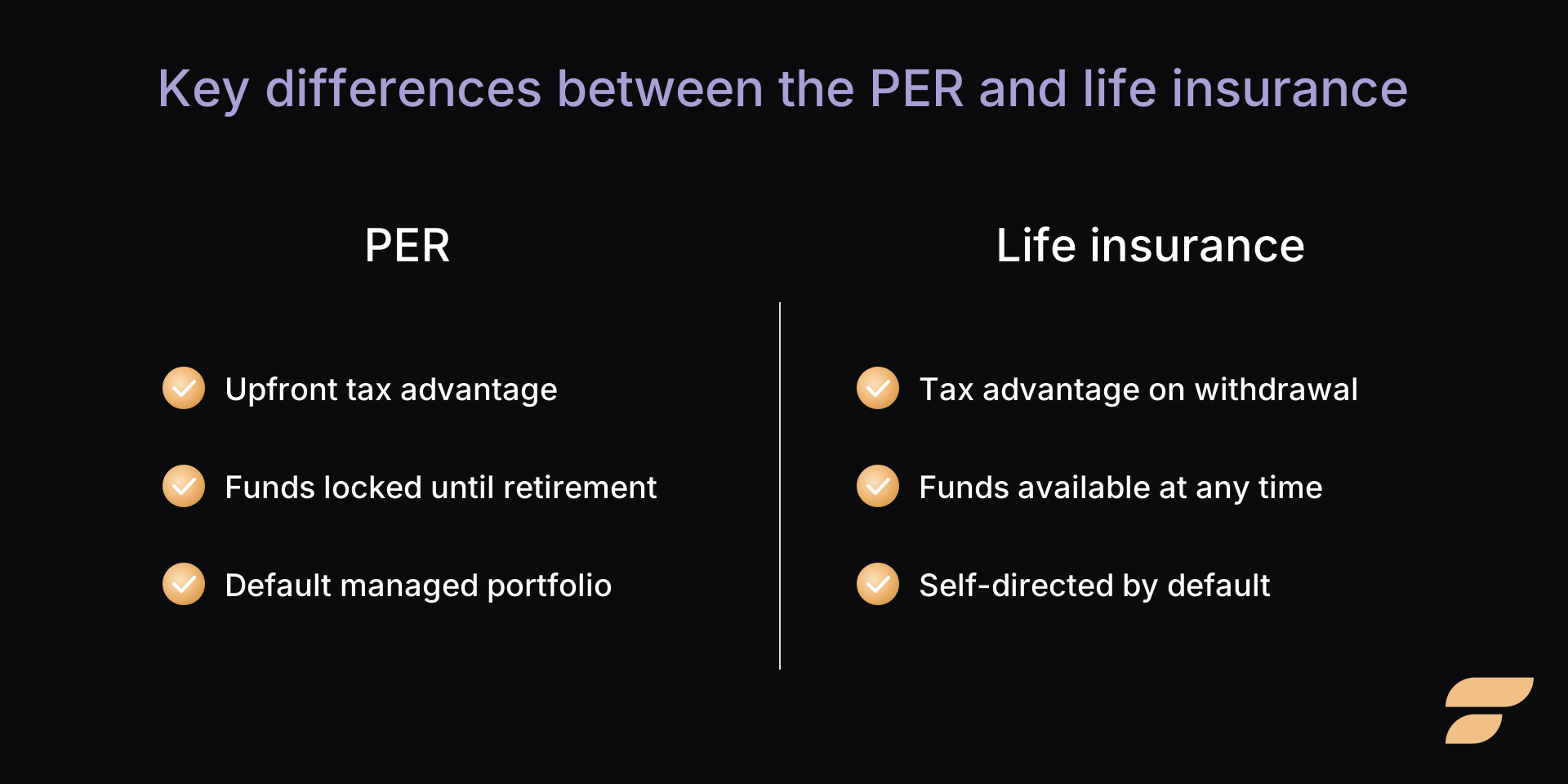
- Availability of savings: life insurance offers availability at any time. The PER, by contrast, locks up savings until retirement, except in specific cases of early release.
- Main objective: the PER is designed to build supplementary retirement income, with favourable tax treatment on contributions. Life insurance aims for savings adaptable to several life projects, with favourable tax treatment mainly on withdrawal.
- Managed-portfolio service on the PER: this option is offered by default on the PER, whereas on life insurance the default mode is self-directed management - managed-portfolio service remains available as an option depending on the contract.
- Age of subscription: life insurance is accessible at any age, including to minors represented by their legal guardians. The individual PER, however, requires you to be of legal age (at least 18 since 1 January 2024).
Your choice between the PER or life insurance will depend on your savings goals, your time horizon, and your risk tolerance. Each has its own strengths and can meet specific needs depending on your personal situation.
within reach
Non-contractual document for promotional purposes. Investment in unit-linked vehicles carries a risk of capital loss, since their value is subject to fluctuation, both upwards and downwards, depending in particular on developments in the financial markets. The insurer commits to the number of units, not their value, which it does not guarantee. This life insurance policy is an individual life insurance policy, denominated in euros and/or unit-linked vehicles, underwritten by Generali Vie, a company governed by the French Insurance Code. Finary SAS — 58 rue de Monceau 75380 Paris 8 — Investment Firm authorised by the ACPR under no. 19283, ORIAS no. 21001279, member of AMAFI
Tax advantages of the PER
Deductible contributions to reduce your taxes
One of the main attractions of the PER (Plan d'Épargne Retraite) is the ability to deduct contributions from your taxable income. This mechanism can generate a substantial tax saving, particularly valuable for taxpayers with a high TMI (marginal tax rate).
For example, if your TMI is 30%, a €10,000 contribution to your PER reduces your taxable income by €10,000, generating a tax saving of €3,000. With a TMI of 41%, this saving reaches €4,100. Note: since 1 January 2026, contributions made after age 70 are no longer deductible from taxable income.
Potentially higher returns thanks to the deduction
The tax saving generated by deductible contributions can be reinvested, boosting the overall return of your savings strategy. Imagine you invest €10,000 and your tax saving is €3,000. You could reinvest that amount in other financial instruments such as the stock market, real estate, or even another PER.
This lever increases your invested capital, potentially generating higher returns over the long term. By comparison, with life insurance, contributions are not deductible.
Taxation on withdrawal (tax on capital and gains)
Amounts released at retirement from a PER are partly subject to income tax: the portion of capital corresponding to deducted voluntary contributions is taxed at the progressive income tax scale (without the 10% allowance), while the portion from non-deducted contributions is exempt from income tax. Capital gains, meanwhile, are subject to the flat tax (PFU) at 31.4% since 1 January 2026 (versus 30% previously), with the option to elect for the progressive scale instead.
That said, you can manage this tax impact by opting for a payout split into capital instalments over several years. This method, detailed in our guide to PER taxation, can help avoid pushing a large amount into a higher tax bracket at once. Also, if you are not taxable at the time of your contributions, you can choose not to deduct them. This choice lets you benefit from lighter taxation on withdrawal.
What are the advantages of life insurance?
Life insurance stays available at any time, with no lock-up until retirement, and offers, after eight years, reduced taxation on withdrawals as well as a favourable framework for passing on your capital.
Availability of savings at any time
One of the key features of life insurance is the immediate availability of your savings. Unlike the PER, where funds stay locked until retirement (with a few exceptions), life insurance lets you withdraw your funds at any time. Whether you need money for a major purchase, an emergency, or simply to enjoy life, life insurance offers this flexibility with few constraints.
To precisely estimate the tax impact of a withdrawal based on your situation, you can use Finary's life insurance tax simulator.
Favourable taxation on withdrawals
Life insurance benefits from a particularly favourable tax regime after eight years of holding the policy. From that point, withdrawals benefit from an annual tax allowance of €4,600 on capital gains for a single person, and €9,200 for a couple. This means you can withdraw gains every year without paying income tax (excluding social contributions). To go further, see our complete guide to life insurance taxation.
More capital invested
Non-contractual document for promotional purposes. Investment in unit-linked vehicles carries a risk of capital loss, since their value is subject to fluctuation, both upwards and downwards, depending in particular on developments in the financial markets. The insurer commits to the number of units, not their value, which it does not guarantee. This life insurance policy is an individual life insurance policy, denominated in euros and/or unit-linked vehicles, underwritten by Generali Vie, a company governed by the French Insurance Code. Finary SAS — 58 rue de Monceau 75380 Paris 8 — Investment Firm authorised by the ACPR under no. 19283, ORIAS no. 21001279, member of AMAFI
A powerful wealth transfer tool
Life insurance is one of the most powerful wealth-transfer tools under French law. The capital is passed on to designated beneficiaries outside the estate, with an allowance of up to €152,500 per beneficiary. This is often what tips the balance for savers thinking of their loved ones. The detailed scales, partly shared with the PER, are presented further down in the "Beneficiary designation" section.
No tax advantage on contributions
Unlike the PER, life insurance offers no tax advantage on contributions. The amounts invested are not deductible from taxable income, which means your savings effort is immediately visible in your available budget.
In exchange for this lack of upfront advantage, life insurance offers lighter taxation on withdrawal and full availability of your savings.
A worked example comparing the PER and life insurance
To better understand how the PER (Plan d'Épargne Retraite) and life insurance compare in terms of returns and taxation, let's look at some concrete examples. We will see how taxation and returns evolve over the long term for two different profiles.
Case of a single person with a 30% TMI
A €10,000 contribution to a PER
Imagine a single person with a 30% TMI decides to pay €10,000 into a PER. Thanks to the deductibility of contributions, they immediately save €3,000 on their income tax. They reinvest this saving into their PER, at an annual return of 5%.
- Initial tax savings: €3,000
- Total invested: €13,000 (€10,000 + €3,000)
At retirement, after 20 years at 5% annual return:
- Capital at payout: ~€34,500 (13,000 × 2.653)
- Tax on contributions (€13,000 at TMI 30%): €3,900
- Tax on gains (€21,500 at PFU 31.4%): €6,751
- Net after tax: ~€23,850
A €10,000 contribution to life insurance
Now, if they place the same €10,000 into life insurance, there is no tax advantage on contribution. After 20 years at the same 5% return, the capital reaches €26,533.
- Tax allowance after 8 years: they benefit from an annual allowance of €4,600 on capital gains for withdrawals.
- Tax on gains: after the allowance, life insurance gains are subject to 7.5% income tax + 17.2% social contributions (24.7% in total) for contributions under €150,000, or to the 30% flat tax (12.8% + 17.2%) for the portion of contributions above that threshold. Note: the 17.2% social contributions remain due on all gains, even the portion covered by the annual allowance.
Long-term return comparison
| Criterion | PER | Life insurance |
|---|---|---|
| Initial tax advantage | €3,000 tax saving | None |
| Total invested | €13,000 | €10,000 |
| Capital after 20 years (5% p.a.) | ~€34,500 | ~€26,533 |
| Tax on capital (contributions) | €13,000 taxed at TMI 30% | Not taxed |
| Tax on gains | PFU 31.4% (no allowance) | 24.7% after €4,600 allowance |
| Net after tax | ~€23,850 | ~€23,586 |
Case of a married couple with a 41% TMI
A €20,000 contribution to a PER
For a married couple with a 41% TMI, if they pay €20,000 into a PER, they save €8,200 in tax and can reinvest that amount.
- Initial tax savings: €8,200
- Total invested: €28,200 (€20,000 + €8,200)
After 20 years at a 5% annual return:
- Capital at payout: €74,823
- Tax on capital (41%): with their TMI remaining at 41%, they will be taxed on the €28,200 of deducted contributions.
- Tax on gains at the 31.4% PFU: the gains (~€46,623, i.e. 74,823 − 28,200) are also taxable.
A €20,000 contribution to life insurance
If this couple places €20,000 into life insurance at a 5% return over 20 years, the capital reaches €53,066.
- Tax allowance after 8 years: €9,200 on capital gains for withdrawals.
- Tax on gains (24.7%): as in the previous case, since the €20,000 contributed stays under the €150,000 threshold, gains after the allowance are subject to 7.5% income tax + 17.2% social contributions, or 24.7% in total.
Long-term return comparison
| Criterion | PER | Life insurance |
|---|---|---|
| Initial tax advantage | €8,200 tax saving | None |
| Total invested | €28,200 | €20,000 |
| Capital after 20 years (5% p.a.) | ~€74,823 | ~€53,066 |
| Tax on capital (contributions) | €28,200 taxed at TMI 41% | Not taxed |
| Tax on gains | PFU 31.4% (no allowance) | 24.7% after €9,200 allowance |
| Net after tax | ~€48,621 | ~€47,170 |
These examples show that the PER keeps an advantage, but a modest and conditional one: roughly +1% at a 30% TMI and +3% at a 41% TMI in these scenarios once the exit taxation of both products is fully accounted for, and the advantage is sharper the higher the TMI, especially if it falls at retirement. This advantage relies on reinvesting the tax saving (which is itself taxed at the TMI on withdrawal), and it has narrowed since 2026 with the PFU rising to 31.4% on PER gains, while life insurance keeps its lighter taxation on withdrawal (annual allowance of €4,600 / €9,200).
Life insurance also keeps the advantage of availability and wealth transfer. Compound interest affects the final result, with no guarantee of performance.
How to invest through a PER or life insurance
Both wrappers let you invest in euro funds and unit-linked funds, with a choice of management mode (self-directed, managed-portfolio, profiled, or advised) based on your risk profile.
Choosing investment options (euro funds, unit-linked funds)
For both the PER and life insurance, you can diversify your investments across different options. Both products let you allocate your savings to:
- Euro funds: these funds carry little risk since they are mainly made up of bonds. The capital is protected by the insurer, who commits to its value subject to their financial strength, and interest is locked in annually. They particularly suit savers seeking maximum security.
- Unit-linked funds: these products are invested in the market, such as stocks, bonds, SCPI (a French non-listed real-estate investment fund, comparable to a REIT) or ETFs. They do not guarantee the capital. Performance is variable and depends on financial markets.
The choice between these options depends on your risk tolerance, investment horizon and goals. A balanced split between euro funds and unit-linked funds can offer attractive performance while managing risk.
Managed-portfolio service on the PER ahead of retirement
The PER's real distinguishing feature is not the range of management modes (life insurance offers the same ones) but the fact that horizon-based managed-portfolio service is offered by default (French Pacte law), whereas life insurance usually starts in self-directed management. This mode automatically adjusts the allocation based on your age: as retirement approaches, it progressively reduces the risky share in favour of more secure options such as euro funds. Under the French Pacte law, this horizon-based managed-portfolio service applies by default to every new contribution, unless the saver expressly opts out.
The main modes, available on both the PER and life insurance:
- Self-directed management: you select your own investment options (for autonomous investors).
- Managed-portfolio service (or discretionary management): management is delegated and automatically optimised over time (the default mode on the PER).
- Profiled management: your savings follow a predefined profile (cautious, balanced, dynamic) based on your risk tolerance.
- Advised management: you keep the final decision, but based on an adviser's recommendations (depending on the contract).
Fees and costs
Fees are a crucial factor to consider when subscribing to a PER or life insurance. Here are the main types of fees to watch:
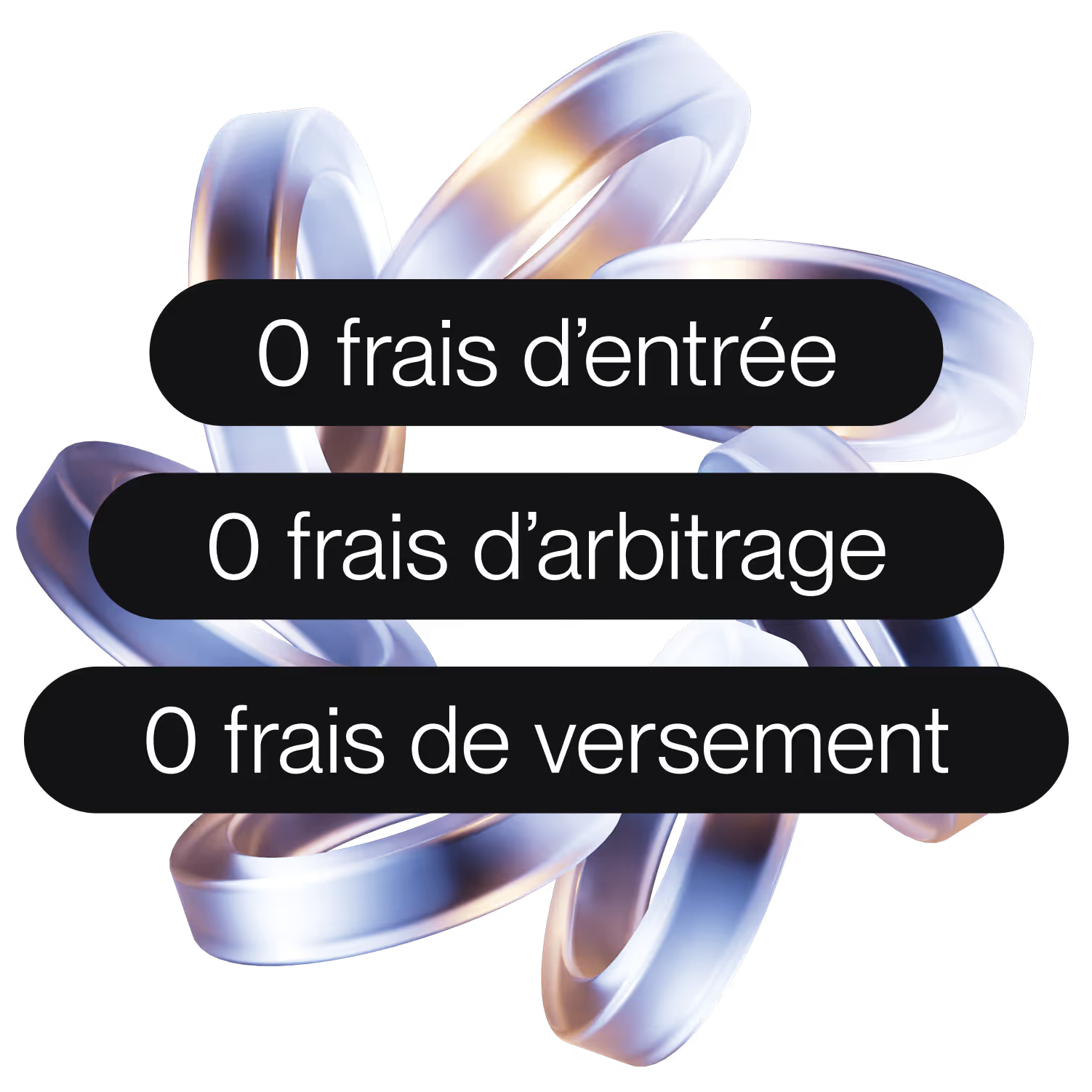
- Entry fees: charged on each contribution to your contract. Both the PER and life insurance can apply them, although some insurers offer contracts with no entry fees to attract customers.
- Management fees: charged annually on your outstanding savings, they vary depending on the investment options chosen (often higher for unit-linked funds than for euro funds).
- Switching fees: charged when you change the allocation of your investment between the different options.
- Transfer fees: for PERs, fees may apply when transferring an older retirement savings product (such as a PERP) to a new PER, although these are capped.
To make sure fees do not eat too much into your savings' returns, it is wise to compare offers from different insurers. You can also seek help from wealth management advisers. Choosing a contract with competitive fees can significantly improve the net return on your investment over the long term.
Subscribing to a PER or life insurance
Beneficiary designation
Whichever you choose, the PER or life insurance, designating beneficiaries is a crucial step. It specifies who will receive the capital in the event of death. You can name one or more people and change them at any time. This flexibility is essential to ensure your savings are passed on according to your wishes.
- PER: for the insurance-based PER, designated beneficiaries benefit from an allowance of €152,500 per beneficiary if the holder dies before age 70 (art. 990 I of the French General Tax Code (CGI)), with the excess taxed at 20% up to €700,000, then at 31.25%. If death occurs after age 70, an overall allowance of €30,500 applies across all beneficiaries, with the surplus reintegrated into the estate and subject to standard inheritance duties (art. 757 B CGI). Note: unlike life insurance, it is the holder's age at death that determines the applicable regime, not the date of contributions.
- Life insurance: capital paid in before age 70 benefits from an allowance of €152,500 per beneficiary; beyond that, the taxable portion is taxed at 20% up to €700,000, then at 31.25%. For contributions made after age 70, the overall allowance drops to €30,500, and only the premiums (excluding gains) are reintegrated into the estate. Here, it is the date of contributions that determines the regime, unlike the PER where the age at death counts.
Duty of advice from insurers and banks
When subscribing to a PER or life insurance, insurers and banks have a duty of advice. This means they must inform you transparently about the products' features and make sure they match your goals and investor profile.
PER or life insurance: how to decide?
The real answer is rarely one against the other. The PER rewards high TMIs who reinvest their tax saving and accept locking up their savings until retirement. Life insurance keeps money available and optimises wealth transfer.
In most cases, the right approach is not to choose, but to combine: the PER to reduce taxes during your working life, life insurance for flexibility and inheritance. Three criteria tip the balance: your TMI today, your need for liquidity, and your time horizon before retirement.

Frequently asked questions
Can you combine a PER and life insurance?
Yes, both wrappers can be combined without limit. Many savers open a PER for the upfront tax advantage and a life insurance policy for availability and wealth transfer. They are not mutually exclusive: they serve complementary goals.
PER or life insurance: which to choose based on your TMI?
The PER becomes attractive when your marginal tax rate (TMI) is high. Deducting contributions generates an immediate saving: €3,000 at a 30% TMI, €4,100 at 41%, for €10,000 contributed. Below 30%, life insurance often remains more flexible.
Can you transfer life insurance into a PER?
No, no direct transfer exists. The favourable tax mechanism (doubling the allowance) ended on 31 December 2022. Since 2023, you have to withdraw from the life insurance policy and then pay into the PER, without carrying over the contract's tax seniority.
What happens to a PER in the event of death?
The insurance-based PER is passed on to the designated beneficiaries. If the holder dies before age 70, an allowance of €152,500 per beneficiary applies (art. 990 I CGI). After age 70, the overall allowance drops to €30,500 (art. 757 B CGI). It is the age at death that counts.
When can you unlock a PER before retirement?
The PER stays locked until retirement, except in cases provided for by law: purchasing a primary residence, expiry of unemployment benefits, disability, death of a spouse or partner, over-indebtedness, and cessation of self-employed activity after court-ordered liquidation.
PER or life insurance: which pays off more?
In our examples (5%/year, 20 years), the PER keeps a modest net advantage: roughly +1% at a 30% TMI, +3% at 41%, and only if the tax saving is reinvested. The gap narrows when life insurance spreads out its withdrawals. Investing carries a risk of capital loss; past performance is not a reliable indicator of future performance.
Sources
Légifrance: French Pacte law no. 2019-486 of 22 May 2019
impots.gouv.fr: the taxation of life insurance and the PEA
Service-public.fr: change to the flat tax (PFU) rate as of 1 January 2026
Service-public.fr: the individual retirement savings plan (PER)
Regulatory disclaimers: Marketing communication. Investing carries a risk of partial or total capital loss. Past performance is not a reliable indicator of future performance. This article is provided for information and educational purposes only; it does not constitute personalised investment advice, a buy or sell recommendation, or tax advice. The capital guarantee on euro funds is provided by the insurer and depends on its financial strength. In a severe systemic crisis, the French "Sapin 2" law allows withdrawals to be temporarily restricted (liquidity), without affecting the guaranteed capital. Unit-linked funds are not guaranteed and carry a risk of capital loss. Before investing, read the Key Information Document (KID) and, where relevant, consult an authorised adviser. Finary SAS, an investment firm authorised by the ACPR (no. 19283), member of AMAFI. Insurance broker registered with ORIAS (no. 21001279), member of the CNCGP (association approved by the AMF). Crypto-Asset Service Provider (CASP) authorised by the AMF under the MiCA regime, references no. A2026-026 and no. N2026-008.