What Are the Risks of the PER in France?

Updated on 30 July 2026
The PER (France's retirement savings plan) carries three main risks: capital loss on unit-linked funds, savings locked up until retirement except for six early-release cases in France, and exit taxation that can be less favourable than expected. This guide details these risks with concrete figures to weigh before subscribing.

- According to the French Ministry of the Economy, the PER had more than 12.9 million holders and €150.4 billion in assets under management as of 31 December 2025.
- Unit-linked funds do not guarantee the capital, unlike euro funds, and follow the fluctuations of financial markets.
- The PER can only be unlocked before retirement in six situations set out by law, such as buying your main home.
- Management fees of 1.5% instead of 0.5% a year can reduce the final capital by tens of thousands of euros over 25 years.
- Exit taxation depends on the withdrawal method chosen, lump sum or annuity, and on the holder's future tax rate, which can reduce the initial tax benefit.
According to the French Ministry of the Economy, “there are now more than 12.9 million PER holders, for a total of €150.4 billion in assets under management as of 31 December 2025”, across all types of PER combined.
Understanding the risks of the PER: an overview to help you save better
What are the main risks of the PER to know before subscribing?
The PER offers an interesting outlook, but it carries risks that are often underestimated. Before subscribing, you need to look past the tax promises to weigh these risks.
The first risk is capital loss. Indeed, the PER does not guarantee the capital invested. When you choose unit-linked funds, your savings follow the fluctuations of financial markets.
A stock market crash, a bond crisis or a sector correction can reduce the value of your portfolio. Euro funds offer relative security, but their returns are steadily declining, often barely above inflation.
Locking up the funds is another major risk. Savings placed in a PER stay locked until retirement, barring exceptional cases.
Exit taxation also deserves close attention. The upfront tax break is often the main draw, but the tax applied on withdrawal, as a lump sum or an annuity, can be complex and sometimes unfavourable.
Finally, fees erode performance over the long run. Entry, management, switching and transfer fees add up and can significantly reduce the final capital. Their impact is often underestimated, especially on traditional contracts.
Why can the PER carry a risk of capital loss?
Equity markets can fall sharply during a crisis. Even bonds, once considered safe, have suffered turbulence, particularly with recent rate hikes.
This risk grows with the PER's duration. A long-term horizon often helps ride out downturns, but it does not guarantee you won't withdraw your money at an unfavourable moment. For example, retiring in the middle of a financial crisis can significantly reduce the capital accumulated.
Even diversification does not fully remove this risk. A portfolio too concentrated in one sector or region can suffer significant losses. Inflation, though discreet, also erodes purchasing power even if the PER's nominal value stays stable.
How can Finary help you assess these risks?

Finary offers a solution built to analyse and manage the risks tied to the PER. The platform does more than aggregate your investments: it examines your PER's composition, detects risk concentrations and simulates the impact of different market scenarios.
With real-time tracking tools, Finary lets you:
- Track how your savings evolve
- Compare the performance of your holdings
- Anticipate the long-term effect of fees
In short, understanding the PER's risks means facing reality head-on. With the right tools and a clear overview, you can turn these risks into opportunities, provided you stay in control of your decisions.

Why is locking up the funds a major risk of the PER?
Locking up the funds is a major risk of the PER because the savings paid in stay inaccessible until retirement, except in six exceptional situations set out by law, which limits the policyholder's financial flexibility for several decades.
Why locking up the funds is a drag on the PER
The PER works like a vault: once the money is deposited, it stays out of reach until retirement. This constraint can be appealing, but it limits flexibility over part of your wealth, sometimes for several decades.
For example, an entrepreneur ten years from retirement may face an unexpected opportunity or difficulty. The savings invested in the PER stay out of reach, even if they could prove useful. This lock-in forces a rethink of overall cash-flow management.
Many underestimate this constraint, thinking retirement is a distant horizon. Yet life doesn't always follow a set plan.
This lock-up often pushes people to keep cash in other, often less efficient, vehicles to cover the unexpected. Overall returns on your total wealth can suffer as a result. The PER is therefore not just a savings product, but a long-term commitment that requires a clear view of your future needs and real tolerance for uncertainty.
Overall wealth returns can be affected by this lock-up. To better understand the PER's ins and outs, including its pros and cons, see our dedicated article.
What are the exceptional cases for early release of the PER

The law provides for a few exceptions, but they remain limited. The PER can only be unlocked before retirement in six specific situations, all tied to life accidents or to buying your main home:
- Category 2 or 3 disability (of the holder, their spouse or their children)
- Death of the spouse or PACS partner
- Expiry of unemployment benefits
- Over-indebtedness (ruling of the debt commission)
- Cessation of a self-employed activity following a court-ordered liquidation
- Purchase of your main home
Outside these cases, it is impossible to access your savings, even in case of hardship.
This lock-in is stricter than that of life insurance. What's more, every early-release request requires supporting documents, processing delays and sometimes exchanges with the insurer or the bank.
This rigid framework often comes as a surprise. Many discover too late that the PER is not a safety net, but a sealed vault.
Comparison with life insurance: how much flexibility for your savings
| Criterion | PER | Life insurance |
|---|---|---|
| Favourable taxation | On entry | On exit (after 8 years) |
| Availability of funds | Locked until retirement (except 6 exceptional cases) | Available at any time |
| Managed-portfolio service | Yes, by default, unless self-directed management is explicitly chosen | Possible depending on the contract, not systematic |
Life insurance offers far more flexibility than the PER. It lets you withdraw all or part of the capital at any time, with no justification needed.
It also offers:
- scheduled partial withdrawals,
- advances,
- the option to adjust contributions.
Everything is designed to adapt to life's ups and downs.
Here is a comparison table illustrating this difference in flexibility:
| Criterion | PER | Life insurance |
|---|---|---|
| Locking of funds | Until retirement (except exceptional cases) | Withdrawals possible at any time |
| Early release | 6 strict cases, supporting documents required | Free, no justification needed |
| Withdrawal times | 30 to 60 days (in case of early release) | Generally 2 to 15 days |
| Exit taxation | Complex, depends on the withdrawal method | Favourable after 8 years |
To estimate the tax due on a withdrawal from your life insurance policy and compare it with a PER exit, you can use the Finary life insurance simulator.
This difference matters. Life insurance adapts to the unexpected, while the PER imposes strict discipline.
For some, this constraint protects against the temptation to dip into savings. For others, it complicates managing life's ups and downs.
In practice, many savers combine both solutions:
- life insurance for flexibility,
- the PER for long-term tax optimisation.
Goals
What is the risk of capital loss with the PER?
The PER's risk of capital loss comes from unit-linked funds: unlike euro funds, they do not guarantee the capital and follow the fluctuations of equity, bond or real-estate markets, with the risk increasing along with the share invested in unit-linked funds.
How do unit-linked funds expose you to the risk of capital loss?
Investing in unit-linked funds (UC) means placing your money on often unpredictable financial markets. Unlike euro funds, which guarantee the capital, unit-linked funds expose your savings to the volatility of equities, bonds, real-estate funds or ETFs. Each holding moves to its own dynamic, with no protection against fluctuations.
For example, a PER invested 70% in European equities could have recorded a significant decline in 2022 (past performance is not a reliable indicator of future performance), depending on market conditions. This type of correction is part of markets' normal cycle. If you have to withdraw your money at that moment, you lock in these losses. The PER is designed for the long term and requires patience, but volatility remains hard to predict.
The psychological impact is often underestimated. Watching your retirement savings drop 20% in a single year can push you into hasty decisions that are rarely beneficial. Unit-linked funds require real risk tolerance.
Euro funds aim for capital safety (the insurer's guarantee, the FGAP (France's insurance guarantee fund for individuals), the Sapin 2 law) whereas unit-linked funds seek a higher potential return in exchange for a risk of capital loss. Allocation depends on each saver's investment horizon and risk profile.
Simulations with figures: what loss probability for your allocation?
The figures provide precise insight. Here are three allocation profiles for a PER, over a 15-year horizon:
- 100% euro funds
- Expected annual return: around 2% to 2.5%
- Risk of capital loss: none, the capital is guaranteed by the insurer
- 50% unit-linked funds / 50% euro funds
- Expected annual return: higher, but variable depending on markets
- Risk of capital loss: moderate on the portion invested in unit-linked funds, particularly in case of withdrawal after a market downturn
- 100% equity unit-linked funds
- Expected annual return: potentially higher over the long run, but with significant volatility
- Risk of capital loss: the highest of the three profiles, particularly over short horizons or in case of withdrawal after a stock market correction
These figures are provided for illustration only and do not constitute a promise or guarantee of return. According to a study by the French Financial Markets Authority (AMF) covering 150 years of French stock market data, no loss was observed on French equities held for 15 years or more, which illustrates the importance of the investment horizon, without guaranteeing this outcome for the future. It shows that even over 15 years, a heavy allocation to unit-linked funds does not remove the risk of loss. Volatility can improve performance, but it requires solid preparation. A withdrawal after a stock market crisis can wipe out years of effort.
A point often overlooked: inflation. A euro fund returning 2% in a context of 3% inflation loses purchasing power, even if the capital is preserved. Conversely, a more dynamic allocation can outpace inflation, but is more exposed to fluctuations.
Taxation and fees of the PER: hidden risks for your returns
How exit taxation can reduce the PER's benefits
Many enjoy the upfront tax benefit without planning for taxation on exit, often at the moment they expect it least.
The mechanism is simple: deducting contributions reduces your taxable income today. At retirement, however, the lump sum or the annuity is subject to income tax under the scale in force and your future tax situation.
For example, an executive contributes €5,000 a year to their PER, deducted at a 41% marginal tax rate. At retirement, they choose a lump-sum exit, but their tax rate has not dropped as much as hoped. The capital then becomes taxable, on top of social security contributions on the gains.
The initial tax benefit can therefore shrink, especially if taxation tightens.
A point often overlooked: the PER's tax treatment relies on an estimate of your future tax rate. If that estimate is wrong, the tax gain can disappear. Unlike life insurance, you cannot adjust the exit taxation or optimise it through partial withdrawals.
Fees of the PER: what impact on your savings over the long term (20-30 years)?
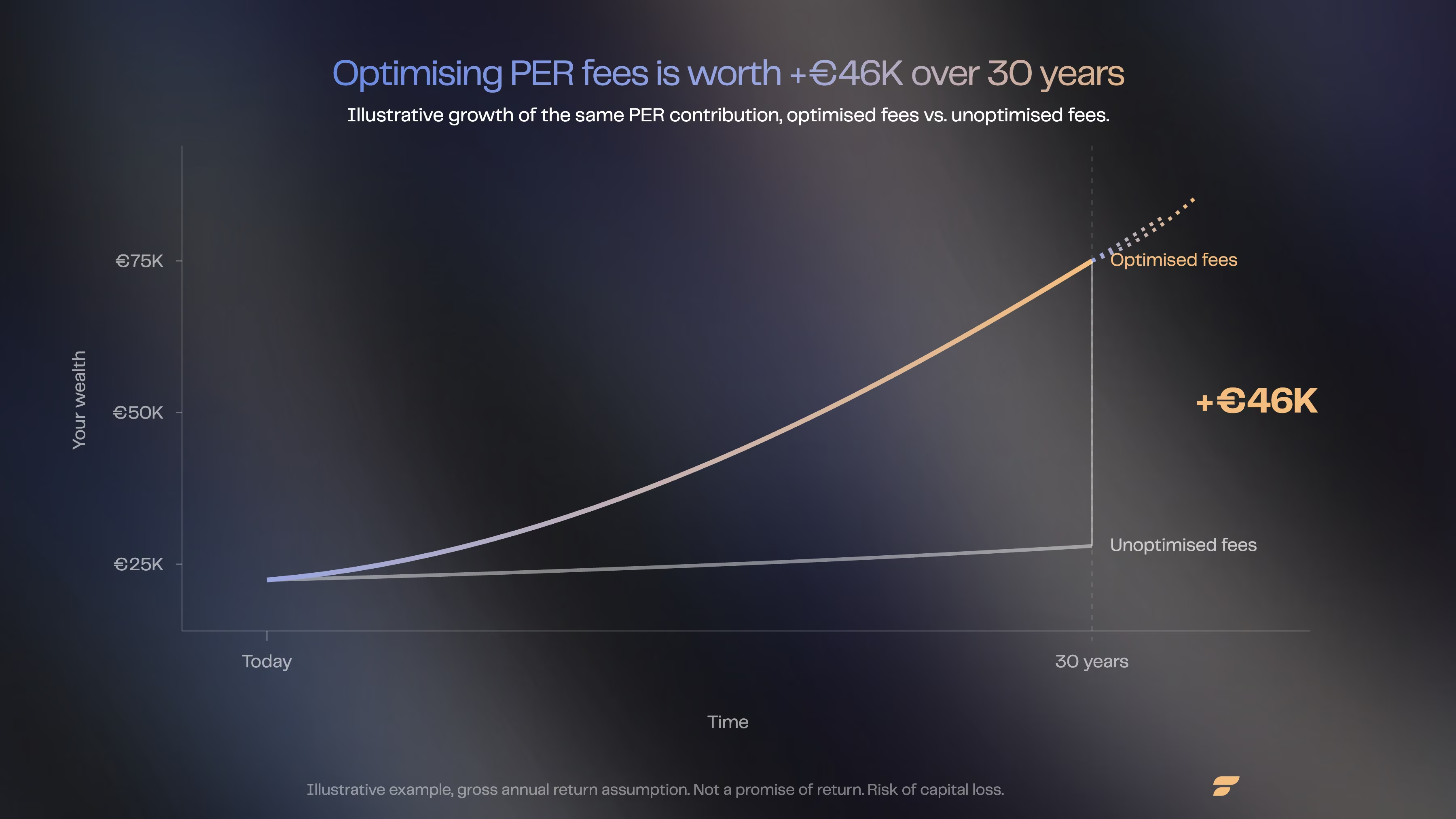
The PER's fees, often underestimated, erode performance year after year. For example, a contract with 1.5% in annual management fees can cost around a quarter of the final capital over 20 years compared with a low-fee contract, all else being equal (based on a 5% gross annual return, see the table below).
If you add entry fees of 3% to 5%, your savings already start at a disadvantage.
Here is a table showing the impact of fees on a €50,000 PER invested over 25 years, with a 5% gross annual return:
| Annual fees | Final capital (after fees) | Loss vs. 0.5% fees |
|---|---|---|
| 0.5% | €150,272 | - |
| 1.0% | €133,292 | -€16,980 |
| 1.5% | €118,162 | -€32,110 |
The difference is significant: €32,110 less for the same savings effort, purely because of fees. This calculation does not include switching, transfer or exit fees, which can add up further.
Fees accumulate over time and amplify the negative effect. A low-cost PER is not a luxury, it is a necessity to protect your returns.
Want to compare fees across different savings products before choosing your PER? Discover how fees also weigh on life insurance performance in our complete guide to life insurance fees.
Mastering PER risk to optimise your retirement savings
The PER does carry real risks - capital loss, locked-up funds, high fees - but these constraints should not overshadow its potential for tax and wealth optimisation.
The key lies in an informed approach: consider diversifying your holdings according to your profile, compare contract fees, and use analysis tools like Finary to track your savings in real time and adjust your strategy. With active management and thoughtful choices, the PER can be a relevant tool for retirement planning, provided the analysis is tailored to your wealth and tax situation.

Frequently asked questions
Is the PER a risk-free investment?
No. The PER is not a guaranteed investment like a regulated savings account. On unit-linked funds, savings follow the financial markets and can lose value; only euro funds offer a capital guarantee provided by the insurer, which remains subject to its financial strength.
Can you lose money with a PER?
Yes, if the savings are invested in unit-linked funds. Unlike euro funds, unit-linked funds do not guarantee the capital and follow the fluctuations of equity, bond or real-estate markets; a market downturn at the time of withdrawal can durably reduce the capital available.
In which cases can you unlock a PER before retirement?
The law provides for six cases of early release: disability of the holder, their spouse or their children, death of the spouse or PACS partner, expiry of unemployment benefits, over-indebtedness, cessation of a self-employed activity following court-ordered liquidation, and purchase of your main home.
Is the PER riskier than life insurance?
The PER is mainly more rigid: savings stay locked until retirement barring exceptional cases, versus a withdrawal possible at any time with life insurance. The risk of capital loss depends above all on the allocation chosen, euro funds or unit-linked funds, not on the product itself.
How can you reduce the risks linked to PER fees?
Comparing management and entry fees before subscribing, favouring a low-fee, self-directed contract, and regularly monitoring the net performance of your holdings all help limit the impact of fees, which can reach tens of thousands of euros over 20 to 25 years.
Sources
France Assureurs, data on insurance-based PER plans marketed by insurers
Service-public.fr, practical guide to the individual retirement savings plan
Vie-publique.fr, overview of the Sapin 2 law of 9 December 2016
Regulatory disclaimers: Marketing communication. Investing carries a risk of partial or total capital loss. Past performance is not a reliable indicator of future performance. This article is provided for information and educational purposes only; it does not constitute personalised investment advice, a buy or sell recommendation, or tax advice. The capital guarantee on euro funds is provided by the insurer and depends on its financial strength. In a severe systemic crisis, the French “Sapin 2” law allows withdrawals to be temporarily restricted (liquidity), without affecting the guaranteed capital. Unit-linked funds are not guaranteed and carry a risk of capital loss. Before investing, read the Key Information Document (KID) and, where relevant, consult an authorised adviser. Finary SAS, an investment firm authorised by the ACPR (no. 19283), member of AMAFI. Insurance broker registered with ORIAS (no. 21001279), member of the CNCGP (association approved by the AMF). Crypto-Asset Service Provider (CASP) authorised by the AMF under the MiCA regime, references no. A2026-026 and no. N2026-008.