PER Taxation in France: The Complete Guide

Updated on 30 July 2026
PER (France's retirement savings plan) taxation in France varies by phase: voluntary contributions are deductible from taxable income up to a cap, while a lump-sum or annuity payout is subject to income tax and social security contributions of 18.6% since 2026. This article covers every stage, from saving to inheritance.

- Voluntary contributions to a PER reduce income tax, up to a cap revised each year.
- At retirement, savings can be withdrawn as a lump sum, as a life annuity, or as a combination of both, depending on the tax treatment you're after.
- In the event of death before age 70, each beneficiary receives a €152,500 allowance on the amounts transferred.
- Since 1 January 2026, social security contributions on amounts withdrawn, whether as a lump sum or an annuity, have risen from 17.2% to 18.6%.
What Is a PER?
Definition and objectives
The PER was created by the French Pacte law of 22 May 2019. It offers a long-term retirement savings solution, designed to supplement your income once you've stopped working. Gone are the days of the Perp, the Madelin contract, or the Perco!
The PER simplifies and streamlines retirement savings, while offering attractive tax advantages.
The three types of PER
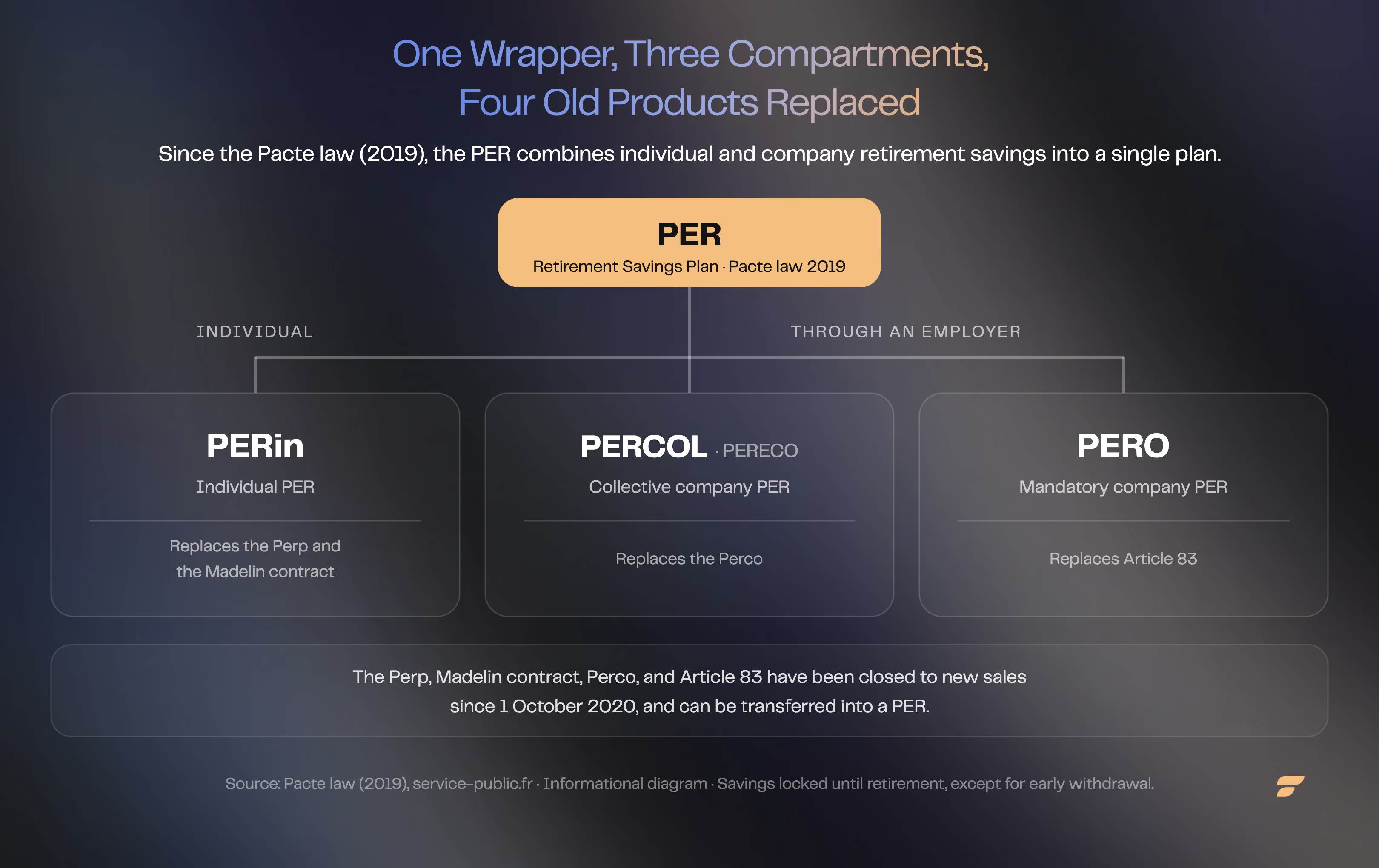
Individual PER
The individual PER is open to everyone, with no age or employment condition. Whether you're an employee, self-employed, or not working, you can save for retirement. You can choose between a securities account and a group insurance contract. Managed-portfolio service is the default option, reducing risk as you approach retirement.
Collective company PER
The collective company PER is available to a company's employees. It extends employee savings schemes such as the Perco. Employees can contribute voluntarily or receive payments from profit-sharing, incentive schemes, and employer top-ups.
Mandatory company PER
This PER is more restrictive: it's imposed on certain categories of employees, or on the whole company, by the employer's decision. It allows mandatory contributions and employer contributions with tax advantages, and includes the specifics of Article 83 retirement contracts. You can hold several PERs at the same time, provided you stay within the overall deduction caps.
Advantages of the PER over earlier schemes
Why choose the PER over an older scheme? The PER is more flexible. You can transfer your older retirement savings products (Perp, Madelin contracts, Perco) into a PER without losing your tax advantages, subject to certain rules.
The PER offers a range of payout options: as a lump sum, as an annuity, or a combination of both. It also allows early withdrawal in specific cases, such as buying your main home. Before committing, it's worth taking the time to understand the risks of the PER, particularly those linked to unit-linked funds.
Eligibility criteria and beneficiary categories
The PER is inclusive: young or old, working or not, anyone can open an individual PER. Employees get access to company PERs based on their employer's decisions.
The self-employed can also take out an individual PER. Everyone can benefit from the PER's advantages, depending on their professional and personal situation.
Taxation during the savings phase
Tax deduction on contributions
The PER allows voluntary contributions to be deducted from tax. Your voluntary contributions are deducted from your taxable income. This mechanism can significantly reduce your annual tax bill. It combines retirement saving with a reduction in income tax, within the legal limits. However, this deductibility is capped, as detailed below.
Deduction caps for voluntary contributions
The PER's tax deduction isn't unlimited. You can deduct voluntary contributions up to 10% of your previous year's professional income. The cap is revised every year (check with the tax authorities). Two changes apply from 1 January 2026: contributions made after the holder's 70th birthday are no longer deductible, and unused deduction caps can now be carried forward for 5 years (up from 3 years previously) for amounts paid in from 2026 onward, with the caps still pooled between spouses (service-public.gouv.fr).
For the self-employed, the cap can reach €88,911 in 2026 (10% of the Plafond Annuel de la Sécurité Sociale, or PASS - France's annual social security ceiling - capped at 8 PASS, plus a 15% increase on the portion between 1 and 8 PASS). All the more reason to optimise your PER contributions based on your tax situation!
Non-deductible contributions
You can choose not to deduct your PER contributions from your taxes. Why? It can be tax-advantageous at retirement. If you choose this option, the portion of the annuity from these contributions will be subject to a separate tax regime. This option is worth considering based on the saver's tax situation both when contributing and when withdrawing.
Impact of the withholding tax system
Since the introduction of withholding tax (prélèvement à la source), life annuities and lump sums paid out from a PER are directly subject to this tax. Contributions deducted from tax at the time they were made are added back into your taxable income on withdrawal, just like ordinary pensions.
The portion corresponding to investment gains is subject to the flat tax (PFU) of 31.4%. That includes 12.8% income tax and 18.6% social security contributions since 1 January 2026, up from 17.2% previously, due to the CSG (France's general social-security contribution) increase passed in the 2026 Social Security financing law (service-public.gouv.fr). In short, withholding tax simplifies settling your tax obligations and managing your finances.
Understanding PER taxation during the savings phase is essential to optimising your plan. Next up: taxation on the lump-sum payout. Ready? Let's go!

How is a PER lump-sum payout taxed?
A lump-sum payout is taxed differently depending on where the money came from: amounts from deducted contributions are subject to the income tax scale, while gains on non-deducted contributions fall under the 31.4% flat tax (PFU).
Taxation of lump sums from deducted contributions
When you withdraw your savings, how the lump-sum payout is structured matters. If you chose deductible contributions, the capital withdrawn is subject to income tax. These amounts are added to your other income for the year and taxed under the progressive income tax scale.
On top of that, this capital is subject to social security contributions of 18.6% since 1 January 2026. That can add up to a significant tax burden, especially for a large one-off withdrawal.
Taxation of gains from non-deducted contributions
If you chose not to deduct your contributions from tax, you benefit from a more favourable tax regime on the lump-sum payout. Gains made on your investments are taxed under the flat tax (Prélèvement Forfaitaire Unique, or PFU) at 31.4%. That includes 12.8% income tax and 18.6% social security contributions since 1 January 2026.
This regime applies to gains from non-deducted contributions. You can also apply for an exemption from this flat tax under certain income conditions.
How to apply for an exemption from the flat tax
To qualify for an exemption from the 12.8% flat-rate withholding, your reference taxable income for year N-2 must be below €25,000 for a single person or €50,000 for a couple.
You must submit your exemption request to your financial institution before 30 November each year. It must include a signed declaration certifying that your taxable income is below the required thresholds. You'll then only pay the 18.6% social security contributions in place since 1 January 2026, a meaningful tax saving.
Cases of full exemption on gains
The PER provides for full exemption from income tax and social security contributions on amounts withdrawn early in five so-called "life accident" situations: disability of the holder, their spouse, or their child; death of the spouse or civil-partnership (Pacs) partner; expiry of unemployment benefits; over-indebtedness; or the end of self-employed activity following compulsory liquidation (service-public.gouv.fr).
This full exemption, however, doesn't apply to early withdrawal for buying a main home, which follows the standard taxation of a lump-sum payout (see above).
How is a PER annuity payout taxed?
A life annuity from a PER is subject to income tax under a regime that depends on where the contributions came from (deducted or not at the time), and it carries social security contributions of 18.6% since 1 January 2026.
Tax regime for the annuity by contribution type
The annuity's tax treatment depends on where the contributions came from. For the portion from contributions deducted at the time, the annuity is taxed under the pension income regime, with a flat 10% allowance.
For the portion from non-deducted contributions, the annuity falls under the "rente viagère à titre onéreux" regime (a life annuity purchased for consideration): only a fraction is taxable, determined by the holder's age when the first annuity payment is made.
According to Service-Public.fr, the overall rate of social security contributions on the PER rose from 17.2% to 18.6% on 1 January 2026, due to a 1.4-point increase in the CSG on investment income. This new rate applies to the taxable portion of the annuity, whether it comes from deducted or non-deducted contributions (service-public.gouv.fr).
Taxable fraction by age (non-deducted contributions)
For the portion of the annuity from non-deducted contributions, the taxable fraction decreases with the holder's age at the first annuity payment: 70% before age 50, 50% between ages 50 and 59, 40% between ages 60 and 69, and 30% from age 70 (service-public.gouv.fr).
The older the holder is when the first annuity payment is made, the larger the exempt portion.
Social security contributions on annuities
Whether it comes from deducted or non-deducted contributions, the taxable portion of the annuity carries social security contributions of 18.6% since 1 January 2026, up from 17.2% previously.
That's a significant cost, especially for long payout periods. Some PER contracts offer annuity options (spousal reversion, guaranteed payments) that affect the amount of the initial annuity.
Goals
PER taxation on death
Closing the plan
The death of a PER holder triggers closure of the account. The accumulated funds are then paid to the named beneficiaries or, failing that, to the legal heirs. The tax choices made during the saving and withdrawal phases have a major impact on how this savings is passed on.
Passing on savings to heirs or named beneficiaries
The tax treatment of the transfer depends on the holder's age at death. If the holder dies before age 70, each beneficiary receives a tax allowance of €152,500 (impots.gouv.fr). Only the amount above that is taxed, at 20% up to €700,000 and 31.25% beyond that.
If death occurs after age 70, the tax rules are stricter. Amounts paid to beneficiaries are added back into the estate, after an overall allowance of €30,500 shared among all beneficiaries.
Amounts exceeding that threshold are subject to inheritance tax, which varies depending on the relationship between the saver and the beneficiary.
Tax regimes: securities account vs. group insurance contract
The type of PER also affects taxation on death. A PER held as a securities account is added to the estate under standard inheritance tax rules. A PER held as a group insurance contract, however, benefits from the life insurance tax regime.
That means beneficiaries can benefit from the €152,500 allowance before age 70 and the €30,500 allowance after age 70. This difference could be one factor among others in choosing the form of your PER to optimise how you pass on your wealth.
Read our complete guide comparing life insurance and the PER.
Allowances and specific levies based on age at death
Understanding the allowances and specific levies linked to age at death is key to fine-tuning your PER tax strategy:
- Before age 70: a €152,500 allowance per beneficiary. Above that, a specific levy of 20% applies up to €700,000, then 31.25% beyond that.
- After age 70: an overall allowance of €30,500 for all beneficiaries combined. Amounts exceeding this threshold are subject to standard inheritance tax.
These allowances and levies encourage thoughtful wealth transfer planning and reward saving for retirement. These are important parameters to know as part of any estate planning.
Payout options and associated taxation
Options: lump sum, annuity, or a combination of both
The PER stands out for its flexibility at payout. At the legal retirement age, you can withdraw your savings as a lump sum, as a life annuity, or as a combination of both. This range of choices lets you tailor your withdrawal strategy to your financial needs.
Lump-sum payout
A lump-sum payout can be taken all at once or in instalments. That offers plenty of flexibility for your plans or one-off needs. However, this option comes with specific taxation on the capital withdrawn.
If you deducted your contributions while saving, the capital withdrawn is subject to income tax with no 10% allowance. Gains on these contributions also carry social security contributions of 18.6% since 1 January 2026.
Annuity payout
Choosing a life annuity means a regular income (subject to the insurer's solvency) throughout retirement. Depending on where the contributions came from, the annuity is taxed either under the progressive income tax scale with a 10% allowance (deducted contributions), or according to the taxable fraction linked to the holder's age at the first annuity payment (non-deducted contributions, see above).
It's also worth noting that, if you die before all your savings have been paid out, the remaining funds revert to the insurer, unless a reversion or guaranteed-payment option was included in the contract.
A combination of both
If you're torn between a lump sum and an annuity, you can choose a combination of both. That way, you can withdraw part of your savings as a lump sum for immediate plans and convert the rest into a life annuity to secure your future income.
Early withdrawal cases and associated taxation
Certain situations allow for early withdrawal of your PER savings, such as buying your main home or other exceptional circumstances (disability, death of a spouse, end of self-employed activity).
Taxation of early withdrawal
For buying a main home, the amounts withdrawn are taxed the same way as a lump-sum payout at retirement. The portion corresponding to contributions is subject to income tax, while the growth is subject to the flat tax (Prélèvement Forfaitaire Unique, or PFU) of 31.4% since 1 January 2026 (12.8% income tax and 18.6% social security contributions). This setup lets you use your accumulated savings for a major investment, under the tax rules that apply to early withdrawal.
Understanding PER taxation is essential to making the most of your retirement savings. Choosing wisely between the different options, and staying aware of the tax implications, can help you prepare for retirement. Keep adjusting your strategy as your situation and tax rules evolve. To find the contract best suited to your profile, check out our comparison of the best PERs.

Frequently asked questions
Can you deduct all of your PER contributions?
No, the deduction is capped at 10% of the previous year's professional income, up to €37,680 for an employee in 2026, or up to €88,911 for a self-employed person. Since 2026, contributions made after age 70 are no longer deductible.
What happens tax-wise with an early PER withdrawal?
For buying a main home, the tax treatment is the same as a standard lump-sum payout (income tax and 18.6% social security contributions). In the five "life accident" cases (disability, death of a spouse, unemployment, over-indebtedness, compulsory liquidation), the exemption is total.
How is a PER annuity payout taxed?
It depends on where the contributions came from: the portion from deducted contributions is taxed like a pension, with a 10% allowance, while the portion from non-deducted contributions follows the "rente viagère à titre onéreux" regime, with a taxable fraction that depends on age.
Is the PER subject to the real estate wealth tax (IFI)?
As long as the PER isn't redeemable, the real estate assets it holds (SCPI units, for example) are exempt from the IFI. This exemption ends as soon as the savings become available, at retirement or on early withdrawal: the real estate value is then added back into taxable wealth.
What is the tax treatment of a PER when the holder dies?
If death occurs before the holder turns 70, each beneficiary gets a €152,500 allowance, then a 20% levy up to €700,000 and 31.25% beyond that. After age 70, the overall allowance drops to €30,500 for all beneficiaries combined.
What's the difference in the deduction cap between an employee and a self-employed person?
An employee can deduct 10% of their professional income, between a floor of €4,710 and a cap of €37,680 in 2026. A self-employed person benefits from a higher cap, which can reach €88,911 thanks to a 15% increase on part of their taxable profit.
Sources
Service-Public.fr, Individual retirement savings plan: new tax rules in 2026
Service-Public.fr, Retirement savings plan (PER): deduction caps
Service-Public.fr, Income tax, declaring life annuities
Service-Public.fr, Individual PER, early withdrawal cases
impots.gouv.fr, Exemption from the non-final flat-rate withholding
impots.gouv.fr, Taxation of life insurance and the PER when the beneficiary dies
Légifrance, Law No. 2026-103 of 19 February 2026 on the 2026 budget
Service-Public.fr, Annual social security ceiling (PASS) 2026
Regulatory disclaimers: Marketing communication. Investing carries a risk of partial or total capital loss. Past performance is not a reliable indicator of future performance. This article is provided for information and educational purposes only; it does not constitute personalised investment advice, a buy or sell recommendation, or tax advice. The capital guarantee on euro funds is provided by the insurer and depends on its financial strength. In a severe systemic crisis, the French "Sapin 2" law allows withdrawals to be temporarily restricted (liquidity), without affecting the guaranteed capital. Unit-linked funds are not guaranteed and carry a risk of capital loss. Before investing, read the Key Information Document (KID) and, where relevant, consult an authorised adviser. Finary SAS, an investment firm authorised by the ACPR (no. 19283), member of AMAFI. Insurance broker registered with ORIAS (no. 21001279), member of the CNCGP (association approved by the AMF). Crypto-Asset Service Provider (CASP) authorised by the AMF under the MiCA regime, references no. A2026-026 and no. N2026-008.