Early PER Withdrawal in France: The Complete 2026 Guide

Updated 7 August 2026
Many savers in France believe their Plan d'Épargne Retraite (PER, France's retirement savings plan) is locked until retirement. In reality, the law provides for seven cases of early withdrawal: invalidity, death of a spouse, expiration of unemployment benefits, over-indebtedness, judicial liquidation of a self-employed activity, a serious medical condition affecting a dependent child, and the purchase of a primary residence, under favourable tax treatment.

- Seven legal cases, set out in article L224-4 of the French Monetary and Financial Code, allow early withdrawal from a PER, including invalidity, a serious medical condition affecting a dependent child, and the purchase of a primary residence.
- For a life-changing event, the capital is exempt from income tax; capital gains remain subject to social security contributions (18.6% in 2026).
- For the purchase of a primary residence, the capital that was deducted on entry is added back to taxable income, and capital gains are taxed at the flat tax (PFU) rate of 31.4%.
- The scheme manager legally has two months to pay out the funds after receiving a complete file.
- The "primary residence" withdrawal can only be used once per PER holder.
What is early withdrawal from a PER?
Early withdrawal from a PER allows you to withdraw your retirement savings before the legal retirement age, in one of the seven cases strictly defined by article L224-4 of the French Monetary and Financial Code.
A France's retirement savings plan (PER) is generally used to build savings that stay locked until retirement. Early withdrawal from a PER allows you, in specific situations, to withdraw your savings before the legal retirement age.
This option often meets urgent needs, such as coping with prolonged unemployment, invalidity or over-indebtedness. For others, it is a deliberate choice, for example to finance the purchase of their primary residence. The PER, although designed to prepare for the future, can therefore support immediate needs.
Key differences between a PER withdrawal at retirement and an early withdrawal
Withdrawing from a PER at retirement is a planned step, with clear rules and generally favourable tax treatment.
Early withdrawal, on the other hand, is an exceptional exit, subject to strict conditions.
The main differences concern:
- Taxation, which can be less favourable in the case of early withdrawal.
- The need to provide supporting documents depending on the reason for withdrawal.
- The method of withdrawal, which depends on the origin of the funds and the reason.
Withdrawing before the term often reflects a constraint, rarely a choice of convenience. Yet in some cases, early withdrawal avoids resorting to costly credit or selling other assets. Depending on the situation, it can be an option worth considering case by case.
The pros and cons of breaking a PER before the term
For a real-estate project, the PER can, under legal conditions, be used as a financial contribution.
However, this flexibility comes at a cost:
- The tax treatment applied can be less advantageous, especially if the contributions benefited from tax relief.
- Social security contributions, income tax and any fees reduce the net amount available.
- Withdrawing prematurely forgoes long-term compounding, meaning the compound interest that could have accumulated.
- Early withdrawal remains strictly regulated by law and only applies to specific cases, excluding personal projects not provided for by the regulations.
Early withdrawal from a PER should therefore be considered carefully, taking into account the tax, wealth and personal consequences. As each situation is unique, the decision depends on individual circumstances.
To understand whether a PER suits your saver profile despite these withdrawal constraints, discover our detailed analysis of the pros and cons of the PER before making your decision.
The legal cases and conditions for an early withdrawal from your PER
What are the seven cases of early withdrawal from a PER?
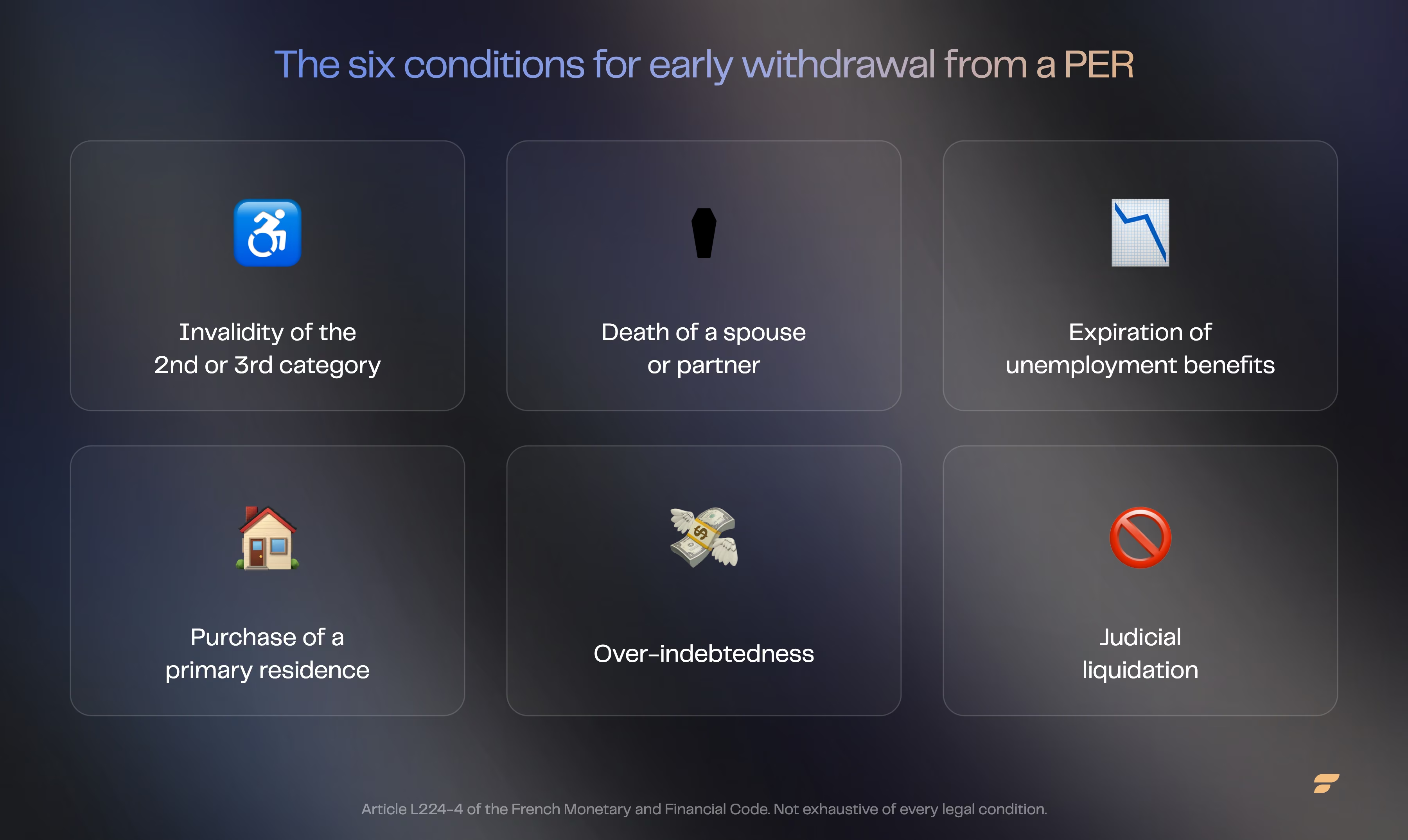
The PER acts like a safe, but the law allows it to be opened in seven exceptional situations. These cases protect the saver during major hardship. According to service-public.fr, these cases are strictly interpreted and cannot be extended by the scheme manager.
The seven situations allowing early withdrawal are:
- Invalidity of the 2nd or 3rd category (you, your children, your spouse or civil partner) Invalidity recognised by French Social Security disrupts daily life. The PER can then be unlocked with no age or holding-period requirement.
- A serious illness, disability or particularly severe accident affecting a dependent child When a dependent child of the holder faces a serious illness, a disability or a particularly severe accident, the PER can be unlocked early, independently of the standard invalidity case.
- Death of a spouse or civil partnerThe loss of a loved one can cause sudden financial hardship. The PER becomes accessible to deal with this emergency, with no restriction on how the funds are used.
- Expiration of unemployment benefitsWhen France Travail unemployment benefits end and resources run out, the PER can provide support. All unemployment benefit entitlements must be exhausted to access it.
- Over-indebtednessOnce the file is accepted by the over-indebtedness commission, the PER can be unlocked to prevent the financial situation from worsening.
- Cessation of self-employed activity following judicial liquidationSelf-employed workers can unlock their PER if their business is liquidated, recognising the financial precarity of entrepreneurship.
- Purchase of a primary residenceThis positive exception allows the PER to be used to buy a first primary residence, once only, solely for the purchase itself, not for renovation work or loan repayment.
Each situation is strictly regulated. The law does not allow withdrawal for hardships it does not provide for, which protects the purpose of the PER, even if it can seem restrictive.
Goals
Early PER withdrawal for a primary residence purchase: conditions and tax rules
Buying a primary residence is the only "voluntary" early exit option from a PER before retirement. This option can be used by first-time buyers looking to build a deposit.
To unlock your PER under these conditions, you must:
- Provide a preliminary sale agreement or a deed of purchase,
- Show that the property will be your primary residence,
- Indicate the amount to be withdrawn, in full or in part.
Regarding taxation:
- If the contributions were deducted from income tax, the portion corresponding to the capital is added back to your taxable income, and capital gains are subject to the flat tax (PFU) at 31.4% (12.8% income tax and 18.6% social security contributions in 2026).
- If the contributions were not deducted, the capital is exempt and only the capital gain is taxed at the PFU rate of 31.4%.
Concrete example : For a contribution of €20,000 deducted from income, generating €2,000 in interest:
- The amount withdrawn for the purchase is €22,000.
- The €20,000 is added to that year's taxable income.
- The €2,000 in interest is subject to the PFU at 31.4%, i.e. €628.
Key points:
- Only one "primary residence" withdrawal is allowed per PER, per lifetime.
- The law requires payment within two months of receiving the complete file, although timeframes vary between providers.
This option can help finance a property purchase, provided you plan ahead for the tax treatment and assess the impact on your tax bill.
How do you request early withdrawal from your PER, and what tax applies?
Early withdrawal from a PER requires contacting the scheme manager in writing with the supporting documents matching the reason given; the applicable tax then depends on the reason for withdrawal and the compartment concerned.
How to unlock a PER: the step-by-step procedure and letter templates for your request
Unlocking a PER before retirement requires following a precise procedure, tailored to your situation. The starting point is identifying the reason for early withdrawal: a life-changing event, the purchase of a primary residence, or another case provided for by law. Each reason requires specific supporting documents.
Start by contacting your PER scheme manager (bank, insurer, or online platform). Favour written communication, by email or registered letter with acknowledgement of receipt, to keep a record in case of a dispute or delay.
In your letter, clearly state:
- the reason for the withdrawal,
- the compartment concerned (voluntary contributions, employee savings, etc.),
- all the necessary supporting documents.
An effective letter template should include:
- your full contact details and your PER contract number,
- the exact reason for the request (for example: "purchase of a primary residence"),
- the list of documents enclosed,
- an explicit request for a transfer to your bank account, with your bank details (RIB).
Example:
Dear Sir or Madam,
I am requesting the early withdrawal of my PER, contract no. XXXX, in accordance with article L224-4 of the French Monetary and Financial Code, for the purchase of my primary residence.
Please find enclosed:
- Signed preliminary purchase agreement
- Proof of identity
- Bank details (RIB)
Thank you for processing the payment as soon as possible.
Yours sincerely, [Signature]
The clarity and completeness of the file are essential. An incomplete file causes additional delays. Scheme managers must pay out the funds within two months of receiving a complete file (article L.132-21 of the French Insurance Code). Any missing document restarts this deadline.
Checklist of supporting documents to provide
Each reason for withdrawal requires specific supporting documents. The slightest omission complicates the process. Adapt it to your situation:
- Purchase of a primary residence : preliminary sale agreement or notarial deed, proof of identity, bank details (RIB), and a first-time-buyer sworn statement if required.
- Invalidity (2nd or 3rd category) : Social Security notification, medical certificate, proof of identity.
- Serious illness, disability or serious accident affecting a dependent child : medical certificate or disability notification concerning the child, proof of dependency (family record book, tax notice), proof of identity of the PER holder.
- Death of a spouse/civil partner : death certificate, family record book, proof of identity.
- Expiration of unemployment benefits : France Travail certificate, proof of end of entitlement, proof of identity.
- Over-indebtedness : notification from the over-indebtedness commission, proof of identity.
- Cessation of self-employed activity following judicial liquidation : liquidation judgment, company registration extract (Kbis), proof of identity.
Keep a copy of every document sent and note the date it was sent. If the legal deadline is exceeded, send a written reminder, then a formal notice to speed up processing.
If the situation remains blocked, you can refer the matter to the insurance ombudsman or the ACPR (the French Prudential Supervision and Resolution Authority).
How is early withdrawal from a PER taxed?
The tax treatment of early withdrawal from a PER varies depending on the reason for withdrawal, the compartment concerned and the nature of the contributions. Each situation has its own specific rules.
- Withdrawal for a life-changing event : the capital corresponding to the contributions is exempt from income tax and social security contributions; capital gains remain subject to social security contributions (18.6% in 2026).
- Withdrawal for the purchase of a primary residence :
- Voluntary contributions (compartment 1):
- If the contributions were deducted on entry, the capital is taxed at income tax rates, and capital gains at the flat tax (PFU) rate of 31.4%.
- If the contributions were not deducted, only the capital gain is taxed at the PFU rate (31.4%).
- Compartments 2 and 3 (employee savings and mandatory contributions): specific tax treatment, often more favourable depending on the withdrawal method.
- Voluntary contributions (compartment 1):
For example, for a withdrawal of €20,000 including €5,000 in capital gains, with contributions deducted on entry and a marginal tax rate (TMI) of 30%:
- €15,000 taxed at 30% = €4,500 in tax,
- €5,000 taxed at the PFU rate (31.4%) = €1,570, net amount received: €13,930 (total tax of €4,500 + €1,570 = €6,070).
Some scheme managers withhold the tax at source. Others leave it to the saver to declare it. Always check the withholding method to avoid any unpleasant surprises when filing your annual tax return.
A large withdrawal can change your tax bracket for the current year. Splitting the withdrawal across two calendar years can smooth out the tax impact. Depending on the saver's personal situation, this optimisation can reduce the tax impact.

A worked comparison: withdraw from your PER now, or wait until retirement?
Consider two situations. You withdraw from your PER at 45 to finance a property project. Or you let your savings grow until retirement, hoping for a larger capital sum and more favourable tax treatment.
Withdrawing from your PER has significant consequences, sometimes less visible than they appear.
For example, a €40,000 PER invested in unit-linked funds, which carry a risk of capital loss, with an assumed return of 4% net of fees (for illustration purposes only, not guaranteed). If you withdraw this amount today to buy your primary residence, you lose the cumulative effect of compound interest. Over 15 years, this capital could have reached close to €72,000 (before tax), a difference of €32,000.
This calculation does not factor in the tax due on withdrawal or how the released funds are used.
Taxation also changes the picture. Withdrawing capital before retirement (outside the exceptional cases) means capital gains are taxed at the flat tax (PFU) rate of 31.4%, and deducted contributions are added back to your taxable income. At retirement, the tax treatment depends on your marginal tax rate, which is often lower, and on a possible annuity option benefiting from a tax allowance.
Waiting until retirement can, depending on the situation, offer different, sometimes more favourable, tax treatment.
But the decision is not just about the numbers. It also depends on your wealth-building plans. For example:
- A property purchase that avoids costly credit
- A rare investment opportunity
Sometimes, withdrawing from your PER lets you seize a unique opportunity, even if it reduces future returns.
Mastering the stakes of early PER withdrawal to optimise your wealth strategy
Early withdrawal from a PER is a valuable but complex option that requires a rigorous analysis of your personal and tax situation.
Between strict legal constraints and a tax impact that varies by compartment, every decision must fit into an overall wealth strategy. Tracking your PER alongside the rest of your wealth, for example through an app like Finary, helps make this decision more objective.

Frequently asked questions
Can you withdraw from a PER to pay off debts or taxes?
No. Paying off ordinary debts or taxes is not one of the seven legal cases. Only over-indebtedness validated by the competent commission allows withdrawal for a financial reason.
Is withdrawal for a primary residence possible if you already own a home?
Yes. The law does not require you to be a first-time buyer: what matters is that the property purchased becomes your primary residence. This withdrawal can only be used once.
Can a mandatory company PER be withdrawn to buy a primary residence?
No. Amounts from the mandatory compartment (mandatory employer contributions) cannot be withdrawn for the purchase of a primary residence, unlike voluntary contributions and employee savings.
How long does an early PER withdrawal take?
Generally allow two months after the complete file is received, in accordance with article L.132-21 of the French Insurance Code. Any missing document restarts this deadline. Keep proof of sending so you can follow up with the scheme manager if needed.
Does early withdrawal involve any fees?
The law does not provide for an exit penalty, but some contracts apply switching or withdrawal fees. Check your PER's terms before submitting your request.
Sources
Service-public.fr, France's retirement savings plan (PER): cases of early withdrawal
Légifrance, article L224-4 of the French Monetary and Financial Code
Regulatory disclaimers: Marketing communication. Investing carries a risk of partial or total capital loss. Past performance is not a reliable indicator of future performance. This article is provided for information and educational purposes only; it does not constitute personalised investment advice, a buy or sell recommendation, or tax advice. The capital guarantee on euro funds is provided by the insurer and depends on its financial strength. In a severe systemic crisis, the French "Sapin 2" law allows withdrawals to be temporarily restricted (liquidity), without affecting the guaranteed capital. Unit-linked funds are not guaranteed and carry a risk of capital loss. Before investing, read the Key Information Document (KID) and, where relevant, consult an authorised adviser. Finary SAS, an investment firm authorised by the ACPR (no. 19283), member of AMAFI. Insurance broker registered with ORIAS (no. 21001279), member of the CNCGP (association approved by the AMF). Crypto-Asset Service Provider (CASP), authorised by the AMF under the MiCA regime, under references no. A2026-026 (AMF authorisation, art. 63 MiCA) and no. N2026-008 (ACPR notification, art. 60 MiCA).