PER Benefits: Understanding Its Advantages to Prepare for Retirement in France

Updated on 30 July 2026
The Plan d'Épargne Retraite (PER), France's retirement savings plan, offers three main advantages: a tax deduction on voluntary contributions, a flexible payout in capital or annuity at retirement, and early withdrawal for the purchase of a primary residence or in the event of a life accident.

- Voluntary contributions are deductible from taxable income, up to €37,680 a year for an employee in 2026.
- No minimum contribution is required: savers can contribute at their own pace, with no mandatory monthly amount.
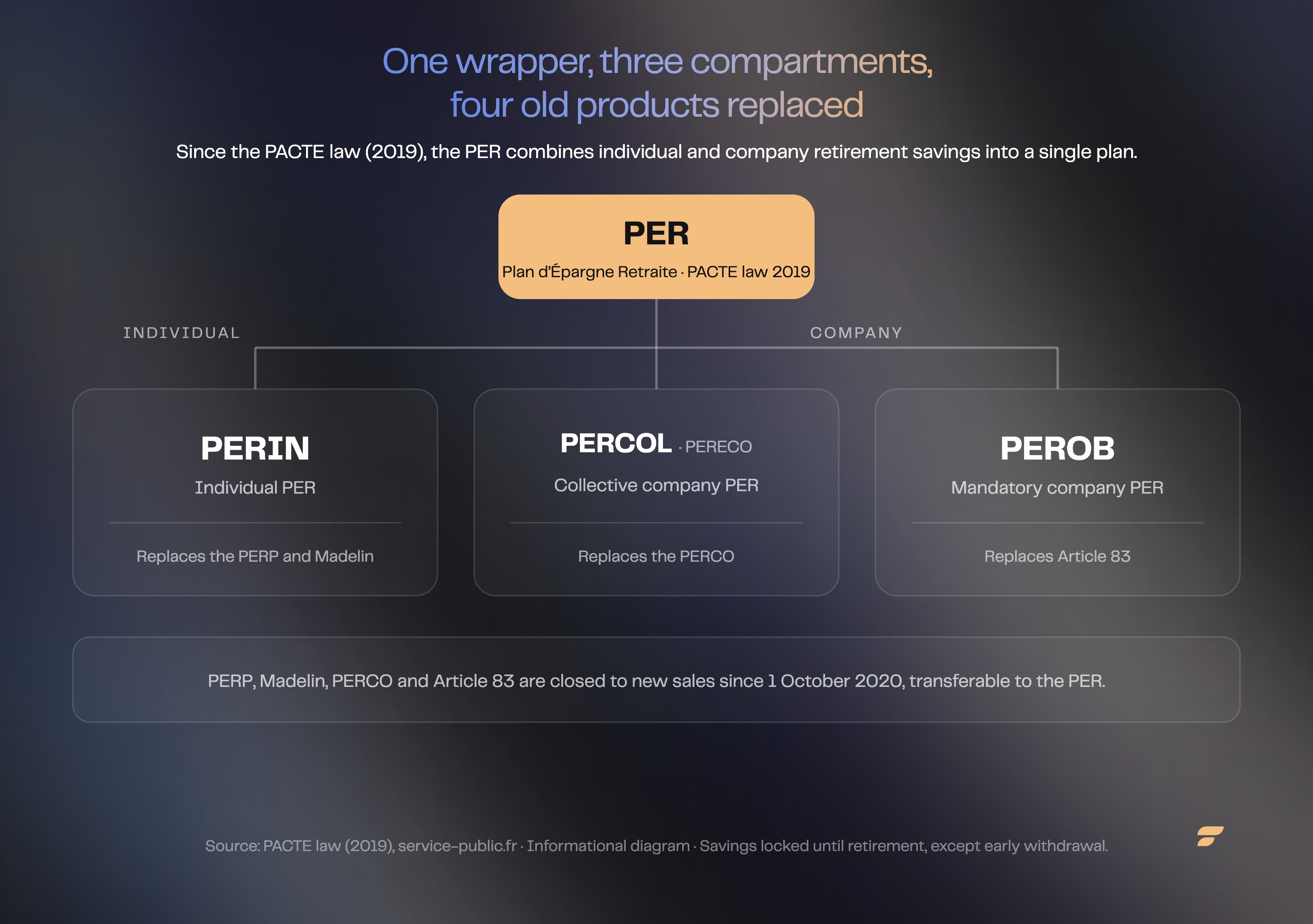
- The PER comes in three forms, individual (PERIN), collective (PERCOL) and mandatory (PEROB), each suited to a different situation.
- In the event of death before age 70, each beneficiary receives a €152,500 tax allowance before the transferred amounts are taxed.
- The PER offers a wide range of investment options, euro funds and unit-linked funds, suited to different risk profiles.
What Is the PER and How Does It Work?
The PER is a long-term savings product that lets you build capital or an annuity available at retirement, with contributions deductible from taxable income under certain conditions.
Definition and Purpose of the Plan d'Épargne Retraite
The Plan d'Épargne Retraite (PER) is a financial product designed to help working people prepare for retirement. Created in 2019 under the French PACTE law, it replaced older schemes such as the Madelin law and the PERP. Its purpose is simple: to let everyone build up capital throughout their working life, capital that becomes available at retirement. It is one way to help offset the drop in income often seen at the end of a career.
The 3 Types of PER
Individual PER (PERIN)
The individual PER, or PERIN, is designed specifically for private individuals. As the name suggests, it is individual and unrestricted. Each saver can make voluntary contributions at their own pace and according to their financial means. It offers great flexibility both in the amounts invested and in how the plan is managed.
Mandatory Company PER (PEROB)
The mandatory company PER, or PEROB, is a collective product set up by the employer. Unlike the optional collective PER (PERCOL), it requires designated employees to subscribe. This type of PER is often reserved for certain categories of employees within the company.
Collective Company PER (PERCOL)
The collective company PER, or PERCOL, is also set up by the company, but this time membership is optional for employees. It is funded mainly by profit-sharing and incentive payments, along with employees' voluntary contributions.
General Rules and How the PER Works
How the PER works rests on clear rules. The invested funds are locked until retirement, except in certain cases (purchase of a primary residence or a life accident). You can get your money back as a life annuity or as capital, giving you great flexibility. Taxation is also a central aspect: contributions can be deducted from taxable income, subject to certain conditions and limits.
Opening and Subscription Process
Opening a PER is relatively simple and is usually done through an insurer. Comparing offers helps you choose the contract best suited to your profile, in particular via a ranking of the best PER plans. When subscribing, the policyholder designates beneficiaries in the event of early death. The contract's terms and management options (managed or self-directed) are also set at this point. Managed-portfolio management consists of automatic adjustments based on your investment horizon, while self-directed management lets the saver decide their own allocations.
In short, the PER is a solution built to help working people prepare for retirement proactively and with peace of mind.

What Are the Tax Benefits of the PER?
The PER offers three tax levers: deducting contributions from taxable income, a favourable cap outside the general tax-loophole limit, and controlled taxation on exit.
Deducting Contributions From Taxable Income
One of the main advantages of the Plan d'Épargne Retraite (PER) is the ability to deduct voluntary contributions from your taxable income. This tax benefit effectively reduces your taxable base as soon as you join the plan. Whether you are an employee or self-employed, this deduction can be useful during your working years, when income is often at its highest.
Deduction Ceilings in Detail
The PER's deduction ceilings offer some flexibility. In 2026, employees can deduct whichever of the following two amounts is higher: 10% of their 2025 net professional income, up to €37,680, or €4,710 if that amount is higher. For the self-employed, the ceiling is higher: 10% of taxable profit, up to €37,094, plus 15% of the portion of profit between one and eight times the Plafond Annuel de la Sécurité Sociale, or PASS (France's annual social-security ceiling).
Examples of Tax Savings by Marginal Tax Rate (TMI)
Let's look at a simple table of tax savings by marginal tax rate (TMI):
| TMI | Amount contributed | Estimated tax saving | |
|---|---|---|---|
| 11% | €10,000 | €1,100 | |
| 30% | €10,000 | €3,000 | |
| 41% | €10,000 | €4,100 | |
| 45% | €10,000 | €4,500 |
As you can see, the higher your TMI, the greater the tax benefit. It's an excellent way to maximise your savings while lowering your tax bill. According to service-public.gouv.fr, France's 2026 income tax scale has five brackets: 0%, 11%, 30%, 41% and 45%.
Favourable Taxation on Exit (Annuity or Capital)
PER taxation also brings benefits on exit. At retirement, if you choose a life annuity payout, it is taxed like a retirement pension. This can be advantageous if your TMI has fallen due to lower income. If you opt for a lump-sum payout instead, the portion corresponding to your deducted contributions is added to your taxable income and subject to the progressive income tax scale, while the portion corresponding to the gains is subject to the flat tax (PFU) of 31.4% (12.8% income tax and 18.6% social security contributions). This lump-sum option can be attractive if your TMI has fallen by the time you retire, easing the tax burden on the contributions portion.
A Tax Benefit Outside the Tax-Loophole Cap
The PER's tax deduction is also not subject to the €10,000 annual cap on tax loopholes per household. This means deductions obtained through a PER add to those from other tax-relief schemes, such as the former Pinel scheme (closed to new subscriptions since 1 January 2025) or other property tax-relief schemes, which increases the potential for tax relief.
In conclusion, the PER stands out as an extremely advantageous tax solution for preparing for retirement. It is optimised at every stage, from entry to exit, including how contributions and withdrawals are managed.
Building Retirement Capital With the PER

Anticipating Lower Income in Retirement
With pension reforms, replacement rates (the share of salary received as a pension) are falling. To offset this decline, building capital through the PER can make sense. This vehicle can help generate additional income and maintain a comfortable standard of living in retirement.
Flexible Contributions and Savings Effort
The PER stands out for its flexible contributions. You can contribute at your own pace, with no obligation to make minimum monthly payments. This freedom lets you adjust your contributions to your financial means and priorities. Whether through small regular payments or larger one-off contributions, the plan adapts to your needs. Tools such as Finary also let you track your PER's progress alongside your other assets, for a complete view of your wealth.
Possible Early Withdrawal
For the Purchase of a Primary Residence
The PER offers an interesting option for early withdrawal for the purchase of your primary residence. Whether you are a young adult planning your first property purchase or a household reorganising its wealth, this option gives you greater control over your savings.
In the Event of a Life Accident (Disability, Over-Indebtedness, etc.)
The PER also provides for early withdrawal in exceptional circumstances:
- Disability of the policyholder, their spouse or their children
- Death of a spouse or PACS partner
- Over-indebtedness of the policyholder
- Court-ordered liquidation resulting in the end of salaried employment
- Expiry of unemployment benefit rights
These provisions ensure your savings remain accessible in the event of hardship, allowing access to the funds in these situations.
Flexible Payout in Capital or Annuity at Retirement
The PER offers flexible payout options, whether as a life annuity or as capital. Unlike older plans such as the Madelin or the PERP, which limited you to an annuity payout, the PER now lets you choose the method that suits your personal situation. You can opt for a full lump-sum payout, a life annuity, or a combination of the two, giving you the flexibility to adapt your withdrawals to your specific needs in retirement.
Benefits in the Event of the Policyholder's Early Death
If the policyholder dies prematurely, the PER offers significant benefits for the beneficiaries. If death occurs before age 70, each beneficiary can claim a €152,500 tax allowance. Any gain above that is taxed at 20% up to €700,000, then at 31.25% beyond that. After age 70, a single €30,500 allowance applies, with standard inheritance tax on the surplus.
The PER is one tool among others for preparing for retirement, alongside, for example, life insurance. Its value depends on your tax situation, your investment horizon and your risk tolerance. The invested funds are locked until retirement except in cases of early withdrawal provided for by law.
Goals
Frequently Asked Questions
Is the PER Really Tax-Efficient for Everyone?
The PER's tax benefit depends on your marginal tax rate (TMI). The higher your TMI during your working life, the more valuable the deduction on contributions. Conversely, a taxpayer who pays little or no income tax gets little benefit from this deduction.
Can You Withdraw Money From a PER Before Retirement?
Yes, in certain cases: purchasing a primary residence or a life accident (disability, death of a spouse, over-indebtedness, court-ordered liquidation, or the end of unemployment benefit rights). Outside these situations, the funds remain locked until retirement.
What Happens to a PER if the Holder Dies Before Retirement?
The capital passes to the named beneficiaries. If death occurs before age 70, each beneficiary receives a €152,500 tax allowance, then the remainder is taxed at 20% up to €700,000 and 31.25% beyond that.
What Is the Difference Between PERIN, PERCOL and PEROB?
The PERIN is opened individually by a private individual. The PERCOL is an optional company PER, funded in particular by profit-sharing and incentive payments. The PEROB is a mandatory company PER, imposed on certain categories of employees designated by the employer.
Should You Choose an Annuity or a Lump Sum at Retirement?
It depends on your need for regular income and your personal tax situation. The annuity is taxed like a retirement pension, while the lump-sum payout separates the contributions portion, taxed under the income tax scale, from the gains portion, taxed at 31.4% under the flat tax (PFU).
Sources
Service-public.fr, Plan d'Épargne Retraite (PER): how it works, deduction ceilings and taxation
AMF, whitelist of Crypto-Asset Service Providers (CASP), Finary SAS
Regulatory disclaimers: Marketing communication. Investing carries a risk of partial or total capital loss. Past performance is not a reliable indicator of future performance. This article is provided for information and educational purposes only; it does not constitute personalised investment advice, a buy or sell recommendation, or tax advice. The capital guarantee on euro funds is provided by the insurer and depends on its financial strength. In a severe systemic crisis, the French "Sapin 2" law allows withdrawals to be temporarily restricted (liquidity), without affecting the guaranteed capital. Unit-linked funds are not guaranteed and carry a risk of capital loss.
Before investing, read the Key Information Document (KID) and, where relevant, consult an authorised adviser.
Finary SAS, an investment firm authorised by the ACPR (no. 19283), member of AMAFI. Insurance broker registered with ORIAS (no. 21001279), member of the CNCGP (association approved by the AMF). Crypto-Asset Service Provider (CASP) authorised by the AMF under the MiCA regime, references no. A2026-026 and no. N2026-008.