Why Open a Life Insurance Policy in France? Complete Guide

Updated on 6 August 2026
Opening a life insurance policy in France lets you grow your savings within a favourable tax framework after eight years, keep access to your funds at any time, and pass on capital under good conditions. Accessible from the very first euro, it suits any saver, not just retirees or high-net-worth individuals.

- After eight years, each withdrawal benefits from an annual tax allowance of €4,600 (€9,200 for a couple) before any gains are taxed.
- On death, each named beneficiary can receive up to €152,500 free of inheritance tax, outside the usual estate rules.
- Since France's 2019 Pacte law, a policy can be transferred to another policy with the same insurer without losing its tax seniority.
- Your savings stay available at any time through a withdrawal, and a policy advance lets you borrow without cashing in the investment.
- Euro funds protect the capital, while unit-linked funds aim for higher returns with a risk of capital loss.
Understanding life insurance
What is life insurance?
Life insurance remains one of the most popular investments among savers in France. Despite what the name suggests, it isn't a simple policy against life's mishaps, but a highly flexible savings contract.

This investment is no longer just for retirees: it suits anyone who wants to grow their money, plan a project, or pass on capital, all while keeping the freedom to withdraw their savings.
You sign a contract with an insurer and make contributions at your own pace, with no constraint on amount or frequency.
The insurer invests your money across different investment options: some guarantee the capital, others aim for higher returns through the financial markets.
When you withdraw, you or your beneficiaries receive the capital plus any gains, under a tax regime that eases over the years.
How a life insurance policy works
Opening a life insurance policy means laying the groundwork for a long-term plan. You start with an initial contribution, then fund the policy as your means allow.
There is no cap and no obligation to contribute regularly. Your money stays available: you can withdraw all or part of your savings at any time, subject to a short processing delay.
Life insurance stands out for the diversity of its investment options:
- Euro funds: capital guaranteed by the insurer (subject to its solvency, the FGAP [France's insurance policyholder guarantee fund] and the French "Sapin 2" law), with modest returns.
- Unit-linked funds: higher return potential, but with a risk of capital loss.
You can split your savings across these options, adjust your choices to match your goals or risk tolerance, and change that allocation at any time.
Your gains (interest, capital appreciation) are added to the capital. Taxation only applies when you withdraw, and it eases after eight years of holding the policy.
Life insurance versus other savings products
Life insurance stands clearly apart from other savings solutions. Unlike the Livret A (France's flagship tax-free savings account), which quickly hits its contribution cap, life insurance imposes no limit on contributions.
The PER (France's retirement savings plan) offers a tax break on contributions but locks up the savings until retirement (except in special cases: buying a primary residence, life accidents).
The PEA (a French tax-advantaged equity savings account) targets European equities, with attractive taxation after five years, but it remains less flexible for wealth transfer.
Want to compare life insurance with other savings products like the Livret A, the PEA or the PER? Check out our detailed comparisons to find the solution best suited to your savings: Livret A vs. life insurance, PEA or life insurance and PER or life insurance.
The table below summarises the main differences:
| Criterion | Life insurance | Savings accounts (Livret A, LDDS: France's sustainable development savings account) | PER (France's retirement savings plan) | PEA (a French tax-advantaged equity savings account) |
|---|---|---|---|---|
| Purpose | Savings, wealth transfer, retirement | Precautionary savings | Retirement planning | Investment in European equities |
| Taxation | Favourable after 8 years | Tax-exempt | Tax deduction on contributions, taxed on withdrawal | Exempt from income tax after 5 years (18.6% social security contributions) |
| Liquidity | Withdrawals at any time | Withdrawals at any time | Locked until retirement, except in special cases (primary residence, life accidents) | Free withdrawals after 5 years (early closure otherwise) |
| Returns | Varies by investment option | Low, fixed rate | Varies by investment option | Varies, depends on markets |
| Risk | Low to high depending on investment option | Low | Low to high depending on investment option | High (capital not guaranteed) |
Goals
Why take out life insurance?
Taking out life insurance lets you grow your savings across a range of investment options, reduce taxation after eight years, and plan the transfer of your estate, all while keeping access to your capital at any time.
Financial benefits of life insurance: returns and diversification
Life insurance is not just a simple savings product. It offers real flexibility to grow your savings.
Life insurance offers several options:
- investing in equity markets;
- securing your capital in euro funds;
- diversifying into real estate, all within a single policy.
This diversity helps manage economic uncertainty. Diversifying your investments becomes essential to protect and grow your savings.
Returns often grab attention, but they need context. According to the ACPR, the average return on euro funds for 2025 is expected to stabilise around 2.65%, net of fees on assets under management and before social security contributions, according to a preliminary estimate. Past performance is no guarantee of future performance.
Some higher-performing policies reach 3% to 4%. But life insurance isn't just about performance: it lets you adjust your risk level to match your profile.
Depending on your time horizon and risk tolerance, each saver may consider a different allocation; a personalised recommendation from a CIF (Conseiller en Investissements Financiers, a French-licensed independent financial adviser) is advisable. This ability to tailor your allocation to your personal situation sets life insurance apart from other investments.
Another advantage: you can rebalance your investments without triggering immediate taxation.
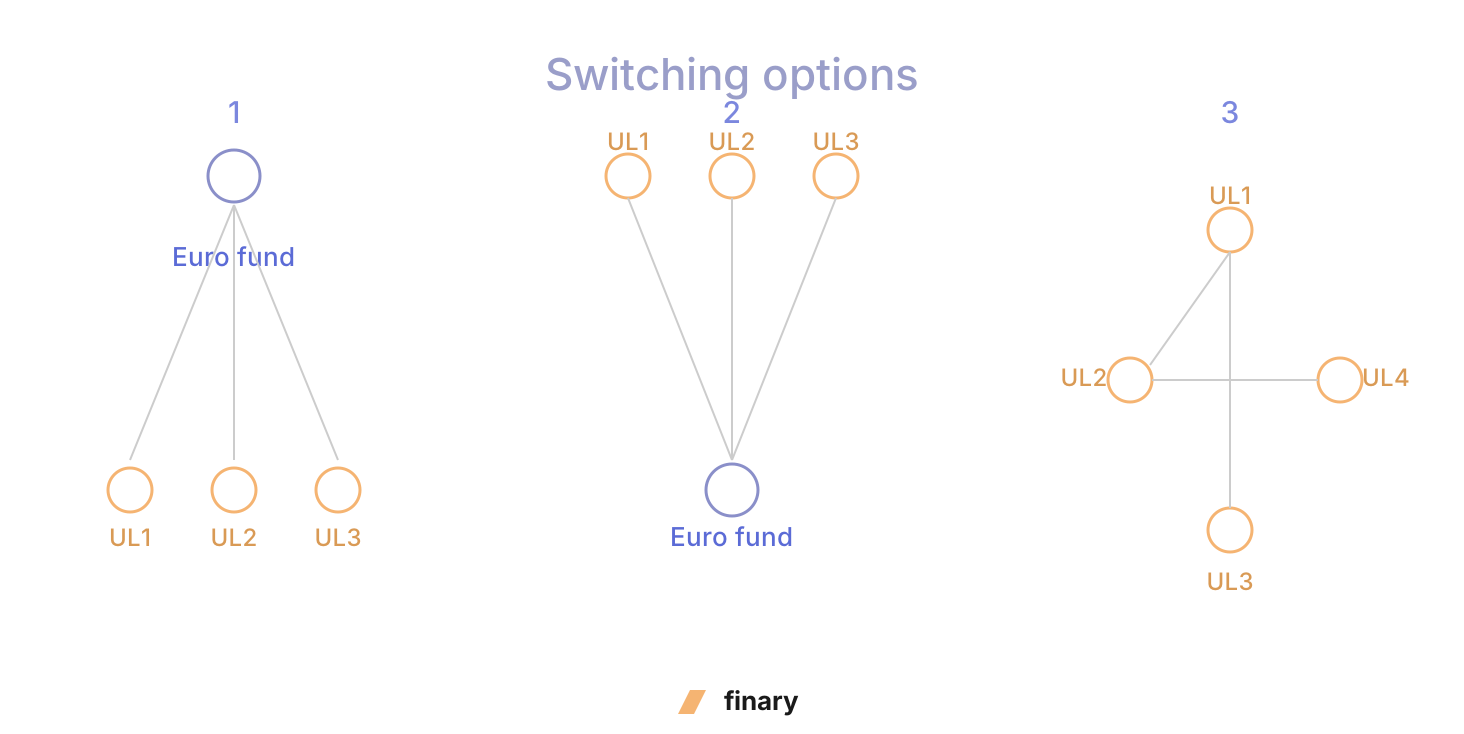
Switching from an equity fund to a euro fund, or the other way round, doesn't trigger taxation with each move. This flexibility makes it easier to optimise performance over the long term.
Tax benefits of life insurance: optimising your taxation
The taxation of life insurance changes over time. Contrary to popular belief, the money remains available at any time; it's the tax treatment that becomes more favourable after eight years.
After this period, each withdrawal benefits from an annual tax allowance of €4,600 (€9,200 for a couple). A large share of the gains thus escapes taxation.
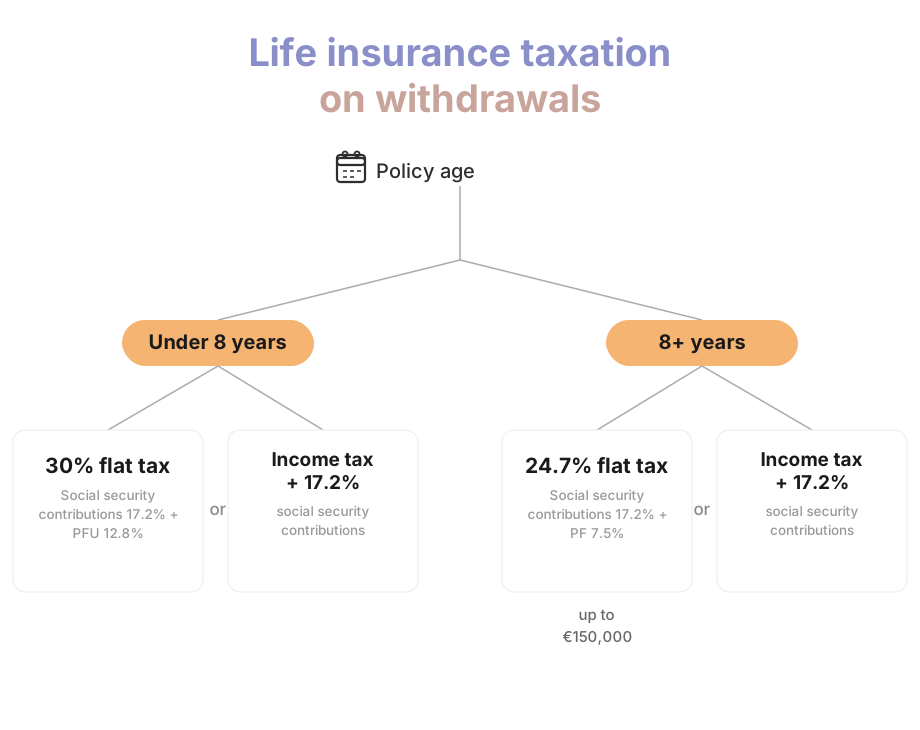
Before eight years, gains are taxed at 30% (a 12.8% flat-rate levy on income plus 17.2% in social security contributions), a rate that is even slightly lower than most other financial investments since 1 January 2026, when social security contributions rose to 18.6% outside life insurance. After eight years, the rate drops to 7.5% (excluding social security contributions), which makes life insurance more attractive than many other savings products. How long you've held the policy affects the applicable tax rate.
Another important point: taxation only applies to the portion of gains withdrawn, never to the initial capital.
For example, if you withdraw €10,000 including €1,000 in gains, only that portion is taxed. This mechanism lets you plan withdrawals while limiting the tax impact.
Life insurance for wealth transfer: estate benefits
Passing on wealth can quickly become complicated. Life insurance simplifies the process through the beneficiary clause. You freely choose who will receive the capital: spouse, children, loved ones, charities... with no justification required.
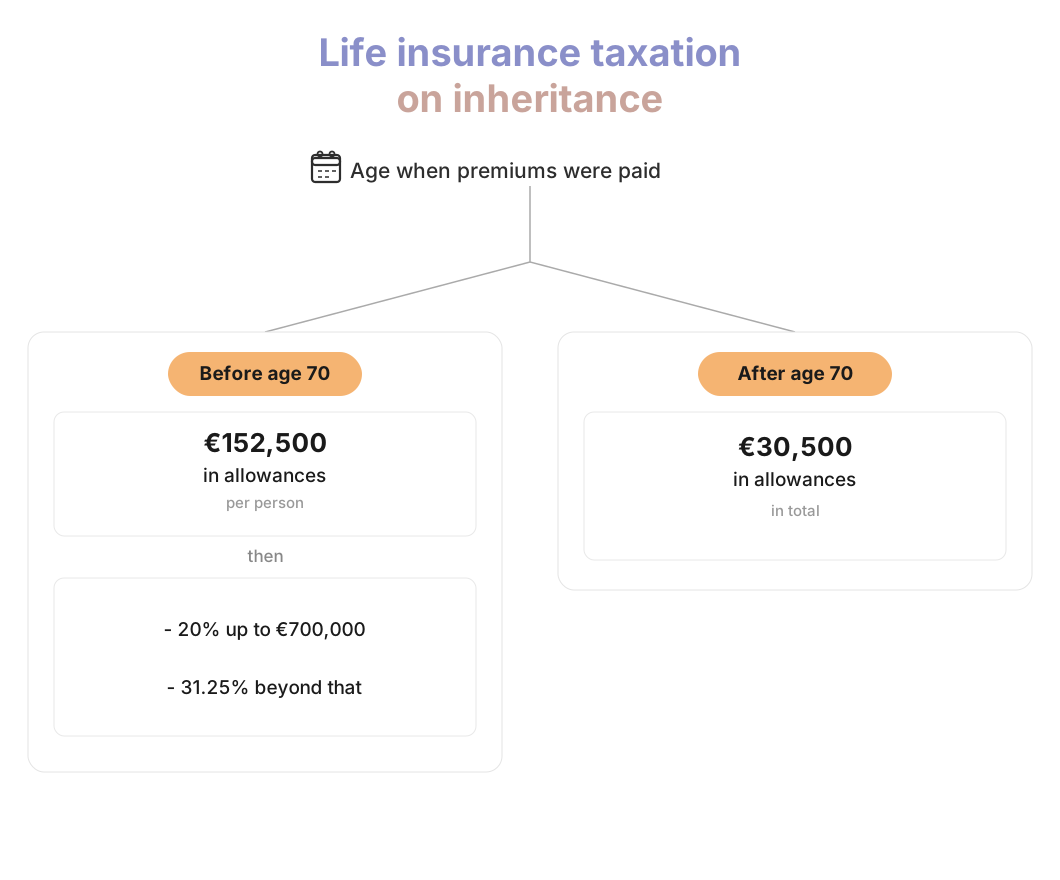
Each beneficiary can receive up to €152,500 free of inheritance tax, a framework separate from the standard inheritance rules.
A spouse or PACS partner benefits from a full exemption, regardless of the amount transferred. For blended families or more distant beneficiaries, life insurance offers great freedom. It lets you work around the constraints of standard inheritance law while benefiting from lighter taxation.
Certain strategies, such as the split beneficiary clause, allow you to separate the usufruct from the bare ownership.
This protects the surviving spouse while ensuring the transfer to the children, with optimised taxation. Few investments offer as many options for planning your estate so simply.
What are the benefits of life insurance depending on how long you hold it?
Life insurance adapts to every time horizon: it provides liquidity in the short term, supports projects in the medium term, then optimises taxation and wealth transfer in the long term.
Short-term benefits of life insurance: flexibility and liquidity
Many people think life insurance is only for long-term investing. Yet it also meets immediate needs.
Your savings remain available through a withdrawal, subject to the insurer's processing time, even if it takes a few days to complete. This flexibility, rare among investments, lets you deal with the unexpected without giving up on performance.
The liquidity of life insurance, combined with the option of taking a policy advance (a loan against the contract, with no tax impact), makes it an advanced form of precautionary savings. It offers a margin of manoeuvre that the PEA, the PER, or certain regulated savings accounts don't provide.
Medium-term benefits of life insurance: planning your projects
Over a period of 3 to 8 years, life insurance supports many projects: buying property, travelling, starting a business.
The tax treatment remains competitive before this point: 30% on gains (12.8% flat tax (PFU) plus 17.2% in social security contributions), a rate that is even slightly lower than most other financial investments since 2026.
Medium-term life insurance stands out for the ability to adjust your allocation. For example, for a property project five years away, you can gradually secure your capital by shifting from unit-linked funds into the euro fund as the deadline approaches.
This dynamic management, accessible even to beginners through managed-portfolio management, helps optimise returns while limiting risk.
Long-term benefits of life insurance: preparing for retirement and passing on wealth
Over the long term, life insurance reaches its full potential. Compound interest turns regular contributions into significant capital.
The longer it runs, the more the gains accumulate: interest generates further interest, year after year. A policy opened at age 25, even with modest contributions, can help prepare for retirement or a future wealth transfer.
To better visualise the power of compound interest discussed in this article, try our compound interest calculator.
Life insurance also protects your savings. After eight years, the tax treatment becomes highly favourable:
- Each year, €4,600 in gains (€9,200 for a couple) are tax-exempt.
- Beyond that, the tax rate drops to 7.5% (excluding 17.2% in social security contributions).
- On death, the transfer happens outside the estate, with a €152,500 allowance per beneficiary.
This mechanism, unique in the French financial landscape, makes it possible to pass on wealth with lighter taxation and to benefit your loved ones.
Why open a life insurance policy young?
Opening a life insurance policy young lets you benefit longer from the effect of compound interest and reach the eight-year threshold sooner, which triggers the most favourable taxation on gains.
Benefits of life insurance for young professionals: building capital early
Saving before age 30 lets you fully benefit from the growth of your capital. How long you hold the policy strengthens the effect of compound interest on your savings. Many young professionals hesitate, thinking life insurance is mainly for people nearing retirement. Yet starting early can boost the effect of compound interest over the long term.
For example, a 25-year-old who invests €100 a month in a life insurance policy earning 2.5% could reach around €13,000 by age 35 (a hypothetical, non-contractual example, excluding fees and taxation). Ten years later, keeping up the same monthly contributions, that capital would have more than doubled, driven by the regularity of the contributions and the accumulated interest.
Starting early to optimise your taxation: why 8 years matters
Life insurance offers a major tax advantage after eight years of holding the policy. Once that period is reached, every euro of gain benefits from an annual tax allowance (€4,600 for a single person, €9,200 for a couple), then a reduced tax rate of 7.5%.
This period starts from the moment the policy is opened, not from the date of the first contribution. Waiting to open a policy therefore delays access to these benefits.
Opening a life insurance policy at 22 or 25, even with a small amount, lets you get ahead. By age 30, the policy could already be 5 to 8 years old.
You can then make withdrawals for a property purchase, a trip, or a life change, while benefiting from highly favourable taxation. On a gain of €4,600, the tax saving can reach several hundred euros each year.
More capital invested

Non-contractual document for promotional purposes. Investment in unit-linked vehicles carries a risk of capital loss, since their value is subject to fluctuation, both upwards and downwards, depending in particular on developments in the financial markets. The insurer commits to the number of unit-linked funds, not to their value, which it does not guarantee. This e-vie life insurance policy is an individual life insurance policy, denominated in euros and/or unit-linked funds, underwritten by Generali Vie, a company governed by the French Insurance Code. Finary SAS - 58 rue de Monceau 75380 Paris 8 - Investment Firm authorised by the ACPR under no. 19283, ORIAS no. 21001279, member of AMAFI
Life insurance for different projects
Funding a property project with life insurance: pros and cons
Life insurance, often seen as a long-term investment, increasingly fits into the property strategy of many experienced savers.
It provides a cash reserve accessible at any time, with no justification or penalty, which appeals to those planning a property purchase in the near future.
Rather than leaving a deposit sitting in a low-yield savings account, putting that sum into a life insurance policy lets you aim for higher returns while keeping the funds available.
Some savers use a policy advance, a mechanism that works like a fast loan, with no tax impact. The insurer lends up to 60-80% of the policy's value, often at a rate lower than a consumer loan.
Meanwhile, the money stays invested and keeps generating interest, avoiding the need to break the investment. This option is used by some property investors who need to manage signing delays or unexpected financing gaps.
Preparing for retirement with life insurance: supplementing your pension
Retirement marks the start of a new chapter. Life insurance can be a tool for building a supplementary income, all while offering great flexibility. Unlike the PER, which locks up savings until retirement, life insurance lets you choose between a lump-sum payout, scheduled withdrawals, or conversion into a life annuity.
This policy stands out for its flexible management: you adapt your contributions to your means and adjust your risk level according to your age or needs.
As retirement approaches, you can gradually secure the capital in euro funds, while keeping a dynamic portion to benefit from market growth.
Building precautionary savings: security and availability
Life insurance isn't limited to long-term projects. It also adapts perfectly to precautionary savings, that essential safety net for the unexpected. Its liquidity rivals that of regulated savings accounts, while often offering higher returns.
An often overlooked feature: the ability to name a beneficiary, even for simple precautionary savings.
On death, the capital doesn't go through the standard estate process: it's transferred quickly, with no complex formalities. This extra protection sets life insurance apart from other savings solutions.
How to choose your life insurance policy?
The right life insurance policy depends on the saver's profile: simplicity and euro funds for cautious profiles, or a wide range of investment options and managed-portfolio management for those seeking performance and diversification.
The different types of life insurance policies: single-fund, multi-fund
Life insurance comes in several formats, each with its own features. The single-fund policy, often called "classic," is built on the euro fund.
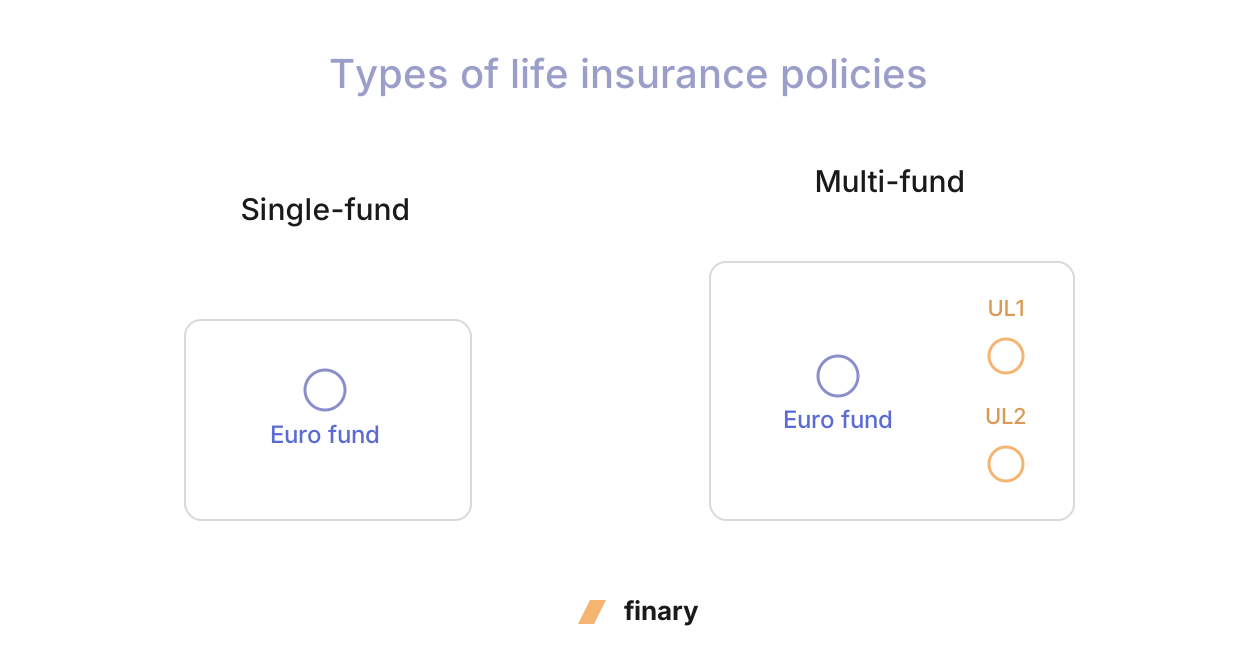
This type of policy offers strong security, with capital guaranteed by the insurer (subject to its solvency) and modest returns.
However, this choice limits the growth potential over the long term. The return on the euro fund, even though it protects against inflation, remains lower than the performance of the financial markets over ten or twenty years.
The multi-fund policy, meanwhile, lets you diversify your savings. It combines a euro fund and unit-linked funds: equities, bonds, real estate, thematic funds, ETFs, and more. This structure gives access to global growth, but also exposes you to volatility.
Comparing life insurance policies: finding the right policy for your profile
Comparing life insurance policies is a bit like choosing a smartphone. Beyond the technical specifications, everything depends on your needs, your lifestyle and your priorities.
Some savers look for simplicity:
- a high-performing euro fund
- low fees
- a clear interface
Others prefer diversity and customisation:
- access to many investment options
- managed-portfolio management
- protection add-ons
- the option to invest in thematic funds or low-cost ETFs
The policy needs to match your profile. Do you want to manage every switch yourself? Or would you rather hand over management to experts through a mandate? Do you need protection add-ons or a customised beneficiary clause? The quality of customer service, the speed of transactions and the transparency of reporting also shape the day-to-day experience.
A point often overlooked: the portability of life insurance. Since France's 2019 Pacte law, it has been possible to transfer a life insurance policy to another policy, provided you stay with the same insurer: the tax seniority is then preserved (French General Tax Code, art. 125-0 A). Transferring between two different insurers, however, remains impossible, and the insurer is not obliged to accept the request. Outside this case, changing insurer means cashing in the old policy, which triggers tax consequences. It's therefore essential to choose carefully from the start, anticipating your future needs.
In summary
Life insurance is a policy that lets you manage your savings within a specific tax framework and with real flexibility. This investment can help you build capital, fund personal projects, or prepare the transfer of your estate under favourable conditions.
By understanding the reasons to open a life insurance policy, you can use this contract to organise your savings and the transfer of wealth to your loved ones.
within reach
Non-contractual document for promotional purposes. Investment in unit-linked vehicles carries a risk of capital loss, since their value is subject to fluctuation, both upwards and downwards, depending in particular on developments in the financial markets. The insurer commits to the number of unit-linked funds, not to their value, which it does not guarantee. This e-vie life insurance policy is an individual life insurance policy, denominated in euros and/or unit-linked funds, underwritten by Generali Vie, a company governed by the French Insurance Code. Finary SAS - 58 rue de Monceau 75380 Paris 8 - Investment Firm authorised by the ACPR under no. 19283, ORIAS no. 21001279, member of AMAFI
Frequently asked questions
Is a minimum amount required to open a life insurance policy?
No, there is no legal minimum. Most online policies can be opened with an initial contribution of a few hundred euros, sometimes less. Further contributions are unrestricted, with no fixed amount or frequency, which makes life insurance accessible from the start of your working life.
What happens if you withdraw money before eight years?
The capital remains accessible at any time through a withdrawal. Before eight years, the gains withdrawn are taxed at 30% (a 12.8% flat-rate levy on income plus 17.2% in social security contributions). Only the portion of gains is taxed, never the capital initially contributed.
Can you transfer your life insurance policy to another insurer?
No, a transfer is only possible between two policies with the same insurer, since France's 2019 Pacte law: the tax seniority is then preserved. A transfer to another insurer remains impossible; changing insurer requires cashing in the policy, with tax consequences.
Can you open several life insurance policies?
Yes, no law limits the number of life insurance policies a single person can hold. Having several policies lets you diversify insurers, test different management styles, or prepare for separate projects, with each policy keeping its own tax seniority.
From what age can you open a life insurance policy?
There is no minimum age: a policy can even be opened in the name of a minor by their legal representatives. The earlier the policy is opened, the sooner the eight-year threshold is reached, allowing you to benefit longer from the favourable taxation.
Sources
Impots.gouv.fr, how life insurance policy earnings have been taxed since 1 January 2018
Impots.gouv.fr, I am a life insurance beneficiary, how to declare it
Service-public.gouv.fr, change to the flat tax (PFU) rate as of 1 January 2026
ACPR, note no. 179, life insurance in 2025
Gan Prévoyance, transferring a life insurance policy to another life insurance policy
Auguste Patrimoine, life insurance transfer: legal framework, taxation and strategies in 2026
Éditions Francis Lefebvre, the main changes introduced by the Pacte law for life insurance
Regulatory disclaimers: Marketing communication. Investing carries a risk of partial or total capital loss. Past performance is not a reliable indicator of future performance. This article is provided for information and educational purposes only; it does not constitute personalised investment advice, a buy or sell recommendation, or tax advice. The capital guarantee on euro funds is provided by the insurer and depends on its financial strength. In a severe systemic crisis, the French "Sapin 2" law allows withdrawals to be temporarily restricted (liquidity), without affecting the guaranteed capital. Unit-linked funds are not guaranteed and carry a risk of capital loss. Before investing, read the Key Information Document (KID) and, where relevant, consult an authorised adviser. Finary SAS, an investment firm authorised by the ACPR (no. 19283), member of AMAFI. Insurance broker registered with ORIAS (no. 21001279), member of the CNCGP (association approved by the AMF). Crypto-Asset Service Provider (CASP) authorised by the AMF under the MiCA regime, references no. A2026-026 and no. N2026-008.