Life Insurance for Children in France: The Complete 2026 Guide


In France, when your child turns 18, they can empty in one click the policy you patiently funded for 18 years. That is the blind spot of life insurance for children, the one nobody really talks about. And there is a simple way to guard against it.
Life insurance nonetheless remains one of the best financial gifts you can give a child. This guide covers it all: how to open one for a minor, why it is worth it, a detailed comparison with the Livret A, the pacte adjoint (a side agreement attached to a gift that lets you set conditions on how the gifted funds are used) to keep control, what happens at 18, and 2026 taxation.
In one sentence: yes, you can open a life insurance policy in your minor child's name, and the earlier you do it, the more time works in their favor.

Can You Open Life Insurance for a Minor Child?
Yes. A minor can be the policyholder and the insured under a life insurance policy, but they do not sign alone: their legal representatives open and manage the policy on their behalf.
The level of consent required depends on the transaction. For routine matters, one parent is enough. For significant contributions and switches, both parents' consent is generally required. If the parents disagree, or if only one holds parental authority, stricter rules apply: it is best to check with the insurer or a notary before acting.
Age is a factor too. Before age 12, the policy is entirely managed by the legal representatives. From age 12, the child is often asked to co-sign certain actions, without deciding alone.
Why Open Life Insurance for Your Child?
The real gift is not the money paid in. It is time. Opening early gives two decisive advantages: starting the clock and letting compound interest run.
Starting the clock is the reflex to have. Life insurance taxation improves with the age of the policy, and the 8-year counter starts on opening. A policy opened when the child is 2 will already have 16 years of tax seniority by the time they turn 18. The tax allowances will have long been secured.
Compounding over the long term, next. Over 18 years, compound interest turns modest contributions into significant capital. Every euro invested early produces gains, which in turn produce further gains. Time is the fuel behind this snowball effect.
Life Insurance or Livret A for a Child: The Comparison
The Livret A is most parents' first instinct. It is a good tool, but not for the same purpose. The Livret A serves as a rainy-day fund: available and risk-free. Life insurance serves long-term savings, the kind meant to grow over 15 or 18 years.
| Criterion | Livret A | Life insurance |
| Return | 1.5% guaranteed, raised to 1.7% on 1st August 2026 (2026 rate) | Depends on the investment option: secure euro fund, unit-linked funds potentially higher-performing but riskier |
| Cap | €22,950 | No contribution cap |
| Availability | Immediate | Withdrawal possible at any time |
| Taxation | Fully tax-exempt | Very favourable after 8 years (annual tax allowance on gains) |
| Risk | None | None on the euro fund, present on unit-linked funds |
| Ideal horizon | Short term | Long term (10 years or more) |
An example makes the gap concrete. Take Léa, born this year. Her parents put in €1,000 at opening, then €50 a month for 18 years, for €11,800 contributed in total. On a life insurance policy earning 4% net per year, her capital would reach around €17,400 by the time she turns 18. On a Livret A at 1.5% until 31 July 2026, then 1.7% from 1st August 2026, the same contributions would produce around €13,900, or about €3,500 less.
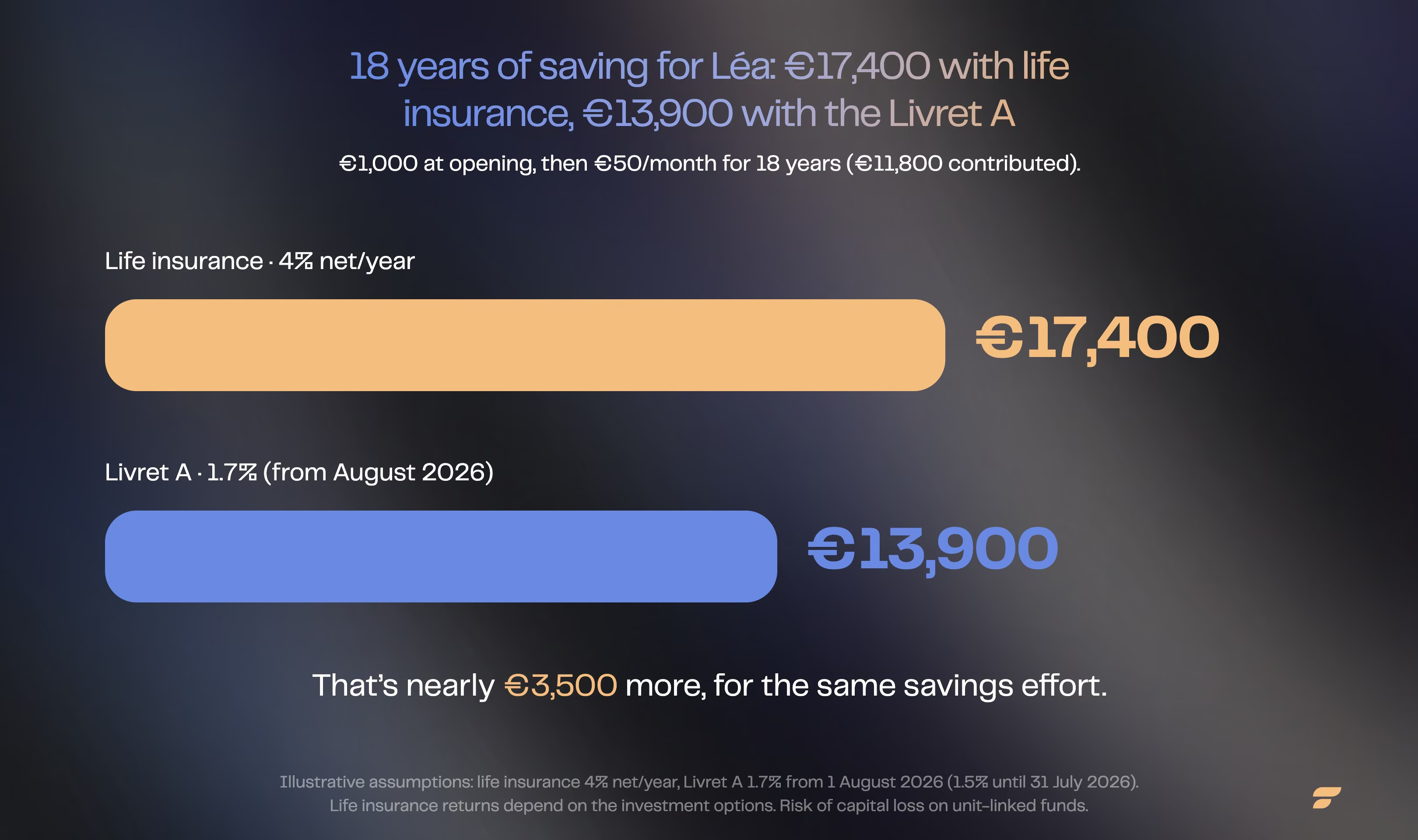
Illustrative example, simplified and constant assumptions. Life insurance returns depend on the investment options chosen. Investing carries risk, including a risk of capital loss on unit-linked funds. Past performance is not a reliable indicator of future performance.
The right approach does not pit the two against each other. The Livret A keeps savings available, life insurance grows the rest. To go further, see our dedicated guide Livret A or life insurance.
How to Fund Your Child's Policy
Once the policy is open, you fund it in two ways: regular contributions, and one-off gifts. The tax distinction between these gifts matters.
A présent d'usage (a customary gift tied to an occasion, such as a birthday, Christmas or passing an exam) is exempt from gift duties and does not count against any tax allowance, as long as it stays proportionate to your income and lifestyle.
A don manuel (a hand-delivered gift), by contrast, is a genuine donation. It must be declared, but it qualifies for generous tax allowances: €100,000 per parent and per child every 15 years, and €31,865 per grandparent and per grandchild. Beyond that, gift duties apply.
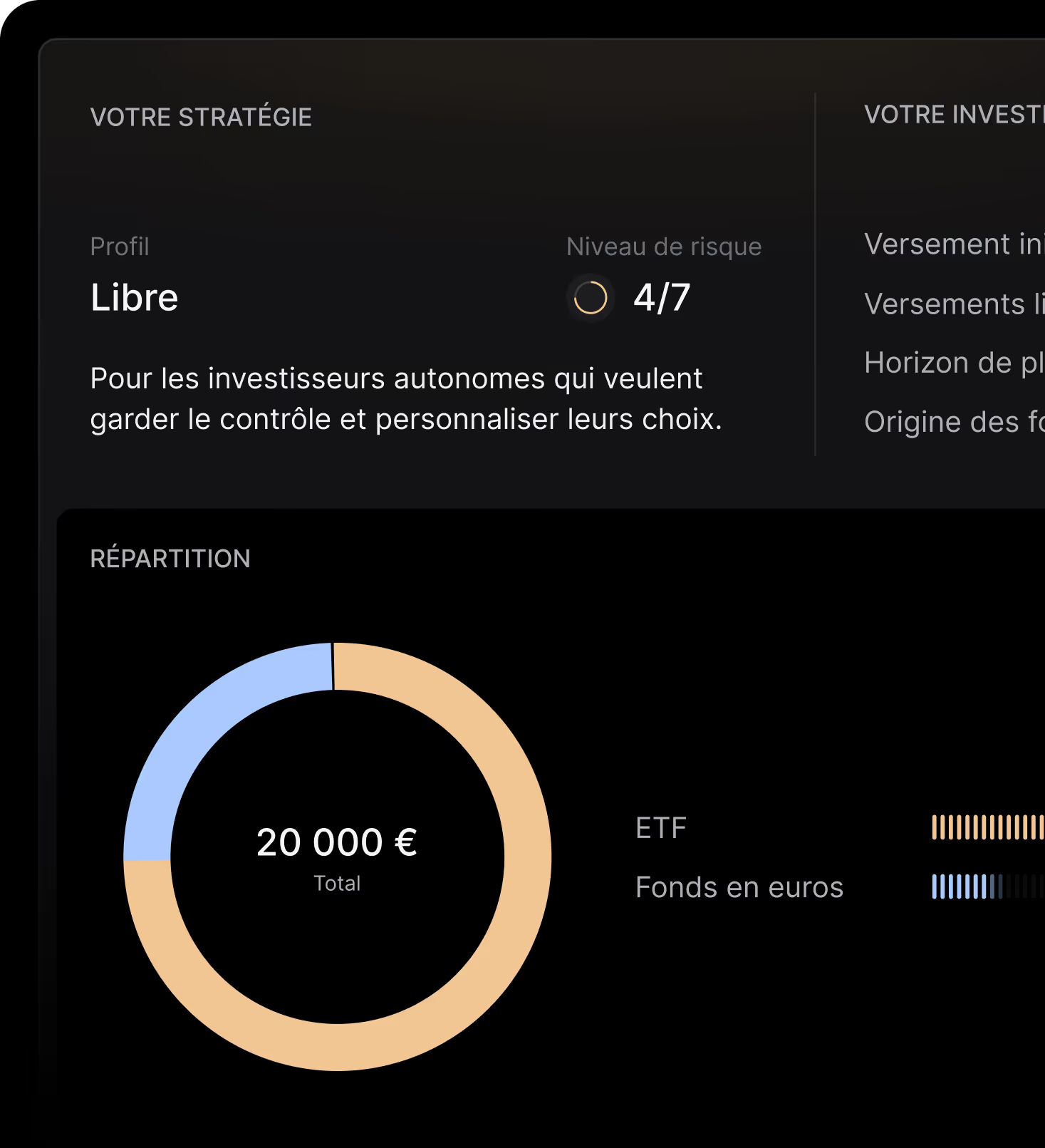
On the investment-option side, an online policy gives access to a wide range to grow this savings over the long term. Finary Life, for example, offers more than 700 investment options, including ETFs and a euro fund, accessible from €300, under self-directed or profiled management.
within reach
Non-contractual document for promotional purposes. Investment in unit-linked vehicles carries a risk of capital loss, since their value is subject to fluctuation, both upwards and downwards, depending in particular on developments in the financial markets. The insurer's commitment relates to the number of units, not their value, which it does not guarantee. The e-vie policy is an individual life insurance policy, denominated in euros and/or unit-linked vehicles, underwritten by Generali Vie, a company governed by the French Insurance Code. Finary SAS - 58 rue de Monceau 75380 Paris 8 - Investment Firm authorised by the ACPR under no. 19283, ORIAS no. 21001279, member of AMAFI.
The Pacte Adjoint: Keeping Control After 18
Here is the answer to the blind spot mentioned in the introduction. The pacte adjoint is a written document that accompanies a gift and governs how the child may use the funds, even after they turn 18.
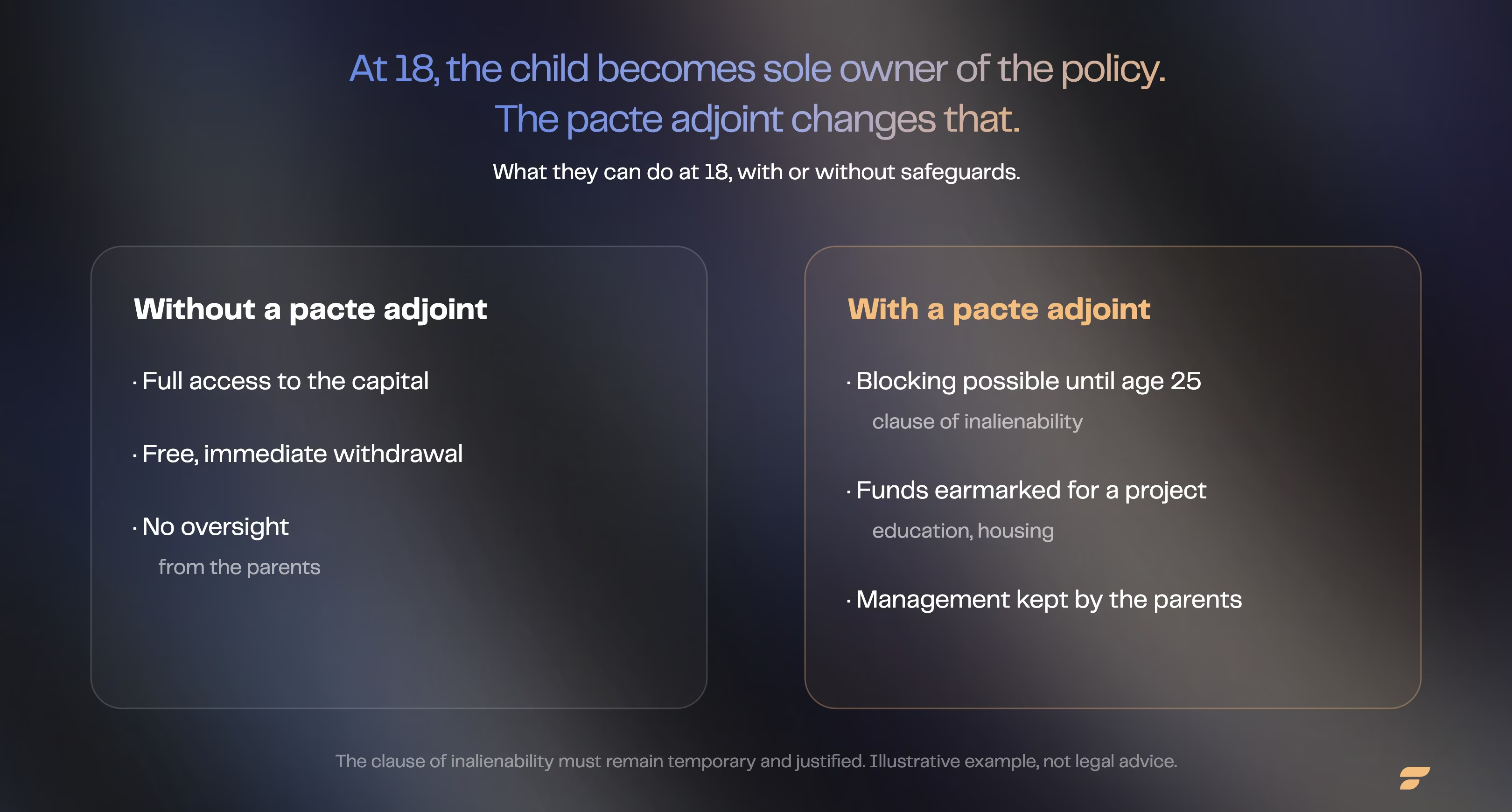
In practice, it lets you add protective clauses. The clause of inalienability blocks withdrawals until an age you set, often 25. The reinvestment clause requires the funds to serve a specific purpose, such as education or housing. The administration clause lets you manage the policy beyond the child's 18th birthday.
Without a pacte adjoint, the child regains full control of the policy at 18, and can withdraw everything. With one, you keep a hand on capital designed for the long term. Also take care over the beneficiary clause, which rounds out this arrangement.
What Happens When the Child Turns 18?
At 18, the minor becomes a policyholder in their own right. Unless a pacte adjoint provides otherwise, they regain full control of their policy: contributions, switches and, above all, withdrawals.
This is the moment of truth. Parents who funded the policy without a pacte adjoint find they have no say left. The child can keep the policy, or withdraw everything.
Hence the value of planning ahead. Since the policy has already been running for years, keeping it open remains almost always the best decision: the tax seniority already acquired has real value. A conversation with the now-adult child beats a bad surprise.
Taxation of Life Insurance for Children in 2026
The taxation of a policy opened for a child follows the standard life insurance rules. It plays out on two levels: withdrawals and transmission.
On withdrawal, only the gains are taxed, never the capital paid in. After 8 years, the policy qualifies for an annual tax allowance on gains of €4,600 (single) or €9,200 (couple). Beyond that, gains are taxed at 7.5% for the share of premiums below €150,000, plus 17.2% in social security contributions. Life insurance was in fact excluded from the 2026 rise in social security contributions, which remain at 17.2%.
On transmission, life insurance remains a powerful tool. For contributions made before the policyholder turns 70, each beneficiary benefits from a tax allowance of €152,500 (Article 990 I of the French General Tax Code). For details, see our guides on life insurance taxation and tax caps and allowances.
How to Open Life Insurance for Your Child, Step by Step
Opening one is simple, especially with an online policy. Here is the typical process.
- Choose the policy: favour a policy with low fees, a solid euro fund and a wide choice of investment options.
- Gather the documents: proof of identity for the child and the legal representatives, the family record book (livret de famille), proof of address.
- Get both parents' consent if required, depending on the amounts and the nature of the transaction.
- Set the allocation: a secure share on the euro fund, a growth share on unit-linked funds, depending on the time horizon.
- Set up the contributions: an initial payment, then scheduled contributions to smooth investment over time.
The Final Word
Opening life insurance for your child is giving the one gift money cannot buy later: time. Fifteen or eighteen years of compounding and tax seniority, impossible to make up for on the day they turn 18. The real risk is not the market, it is forgetting: opening too late, or opening without a pacte adjoint and watching, powerless, as a newly-legal adult empties in one click what you had built for them.
Goals
FAQ: Life Insurance for Children
From What Age Can You Open Life Insurance for a Child?
From birth. The earlier the policy is opened, the sooner it starts the clock and benefits from compound interest. There is no minimum age.
Can Grandparents Open Life Insurance for Their Grandchild?
No, opening one must go through the legal representatives. They can, however, contribute to the child's policy, or open their own policy naming the grandchild as beneficiary.
Can the Child Get the Money Back at 18?
Yes, unless a pacte adjoint provides otherwise. At 18, they become sole master of the policy and can make withdrawals.
Is Both Parents' Consent Required?
For significant contributions and switches, the consent of both legal representatives is generally required. For routine matters, one parent may be enough.
What Is the Contribution Cap on a Child's Life Insurance?
Life insurance has no contribution cap. Only the gift tax allowances limit the amounts that can be transferred tax-free.
Life Insurance or Livret A for a Child?
The two are complementary. The Livret A for available, risk-free savings, life insurance for growing long-term savings over 15 to 18 years.
Regulatory disclaimers:
Marketing communication. Investing carries a risk of partial or total capital loss. Past performance is not a reliable indicator of future performance. This article is provided for information and educational purposes only; it does not constitute personalised investment advice, a buy or sell recommendation, or tax advice.
The capital guarantee on euro funds is provided by the insurer and depends on its financial strength. In a severe systemic crisis, the French Sapin 2 law allows withdrawals to be temporarily restricted (liquidity), without affecting the guaranteed capital. Unit-linked funds are not guaranteed and carry a risk of capital loss.
Before investing, read the Key Information Document (KID) and, where relevant, consult an authorised adviser.
Finary SAS, an investment firm authorised by the ACPR (no. 19283), member of AMAFI. Insurance broker registered with ORIAS (no. 21001279), member of the CNCGP (association approved by the AMF). Crypto-Asset Service Provider (CASP) authorised by the AMF under the MiCA regime, references no. A2026-026 and no. N2026-008.