Life Insurance After 70 in France: Tax and Inheritance Rules for 2026


Past age 70, many people think it is too late to open or fund a life insurance policy in France. It is often the opposite. Gains generated by premiums paid after age 70 escape inheritance tax entirely. Used well, life insurance remains one of the most effective tools for passing on wealth, even at an advanced age.
Everything hinges on a tax shift at age 70, and on a frequent mix-up between the tax on withdrawals and the tax on inheritance. This guide untangles the two, and details the €30,500 allowance, the exemption on gains, contribution strategies, split ownership of the beneficiary clause, and the steps for your loved ones.
In one sentence: at 70, it is not life insurance that changes, it is the tax treatment of premiums on death, and it remains advantageous.

What changes for tax purposes at age 70
Age 70 is a tax threshold, but only for inheritance purposes. What triggers it is not when the policy was opened: it is the date of each premium. A policy opened at 50 that receives premiums at 72 will have those premiums fall under the over-70 regime.
Two regimes therefore coexist, depending on the age at which you pay in.
For premiums paid before age 70, the applicable rule is Article 990 I of the French General Tax Code. Each beneficiary benefits from a €152,500 allowance, across all policies combined. Beyond that threshold, each beneficiary is taxed at 20% on the taxable portion up to €700,000, then at 31.25%. This Article 990 I levy is specific to inheritance tax on death, not to be confused with the flat tax (PFU), which applies to gains on a withdrawal.
For premiums paid after age 70, the applicable rule is Article 757 B. Only the premiums paid enter the taxable base for inheritance tax, after an overall allowance of €30,500. The gains generated by these premiums, meanwhile, are fully exempt.
Before or after age 70: the comparison
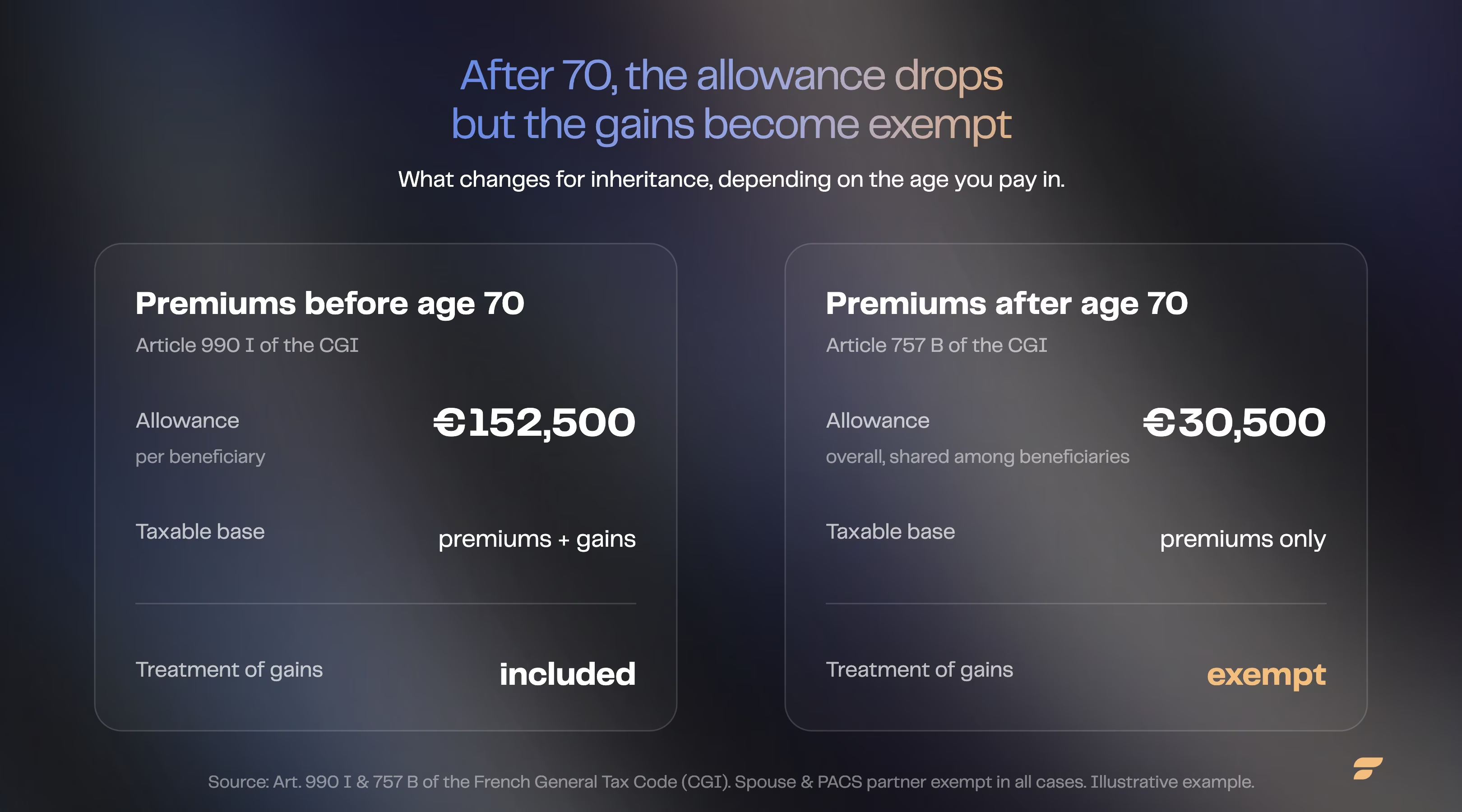
Here are the two regimes side by side, on the points that matter for inheritance.
| Criterion | Premiums before age 70 (Art. 990 I) | Premiums after age 70 (Art. 757 B) |
| Allowance | €152,500 per beneficiary | €30,500 overall (shared) |
| Taxable base | Capital transferred (premiums + gains) | Premiums paid only |
| Treatment of gains | Included in the taxable base | Fully exempt |
| Tax beyond the allowance | 20% then 31.25% | Inheritance tax according to family relationship |
| Spouse / PACS beneficiary | Exempt | Exempt |
This clears up a common misconception. Continuing to pay into a policy after age 70 is not a tax mistake: it is sometimes an excellent strategy, especially if the €152,500 allowance has already been used up. To go further, read our guide on life insurance inheritance tax, and the detail of life insurance tax caps and allowances.
The €30,500 allowance: how it works
The €30,500 allowance applies to premiums paid after age 70. It is a global allowance: it is shared among all taxable beneficiaries, in proportion to their shares, and it covers every policy taken out on the life of the same insured person. Exempt beneficiaries (a married spouse, a PACS partner) are left out of the split and do not reduce the share available to the others.
This is a major difference from the allowance before age 70. The €152,500 applies per beneficiary. The €30,500, on the other hand, is unique across the whole policy and all its beneficiaries. The more beneficiaries there are, the more the allowance is diluted.
A married spouse or a PACS partner escapes this logic entirely: they are fully exempt, regardless of the age at which premiums were paid. The question of the allowance therefore does not arise for them.
The exemption on gains: the most underrated advantage
Here is the point most savers are unaware of, and it is what makes life insurance after 70 such a powerful tool. Only the premiums paid are taxable. All the gains generated by these premiums are exempt from inheritance tax.
Take Jacques, aged 72. He pays €50,000 into his policy. Fifteen years later, that €50,000 is worth €80,000, thanks to interest and capital gains. On his death, only the €50,000 in premiums enters the taxable base, even before the €30,500 allowance. The €30,000 in gains passes to the beneficiary free of any inheritance tax.
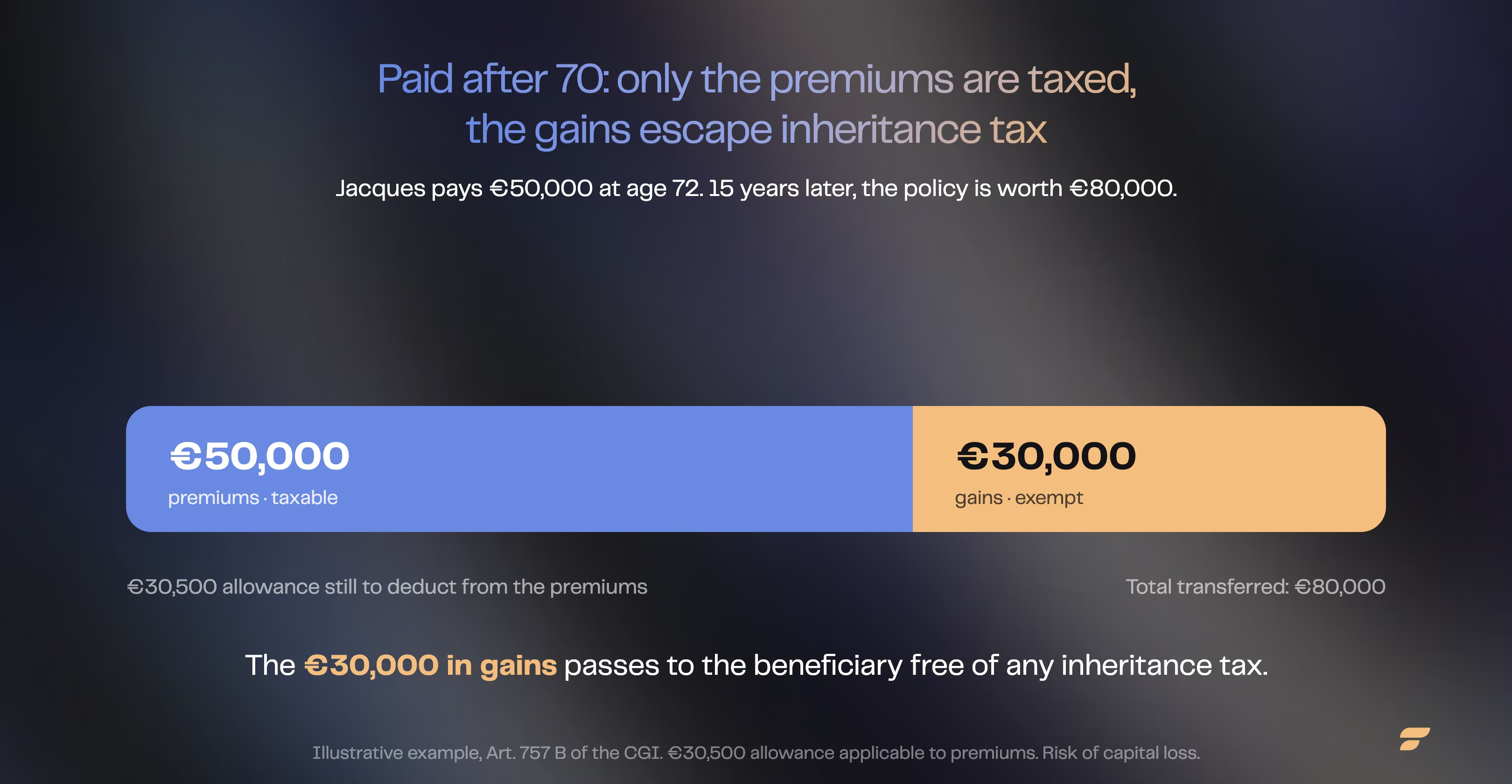
The longer the policy runs after the premium is paid, the larger the exempt share becomes. That is a strong argument for paying in early after age 70, rather than waiting. At this age, a secure euro fund is often the preferred option for growing these premiums without risking the capital: that is, for example, the role of the Netissima fund offered through Finary Life.
Netissima
Non-contractual document for promotional purposes. Investment in unit-linked vehicles carries a risk of capital loss, since their value is subject to fluctuation, both upwards and downwards, depending in particular on developments in the financial markets. The insurer commits to the number of units, not their value, which it does not guarantee. This life insurance policy is an individual life insurance policy, denominated in euros and/or unit-linked vehicles, underwritten by Generali Vie, a company governed by the French Insurance Code. Finary SAS, 58 rue de Monceau 75380 Paris 8, Investment Firm authorised by the ACPR under no. 19283, ORIAS no. 21001279, member of AMAFI
Should you keep paying into your policy after 70?
The answer depends on your situation, but three cases come up often. Here is how to think it through.
If your €152,500 allowance has already been used up, paying in after age 70 reopens a €30,500 allowance, and above all brings in future gains that will be exempt. This is often worthwhile.
If you are aiming to pass wealth to your spouse, the age at which premiums are paid does not matter, since they are exempt in every case. The tax question then shifts to second-tier beneficiaries, such as children.
If you need income, know that paying in for inheritance purposes does not lock up your capital. A withdrawal remains possible at any time.
An advanced strategy exists to go further: split ownership of the beneficiary clause, covered further below.
The tax treatment of withdrawals after age 70
Be careful not to mix things up. Turning 70 changes nothing about the tax treatment of withdrawals. If you take money out of your policy during your lifetime, you are taxed like any other policyholder, based on how long the policy has been held.
In practice, only the gains included in the withdrawal are taxed. After 8 years of holding the policy, the policyholder benefits from an annual allowance of €4,600 (single person) or €9,200 (couple) on gains from a withdrawal. Beyond that, gains are taxed at 7.5% for the portion corresponding to premiums paid not exceeding €150,000 (across all policies combined), and at 12.8% for the portion exceeding that threshold, plus 17.2% in social security contributions in both cases.
The age-70 shift therefore concerns inheritance on death, not your withdrawals. Keeping this distinction in mind avoids many reasoning mistakes.
Split ownership of the beneficiary clause
For larger estates, split ownership of the beneficiary clause is a powerful optimisation. The principle: separate the usufruct from the bare ownership of the capital transferred.
In practice, you name your spouse as beneficiary of the usufruct, and your children as beneficiaries of the bare ownership. On death, the spouse receives the capital and can use it, on the understanding that they must return it to the children on their own death, in the form of a debt claim.
The advantage is twofold. The spouse keeps income and available capital. The children eventually receive the capital, having benefited from an allowance on the value of the bare ownership. Drafting the beneficiary clause is decisive here, and deserves a notary's advice.
Inheritance procedures: how your loved ones are informed
On death, life insurance follows its own process, separate from the standard estate. The capital is paid directly to the named beneficiaries, outside the estate, which is one of its major advantages.
That assumes the beneficiaries know the policy exists. If they do not, they can contact AGIRA, the body responsible for tracing unclaimed life insurance policies. The notary handling the estate also checks for the existence of any policies.
Once informed, beneficiaries then send the insurer the death certificate and supporting documents. The insurer must then pay out the capital within one month of receiving the complete file, beyond which late-payment interest applies. For the general framework, see our guide on life insurance and inheritance.
More capital invested

Non-contractual document for promotional purposes. Investment in unit-linked vehicles carries a risk of capital loss, since their value is subject to fluctuation, both upwards and downwards, depending in particular on developments in the financial markets. The insurer commits to the number of units, not their value, which it does not guarantee. This life insurance policy is an individual life insurance policy, denominated in euros and/or unit-linked vehicles, underwritten by Generali Vie, a company governed by the French Insurance Code. Finary SAS, 58 rue de Monceau 75380 Paris 8, Investment Firm authorised by the ACPR under no. 19283, ORIAS no. 21001279, member of AMAFI
The bottom line
Life insurance after 70 suffers from a poor reputation, built on a misunderstanding. Yes, the allowance drops from €152,500 to €30,500. But in exchange, all future gains become exempt, and the spouse remains protected no matter what. The real risk at this age is not paying in: it is giving up an effective inheritance tool out of fear of a rule that was misunderstood. Understanding the age-70 shift means giving yourself back the choice.
FAQ: life insurance after 70
Can you open a life insurance policy after age 70?
Yes, with no age limit. Premiums will fall under the Article 757 B regime, with an overall allowance of €30,500 and an exemption on gains in the event of inheritance.
What is the life insurance allowance after age 70?
An overall allowance of €30,500 on premiums paid after age 70, shared among all beneficiaries. The gains generated by these premiums are fully exempt.
Are gains really exempt after age 70?
Yes. Only the premiums paid after age 70 enter the taxable base. The interest and capital gains generated escape inheritance tax entirely.
Does the surviving spouse pay tax on life insurance?
No. A married spouse and a PACS partner are fully exempt from inheritance tax on life insurance, regardless of the age at which premiums were paid.
Does the tax treatment of withdrawals change after age 70?
No. Withdrawals remain taxed according to how long the policy has been held, with the annual allowance of €4,600 or €9,200 after 8 years. Age 70 only concerns inheritance.
Do you need to declare life insurance to the notary?
The capital is paid to beneficiaries outside the estate. The notary does, however, check for the existence of policies, and beneficiaries who are unaware of a policy can contact AGIRA.
Regulatory disclaimers:
Marketing communication. Investing carries a risk of partial or total capital loss. Past performance is not a reliable indicator of future performance. This article is provided for information and educational purposes only; it does not constitute personalised investment advice, a buy or sell recommendation, or tax advice.
The capital guarantee on euro funds is provided by the insurer and depends on its financial strength. In a severe systemic crisis, the French "Sapin 2" law allows withdrawals to be temporarily restricted (liquidity), without affecting the guaranteed capital. Unit-linked funds are not guaranteed and carry a risk of capital loss.
Before investing, read the Key Information Document (KID) and, where relevant, consult an authorised adviser.
Finary SAS, an investment firm authorised by the ACPR (no. 19283), member of AMAFI. Insurance broker registered with ORIAS (no. 21001279), member of the CNCGP (association approved by the AMF). Crypto-Asset Service Provider (CASP) authorised by the AMF under the MiCA regime, references no. A2026-026 and no. N2026-008.