Unlocking a life insurance policy in France: complete guide

Updated on 7 August 2026
Unlocking a life insurance policy in France means recovering all or part of your savings, through a partial withdrawal, a full surrender or a policy advance. This guide details the procedures, timelines and taxation that apply depending on how long the policy has been open, so you can choose the option best suited to your situation.

- Three options let you unlock a life insurance policy: a partial withdrawal, a full surrender or a policy advance, each with different tax consequences.
- After 8 years, gains withdrawn benefit from an annual tax allowance of €4,600 (€9,200 for a couple), then a reduced tax rate of 7.5% beyond that.
- The 17.2% social security contributions apply in every case, regardless of the policy's age.
- The insurer has a contractual deadline to pay out the funds (a few days for a withdrawal, 1 month after a death).
Why and when should you unlock a life insurance policy?
You can unlock a life insurance policy at any time, through a partial withdrawal, a full surrender or a policy advance, or when the policyholder dies, for the benefit of the named beneficiaries. At the end of December 2025, total life insurance assets in France reached €2.107 trillion, according to France Assureurs, making it the French people's favourite financial investment.
Common reasons for unlocking a policy before term
You can unlock your life insurance policy before its term to fund projects or deal with the unexpected. For example, a real-estate investment opportunity or urgent repairs to your home.
Unplanned life projects are often what drives this decision. Funding your children's studies abroad, launching your business, or that trip you have been dreaming of for years. Your life insurance policy can give you a financial boost.
There are also less welcome surprises. Job loss, significant medical expenses or a drop in income can force you to dip into these savings. In these difficult moments, your life insurance policy acts as a safety net.
When the policyholder dies
The policyholder's death is a special case. Unlocking the funds is not automatic. The beneficiary clause determines what happens to your savings.
The named beneficiaries must contact the insurer directly. They will need to provide a death certificate, proof of identity and other documents. The insurer then has one month to pay out the funds after receiving the complete file.
Other special circumstances
French law provides for cases where unlocking the policy comes with favourable tax treatment, acting as a financial lifeline.
Article 125-0 A II of the French General Tax Code (Code général des impôts, CGI) provides an exemption from income tax (but not from social security contributions) in four situations: dismissal, compulsory liquidation, early retirement, or recognition of a category 2 or 3 disability. This exemption applies to the policyholder or their spouse or civil partner (PACS), provided the withdrawal takes place before the end of the year following the event.
Find all the conditions on the website of the French Ministry of the Economy and Finance.
Impact on management fees
Unlocking your life insurance policy can affect the policy's management fees.
With a partial withdrawal, fees continue to apply to the remaining capital. Some policies also charge extra fees on withdrawals, depending on the policy's age or the amount withdrawn.
For example, with 1% in annual fees, withdrawing half the capital will reduce the fees in absolute terms, but their relative weight will stay the same.
If your policy holds unit-linked funds, a withdrawal can trigger automatic fund switches, generating extra fees.
It is essential to review your policy's terms before unlocking it. A poorly planned withdrawal can cost more than expected, eating into your savings.
What are the different ways to unlock a life insurance policy?
Three solutions let you unlock a life insurance policy: a partial withdrawal, a full surrender and a policy advance, each with different consequences for taxation and the policy's structure.

Partial withdrawal
A partial withdrawal lets you take out part of your savings without ending your policy. This option can meet a one-off financial need without sacrificing the long-term benefits.
Say you need €10,000 for renovation work. Instead of closing the policy, you make a partial withdrawal of that amount. Your policy keeps existing and growing, and you keep the tax benefits tied to its age.
Be careful, though: a partial withdrawal can change how your savings are split between the euro fund and unit-linked funds. You could end up with a different risk profile than the one you originally chose.
Full surrender
A full surrender means recovering all of your savings. But be careful: your policy is then permanently closed.
This option can look appealing if you need a large sum quickly, to buy a house or invest in your business. Still, it is worth weighing the implications carefully. By closing your policy, you lose all the tax benefits built up over the years.
A full surrender can also expose you to heavier taxation, especially if your policy is less than 8 years old. You could end up paying tax on a large share of your gains, when a partial withdrawal might have been more tax-efficient.
Policy advance
A policy advance is another option. Your insurer lends you money, using your savings as collateral.
Say you need €20,000 for a car. Instead of withdrawing that amount, you ask your insurer for an advance.
The main advantage? Your policy stays untouched. You do not draw on your savings, you trigger no taxation, and your policy keeps growing.
But it is not free: you will have to pay interest on the advance. And if you do not repay it in time, the insurer can make a withdrawal from your policy to reimburse itself, which would then trigger tax on the corresponding gains.
More capital invested
Non-contractual document for promotional purposes. Investment in unit-linked funds carries a risk of capital loss, since their value is subject to fluctuation, both upwards and downwards, depending in particular on developments in the financial markets. The insurer guarantees the number of unit-linked funds held, not their value, which it does not guarantee. The e-vie life insurance policy is an individual life insurance policy, denominated in euros and/or unit-linked funds, underwritten by Generali Vie, a company governed by the French Insurance Code. Finary SAS - 58 rue de Monceau 75380 Paris 8 - Investment Firm authorised by the ACPR under no. 19283, ORIAS no. 21001279, member of AMAFI
Procedure and timelines for unlocking a life insurance policy
Steps to request a withdrawal
To unlock your life insurance policy, follow these steps:
- Prepare your file with proof of identity, a bank account statement (RIB) and a recent proof of address. Above a certain amount, which varies by insurer, you will also need to fill in an additional questionnaire.
- Submit your request, specifying the policy number, the amount to withdraw (for a partial withdrawal) and your tax option.
- Send your request, online if possible, or otherwise by registered letter or through an advisor.
Processing times
Once the request is sent, the insurer has a contractual deadline to pay out the funds. In practice:
- For a partial withdrawal, the timeline averages 3 days (indicative, and it varies by insurer), sometimes as little as 24 hours if everything is in order.
- For a full surrender, expect generally between 1 and 6 days (indicative, and it varies by insurer).
Be careful: if your policy holds unit-linked funds, the timeline can stretch to 20 days for funds that are not priced weekly.
What taxation applies when you unlock a life insurance policy?
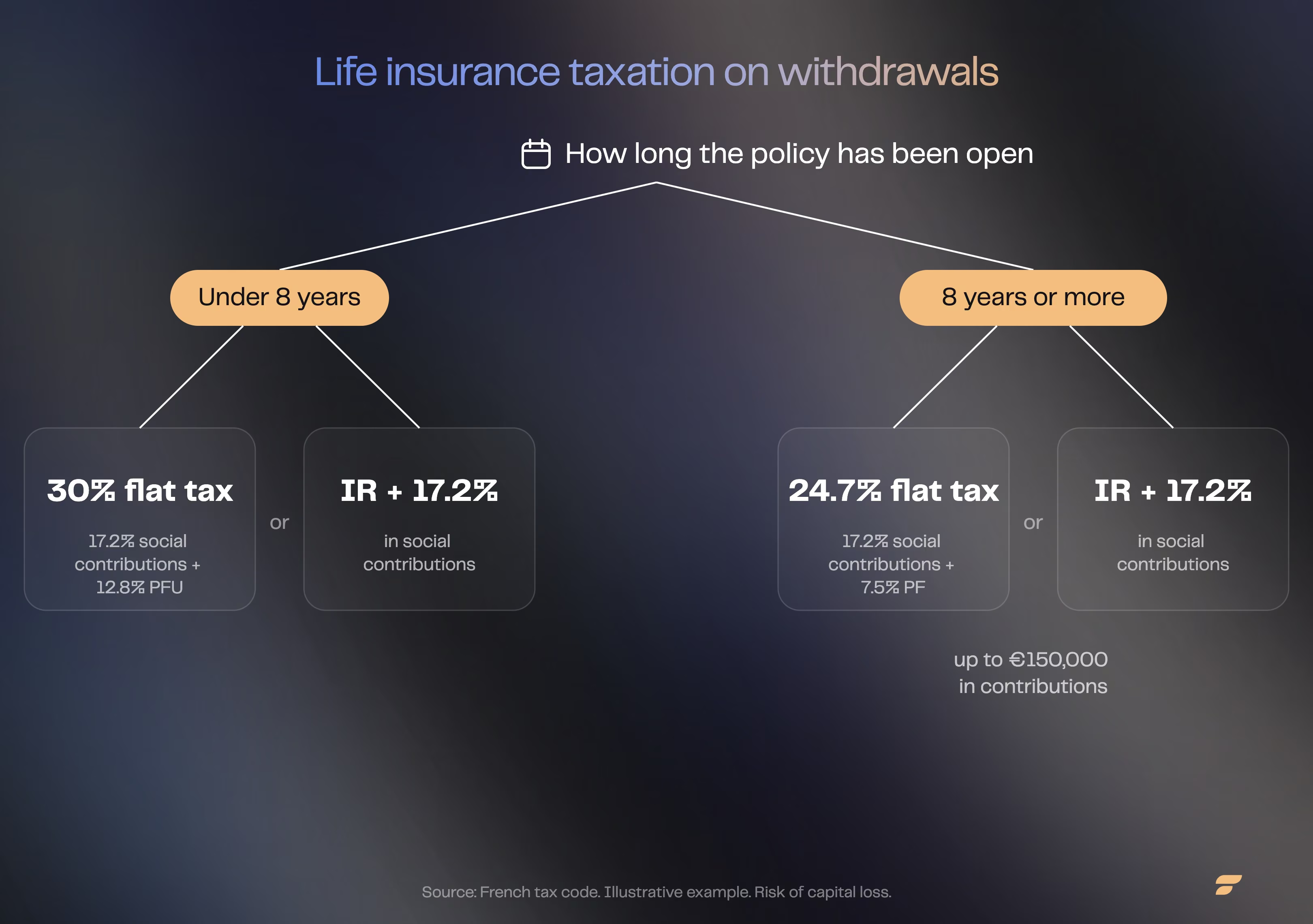
The taxation of a withdrawal depends above all on the policy's age: before 8 years, gains are taxed at 30% (17.2% in social security contributions and 12.8% in flat-rate withholding) or under the income tax scale; after 8 years, an annual tax allowance applies and the rate drops to 24.7%, up to €150,000 in cumulative contributions.
Taxation on gains
This taxation depends on the policy's age:
Impact of social security contributions
The 17.2% social security contributions apply no matter what, regardless of the policy's age.
For euro funds, they are deducted every year. For unit-linked funds, they are deducted at the time of withdrawal.
Tax allowances and exemptions
After 8 years, you benefit from an annual allowance worth €4,600 (€9,200 for a couple) on income tax, but not on social security contributions.
Special cases
You can benefit from an income tax exemption (but not on social security contributions) in the event of dismissal, early retirement, compulsory liquidation or a category 2 or 3 disability.
This exemption only applies in the year of the dismissal or disability, or the year after.
Remember that unlocking the policy should always be a carefully considered decision, even where an exemption applies. You are drawing on savings meant for other projects.
Releasing the funds when the policyholder dies
Procedures for beneficiaries
When the policyholder dies, the beneficiaries must follow these steps:
- Notify the insurance company of the death.
- Gather the requested documents: death certificate, proof of identity, etc.
- Once the file is complete, the insurer has 1 month to pay out the funds (or face penalties).
Tax scales and specific exemptions
Taxation depends on the policyholder's age when the contributions were made:
- For premiums paid before age 70: each beneficiary has a tax allowance of €152,500. Beyond that, a 20% levy applies between €152,500 and €852,500, then 31.25%.
- For premiums paid after age 70: an overall allowance of €30,500 (across all policies and beneficiaries combined) applies to the premiums only. Beyond that, the excess premiums are subject to inheritance tax based on the family relationship. The gains generated by those premiums, however, remain fully exempt from inheritance tax.
The importance of the beneficiary clause
The beneficiary clause determines what happens to your savings after your death. It works a bit like a financial will.

Timeline for receiving the funds after death
Once the complete file has been received, the insurer has one month to pay the capital out to the beneficiaries.
But be careful: gathering all the documents (death certificate, proof of identity, etc.) can take time, especially if the beneficiaries are unaware the policy exists.
If the insurer exceeds the legal deadline, late-payment penalties apply:
- The statutory interest rate increased by 50% for the first 2 months of delay
- Doubled after that
In some cases, if the beneficiaries cannot be found, the insurer must keep searching for them for 10 years. After that period, the funds are transferred to the Caisse des Dépôts et Consignations (the French public deposits authority).
Unlocking the funds after a death takes patience and diligence from everyone involved.
Unlocking a life insurance policy is a decision that deserves careful thought and strategy. From understanding the different withdrawal options to navigating the maze of taxation, every step calls for close attention.
Your life insurance policy is a long-term investment. Unlocking it deserves careful thought to weigh the consequences.
within your reach
Non-contractual document for promotional purposes. Investment in unit-linked funds carries a risk of capital loss, since their value is subject to fluctuation, both upwards and downwards, depending in particular on developments in the financial markets. The insurer guarantees the number of unit-linked funds held, not their value, which it does not guarantee. The e-vie life insurance policy is an individual life insurance policy, denominated in euros and/or unit-linked funds, underwritten by Generali Vie, a company governed by the French Insurance Code. Finary SAS - 58 rue de Monceau 75380 Paris 8 - Investment Firm authorised by the ACPR under no. 19283, ORIAS no. 21001279, member of AMAFI
Frequently asked questions
Who can unlock a life insurance policy?
As a general rule, only the policyholder can unlock their life insurance policy while they are alive. It is their policy, their money, their decision.
The exception is if the policyholder becomes legally incapacitated. A guardian or conservator can then be appointed to make decisions on their behalf.
After the policyholder's death, it is the beneficiaries named in the policy who can claim their share from the insurer.
How does life insurance taxation change over time?
The policy's age is decisive: the older it is, the more favourable the taxation. After 8 years, you benefit from an annual tax allowance of €4,600 (€9,200 for a couple) and a reduced tax rate of 7.5% on gains beyond that, up to €150,000 in cumulative contributions.
What can you do if the insurer refuses?
If the insurer refuses to unlock your life insurance policy, you have options:
- Ask the insurer for a written explanation; it must justify its refusal.
- If the refusal stands, you can turn to the insurance ombudsman, who will review your file and issue an opinion (generally within 90 days).
- As a last resort, you can consider legal action, but try to exhaust the other options first.
How can you minimise the fees linked to unlocking a policy?
Several levers can help limit the fees:
- It can help to check for any withdrawal fees, especially in the policy's early years. When possible, waiting for them to disappear can pay off.
- Partial withdrawals are often more tax-efficient than full surrenders and can avoid closing fees.
- Watch out for automatic fund switches after a partial withdrawal, which can generate extra fees.
- Compare your options: a policy advance can be cheaper than a withdrawal if you plan to repay quickly.
The goal is to keep as much of your savings as possible while minimising the fees linked to unlocking the policy.
Sources
Economie.gouv.fr, what is the tax treatment of life insurance?
Service-public.fr, life insurance
Légifrance, article L132-21 of the French Insurance Code: deadline for paying the surrender value
La Médiation de l'Assurance (the insurance ombudsman)
Regulatory disclaimers: Marketing communication. Investing carries a risk of partial or total capital loss. Past performance is not a reliable indicator of future performance. This article is provided for information and educational purposes only; it does not constitute personalised investment advice, a buy or sell recommendation, or tax advice. The capital guarantee on euro funds is provided by the insurer and depends on its financial strength. In a severe systemic crisis, the French "Sapin 2" law allows withdrawals to be temporarily restricted (liquidity), without affecting the guaranteed capital. Unit-linked funds are not guaranteed and carry a risk of capital loss. Before investing, read the Key Information Document (KID) and, where relevant, consult an authorised adviser. Finary SAS, an investment firm authorised by the ACPR (no. 19283), member of AMAFI. Insurance broker registered with ORIAS (no. 21001279), member of the CNCGP (association approved by the AMF). Crypto-Asset Service Provider (CASP) authorised by the AMF under the MiCA regime, references no. A2026-026 and no. N2026-008.