Life insurance tax allowance in France: how it's calculated and how it works

Updated on 5 August 2026
After 8 years of holding, gains withdrawn from a French life insurance policy benefit from an annual tax allowance of €4,600 for a single person (€9,200 for a married or civil-partnered couple), before the remaining tax rules apply. This article explains how the allowance works on a withdrawal and on a transmission of capital, along with strategies to optimise it.

- The allowance is assessed per tax household and applies across all policies held, not policy by policy.
- Beyond the allowance, the reduced rate of 7.5% applies to gains up to €150,000 of net contributions per person, then 12.8% above that.
- On death, an allowance of €152,500 per beneficiary is available for contributions made before age 70.
- Social contributions of 17.2% remain due on the entire gain, including the portion covered by the allowance.
- A spouse or civil partner (PACS) benefits from a full exemption from inheritance tax, with no cap on the amount.
What is a tax allowance?
Definition of a tax allowance
A tax allowance is a deduction applied by the tax authorities to a taxpayer's taxable base. It is an amount subtracted from the sum subject to tax, which reduces the overall tax burden.
For life insurance, the allowance applies to realised gains, reducing or even cancelling the tax on part of the income generated by the policy.
Purpose of the tax allowance
The tax allowance serves two main purposes:
- Encourage certain investments or economic behaviours.
- Reward long-term holding by lowering the tax on gains.
By offering targeted tax advantages, the French state encourages individuals to direct their savings towards investments deemed beneficial to the economy. Life insurance, for example, benefits from such allowances. This tax policy aims to encourage long-term saving and make it easier to pass on wealth.
How does the life insurance allowance work on a withdrawal?
On a policy older than 8 years, gains withdrawn benefit from an annual allowance of €4,600 for a single person or €9,200 for a married or civil-partnered couple, before the reduced rate of 7.5% applies.
Conditions for the allowance to apply
The allowance on gains from a life insurance withdrawal is subject to specific conditions:
- The policy must be more than 8 years old.
- The allowance applies to realised gains (interest and capital gains), not to the capital invested.
Amount of the available allowances
The annual allowance amounts are set as follows:
- €4,600 for a single person (unmarried, divorced or widowed).
- €9,200 for a married or civil-partnered couple subject to joint taxation.
These amounts apply every year, across all policies combined (service-public.gouv.fr, 2026).
Examples of allowance calculations on a withdrawal
Take two examples to illustrate how the allowance works:
- A €10,000 withdrawal including €2,000 of gains, for a single person (policy older than 8 years, premiums paid below €150,000):
- Gains (€2,000) < allowance (€4,600) → gains taxable under income tax: €0
- Income tax saved: €2,000 × 7.5% = €150
- Social contributions due: €2,000 × 17.2% = €344
- An €80,000 withdrawal including €8,000 of gains, for a couple (policy older than 8 years, premiums paid below €150,000 per person (policyholder)):
- Gains (€8,000) < allowance (€9,200) → gains taxable under income tax: €0
- Income tax saved: €8,000 × 7.5% = €600
- Social contributions due: €8,000 × 17.2% = €1,376
Annual allowance: single person vs married/civil-partnered couple
The allowance for a married or civil-partnered couple (€9,200) is exactly double that of a single person (€4,600). This difference gives couples a larger tax advantage, encouraging joint saving within the household.
This allowance applies per tax household, not per policy. A couple can therefore spread their allowance across multiple life insurance policies.
More capital invested
Non-contractual document for promotional purposes. Investment in unit-linked funds carries a risk of capital loss, since their value is subject to fluctuation, both upwards and downwards, depending in particular on developments in the financial markets. The insurer commits to the number of units, not to their value, which it does not guarantee. This life insurance policy is an individual life insurance policy, denominated in euros and/or unit-linked vehicles, underwritten by Generali Vie, a company governed by the French Insurance Code. Finary SAS — 58 rue de Monceau 75380 Paris 8 — Investment Firm authorised by the ACPR no. 19283, ORIAS no. 21001279, member of AMAFI
The life insurance allowance on a transmission of capital
Conditions that apply when the policyholder dies
The allowance that applies when life insurance capital is transmitted depends on several factors:
- The policyholder's age when the contributions were made.
- The date of the contributions.
- The family relationship between the policyholder and the beneficiary.
These criteria determine the amount of the applicable allowance and the tax treatment of the transmitted capital.
Allowance amounts depending on the conditions
The allowances vary according to the following conditions:
- Contributions made before the policyholder turns 70:
- Full exemption for premiums paid before 13/10/1998.
- A €152,500 allowance per beneficiary for premiums paid after 13/10/1998.
- Contributions made after the policyholder turns 70:
- Full exemption for contributions made before 13/10/1998 (policies taken out before 20/11/1991).
- An overall allowance of €30,500 for contributions made after 13/10/1998.
These allowances are set by articles 990 I and 757 B of the French General Tax Code (ProfessionCGP, 2026).
Practical examples of transmission and the corresponding allowances
Example 1: Transmission of €300,000 in capital (contributions made before age 70)
- Beneficiary 1: €150,000 → Full exemption (< €152,500).
- Beneficiary 2: €150,000 → Full exemption (< €152,500).
Example 2: Transmission of €500,000 in capital (contributions made after age 70)
- Overall allowance of €30,500.
- Amount subject to inheritance tax: €469,500.
How does the choice of beneficiaries affect the allowances?
The choice of beneficiaries has a significant impact on the allowances:
- Naming multiple beneficiaries:
- Each beneficiary benefits from a €152,500 allowance for contributions made before age 70.
- Helps maximise the total exemption.
- Naming a spouse or civil (PACS) partner:
- Full exemption, whatever the amount transmitted.
- Other family relationships:
- Other beneficiaries - contributions before age 70 (art. 990 I):
- Beyond the €152,500 allowance, a flat tax of 20% up to €852,500, then 31.25% above that - regardless of the family relationship.
- Other beneficiaries - contributions after age 70 (art. 757 B):
- Beyond the overall €30,500 allowance, the inheritance tax scale based on the family relationship applies (from 5% between close relatives up to 60% for non-relatives).
- Other beneficiaries - contributions before age 70 (art. 990 I):
What specific allowances apply to spouses and PACS partners?
Spouses and PACS partners benefit from a privileged tax treatment:
- Full exemption from inheritance tax.
- No cap on the amount of capital transmitted.
- Applies regardless of the policyholder's age when the contributions were made.
This exemption adds to the other tax advantages that spouses and PACS partners already enjoy on inheritance. It reinforces the value of life insurance as a wealth-transmission tool within the couple.
What is the tax treatment of life insurance outside the allowance?
Outside the allowance, gains from a withdrawal are subject, at the taxpayer's choice, to the progressive income tax scale or to the flat tax: 12.8% before 8 years or 7.5% after 8 years, plus 17.2% in social contributions.
Income tax vs the flat tax (PFU)
The taxation of life insurance offers two main options for taxing gains:
- Income tax (IR):
- Gains are added to taxable income.
- The progressive income tax scale applies.
- Can be advantageous for taxpayers in a low tax bracket.
- The flat tax (PFU):
- A fixed rate of 12.8% + 17.2% in social contributions (i.e. 30% in total, impots.gouv.fr, 2026).
- Simple to calculate and predictable.
- Often more advantageous for taxpayers in a high tax bracket.
The choice between these two options is left to the taxpayer, who can pick whichever is more advantageous when filing their income tax return.
Tax differences depending on the date of the contributions (before/after 27 September 2017)
Life insurance taxation varies according to the date the contributions were made:
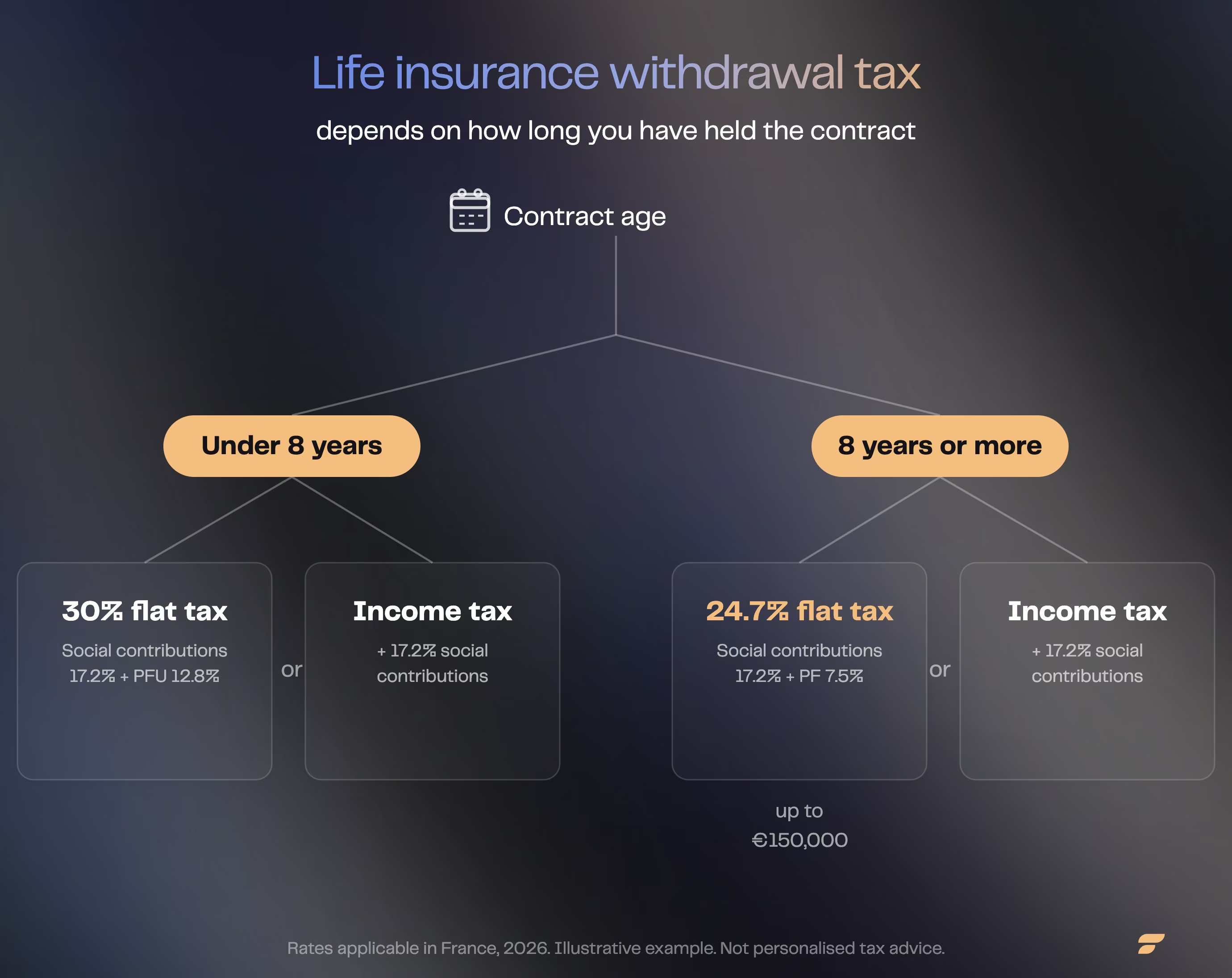
In both cases, social contributions of 17.2% are added on top of these tax rates.
For policies older than 8 years, the annual allowance of €4,600 (€9,200 for a couple) applies before tax, regardless of when the contributions were made.
Example calculation for a withdrawal
Take a €20,000 withdrawal including €5,000 of gains on a 10-year-old policy (contributions made after 27/09/2017):
- Applying the allowance: €5,000 - €4,600 = €400 of taxable gains.
- PFU tax: €400 x 7.5% = €30 of tax.
- Social contributions: social contributions of 17.2% apply to the entire gain (€5,000), regardless of the tax allowance, i.e. €5,000 x 17.2% = €860.
- Total deductions: €30 + €860 = €890.
This difference in tax treatment based on the contribution date encourages savers to keep their older policies while also opening new ones, so as to benefit from the advantages specific to each tax regime.
Understanding the levers linked to the life insurance allowance
Levers built into the regulation
Several regulatory levers can be considered depending on your situation:
- Keep policies for the long term:
- Keep your policies for at least 8 years to benefit from the annual allowance.
- Take advantage of the favourable tax rate on gains (7.5% after 8 years).
- Name multiple beneficiaries:
- Name multiple beneficiaries to maximise the €152,500 allowance per person.
- Spread the capital across different family members.
- Hold several policies:
- Open one policy per parent to double the overall €30,500 allowance on contributions made after age 70.
Policyholder age and contribution dates
Optimising the allowances depends largely on the policyholder's age and the dates of the contributions:
- Before age 70:
- Contributions made before age 70 benefit from the €152,500 allowance per beneficiary.
- Take advantage of there being no cap on the amounts contributed.
- After age 70:
- Beyond €30,500 contributed after age 70, the excess capital enters the estate, but the gains generally remain exempt - which can still be advantageous.
- Consider other savings options for any additional amounts.
Rules that apply to contributions and withdrawals
- Staggering withdrawals:
- Make annual withdrawals within the allowance (€4,600 or €9,200 for a couple).
- Spread withdrawals over several years to maximise the tax advantage.
- Managing contributions:
- According to the French public service portal, the reduced rate of 7.5% applies to gains up to €150,000 of net contributions per person; beyond that threshold, the rate rises to 12.8%.
- Split contributions between spouses to double this threshold.
- Optimising the transmission of capital:
- Contributions made before age 70 make it possible to maximise the €152,500 allowance per beneficiary.
- Naming the spouse as beneficiary gives entitlement to a full exemption.
Why is it advantageous to cap annual withdrawals at the allowance thresholds?
Capping annual withdrawals at the allowance thresholds (€4,600 or €9,200 for a couple) offers several advantages:
- Full exemption on gains:
- Gains within the allowance are exempt from income tax (social contributions of 17.2% remain due).
- Maximum tax saving on these amounts.
- Preserving capital:
- Limited withdrawals keep a larger capital invested in the policy.
- Keep the savings' growth potential intact.
- Smoothing the tax burden:
- Spread withdrawals over several years to optimise the overall tax burden.
- Avoid threshold effects that could increase the tax burden.
Is opening several policies an efficient method?
Opening several life insurance policies is an option available to the policyholder. Life insurance offers several notable advantages.
First, it allows for diversification across investment options, depending on the policy chosen. It offers different management options suited to each person's needs and goals.
The transmission of capital can be organised, with the option of naming different beneficiaries for each policy.
Some limits are worth noting. The annual allowance applies across all life insurance policies held, which can limit the tax advantage for savers who hold several policies.

There are, however, special cases worth considering. It can be worthwhile to keep older policies that benefit from favourable tax conditions inherited from earlier, more generous legislation.
within reach
Non-contractual document for promotional purposes. Investment in unit-linked funds carries a risk of capital loss, since their value is subject to fluctuation, both upwards and downwards, depending in particular on developments in the financial markets. The insurer commits to the number of units, not to their value, which it does not guarantee. This life insurance policy is an individual life insurance policy, denominated in euros and/or unit-linked vehicles, underwritten by Generali Vie, a company governed by the French Insurance Code. Finary SAS — 58 rue de Monceau 75380 Paris 8 — Investment Firm authorised by the ACPR no. 19283, ORIAS no. 21001279, member of AMAFI
Frequently asked questions
From when does a life insurance policy become eligible for the tax allowance?
The allowance applies to gains withdrawn once the policy reaches 8 years of age, counted from its subscription date rather than from each individual contribution. Before that threshold, gains remain subject to the 30% flat tax (12.8% tax and 17.2% social contributions).
Does the €4,600 allowance (or €9,200 for a couple) renew every year?
Yes, this allowance is annual: it renews every calendar year and applies to all withdrawals made during the year, across all life insurance policies combined. Any unused portion in a given year cannot be carried over to the next.
Does an unmarried partner (concubin) benefit from the same exemption as a spouse or PACS partner on death?
No. Unlike a spouse or PACS partner, an unmarried partner is not entitled to any standard exemption on the transmitted capital. They are treated like any other beneficiary: a €152,500 allowance, then a flat tax of 20% up to €852,500, and 31.25% above that, for premiums paid before age 70.
Does the tax allowance also apply to the 17.2% social contributions?
No, the allowance only reduces the base for income tax or the flat tax. Social contributions of 17.2% remain due on the entire gain realised on the withdrawal, including the portion covered by the allowance.
Does the €4,600 / €9,200 allowance apply per policy or across all policies held?
The allowance is assessed per tax household, not per policy. A saver who holds several life insurance policies must add up the gains from all their withdrawals during the year to determine the amount subject to the €4,600 or €9,200 allowance.
Sources
Service-public.fr, What tax applies to the proceeds of a life insurance policy? (in French)
impots.gouv.fr, Life insurance and the PEA (in French)
ProfessionCGP, Life insurance and the article 990 I levy of the French Tax Code (in French)
Regulatory disclaimers: Marketing communication. Investing carries a risk of partial or total capital loss. Past performance is not a reliable indicator of future performance. This article is provided for information and educational purposes only; it does not constitute personalised investment advice, a buy or sell recommendation, or tax advice. The capital guarantee on euro funds is provided by the insurer and depends on its financial strength. In a severe systemic crisis, the French "Sapin 2" law allows withdrawals to be temporarily restricted (liquidity), without affecting the guaranteed capital. Unit-linked funds are not guaranteed and carry a risk of capital loss. Before investing, read the Key Information Document (KID) and, where relevant, consult an authorised adviser. Finary SAS, an investment firm authorised by the ACPR (no. 19283), member of AMAFI. Insurance broker registered with ORIAS (no. 21001279), member of the CNCGP (association approved by the AMF). Crypto-Asset Service Provider (CASP) authorised by the AMF under the MiCA regime, references no. A2026-026 and no. N2026-008.