Self-Directed or Profiled Management for Life Insurance in France: 2026 Guide


You've just opened a life insurance policy in France. One question stops you at the very first step: pick your investment options yourself, or let the policy handle it? That is the whole point of self-directed management versus profiled management. And contrary to a common assumption, delegating does not necessarily mean paying more.
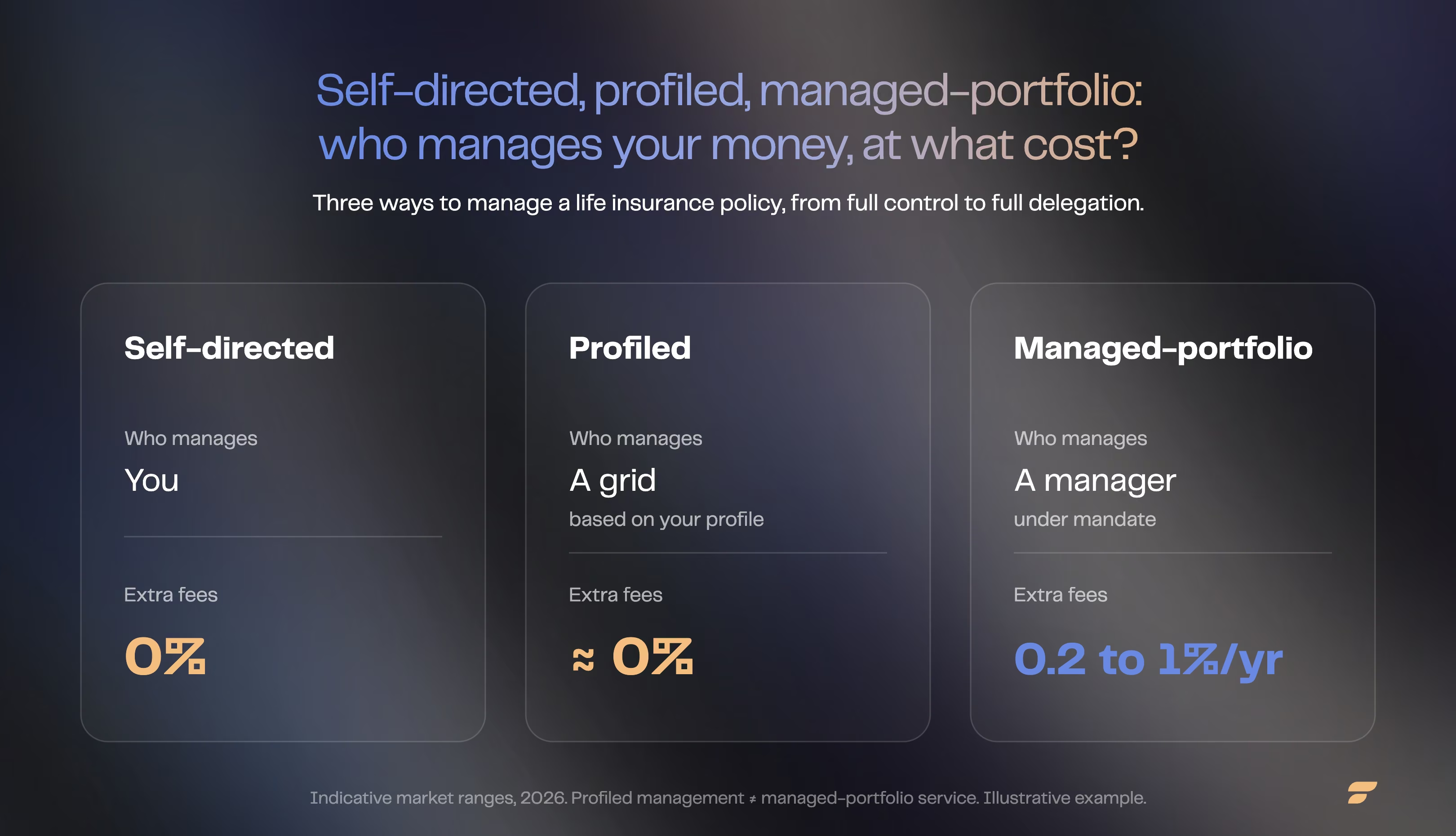
This guide compares the two approaches point by point: how they work, fees, autonomy, performance and taxation. It also clears up a common mix-up, the one between profiled management and the managed-portfolio service, which differ in both how they work and what they cost. By the end, you will know which one matches your profile.
In one sentence: self-directed management lets you choose everything. Profiled management, by contrast, automatically applies an allocation based on a risk profile, usually at no extra cost.

Self-directed or profiled management: the difference in 30 seconds
Self-directed management is the mode where you choose and switch your investment options yourself. Profiled management is an automatic allocation based on a risk profile you set at the start.
The whole decision comes down to one question: do you want to stay in control, or delegate the allocation to a ready-made grid?
| Criterion | Self-directed management | Profiled management |
| Who decides | You | An allocation grid based on your profile |
| Extra fees | None | Usually none |
| Who it suits | The autonomous saver | Anyone who wants a simple, turnkey option |
Self-directed management: you steer your life insurance policy yourself
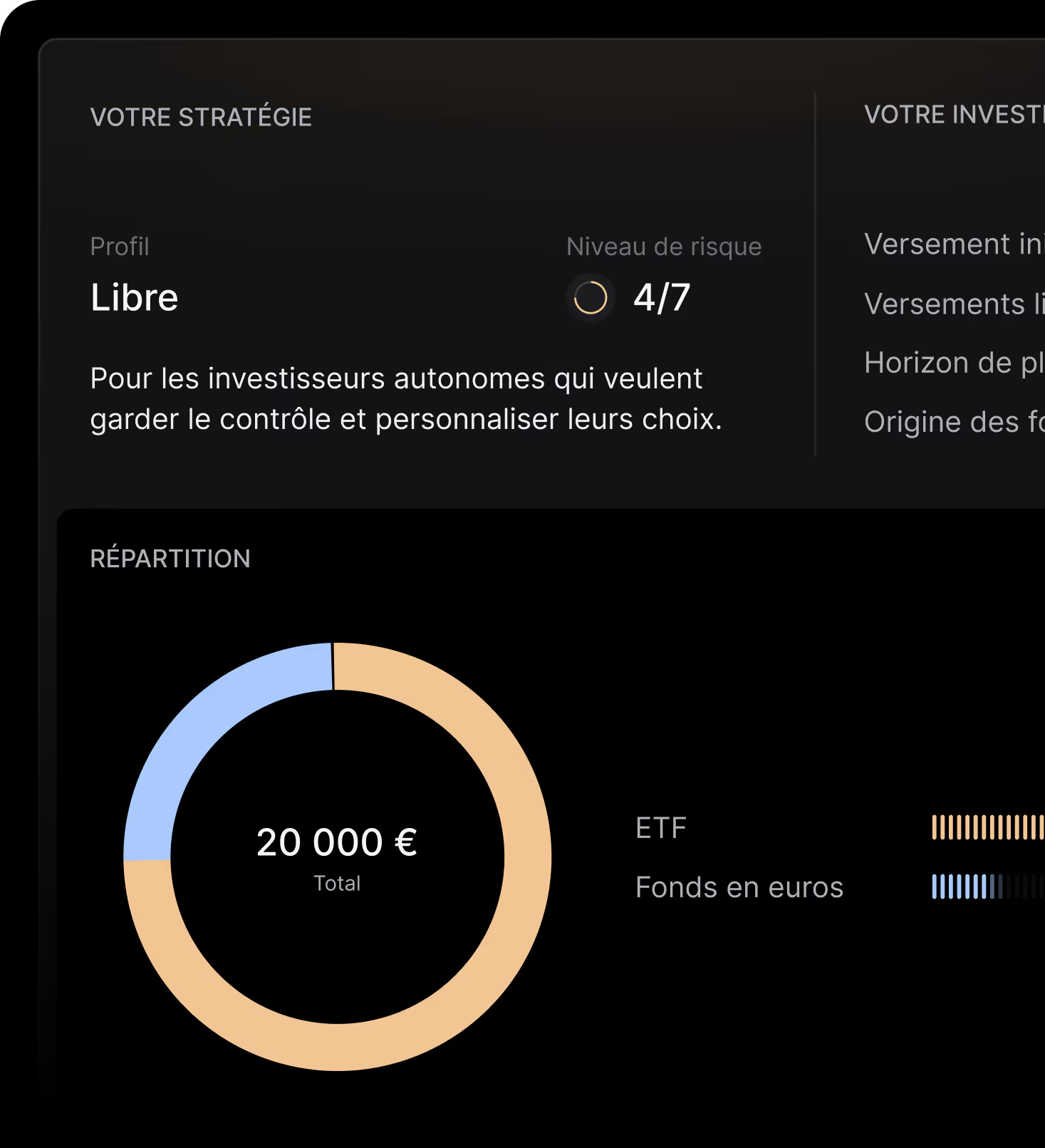
Self-directed management is the mode where you allocate your capital yourself between the secure euro fund and unit-linked funds, which are more dynamic but riskier.
In practice, you choose your investment options from the policy's catalogue. On the best online policies, that represents several hundred funds, ETFs, direct stocks, and even SCPI (a French non-listed real-estate investment fund, comparable to a REIT). You also decide when to make switches, meaning when to move from one investment option to another.
The advantage is twofold. First, the cost: no delegated management fees. You only pay the policy's own fees and those of the investment options you choose. Second, control: you build the allocation that suits you, with no intermediary. Finary Life, for example, launched self-directed management a few weeks ago, alongside its managed-portfolio service. More than 700 investment options are available there from €300.
The trade-off is real. Self-directed management requires some knowledge and a minimum of monitoring. No one rebalances your portfolio for you after a sharp rise in the markets. You are the one watching, and you are the one correcting course.
within reach
Non-contractual document for promotional purposes. Investing in unit-linked vehicles carries a risk of capital loss, since their value is subject to fluctuation, both upwards and downwards, depending in particular on developments in the financial markets. The insurer commits to the number of unit-linked units, not to their value, which it does not guarantee. This life insurance policy is an individual life insurance policy, denominated in euros and/or unit-linked vehicles, underwritten by Generali Vie, a company governed by the French Insurance Code. Finary SAS - 58 rue de Monceau 75380 Paris 8 - Investment Firm authorised by the ACPR under no. 19283, ORIAS no. 21001279, member of AMAFI
Profiled management: automatic allocation based on your profile
Profiled management is the mode where your savings automatically follow a predefined allocation, based on a risk profile chosen at the start. You do not select investment options one by one: you choose a profile, and the policy applies the matching grid.
The profile is the key piece. You answer a questionnaire, then you usually opt for one of three levels: cautious (mostly secure), balanced (a mix of euro funds and unit-linked funds) and dynamic (strong exposure to the markets). The allocation follows this profile and automatically rebalances whenever the markets cause it to drift.
Its often-overlooked strength: profiled management usually does not charge any extra fee. You get a diversified allocation, run automatically, at no additional cost. It is a genuine middle ground, simpler than self-directed management and without the cost of a mandate.
Its limit is standardisation. Every saver with the same profile receives the same standard allocation. Profiled management does not fine-tune itself to your situation: it applies a grid, full stop.
Self-directed vs profiled management: the full comparison
Here is the detailed comparison of the two modes, on the criteria that really decide.
| Criterion | Self-directed management | Profiled management |
| Choosing investment options | Yourself | Automatic grid based on profile |
| Switches | At your initiative | Automatic (rebalancing) |
| Extra fees | 0% | Usually 0% |
| Knowledge required | Medium to high | Low |
| Time required | Regular monitoring | Almost none |
| Customisation | Full | Limited to the standard profile |
| Control | Maximal | Delegated to the grid |
| Taxation | Identical | Identical |
One point deserves to be highlighted: taxation is strictly identical in both cases. The management mode changes nothing about how your policy is taxed. Only the tax seniority of your life insurance matters: after 8 years, you benefit from an annual tax allowance on gains of €4,600 (single person) or €9,200 (couple), according to the French tax authorities. For the detail, see our guides on life insurance taxation and tax caps and allowances.
Fees and performance: why the fee level changes everything
Neither self-directed nor profiled management usually adds any delegated management fees. But the fee level varies widely from one policy to another, and regulation now requires every insurer to publish it in a standardised fee table. Over 20 years, the gap is far from trivial.
Take an example. A saver puts €50,000 into an allocation that returns 4% gross a year. On a low-cost online policy, they bear 0.5% in annual fees, for a 3.5% net return. On a costlier policy, with 1.1% in fees, that drops to 2.9% net.
| Low-cost policy (3.5% net) | Costly policy (2.9% net) | |
| Starting capital | €50,000 | €50,000 |
| After 10 years | €70,530 | €66,510 |
| After 20 years | €99,490 | €88,550 |
| Final gap | -€10,940 |
Illustrative example, simplified and constant assumptions. Actual returns vary depending on the investment options and the markets. Investing carries risks, including the risk of capital loss. Past performance is not a reliable indicator of future performance.
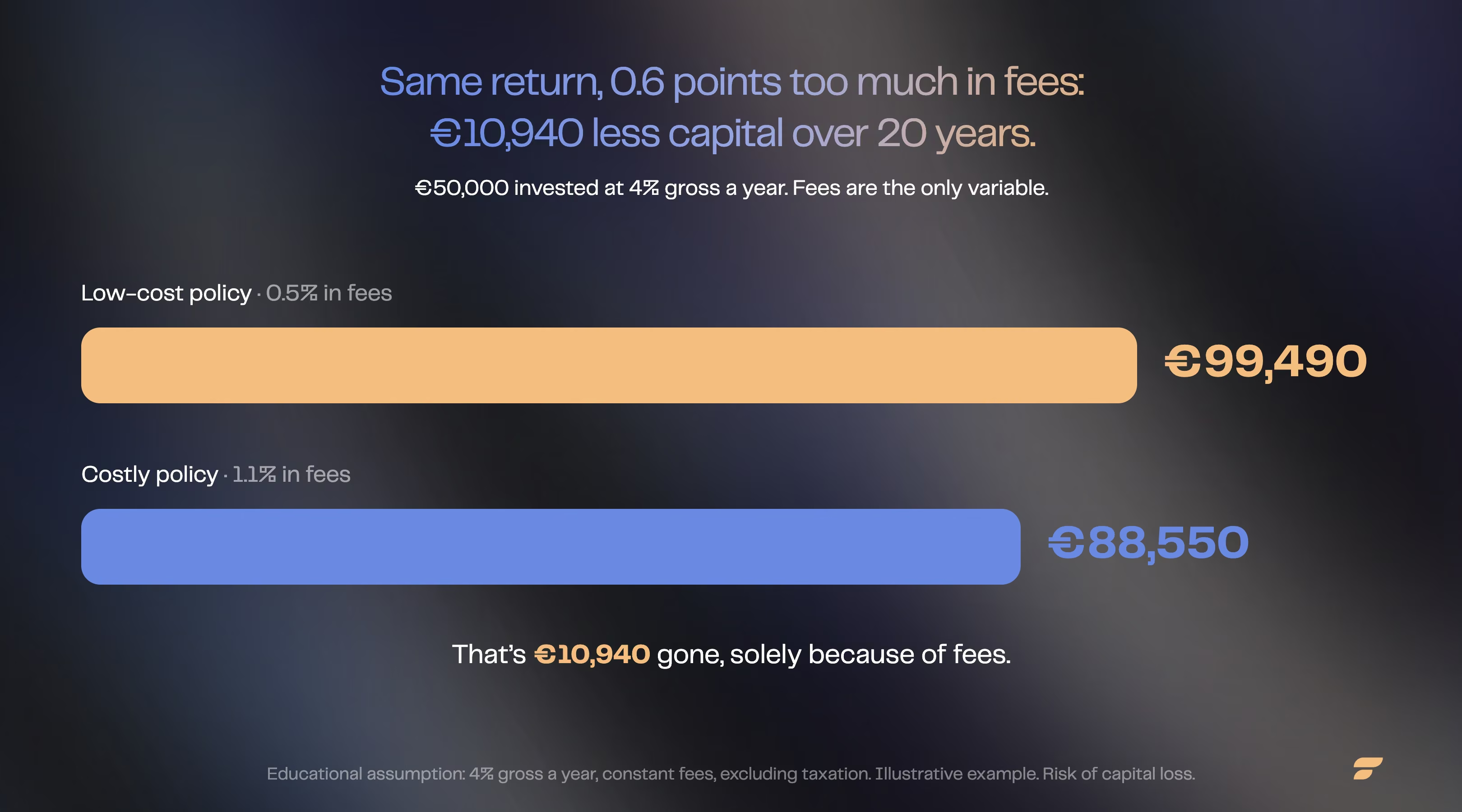
The gap of nearly €11,000 does not come from taking a different level of risk. It comes solely from fees. The lesson holds for both modes: self-directed or profiled, favour a low-cost policy. To dig deeper, read our analysis of life insurance fees.
Can you switch modes or combine the two?
Yes, and it is one of the lesser-known strengths of life insurance: you are not locked into your initial choice. Most policies let you switch from self-directed to profiled management, and back again, during the life of the policy.
Many policies also allow you to combine the two. You put part of your savings into profiled management, and keep the rest in self-directed management. For example, the euro fund and a world ETF under self-directed management, and a dynamic pocket under profiled management.
This flexibility answers a common case: the saver who wants to stay in control of the core of their savings, but delegate the part they are less comfortable with.
More capital invested

Non-contractual document for promotional purposes. Investing in unit-linked vehicles carries a risk of capital loss, since their value is subject to fluctuation, both upwards and downwards, depending in particular on developments in the financial markets. The insurer commits to the number of unit-linked units, not to their value, which it does not guarantee. This life insurance policy is an individual life insurance policy, denominated in euros and/or unit-linked vehicles, underwritten by Generali Vie, a company governed by the French Insurance Code. Finary SAS - 58 rue de Monceau 75380 Paris 8 - Investment Firm authorised by the ACPR under no. 19283, ORIAS no. 21001279, member of AMAFI
Self-directed or profiled management: how to choose?
The right mode depends on three variables: your level of knowledge, the time you want to devote to it, and how much you want to stay in control. Here is how to decide.
Choose self-directed management if you understand the difference between a euro fund and a unit-linked fund, if you are willing to check on your policy a few times a year, and if you want full control over your allocation.
Choose profiled management if you want to delegate the allocation without paying for a mandate. It is the turnkey choice: an automatic allocation matched to your profile, with nothing to manage yourself.
Combine the two if you want the best of both worlds: control over the core of your savings, and delegation on a pocket you are less comfortable with.
The bottom line
Self-directed or profiled management: the right choice is not a question of skill level, but of temperament. Self-directed management rewards those who want to stay in control, with full control and zero delegation fees. Profiled management offers the peace of mind of an automatic allocation, usually at no extra cost. And since nothing stops you from combining the two, or changing your mind, the real risk is not choosing wrongly: it is leaving your savings asleep in a euro fund for lack of having decided.
FAQ: self-directed or profiled management
Are profiled management and the managed-portfolio service the same thing?
No. Profiled management applies an automatic allocation based on a standard profile, usually at no extra cost. The managed-portfolio service, or discretionary management, is active management delegated to a manager, with a mandate fee.
Does profiled management cost more?
Usually not, and that is its main advantage. Check your policy's terms all the same, since practices vary from one insurer to another.
Does profiled management return more than self-directed management?
Not mechanically. It offers a diversified allocation run automatically, but a well-built self-directed allocation can perform just as well, or better, for comparable fees.
Do you need to be an expert to choose self-directed management?
No. A simple allocation, such as a diversified world ETF combined with a euro fund, is accessible to a beginner saver willing to do a minimum of research.
Can you switch from profiled to self-directed management?
Yes, most policies let you change modes along the way, without closing the policy or losing its tax seniority.
Does the management mode change the taxation?
No. Life insurance taxation depends on the age of the policy and the amounts withdrawn, never on the management mode chosen.
Regulatory disclaimers:
Marketing communication. Investing carries a risk of partial or total capital loss. Past performance is not a reliable indicator of future performance. This article is provided for information and educational purposes only; it does not constitute personalised investment advice, a buy or sell recommendation, or tax advice.
The capital guarantee on euro funds is provided by the insurer and depends on its financial strength. In a severe systemic crisis, the French "Sapin 2" law allows withdrawals to be temporarily restricted (liquidity), without affecting the guaranteed capital. Unit-linked funds are not guaranteed and carry a risk of capital loss.
Before investing, read the Key Information Document (KID) and, where relevant, consult an authorised adviser.
Finary SAS, an investment firm authorised by the ACPR (no. 19283), member of AMAFI. Insurance broker registered with ORIAS (no. 21001279), member of the CNCGP (association approved by the AMF). Crypto-Asset Service Provider (CASP) authorised by the AMF under the MiCA regime, references no. A2026-026 and no. N2026-008.