Life insurance switching in France: how does it work?

Updated on 5 August 2026
In France, switching (arbitrage) in life insurance means transferring some or all of your savings from one investment option to another within the same multi-fund policy, for example from the euro fund to a unit-linked fund. This move can boost, protect or rebalance your savings depending on your goals and how the markets are moving.

- Switching is only possible on a multi-fund policy that combines a euro fund and unit-linked funds, not on a single-fund policy.
- Switching fees vary by policy, from 0% to 1% of the amount transferred, depending on the insurer.
- Switching is tax-neutral: any gains stay within the life insurance wrapper and are only taxed on withdrawal.
- There are three switching methods: self-directed (you decide), automatic (preset rules) and discretionary (delegated to a professional).
- Some online policies, such as Finary Life, charge no switching fees at all, no matter how many transactions you make.
What is switching in life insurance?
Switching in life insurance means redirecting some or all of your savings from one investment option to another, within the same multi-fund policy. It's a bit like changing course to steer your savings toward your goals: the euro fund is your main hold, secure and stable, while unit-linked funds are the more adventurous holds, sometimes choppy but potentially more rewarding.
Definition of life insurance switching
Switching means moving some or all of your savings from one hold to another, in other words from one investment option to another within your multi-fund life insurance policy. It's a management action that lets you change how your capital is split across the available investment options, so you can adapt it to your investor profile, your goals and the financial markets.
In practice, you can transfer part of your savings:
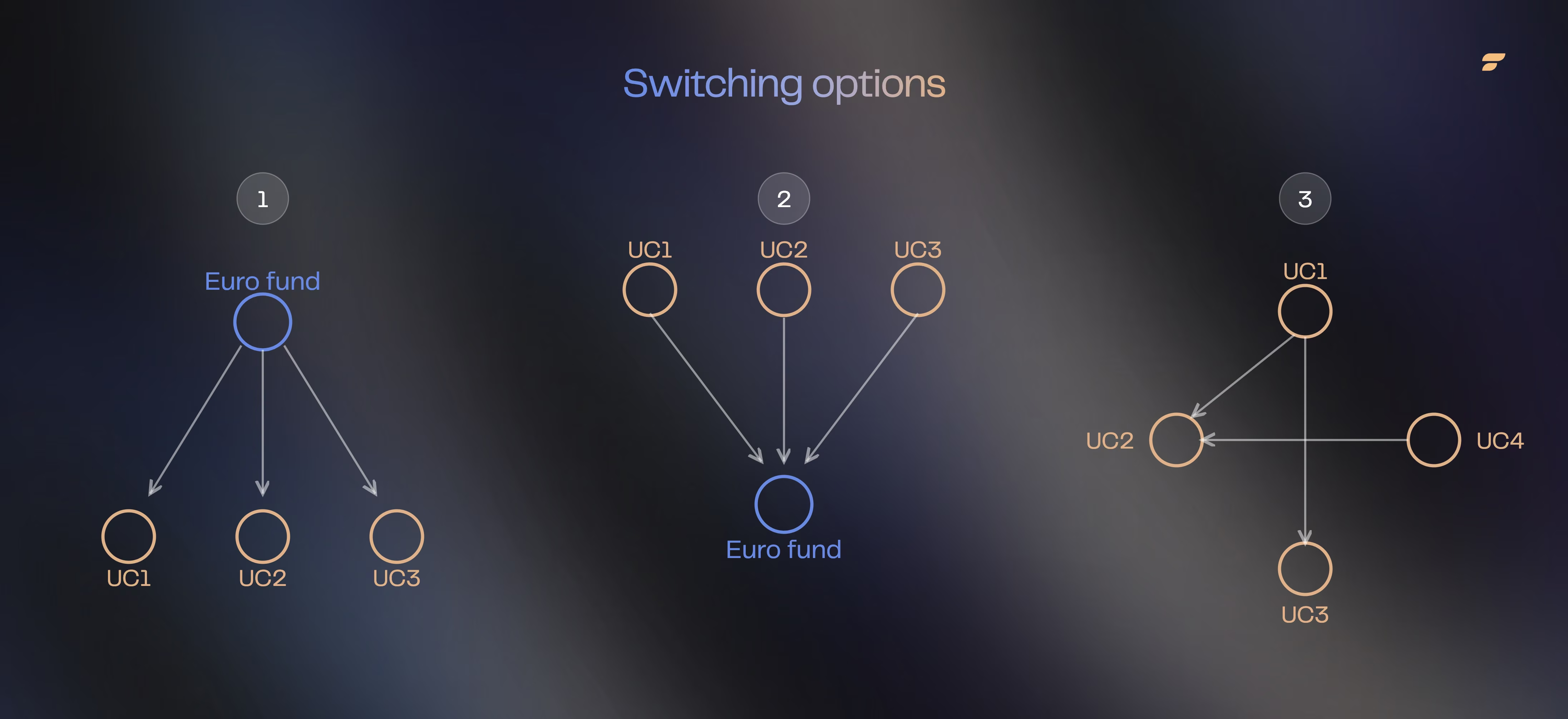
- From the euro fund to one or more unit-linked funds
- From one unit-linked fund to another
- From a unit-linked fund to the euro fund
Single-fund vs multi-fund policies
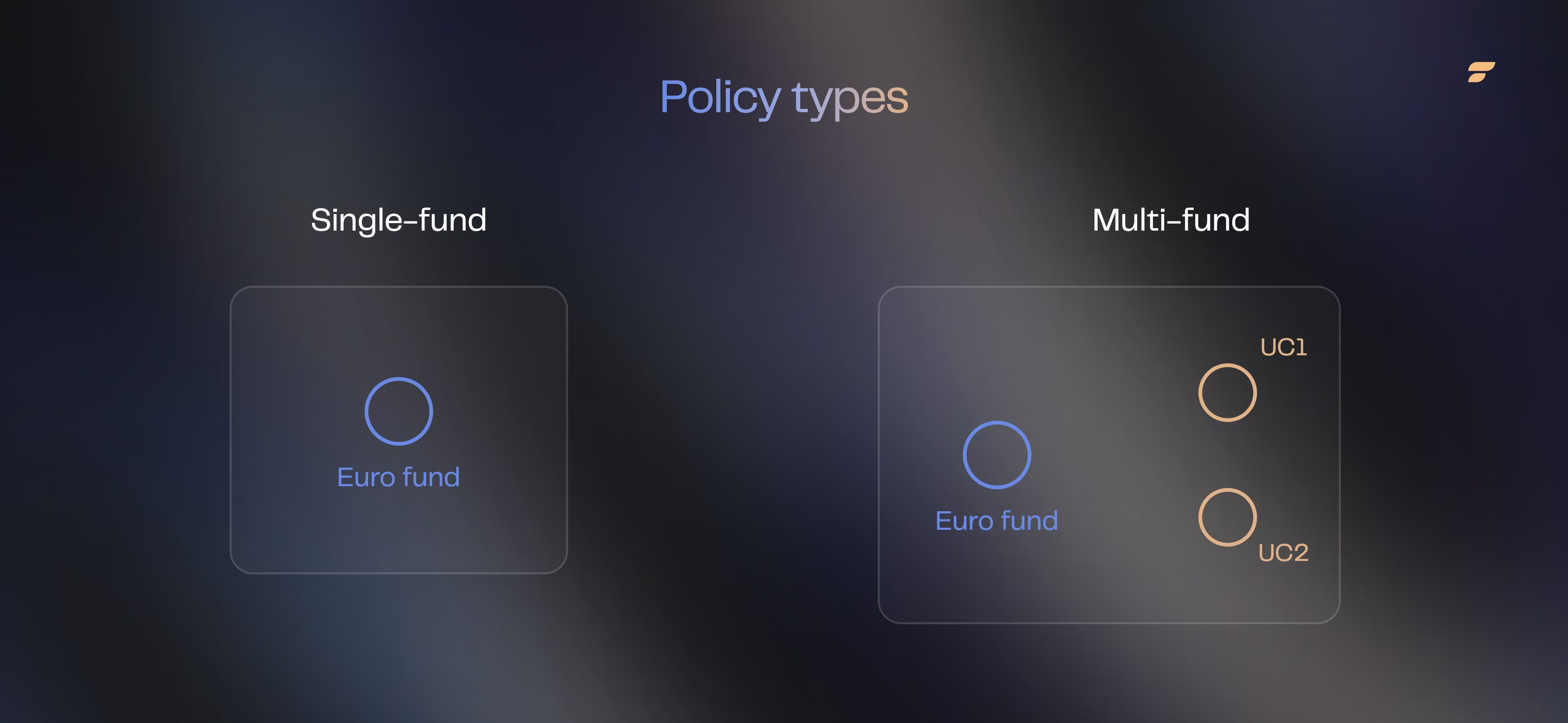
Be aware, though, that switching is only possible within a multi-fund life insurance policy that combines a euro fund and unit-linked investment options. These options can include equities, bonds, UCITS funds (OPCVM in French) or SCPI (a French non-listed real-estate investment fund, comparable to a REIT). Single-fund policies, invested only in the euro fund, don't offer this flexibility.
Goals of life insurance switching
Let's take a moment to look at the goals behind this move. Why switch funds in your life insurance policy? Here are 3 good reasons to do it:
- To boost your savings by tapping into the return potential of unit-linked funds. For example, you can direct part of your capital toward equities when markets are favourable.
- To protect your gains by moving them into the safety of the euro fund. This locks in the returns made on unit-linked funds before a market downturn.
- To rebalance your allocation based on your risk profile and plans. The closer your target date gets, the more you can scale back unit-linked funds and increase the euro fund share, depending on your profile.
Switching is therefore an excellent way to actively steer your policy and get the most out of it. That said, it's important to follow a few essential ground rules. Stay the course. We'll guide you through the rest of this article so you can switch funds with confidence.
More capital invested

Non-contractual document for promotional purposes. Investment in unit-linked vehicles carries a risk of capital loss, since their value is subject to fluctuation, both upwards and downwards, depending in particular on developments in the financial markets. The insurer commits to the number of units, not to their value, which it does not guarantee. This life insurance policy is an individual life insurance policy, denominated in euros and/or unit-linked vehicles, underwritten by Generali Vie, a company governed by the French Insurance Code. Finary SAS - 58 rue de Monceau 75380 Paris 8 - Investment Firm authorised by the ACPR under no. 19283, ORIAS no. 21001279, member of AMAFI
The different types of switching

You're at the helm of your multi-fund life insurance policy, ready to manage your savings. But how do you actually go about it? Don't worry, you won't need a boating licence to switch funds in your policy! There are different steering options to suit your appetite for financial management.
Self-directed switching
Do you have the soul of a captain and want to keep your hands on the wheel? Self-directed switching is for you. With this management style, you make the switching decisions yourself and carry them out as you see fit, based on your own analysis and market opportunities.
It's the most flexible approach, but also the most demanding. You need to track how your funds are performing regularly and react accordingly.
Automatic switching
If you'd rather set your course in advance and let your policy sail on its own, automatic switching is for you. You define allocation rules and trigger thresholds, either when you take out the policy or later during its life. Switches then happen automatically, with no action needed on your part.
For example, you can choose to lock in gains on a unit-linked fund into the euro fund once they pass a certain level. Conversely, you can also set the policy to automatically top up a unit-linked fund if its value drops below a set floor. The advantage? Your savings adapt to market swings without you having to worry about it.
Discretionary switching
Lastly, if you'd rather hand the wheel to an expert to optimise your policy's course, consider discretionary switching. With this management style, you set the direction and a professional fund manager takes it from there. They'll analyse the markets and carry out the necessary switches on your behalf.
This service usually comes at a cost, charged as a fee or an extra expense, but it can be worthwhile if you have neither the time nor the expertise to actively manage your life insurance policy.
The choice between these three approaches mainly comes down to how much time you have and your level of financial know-how: self-directed switching suits those who want to actively follow the markets, automatic suits those who'd rather set a rule once and for all, and discretionary suits those who prefer to hand the whole process over to a professional. To go further, check out our guide to managed-portfolio life insurance.
Pros and cons of switching
Switching in life insurance is a management tool you can use to adjust your policy's composition, provided you use it well. It offers many benefits, but isn't without risks either. Let's take a closer look together at the strengths and limits of this option.
Benefits of switching
Let's start with the good news! Switching offers real levers to boost and adapt your savings. Judge for yourself:
It lets you seize market opportunities by redirecting your capital toward the best-performing options. This is especially useful during periods of high volatility, when performance gaps can be significant.
It also lets you protect your gains by transferring them to the euro fund (guaranteed by the insurer, subject to its solvency). A way to shelter your returns before a market downturn.
Switching supports diversification by letting you spread your capital across different types of financial assets (equities, bonds, real estate, ...). A good way to smooth out performance over time.
Lastly, it's an excellent tool for rebalancing your allocation based on your investor profile, time horizon and goals. This means you can adjust the euro fund / unit-linked split at any time.
Drawbacks and risks of switching
Switching funds in your life insurance policy isn't without risk or constraints. Here are the main things to watch out for:
Switching into unit-linked funds means accepting a risk of capital loss. Unlike the euro fund, these options carry no guarantee. Their value can go up or down.
Switching well means regularly tracking the financial markets and how your policy is performing. This can quickly become time-consuming and stressful, especially during periods of high volatility.
Each switch generally comes with fees charged by the insurer. These costs can eat into your returns, especially if you make frequent moves. Depending on the policy, switching fees range from 0% to 1% of the amount transferred.
Lastly, don't forget that life insurance is a long-term investment. An opportunistic switch driven by short-term thinking can backfire. It's better to stay the course on your goals over time.

Don't hesitate to get support from a professional to make sure your choices are sound. And keep the long-term horizon of your investment in mind. That's the key to making switching an asset rather than a risk.
Life insurance switching fees
Convinced by the benefits of switching to optimise your life insurance? That's great news! But before you dive in, there's one thing you shouldn't overlook: switching fees. Changing the course of your savings comes at a cost, which can sometimes hurt the profitability of the move. So how do you avoid nasty surprises? Here's everything you need to know about these switching fees.
Fees that vary by policy
First observation: switching fees aren't standardised. Every insurer, every policy has its own pricing policy.
It's therefore important not to judge by appearances alone. Just because your policy shows 0% fees on contributions doesn't mean switching will be free too!
Some online policies, such as Finary Life, charge no switching fees at all, no matter how many transactions you make.
The impact of fees on performance
Why does so much importance get placed on switching fees? Simply because they directly affect your policy's performance. Even when they seem minor, these charges can quickly eat into your returns, especially if you switch often.

Let's take a concrete example. You hold €50,000 in your policy's euro fund. You decide to switch €10,000 into an equity fund. Then, 6 months later, you switch that amount back into the euro fund after a 10% gain. Without switching fees, your gain would be €1,000. But with 1% fees, it would only be €790, a €210 shortfall from fees alone!
To keep your savings on course, it's essential to keep an eye on switching fees. Here are a few tips to limit them:
- It can be worth comparing policies that offer free switches, at least up to a certain limit.
- Making frequent back-and-forth moves can prove costly, so define a consistent switching strategy over time.
- Switching larger amounts helps smooth out the impact of fixed fees.
By following these few rules, you'll give yourself the best chance of fitting switching into your life insurance strategy.
How do you make a switch?
To make a switch, you need to log into your online client area or contact your insurer, specify the direction of the transfer and the funds involved, then confirm the request, which will be carried out based on the applicable net asset values. Follow the guide!
The switching process
First step: log into your online client area or contact your advisor. You'll submit your switching request through your insurer or intermediary. Three channels are generally available:
- Online, via your secure client area. This is the simplest and fastest option if you're comfortable with digital tools. You can view your funds, simulate different switching options and place your orders in a few clicks.
- By post, by sending a completed and signed switching form to your insurer. This is the most traditional method, but also the slowest. Expect several days between sending your request and having it processed.
- By phone, by contacting a customer advisor. This is useful if you need personalised support to define your switching strategy. Do watch out, though, for possible fees linked to this service.
Once your request is registered, the insurer will carry out the requested moves.
Information to provide
For a switch to be validated, you'll need to specify several key pieces of information:
- The direction of the switch: is it a switch from the euro fund to unit-linked funds, from one fund to another, or, conversely, a "return" to the euro fund?
- The funds involved: precisely which funds are being sold and which are being bought? Be sure to check their eligibility for switching and any constraints (minimum amount, cap...).
- The split you want: what percentage of your capital do you want to switch, or what is the new target allocation across your different funds?
- How values are determined: to avoid surprises, specify whether your switch should be based on the net asset values known at the time of the request or at the time of execution.
Self-directed or managed-portfolio management, one-off or scheduled switching... the specifics vary by policy and insurer. Take the time to look into the options your policy offers, and don't hesitate to seek advice to define the strategy best suited to your goals.
Once you've got the hang of switching, you'll see it's an excellent tool for flexibly adjusting the course of your life insurance policy. You'll be able to respond to favourable or adverse market winds, or to changes in your own life!
When should you switch?
The best time to switch usually depends on one of three situations: a personal or professional life change, a lasting turn in the financial markets, or the approaching deadline of your project. Your personal situation, risk profile and goals then help fine-tune that choice.
Good times for automatic switching
If you've opted for automatic switching options, such as locking in gains or phased investing, the key moments will already be set. But nothing stops you from fine-tuning the settings along the way! Here are 3 occasions when it's particularly worth revisiting your strategy:
- When your personal or professional situation changes. Marriage, the birth of a child, divorce, a mortgage, retirement... These life events can change your savings capacity and investment goals. It's the right time to adjust your allocation and switching options accordingly.
- When there's a lasting turn in the financial markets. A stock market crash, rising interest rates, surging inflation... Economic cycles affect your life insurance policy's performance, especially if it's invested in unit-linked funds. This can justify adjusting your exposure, for example by raising your gain-locking thresholds.
- As your project's deadline approaches. The closer the target date gets, the more common it becomes to gradually de-risk your savings. This gradual de-risking can be organised through an automatic switching option such as "target-date de-risking". The idea: gradually transfer your capital from unit-linked funds to the euro fund according to a preset schedule.
To see concretely how your capital could evolve under different de-risking scenarios, use a life insurance simulator.
Outside of these key moments, automatic switching is precisely what frees you from day-to-day management. You don't need to watch your policy constantly.
Good times for one-off switching
With self-directed management, it's up to you to take the initiative on switches. When should you act? A few pointers can help:
When you spot a market opportunity. For example, if you think equity markets have upside potential, you might consider increasing your exposure to unit-linked funds. Conversely, the prospect of a crash may call for a cautious retreat toward bonds or the euro fund.
When your gains reach a meaningful level. Rather than waiting for the peak, some savers choose to lock in part of their gains once they reach a level they consider significant, based on their own strategy. This avoids losing everything in the event of a sudden downturn.
If your actual allocation drifts from your target allocation. Over time and with market fluctuations, the way your savings are split can drift from your original strategy. A one-off rebalancing through "targeted" switches can then be worthwhile.

within your reach
Non-contractual document for promotional purposes. Investment in unit-linked vehicles carries a risk of capital loss, since their value is subject to fluctuation, both upwards and downwards, depending in particular on developments in the financial markets. The insurer commits to the number of units, not to their value, which it does not guarantee. This life insurance policy is an individual life insurance policy, denominated in euros and/or unit-linked vehicles, underwritten by Generali Vie, a company governed by the French Insurance Code. Finary SAS - 58 rue de Monceau 75380 Paris 8 - Investment Firm authorised by the ACPR under no. 19283, ORIAS no. 21001279, member of AMAFI
Taxation of life insurance switching
You're now all set to switch funds in your life insurance policy! But before you dive in, one last point deserves your attention: taxation. Life insurance is known for its specific tax treatment, but you still need to understand the rules to make the most of it.
A tax-neutral move... in most cases
First piece of good news: in most cases, switching is a tax-neutral move. In practice, transferring some or all of your savings from one fund to another doesn't, by itself, trigger any tax.
This is one of life insurance's great strengths: throughout the phase of building up your capital, you can "juggle" between the different unit-linked funds in your policy. This doesn't trigger any taxation. What's more, any gains made along the way continue to benefit from life insurance's specific tax treatment and won't be taxed until you make a withdrawal.
Let's take an example to illustrate this. You invested €10,000 in a unit-linked fund 5 years ago. Today, that capital is worth €15,000, a gain of €5,000. If you decide to switch that €15,000 into another fund, you won't be taxed immediately on the €5,000 gain. It stays within the life insurance tax wrapper.
A few special cases to know about
Be aware, though, that this tax neutrality isn't an absolute rule. Here are a few exceptions to know about:
- "DSK" or "NSK" policies: these specific policies, closed to new subscriptions since 31 December 2004 for DSK and 31 December 2013 for NSK according to the BOFiP, benefited from an income-tax exemption after 8 years, with social contributions still due. For these policies, a switch can, in some cases, call into question the tax seniority and therefore the exemption already earned. Check this point with your insurer if it applies to you!
- Large-scale switches into euro funds: since the French "Sapin 2" law of 2016, the Haut Conseil de Stabilité Financière (High Council for Financial Stability) can authorise insurers to temporarily limit or suspend withdrawals and large-scale switches into euro funds in the event of a serious threat to financial stability. This can be done through return penalties, with the aim of protecting these funds from excessive inflows in certain market conditions.
As you can see, even though most switches are tax-neutral, there can be some caveats depending on your policy's specifics. It's therefore essential to check with your insurer and your tax advisor.
Once you've steered clear of these pitfalls, switching remains a fantastic tool for managing your life insurance policy with confidence, tax-wise included! So don't hesitate any longer. Take the wheel and chart your own course in managing your savings.
Frequently asked questions
How much does switching cost in life insurance?
Switching fees vary by policy, generally between 0% and 1% of the amount transferred. Some online policies, such as Finary Life, charge no switching fees at all, no matter how many transactions you make. It's recommended to check your policy's fee schedule before switching.
Is switching taxable?
No, in most cases. Moving your savings from one fund to another within the same life insurance policy doesn't trigger any immediate tax. Any gains stay within the life insurance tax wrapper and are only taxed when you make a withdrawal.
How long does a switch take?
An online switch is generally processed faster than a request sent by post, since it's registered directly from your client area. The exact timeframe depends on the insurer and how net asset values are calculated (at the time of the request or of execution), which you can check in the policy's terms and conditions.
Can you switch funds on a single-fund policy?
No. Switching requires transferring your savings between several funds, which is only possible on a multi-fund policy combining a euro fund and unit-linked funds. A single-fund policy, invested only in the euro fund, therefore doesn't allow switching.
Is there a limit on the number of switches per year?
It depends on the policy. Some insurers allow an unlimited number of switches, while others cap the number of free switches per year, beyond which fees apply. It's advisable to check your policy's terms and conditions, as well as any restrictions on large-scale switches into the euro fund, which are governed by the French "Sapin 2" law.
What happens if you never switch funds?
Without switching, the initial split of your savings between the euro fund and unit-linked funds evolves naturally with the markets, without ever being rebalanced. Over time, this can pull your allocation away from your original risk profile, especially if unit-linked funds perform strongly.
Sources
BOFiP, tax regime for DSK and NSK equity life insurance policies
AMF, white list of Crypto-Asset Service Providers (CASP), Finary SAS
Regulatory disclaimers: Marketing communication. Investing carries a risk of partial or total capital loss. Past performance is not a reliable indicator of future performance. This article is provided for information and educational purposes only; it does not constitute personalised investment advice, a buy or sell recommendation, or tax advice. The capital guarantee on euro funds is provided by the insurer and depends on its financial strength. In a severe systemic crisis, the French "Sapin 2" law allows withdrawals to be temporarily restricted (liquidity), without affecting the guaranteed capital. Unit-linked funds are not guaranteed and carry a risk of capital loss. Before investing, read the Key Information Document (KID) and, where relevant, consult an authorised adviser. Finary SAS, an investment firm authorised by the ACPR (no. 19283), member of AMAFI. Insurance broker registered with ORIAS (no. 21001279), member of the CNCGP (association approved by the AMF). Crypto-Asset Service Provider (CASP) authorised by the AMF under the MiCA regime, references no. A2026-026 and no. N2026-008.