Euro funds: what are they? Complete 2026 guide

Updated on 31 July 2026
A euro fund is a life insurance investment option whose capital is protected by the insurer, and whose annual interest is locked in for good through the ratchet effect. It is the secure pocket of French life insurance policies, as opposed to unit-linked funds.
This 2026 guide sets out how it works, its guarantees, its returns and its taxation, so you can use it well in your savings.

- Euro funds returned 2.6% on average in 2025, for the third year running, according to France Assureurs.
- The best online policies paid 3% or more in 2025, with no entry fees and management fees below 1%.
- After 8 years, gains are taxed at 24.7% after an annual tax allowance of €4,600 (€9,200 for a couple).
- Social security levies on life insurance remain at 17.2% in 2026, against 18.6% for most other investments.
- Capital protection is usually gross of management fees and rests on the insurer's financial strength.
What is a euro fund?
A euro fund is the secure investment option of a life insurance policy: the insurer contractually undertakes to return the amounts paid in (usually gross of management fees) and adds a share of profits each year, locked in for good.
What a euro fund is
The euro fund is the emblematic savings option of French life insurance. Managed by insurance companies, it accounts for around 60% to 62% of contributions in life insurance policies (source: France Assureurs).
This investment offers protected capital from the insurer, usually excluding management fees and subject to its financial strength. It also benefits from a favourable tax framework, particularly after 8 years.
How does a euro fund work?
The way a euro fund works rests on a simple principle. The insurer invests savers' money mainly in government and corporate bonds (around 80% of the portfolio).
The income generated by those investments is then redistributed to policyholders as profit-sharing, after management fees. That redistribution happens once a year, with a rate published early in the year by each insurer.
Main features
The euro fund has three essential features:
- Protected capital: the insurer contractually undertakes to return the amounts paid in, less fees, subject to its solvency.
- Ratchet effect: interest earned each year is added to the capital and itself earns interest in the following years. For example, on an initial investment of €10,000 with an annual return of 2%, the capital reaches €10,200 in the second year, then €10,404 in the third.
- Liquidity: euro funds generally offer full availability of the savings, allowing withdrawals at any time without penalty (excluding applicable tax).
These features make euro funds a favoured choice for savers looking for safety and stability. This investment can suit short or medium-term projects (1 to 5 years).
More capital invested
Non-contractual document for promotional purposes. Investment in unit-linked vehicles carries a risk of capital loss, since their value is subject to fluctuation, both upwards and downwards, depending in particular on developments in the financial markets. The insurer guarantees the number of unit-linked units, not their value, which it does not guarantee. The e-vie life insurance policy is an individual life insurance policy, denominated in euros and/or unit-linked vehicles, underwritten by Generali Vie, a company governed by the French Insurance Code. Finary SAS - 58 rue de Monceau 75380 Paris 8 - Investment Firm authorised by the ACPR under no. 19283, ORIAS no. 21001279, member of AMAFI
Typical weight of the different asset classes
A classic euro fund is generally made up as follows:
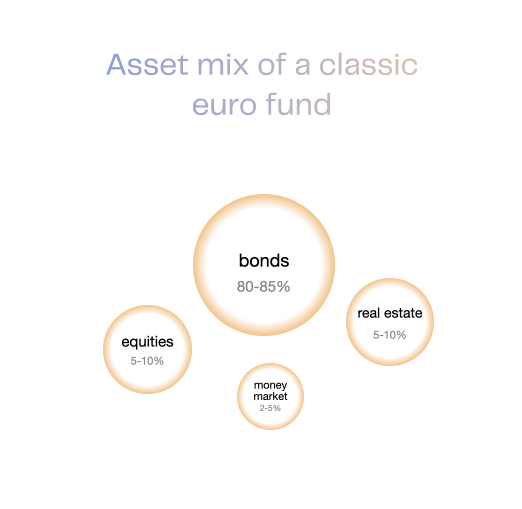
- 80-85% bonds
- 5-10% equities
- 5-10% real estate
- 2-5% money-market instruments
This mix can vary with the insurer's strategy and market conditions.
What guarantees does a euro fund offer?
A euro fund offers three protections: capital protected by the insurer's contractual undertaking, interest locked in for good through the ratchet effect, and savings available at any time.
Capital guarantee
The capital guarantee is the cornerstone of euro funds. The insurer contractually undertakes to return every amount paid in by the saver, less entry fees. That guarantee applies at any time, offering a high level of safety among financial investments, subject to the solvency of the insurer (the French "Sapin 2" law).
Some insurers have recently changed their guarantees, however, moving from capital guaranteed net of management fees to capital guaranteed gross of management fees. That nuance can slightly affect the real long-term performance of the investment.
Ratchet effect and interest locked in for good
The ratchet effect is a major advantage of euro funds. Each year, the interest generated is locked in for good and added to the initial capital. That mechanism ensures an annual crediting of interest to the savings.
A concrete example:
- Year 1: initial capital of €10,000, return of 2% → capital at year end: €10,200
- Year 2: new capital of €10,200, return of 1.8% → capital at year end: €10,383.60
Even if the return falls, the capital keeps growing thanks to the interest previously locked in.
Safety and liquidity of the funds
The safety of euro funds rests on several mechanisms:
- Strict regulation: the French Insurance Code tightly frames how these funds are managed, imposing diversification and reserving rules.
- Return reserves: insurers build up provisions (around 3.7% of assets at the end of 2025, according to France Assureurs) to smooth performance over time and cope with difficult periods.
- Ring-fencing of assets: the assets of the euro fund are kept separate from the insurer's other assets, protecting policyholders' savings should the company fail.
The liquidity is generally available, subject to the "Sapin 2" provisions allowing the HCSF (France's financial stability authority) to suspend withdrawals temporarily. Savers can withdraw at any time, without penalty (excluding applicable tax). In exceptional circumstances such as a bond crash, however, the authorities could in theory freeze withdrawals temporarily to preserve the stability of the financial system.
This combination of safety and liquidity makes euro funds a suitable tool for managing cash over the short to medium term (1 to 5 years). They offer a rare balance between availability and capital preservation.
What are the different types of euro fund?
There are three broad families of euro fund: classic funds, enhanced funds and euro-croissance funds, which differ in their composition, their level of capital protection and their return potential.
Classic euro funds
The most widespread form is the classic euro fund. It is characterised by:
- A mostly bond-based composition (around 80%)
- A form of capital protection (gross or net of management fees depending on the policy)
- A return that varies by year and by insurer, rising in recent years
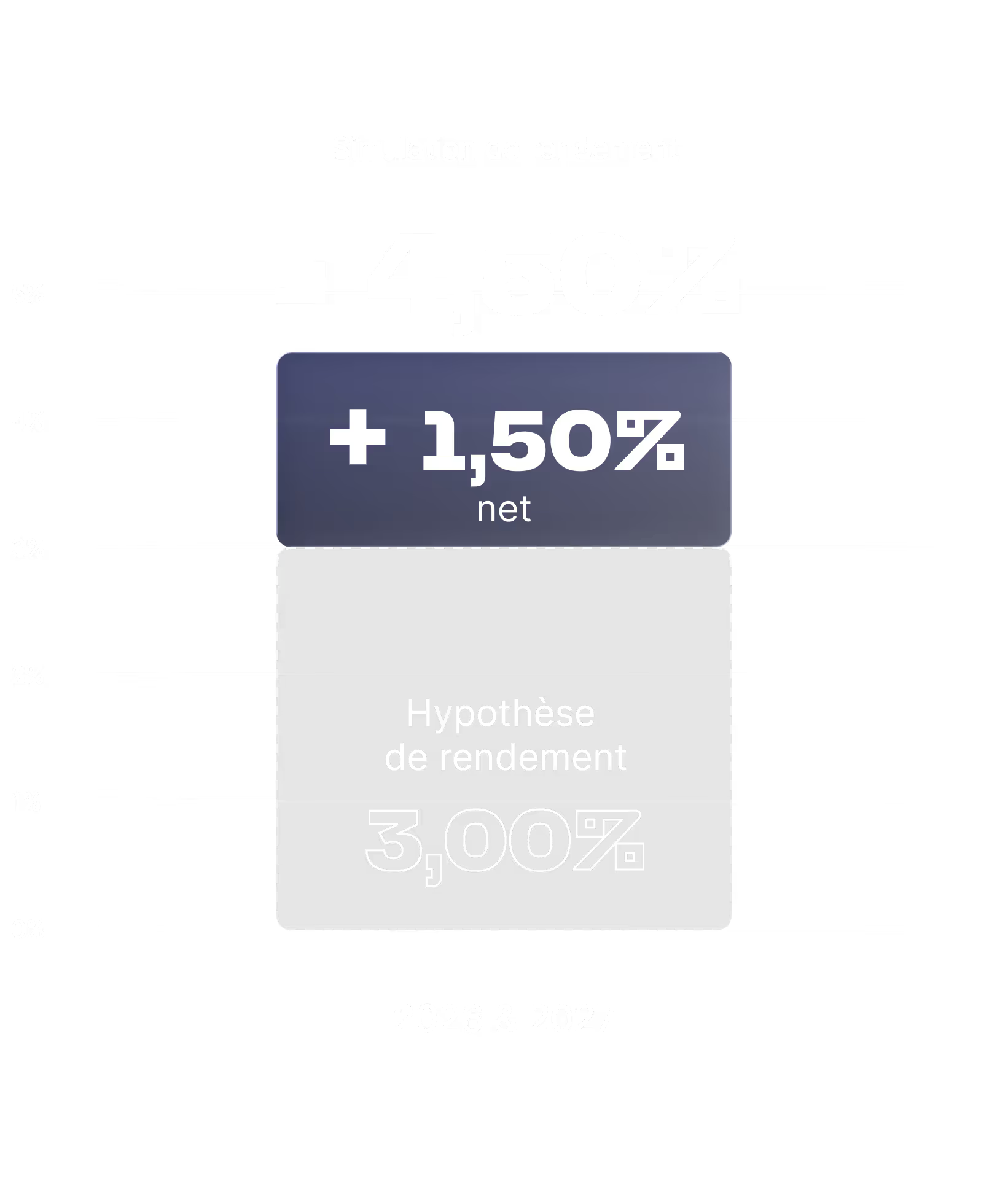
These funds offer a balance between safety and return. In 2025, the best policies on the market posted rates above 3%, while the market average stood at 2.6% (source: ACPR). For example, the Netissima fund from Generali, available through Finary Life, posted a performance of 3% in 2025. They suit savers looking to preserve their capital while earning a regular return.
Netissima
Non-contractual document for promotional purposes. Investment in unit-linked vehicles carries a risk of capital loss, since their value is subject to fluctuation, both upwards and downwards, depending in particular on developments in the financial markets. The insurer guarantees the number of unit-linked units, not their value, which it does not guarantee. The e-vie life insurance policy is an individual life insurance policy, denominated in euros and/or unit-linked vehicles, underwritten by Generali Vie, a company governed by the French Insurance Code. Finary SAS - 58 rue de Monceau 75380 Paris 8 - Investment Firm authorised by the ACPR under no. 19283, ORIAS no. 21001279, member of AMAFI
Enhanced euro funds
The enhanced euro funds, also called diversified funds, aim to deliver higher returns while keeping capital protected. Their specific features are:
- A larger share of risky assets (equities, real estate)
- Greater performance potential
- A potentially higher volatility in annual returns
For example, the Euro Exclusif fund from Boursorama posted a performance of 3.00% in 2025.
Euro-croissance funds
The euro-croissance funds are a recent innovation, designed to combine safety with growth potential. Their main features are:
- A capital guarantee at maturity (usually 8 years or more)
- Greater investment freedom for the manager
- Higher return potential over the long term
A concrete example: the Génération Croiss@nce Durable fund from Boursorama delivered a performance of 3.40% in 2025.
Comparison of the different types of euro fund
| Fund type | Capital protection | Composition | Potential return |
|---|---|---|---|
| Classic | Immediate (gross or net of fees) | ~80% bonds | Competitive |
| Enhanced | Immediate (gross or net of fees) | 60-70% bonds, more equities/real estate | Medium |
| Euro-croissance | At maturity | More flexible, large share of risky assets | High |
The euro-croissance funds, promising as they are, have yet to fully convince savers. Their complexity and the deferred capital guarantee partly explain that reluctance.
Each type of euro fund answers specific needs in terms of safety, liquidity and performance. The choice between these options depends on the saver's risk profile, investment horizon and financial goals.
What return can you expect from a euro fund in 2026?
Euro funds returned 2.6% on average for 2025, for the third year running according to France Assureurs, and the best online policies paid 3% or more.
How the annual return is set
Insurers set the return on euro funds each year based on several factors:
- The financial performance of the fund
- The insurer's commercial policy
- The level of management fees
The final rate of return, or average profit-sharing rate, is published early in the year. It applies retroactively to the year just ended. It is made up of the TMG (the guaranteed minimum rate) and a possible top-up, all of it net of management fees.
History of returns
The trend in returns on euro funds over recent years shows a decline, followed by a recent recovery:
| Year | Average return |
|---|---|
| 2015 | 2.30% |
| 2016 | 1.90% |
| 2017 | 1.80% |
| 2018 | 1.80% |
| 2019 | 1.50% |
| 2020 | 1.50% |
| 2021 | 1.30% |
| 2022 | 1.91% |
| 2023 | 2.60% |
| 2024 | 2.50% |
| 2025 | 2.60% |
2022 marked a turning point, with a significant rise in the average return to 1.91%, the first increase in 20 years. Since then the trend has kept rising, with an average of 2.60% in 2025.
Impact of bond yields and inflation
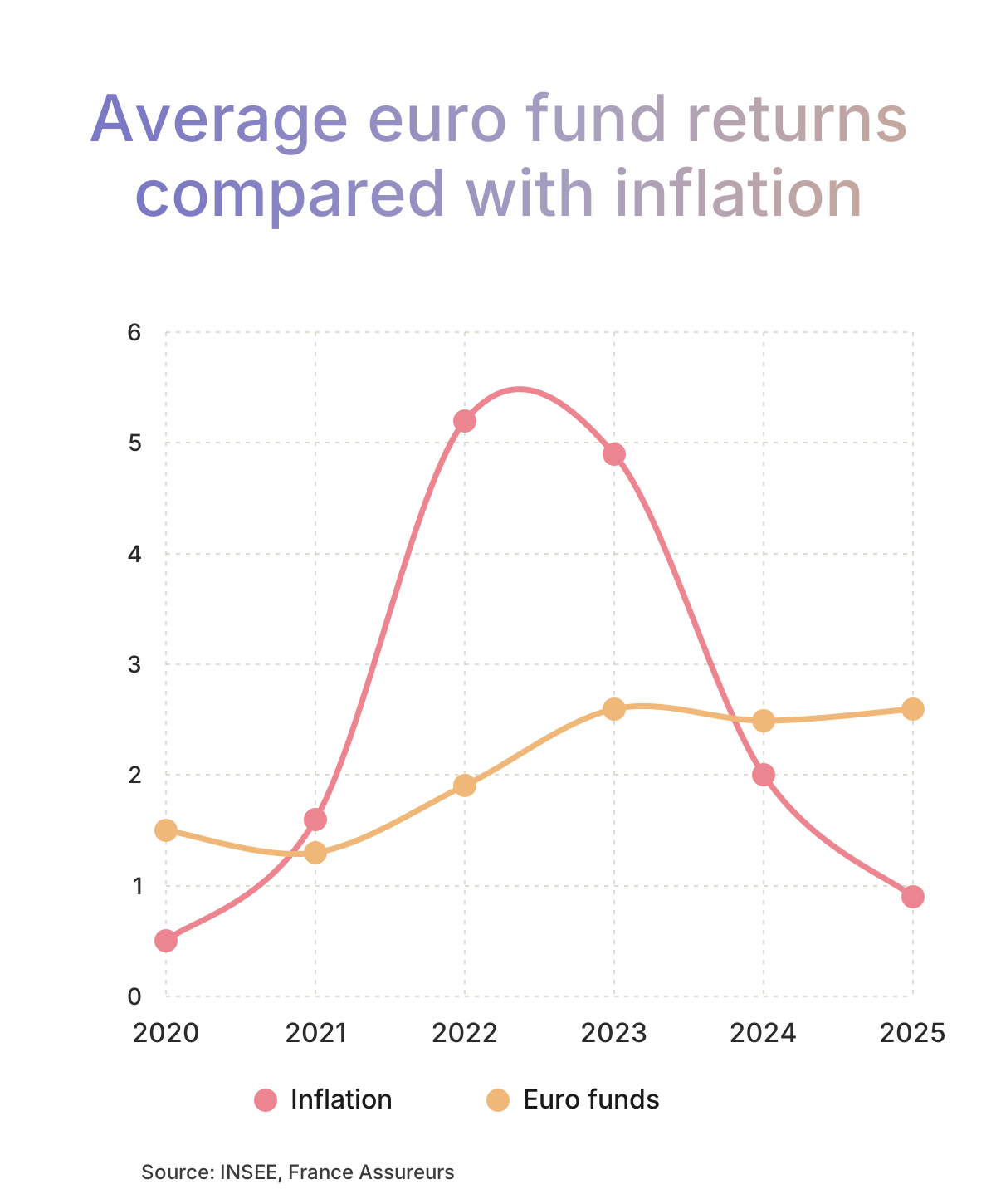
Returns on euro funds are closely tied to bond yields and inflation:
- The rise in bond yields that began in 2022, in reaction to inflation, improved the returns on euro funds.
- High inflation in 2022 (5.2%) and 2023 (4.9%) temporarily eroded the real return. The situation has since improved markedly: with inflation back down to 0.9% in 2025 and euro funds at 2.60% on average, the real return can turn positive again, depending on the policy and the fees applied.
How can you estimate the future return of a euro fund?
Estimating the future return of a euro fund means taking several things into account:
- Track record: a fund that ranks well consistently has a better chance of keeping up good performance.
- Portfolio composition: a more diversified fund can offer better return prospects.
- The insurer's policy: some insurers favour stable returns, others are more aggressive.
- Economic backdrop: the path of bond yields and inflation will shape future returns.
- Return reserves: a fund with large reserves can smooth its performance better over time.
Past performance does not guarantee future results. A prudent approach is to diversify your investments and regularly reassess how relevant your investment choices remain.
Examples of euro funds in 2026
Reviewing the euro funds available in 2026 can rest on recent performance, the fees applied and the economic outlook. Here is an overview of a few promising funds:
- Finary Life - Netissima
- 2025 performance: 3.00%
- Management fees: 0.75% max
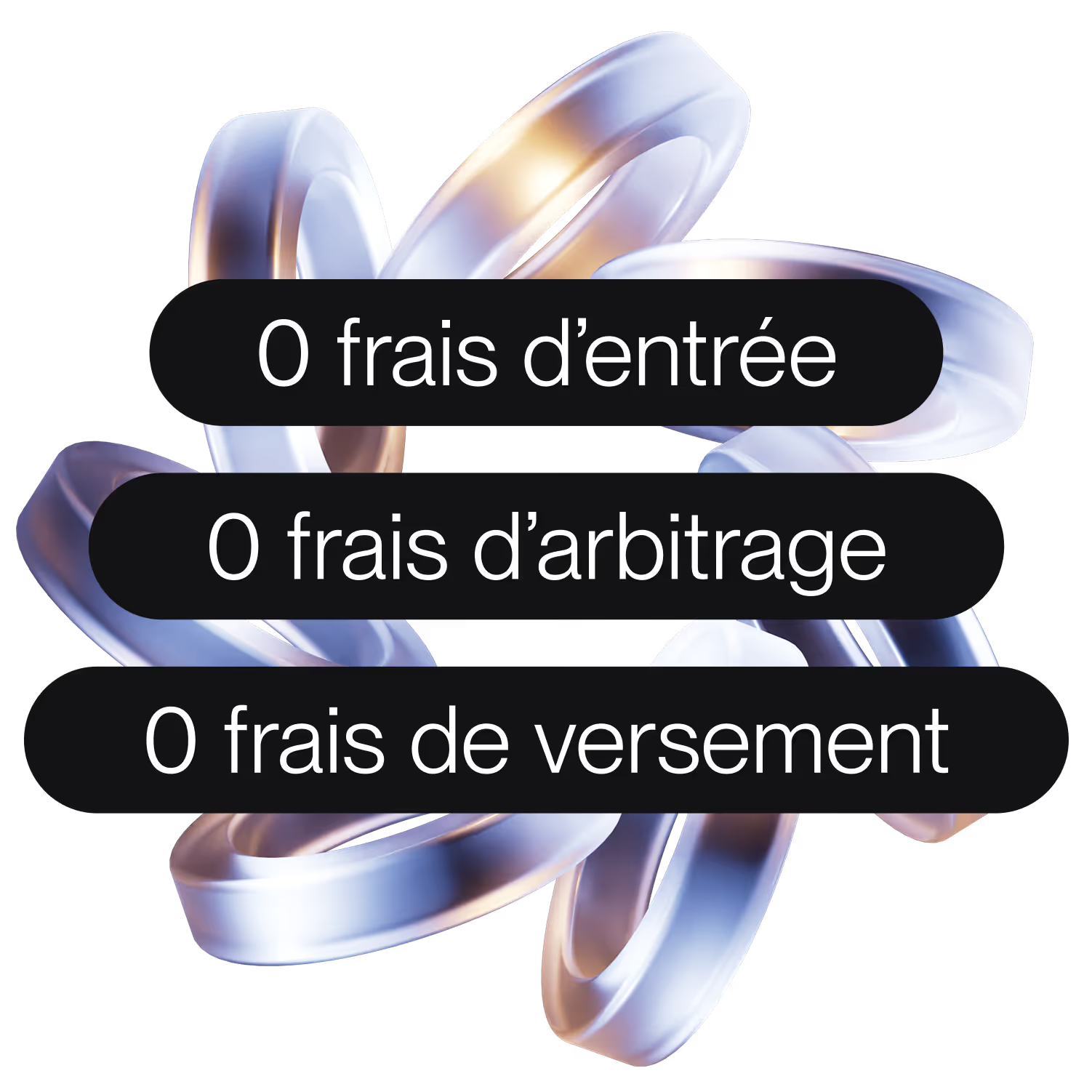
- Strengths: no entry, switching or contribution fees
- Boursorama (BoursoVie) - Euro Exclusif
- 2025 performance: 3.00%
- Management fees: 0.75% max
- Strengths: competitive return, no entry fees
- Linxea (Spirit 2) - Fonds Euro Nouvelle Génération
- 2025 performance: 3.08%
- Management fees: 2% max
- Strengths: best gross performance, but management fees among the highest in the segment
These funds stand out through performance above the market average (2.60% in 2025) and competitive fee structures. To compare every policy available, our selection of the best life insurance policies in 2026 sets out the criteria to use.
It is crucial to note, however, that past performance does not guarantee future results.
Selection factors to consider
- The insurer's financial strength: a solid insurer is better placed to keep up good performance.
- Distribution policy: some insurers favour stable returns, others are more aggressive.
- Accessibility: check the access conditions (minimum amount, share of unit-linked funds required).
- Total fees: consider all fees (entry, management, switching) to assess net performance.
- Portfolio diversification: a more diversified fund can offer better long-term return potential.
Choosing a fund depends on your personal situation, and it can help to diversify your investments and regularly reassess your choices as the market and your own goals change.
What fees and what taxation apply to euro funds?
Euro funds carry annual management fees of around 0.60% to 1%, and their gains follow life insurance taxation: taxed only on withdrawal, at 24.7% after 8 years above the annual tax allowance.
Management and contribution fees

Here is an overview of the main fees:
- Management fees :
- Generally range from 0.60% to 1% a year.
- Example: Finary (Finary Life) - 0.75%, Fortuneo (Fortuneo Vie) - 0.60%.
- Entry/contribution fees :
- From 0% to 5% depending on the policy.
- Trend: online policies often charge 0% entry fees.
- Example: LCL (LCL Vie) - up to 3.5%, Finary (Finary Life) - 0%.
- Switching fees :
- Range from 0% to 1% of the amount switched.
- Example: Caisse d'Epargne (Millevie Initiale 2) - 1%, Finary (Finary Life) - 0%.
within your reach
Non-contractual document for promotional purposes. Investment in unit-linked vehicles carries a risk of capital loss, since their value is subject to fluctuation, both upwards and downwards, depending in particular on developments in the financial markets. The insurer guarantees the number of unit-linked units, not their value, which it does not guarantee. The e-vie life insurance policy is an individual life insurance policy, denominated in euros and/or unit-linked vehicles, underwritten by Generali Vie, a company governed by the French Insurance Code. Finary SAS - 58 rue de Monceau 75380 Paris 8 - Investment Firm authorised by the ACPR under no. 19283, ORIAS no. 21001279, member of AMAFI
Favourable taxation after 8 years
Life insurance, and by extension euro funds, benefits from privileged taxation, particularly after 8 years:
- Annual tax allowance on gains :
- €4,600 for a single person.
- €9,200 for a married or civil-partnered couple.
- Reduced tax rate :
- 24.7% (7.5% income tax + 17.2% in social security levies) on gains above the allowance, for premiums paid up to €150,000 (12.8% income tax beyond that).
- A concrete example: for a gain of €10,000 after 8 years (single person):
- €4,600 exempt from income tax.
- €5,400 taxed at 7.5% = €405 in income tax.
- €10,000 subject to 17.2% in social security levies = €1,720.
- Total levies: €2,125 (21.25% of the gain). Taxation may change.
Note: since 1 January 2026, social security levies on most capital income have risen to 18.6%, but life insurance keeps the 17.2% rate by exception.
Comparison of fees across insurers
Here is a comparison table of life insurance fees for a few representative policies:
| Insurer (Policy) | Entry fees | Management fees (euro fund) | Switching fees |
|---|---|---|---|
| Finary (Finary Life) | 0% | 0.75% | 0% |
| Boursorama (BoursoVie) | 0% | 0.75% | 0% |
| Fortuneo (Fortuneo Vie) | 0% | 0.60% | 0% |
| LCL (LCL Vie) | 3.5% max | 0.80% | 0.7% max |
| Abeille (Evolution Vie) | 0% | 0.60% | 0% |
| Caisse d'Epargne (Millevie Initiale 2) | 3% max | 0.70% | 1% |
This comparison highlights the significant gaps between policies, in particular between traditional insurers and online players. Online policies generally charge lower fees, which can help improve the net return for the saver.
Strategies to get the most from a euro fund investment
Diversification within your life insurance policy
Broad diversification remains a fundamental principle for getting the most from an investment:
- Combine euro funds and unit-linked funds :
- Adjust the split to your risk profile
- Example: 70% euro funds / 30% unit-linked funds (purely illustrative, to be adapted to your profile)
- Use several types of euro fund :
- Combine classic funds and enhanced funds
- Consider euro-croissance funds for the long term
Strategies to cope with falling returns
To get the most from an investment in a context where returns have recovered competitive levels, several strategies can be considered:
- Tactical switches :
- Take advantage of policies that offer switches free of charge
- Example: Finary (Finary Life) and Fortuneo (Fortuneo Vie) offer switches at no cost
- Look at bonus-rate funds :
- Some policies offer a return bonus proportional to the unit-linked funds held
- Assess whether the extra risk is offset by the potential gain
- Use automatic management options :
- Locking in gains: automatic transfer of gains from unit-linked funds to the euro fund
When is a euro fund the better choice?
Choosing a euro fund can suit your personal situation in a few configurations:
- A short to medium-term investment horizon (1 to 5 years):
- Particularly suited to defined projects such as buying a property
- Approaching retirement :
- Progressively securing the capital built up
- Building a rainy-day fund :
- An alternative to regulated savings accounts for large amounts
- A period of economic uncertainty :
- A temporary haven while waiting for investment opportunities
- A complement to riskier investments :
- Balancing an overall portfolio that includes volatile investments (equities, cryptocurrencies)
The euro fund remains a cornerstone of savings, offering a rare balance between safety and return. After years of decline, performance has recovered competitive levels (2.60% on average in 2025), while remaining a common option for the secure part of a portfolio.
The key lies in a diversified investment strategy, wisely combining different types of euro fund with other investment options. To estimate how your savings could grow through a life insurance policy, our life insurance simulator lets you project your returns.
Frequently asked questions
What was the average return on a euro fund in 2025?
Euro funds returned 2.6% on average, net of management fees, in 2025, for the third year running, according to France Assureurs. The best online policies paid 3% or more, before the tax applied on withdrawal.
Can the capital held in a euro fund fall?
Capital is protected by a contractual undertaking from the insurer, usually gross of management fees: if the return paid is lower than the fees, the value can erode slightly. The protection also depends on the insurer's financial strength.
How is a euro fund taxed?
Gains are taxed only on withdrawal. Before 8 years they bear 30% (12.8% income tax and 17.2% in social security levies). After 8 years, an annual tax allowance of €4,600 (€9,200 for a couple) applies, then 24.7% up to €150,000 in premiums paid.
Can you withdraw your money from a euro fund at any time?
Yes, savings held in a euro fund remain available: a partial or total withdrawal is possible at any time, with no contractual penalty in most policies. The "Sapin 2" law does, however, allow withdrawals to be limited temporarily in a serious crisis.
What is the difference between a euro fund and unit-linked funds?
A euro fund offers capital protected by the insurer with a moderate return, while unit-linked funds are invested in the markets: their value fluctuates, with a risk of capital loss, but higher return potential over the long term.
Sources
France Assureurs, Life insurance in 2025: inflows and assets under management
INSEE, Consumer prices in 2025: annual average inflation
Service-public.gouv.fr, Life insurance taxation on withdrawal: tax rates and allowances
Regulatory disclaimers: Marketing communication. Investing carries a risk of partial or total capital loss. Past performance is not a reliable indicator of future performance. This article is provided for information and educational purposes only; it does not constitute personalised investment advice, a buy or sell recommendation, or tax advice. The capital guarantee on euro funds is provided by the insurer and depends on its financial strength. In a severe systemic crisis, the French "Sapin 2" law allows withdrawals to be temporarily restricted (liquidity), without affecting the guaranteed capital. Unit-linked funds are not guaranteed and carry a risk of capital loss. Before investing, read the Key Information Document (KID) and, where relevant, consult an authorised adviser. Finary SAS, an investment firm authorised by the ACPR (no. 19283), member of AMAFI. Insurance broker registered with ORIAS (no. 21001279), member of the CNCGP (association approved by the AMF). Crypto-Asset Service Provider (CASP) authorised by the AMF under the MiCA regime, references no. A2026-026 and no. N2026-008.