Life Insurance and Inheritance: How to Optimise Your Estate in France

Updated on 7 August 2026
"Outside the estate": these two words make life insurance a central tool for passing on wealth in France.
It lets you pass on up to €152,500 per beneficiary outside the estate, subject to legal conditions, while keeping total freedom to choose your beneficiaries right up until your death.

- Each beneficiary gets a €152,500 tax allowance on premiums paid before age 70, unless the premiums are clearly excessive relative to the policyholder's wealth.
- After age 70, the allowance drops to €30,500 shared across all beneficiaries, but the gains generated remain fully exempt from inheritance tax.
- The surviving spouse and the PACS partner (France's civil partnership) benefit from a full exemption from inheritance tax, whatever the amount transferred.
- As long as the beneficiary has not formally accepted the policy, the clause can be changed or revoked with a simple letter to the insurer.
Definition of life insurance and its role in estate planning

Life insurance occupies a central place in wealth management in France. Despite its name, it is not limited to protection: first and foremost, it is a financial investment.
You pay a sum to an insurer, who grows it through the investment options you choose (euro funds, unit-linked funds). When you die, the insurer pays the capital to the beneficiary or beneficiaries you have named.
Life insurance stands out for its great flexibility in passing on wealth. Unlike a standard inheritance, it lets you freely choose your beneficiaries, without the capital automatically becoming part of the estate. You therefore keep control over how your savings are shared right up to the end of your life.
Benefits of life insurance for passing on an inheritance
Life insurance offers specific tax benefits when passing on an inheritance.
Each beneficiary gets an individual allowance of €152,500 (article 990 I of the French General Tax Code, BOFIP as of 30/03/2023) on premiums paid before age 70, which lets you pass on significant sums free of inheritance tax. Beyond that threshold, the tax treatment remains more favourable than that of a standard inheritance.
Life insurance also guarantees valuable confidentiality. The beneficiary clause remains private, unlike a will.
You can therefore benefit a loved one, a friend or a charity, without having to justify your choice to your heirs. This freedom of designation makes life insurance a tool used to organise how your wealth is passed on.
Life insurance vs other estate-planning tools (gifts, bequests)
A gift means transferring an asset during your lifetime, and it is, in principle, irrevocable.
A bequest, set out in a will, only takes effect on death, but must comply with forced heirship: it remains impossible to deprive your children of their minimum share.
Life insurance lets you organise the transfer of your savings with more flexibility, while keeping control of your assets until your death.
It lets you pass on financial capital to the person of your choice, without waiting for the estate to be settled. The policyholder retains the freedom to withdraw funds, switch between investment options, or change their choices at any time.
Simulate the tax impact of your policy with the Finary life insurance simulator.
Above all, it can name a beneficiary outside the family, without forced heirship automatically applying. Few investment wrappers offer this level of control and discretion over passing on wealth.
| Tool | When it transfers | Types of assets transferred | Taxation | Freedom to choose the beneficiary | Compliance with forced heirship |
|---|---|---|---|---|---|
| Life insurance | On death (outside the estate) | Financial capital | Specific tax allowances | Very broad, including outside the family | No, can benefit a third party |
| Gift | During the donor's lifetime | All types | Based on the gift-tax scale; €100,000 allowance per parent and per child, renewable every 15 years | Limited, mainly close family | Yes, must comply with forced heirship |
| Bequest | On death (via a will) | All types | Based on inheritance tax | Broad, but forced heirship must be respected | Yes, must comply with forced heirship |
More capital invested
Non-contractual document for promotional purposes. Investment in unit-linked funds carries a risk of capital loss, since their value is subject to fluctuation, both upwards and downwards, depending in particular on developments in the financial markets. The insurer guarantees the number of unit-linked funds held, not their value, which it does not guarantee. This life insurance policy is an individual life insurance policy, denominated in euros and/or unit-linked vehicles, underwritten by Generali Vie, a company governed by the French Insurance Code. Finary SAS - 58 rue de Monceau 75380 Paris 8 - Investment Firm authorised by the ACPR under no. 19283, ORIAS no. 21001279, member of AMAFI
Is life insurance really always outside the estate?
The "outside the estate" principle needs some clarification. In theory, life insurance falls outside the estate.
In practice, the law protects forced heirs.
If the premiums paid appear "clearly excessive" relative to the policyholder's wealth, they can be reintegrated into the estate. This check is designed to prevent abuse, particularly attempts to deprive children of their share of the inheritance through excessive payments.
The line between free transfer and protecting heirs therefore remains blurred. Life insurance does not let you bypass inheritance law without restriction, but it does offer significant room for manoeuvre, provided you strike a balance between freedom and fairness among family members.
The expertise of a professional proves essential to anticipate, adjust and draft each clause with precision. This ensures the policyholder's wishes are respected while limiting the risk of disputes.
Wondering about the tax impact of life insurance on your estate? Discover our comparison between French and Luxembourg life insurance to further optimise your wealth strategy.
How do you name the beneficiaries of your life insurance policy?
The policyholder freely chooses who will receive the capital through the beneficiary clause. They can draft it in a standard or a personalised way, change it at any time as long as it has not been accepted, and adapt it to specific situations such as a minor beneficiary or split ownership.
Why the beneficiary clause matters, and how to draft it
The beneficiary clause is the central element of your life insurance policy. It is not just about writing down a name. It organises how your wealth is passed on, sometimes beyond the usual rules of inheritance.
Yet many policyholders use the standard wording without realising the importance of every word, or the impact of an imprecise formulation.
A carefully drafted clause helps ensure the capital is passed on to the people you have chosen, while limiting ambiguity.
Conversely, a vague clause can lead to family conflict, delays, or the loss of tax benefits. You therefore need to anticipate various situations: the beneficiary dying before you, the capital being declined, or protecting a minor child or a vulnerable loved one.
Who can be named as a life insurance beneficiary?

Life insurance offers great freedom: you can name almost any person or entity. This includes:
- Children
- Spouse or PACS partner
- Friends
- Nephews and nieces
- Charities or foundations
The law does not impose strict limits on the choice of beneficiary, which makes it possible to pass on wealth to people outside the traditional family circle. You can therefore support a cause, benefit a loved one with no blood relation, or rebalance a family situation.
The beneficiary does not need to be informed that they have been named, except in the case of formal acceptance during the policyholder's lifetime.
Standard beneficiary clause vs personalised beneficiary clause: concrete examples
The standard clause corresponds to the wording: "My spouse, failing that my children, failing that my heirs."
It remains practical but does not account for blended families, children from different relationships, or the wish to benefit one particular loved one.
A personalised clause lets you adapt how the capital is shared out according to your wishes. For example:
- Allocate 70% of the capital to your daughter and 30% to your son.
- Protect your PACS partner, then, if they predecease you, pass it on to your nephews.
- Name a beneficiary under split ownership (usufruct/bare ownership).
- Add conditions: the beneficiary must have reached a certain age, or name a charity.
Every word of the clause can influence how the capital is passed on. Precise wording avoids legal complications and ensures your wishes are respected.
Split ownership involves separating the usufruct (the right to receive income) from the bare ownership (ownership of the capital in the long run).
This technique, often used to protect a spouse while still ensuring the transfer to the children, lets you optimise the tax treatment and achieve specific wealth-planning goals.
For example, you can name your spouse as usufructuary and your children as bare owners. On death, the usufructuary spouse receives the capital and can use it freely.
On the spouse's own death, the capital automatically passes to the children, with no further tax. This solution protects the spouse while still guaranteeing the transfer to the children.
Changing or revoking the beneficiary clause: how does it work?
Your situation changes over time, and your beneficiary clause needs to be able to adapt. As long as the beneficiary has not formally accepted the benefit of the policy, you can change the clause at any time by sending a letter to the insurer.
Events such as a divorce, a birth or a family reconciliation can justify an update.
However, if the beneficiary has accepted the policy during your lifetime (formal acceptance, often before a notary), any change becomes impossible without their agreement.
Revocation works the same way as a change: as long as the beneficiary has not accepted, a simple letter is enough. Some people prefer to name "my heirs" to keep total flexibility, then specify how they want the capital shared out in a will.
Also want to know how a policy comes to an end? Discover all the steps to close a life insurance policy with peace of mind.
What happens if the beneficiary dies before the policyholder?
If the named beneficiary dies before the policyholder and the clause makes no provision for this, the capital goes to the second-ranked beneficiary or, failing that, into the estate. This situation can upset the wealth-planning balance originally intended.
To avoid this uncertainty, it is best to provide for substitute beneficiaries, for example: "failing that, my living children or their descendants." Some people add several ranks of beneficiaries to anticipate every situation.
Can you name a minor as a beneficiary?
Naming a minor child as beneficiary remains common, but it raises practical questions: who will manage the funds until they come of age?
In principle, legal representatives (usually the parents) handle this management. However, it is possible to appoint a specific administrator, through the beneficiary clause or a will.
This precaution becomes essential if you want to prevent the other parent, in the event of separation, from managing the funds. You can also set conditions, for example: the capital will be paid out when the child comes of age or reaches a set age.
within your reach
Non-contractual document for promotional purposes. Investment in unit-linked funds carries a risk of capital loss, since their value is subject to fluctuation, both upwards and downwards, depending in particular on developments in the financial markets. The insurer guarantees the number of unit-linked funds held, not their value, which it does not guarantee. This life insurance policy is an individual life insurance policy, denominated in euros and/or unit-linked vehicles, underwritten by Generali Vie, a company governed by the French Insurance Code. Finary SAS - 58 rue de Monceau 75380 Paris 8 - Investment Firm authorised by the ACPR under no. 19283, ORIAS no. 21001279, member of AMAFI
What is the tax treatment of life insurance in the event of inheritance?
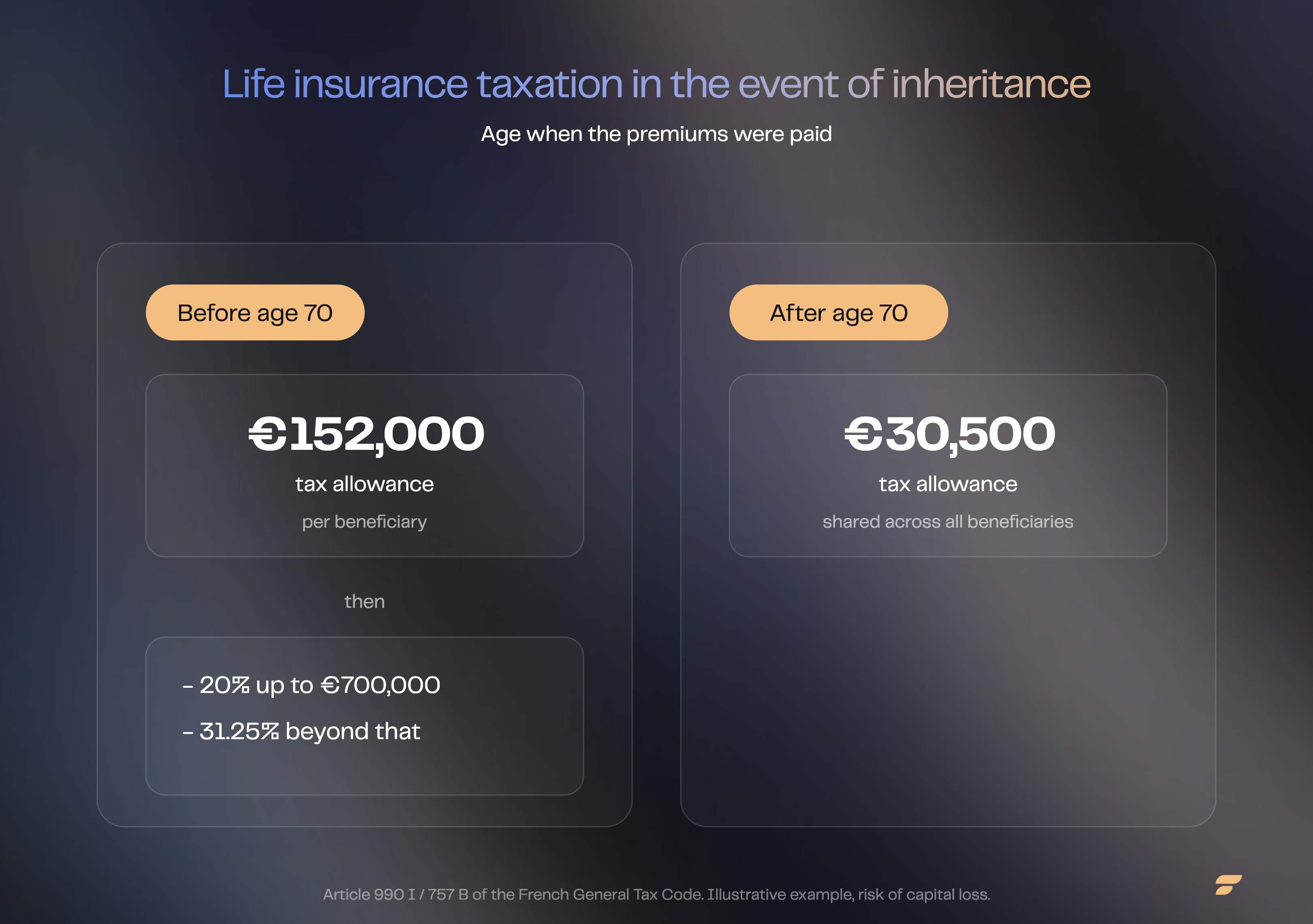
Before age 70, each beneficiary gets a €152,500 tax allowance, taxed at 20% up to €700,000 and then 31.25% beyond that. After age 70, the allowance drops to €30,500 shared among all beneficiaries, but the gains generated remain fully exempt.
Life insurance taxation before age 70: allowances and tax rates
When you pay premiums into a life insurance policy before age 70, each beneficiary gets an individual tax allowance of €152,500.
This threshold does not apply to the policy as a whole, but to each person named, across all the policies held by the same policyholder. You can therefore split the capital among several beneficiaries, each of whom benefits from this allowance.
If the amount transferred exceeds this threshold, the excess portion is taxed at 20% up to €700,000, then 31.25% beyond that.
These amounts come on top of the 17.2% social security levies already deducted from the gains throughout the life of the policy. This rate, preserved for life insurance by the 2026 Social Security Financing Act (Law no. 2025-1403 of 30/12/2025, article 13), remains lower than the 18.6% applied to most other financial investments.
For example, if a €400,000 policy is split between two children, each receives €200,000. After the allowance, only €47,500 per child is taxed at 20%.
The tax treatment therefore remains far more favourable than that of a standard inheritance, where the allowances are lower and the rates progressive.
Life insurance taxation after age 70: allowances and inheritance tax
After age 70, according to the BOFIP (article 757 B of the French General Tax Code, as of 30/03/2023), the allowance drops to €30,500, but it applies to all beneficiaries combined, rather than to each one individually. This change reduces the tax advantage of paying in premiums later in life.
However, the interest and capital gains generated after age 70 fully escape inheritance tax, whatever their amount. An older policy with a strong valuation can therefore remain worthwhile even if the premiums were paid in after age 70.
Take the case of a policyholder who invests €50,000 at age 72 and generates €30,000 in interest. On death, only €19,500 (€50,000 - €30,500) is subject to inheritance tax; the €30,000 in gains remains exempt. This mechanism can influence how wealth is passed on, even after age 70.
Cases of exemption from inheritance tax: spouses, PACS partners, charities
The surviving spouse and the PACS partner benefit from a full exemption from inheritance tax on life insurance, whatever the amount transferred.
Under the current tax framework, this rule makes it possible to pass on your wealth to your partner free of inheritance tax. Charities recognised as being of public benefit also enjoy a full exemption, which makes it easier to put philanthropic strategies in place.
A point that is often overlooked: naming a charity as beneficiary of a life insurance policy can also adjust the taxable share for other heirs. By adjusting how the capital is shared out, this strategy, at the crossroads of tax optimisation and philanthropy, is attracting a growing number of families who want their legacy to have meaning.
How can you optimise the tax treatment of your life insurance as part of estate planning?
Tax optimisation is not just about paying in premiums before age 70. You need to strike a balance between several factors: the number of beneficiaries, the amount of the premiums, the drafting of the beneficiary clause, and consistency with your overall wealth.
Naming several beneficiaries can, depending on the situation, make it possible to draw on several tax allowances. By spreading premium payments over time and factoring in changes within the family, you avoid unpleasant surprises.
Drafting the beneficiary clause requires particular care. An imprecise clause can jeopardise years of planning.
Some people combine life insurance with gifting. For example, a cash gift followed by a payment into a policy in the recipient's name makes it possible to combine the allowances of both mechanisms.
Others opt for split ownership of the beneficiary clause. This technique passes the usufruct to the spouse and the bare ownership to the children. It lets you adjust the tax treatment while protecting the spouse.
Passing on wealth is something you plan for, never something that just happens to you
Life insurance combines favourable tax treatment with targeted wealth transfer. It occupies a central place in wealth management today. But it does not work in isolation.
A comprehensive approach can be worthwhile: take into account all of your assets, changes in the law, and the specific needs of your beneficiaries.
Don't wait to act. Take the time to review your policies and consult a professional to adapt your beneficiary clauses to your family and wealth situation.
Goals
Frequently asked questions
Is life insurance really outside the estate?
Yes, in principle: the capital passed on through the beneficiary clause does not form part of the estate and falls outside the standard inheritance rules. The only limit concerns premiums deemed "clearly excessive" relative to the policyholder's wealth, which can be reintegrated at the heirs' request.
What is the life insurance tax allowance in the event of death?
Each beneficiary gets a €152,500 tax allowance on premiums paid before age 70, beyond which a tax rate of 20% applies up to €700,000, then 31.25%. For premiums paid after age 70, the allowance drops to €30,500, shared among all beneficiaries, but the gains remain fully exempt.
Who can be named as a beneficiary?
The law imposes no limit: a spouse, children, friends, charities or foundations can all be named, including outside the family circle. The beneficiary does not need to be informed that they have been named, except in the case of formal acceptance during the policyholder's lifetime.
What happens if I name "my heirs" in the clause?
Naming "my heirs" remains possible, but it means losing the tax benefits specific to life insurance: the capital then becomes subject to standard inheritance tax rather than the dedicated allowances of €152,500 or €30,500.
Sources
impots.gouv.fr: calculating inheritance tax
service-public.gouv.fr: gift tax and allowances (updated 15/01/2026)
Légifrance: French General Tax Code (articles 990 I and 757 B)
Regulatory disclaimers: Marketing communication. Investing carries a risk of partial or total capital loss. Past performance is not a reliable indicator of future performance. This article is provided for information and educational purposes only; it does not constitute personalised investment advice, a buy or sell recommendation, or tax advice. The capital guarantee on euro funds is provided by the insurer and depends on its financial strength. In a severe systemic crisis, the French "Sapin 2" law allows withdrawals to be temporarily restricted (liquidity), without affecting the guaranteed capital. Unit-linked funds are not guaranteed and carry a risk of capital loss. Before investing, read the Key Information Document (KID) and, where relevant, consult an authorised adviser. Finary SAS, an investment firm authorised by the ACPR (no. 19283), member of AMAFI. Insurance broker registered with ORIAS (no. 21001279), member of the CNCGP (association approved by the AMF). Crypto-Asset Service Provider (CASP) authorised by the AMF under the MiCA regime, references no. A2026-026 and no. N2026-008.