Everything You Need to Know About Life Insurance Taxation in France in 2026

Updated on 5 August 2026
Life insurance in France is taxed at the flat tax (PFU) of 30% before 8 years. After 8 years, an annual allowance of €4,600 (€9,200 for a couple) applies, then gains are taxed at 24.7% up to €150,000 in contributions, 30% beyond that. This article also covers the taxation that applies on death.

- The €150,000 contribution threshold that triggers the reduced 24.7% rate is assessed across all contracts combined, not contract by contract.
- On death, the €152,500 per-beneficiary allowance only applies to premiums paid before age 70.
- After age 70, a global allowance of €30,500 is shared between all beneficiaries and all contracts.
- Redundancy, early retirement, disability, or court-ordered liquidation exempts a withdrawal from income tax, excluding social security contributions.
- Holding several life insurance contracts of different ages lets you arbitrate between allowances already earned and taxation that is still unfavourable.
Introduction to life insurance taxation
Life insurance is not just about guaranteeing a lump sum or annuity on death. It is a wealth-management tool. It lets you save, grow your money, and pass it on under favourable tax conditions. It remains the French people's favourite investment: assets under management reached €2.107 trillion at the end of 2025, up 6.1% year-on-year, with €50.6 billion in net inflows (France Assureurs).
The taxation of life insurance depends on whether you withdraw money or pass it on to your beneficiaries on death.
More capital invested

Non-contractual document for promotional purposes. Investment in unit-linked funds carries a risk of capital loss, since their value is subject to fluctuation, both upwards and downwards, depending in particular on developments in the financial markets. The insurer commits on the number of units, not on their value, which it does not guarantee. The e-vie life insurance policy is an individual life insurance policy, denominated in euros and/or unit-linked funds, underwritten by Generali Vie, a company governed by the French Insurance Code. Finary SAS — 58 rue de Monceau 75380 Paris 8 — Investment Firm authorised by the ACPR under no. 19283, ORIAS no. 21001279, member of AMAFI
How is a life insurance withdrawal taxed?
A life insurance withdrawal is taxed only on its share of gains, according to a scale that depends on how long the contract has been open and when the contributions were paid: flat tax (PFU) of 30% before 8 years, then 24.7% or 30% beyond that, depending on the total amount contributed. It's crucial to understand these implications before drawing on your contract: not all withdrawals are equal from a tax standpoint.
Partial or full withdrawal: definition and tax implications
Let's start with the basics. A withdrawal means taking out all or part of the savings in your life insurance policy:
- Full withdrawal: taking out all of the savings.
- Partial withdrawal: taking out part of the savings.
The taxation of your withdrawal depends on several factors:
- The date your contract was taken out
- The date of your contributions
- The time elapsed since your contract was opened
- The amount of your withdrawal
Let's take an example. You took out a life insurance contract 10 years ago and made regular contributions. Today, you want to withdraw €10,000. This withdrawal will be made up of a share of capital (your contributions) and a share of gains (the interest generated). Only the share of gains will be subject to tax.
Taxation of life insurance contracts over 8 years old
Life insurance taxation becomes more favourable after 8 years. Why? Because lawmakers want to encourage long-term saving.
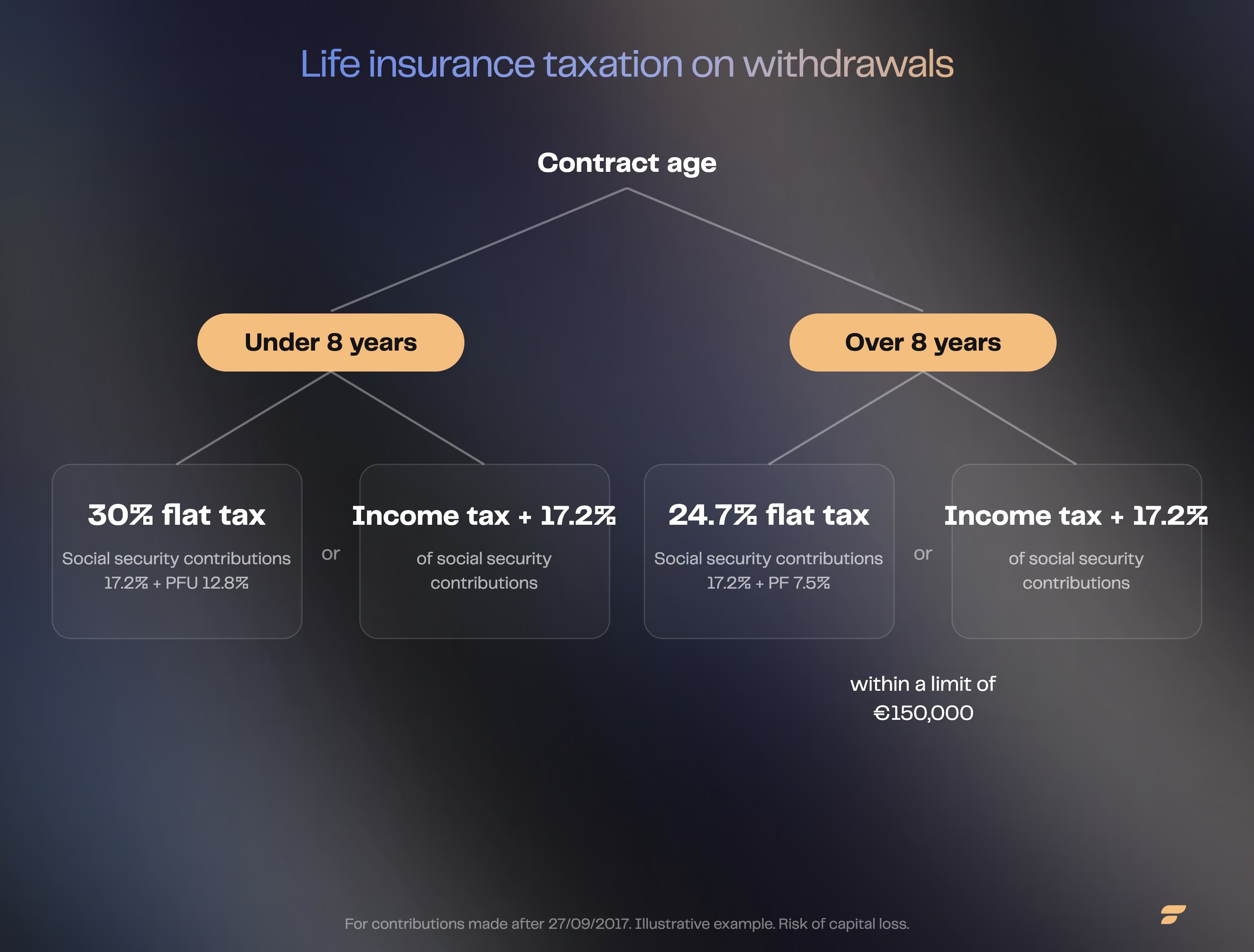
Beyond 8 years, your withdrawals benefit from an annual tax allowance of €4,600 for a single person, €9,200 for a couple. If the share of gains in your withdrawal is below these amounts, you won't pay any income tax, with only the 17.2% social security contributions remaining due.
After the allowance, gains are taxed at 7.5% (or 12.8% beyond €150,000 in contributions), plus 17.2% in social security contributions. Depending on the situation, this regime can be more favourable than the 30% flat tax (PFU) that applies before 8 years. Find out more about life insurance caps.
How to choose between the flat tax and income tax?
The taxation of your withdrawals depends on when your contributions were made and how long your contract has been open. The introduction of the flat tax (PFU) changed life insurance taxation for all contributions made from 27 September 2017.
For premiums paid before 27 September 2017, your gains are subject either to the progressive income tax scale, or, on election, to a flat-rate withholding levy (PFL) of 35% for a contract under 4 years old, 15% between 4 and 8 years, or 7.5% beyond 8 years. The 17.2% social security contributions apply in all cases.
For premiums paid from 27 September 2017, the regime is as follows (service-public.fr):
- Contract under 8 years old: 30% flat tax (12.8% income tax + 17.2% social security contributions).
- Contract over 8 years old, total contributions under €150,000: 7.5% + 17.2% social security contributions (i.e. 24.7%).
- Contract over 8 years old, total contributions over €150,000: 30% flat tax.
The €150,000 threshold is global: it applies across all your life insurance contracts. On election, you can opt for taxation under the progressive income tax scale. This election is global and applies to all your investment income.
What are withdrawal fees and how can you minimise them?
Withdrawing money from your life insurance can involve fees. These fees, set by the contract, can be:
- A percentage of the amount withdrawn
- A flat amount
To minimise these fees:
- Space out your withdrawals over time to benefit from the annual allowances.
- Wait until your contract is over 8 years old to benefit from the tax advantages.
The idea is to adopt a smart strategy that optimises your taxation while minimising fees. Knowing the applicable rules helps you better anticipate the taxation of your withdrawals.
With this in mind, you can better understand your life insurance taxation and make informed decisions about your wealth.
within reach
Non-contractual document for promotional purposes. Investment in unit-linked funds carries a risk of capital loss, since their value is subject to fluctuation, both upwards and downwards, depending in particular on developments in the financial markets. The insurer commits on the number of units, not on their value, which it does not guarantee. The e-vie life insurance policy is an individual life insurance policy, denominated in euros and/or unit-linked funds, underwritten by Generali Vie, a company governed by the French Insurance Code. Finary SAS — 58 rue de Monceau 75380 Paris 8 — Investment Firm authorised by the ACPR under no. 19283, ORIAS no. 21001279, member of AMAFI
How is life insurance taxed on death?
On death, the applicable taxation depends on the age at which the premiums were paid: up to €152,500 per beneficiary escapes inheritance tax for contributions made before age 70, versus a global allowance of €30,500 after age 70 (impots.gouv.fr). Life insurance remains, above all, a wealth-transfer tool: the accumulated capital is paid to the designated beneficiary or beneficiaries, outside the standard estate.
Contributions before age 70: allowances and levies
For premiums paid before age 70, your beneficiaries can receive up to €152,500 per beneficiary without paying inheritance tax. Beyond that, a flat levy of 20% or 31.25% applies, depending on whether each beneficiary's taxable share is below or above €700,000. The surviving spouse and PACS partner, meanwhile, are fully exempt from this levy, regardless of the amount received.
Let's take an example. You have paid €200,000 into your contract and pass it on to your two children, each receiving €100,000. This amount is fully exempt from inheritance tax. This illustrates the impact of the applicable allowances.
Contributions after age 70: allowances and exemptions
Contributions made after age 70 receive specific tax treatment. They are reintegrated into your estate and subject to inheritance tax according to your relationship with the beneficiary.
Fortunately, your beneficiaries benefit from a €30,500 allowance on these contributions, across all contracts and beneficiaries combined. In addition, the interest generated by these contributions remains exempt from inheritance tax.
Find out more about life insurance caps.
How to optimise the transfer based on the age of contributions?
The age at which contributions are made directly affects the taxation of the transfer. Hence the importance of a well-thought-out contribution strategy.
If you started funding your life insurance before age 70, you can keep contributing while taking the applicable tax framework into account. Your beneficiaries will benefit from the tax advantages when you die. If you are 70 or older, other transfer tools, such as gifting, may be considered depending on your situation to limit the tax impact.
The role of the beneficiary clause
A well-drafted beneficiary clause is crucial. It determines who will receive the capital when you die and in what proportions. Good drafting optimises the transfer, for example by splitting the capital between several beneficiaries to make the most of the allowances.
Keep your beneficiary clause up to date. A divorce, a birth, or a death may require a revision. By keeping a close eye on your clause, you ensure your capital will be passed on according to your wishes, under the best possible tax conditions.
Optimising taxation for withdrawals and inheritance
Life insurance taxation can seem complex, but it is also a framework worth knowing for those who master its subtleties. With the right strategies, it is possible to optimise the applicable tax treatment, whether for withdrawals or inheritance.
Strategies to minimise taxes
For withdrawals, depending on your situation, it may be worth delaying withdrawals from your life insurance. Each additional year brings your contract closer to the 8-year mark, with its lighter taxation. If a withdrawal is needed before 8 years, a partial withdrawal can be considered to minimise the taxable share of gains.
Spreading withdrawals out over time is an approach some savers take. By spreading withdrawals over several years, it is possible to benefit from the €4,600 annual allowance several times. For a couple, the annual allowance is €9,200.
On the inheritance side, the tax strategy begins as soon as the contract is taken out. Opening a life insurance policy before age 70 allows you, under the current legal framework, to benefit from tax advantages specific to the transfer. Splitting the capital between several beneficiaries also multiplies the allowances.
Benefiting from specific exemptions
In certain specific situations, you can benefit from tax exemptions on your withdrawals:
- Redundancy
- Early retirement
- Category 2 or 3 disability
- Cessation of self-employed activity following court-ordered liquidation
In these cases, the gains from your withdrawal are exempt from income tax. You remain liable for social security contributions, but that's still money saved! The withdrawal must take place before the end of the year following the event, with supporting documents provided to your insurer.
Older contracts
Contracts signed before 1983 are not taxed on withdrawal, but only for the share of gains linked to premiums paid before 10 October 2019: following a reform that took effect on 1 January 2020, gains linked to premiums paid since that date on a pre-1983 contract are taxed like a standard contract (BOFiP BOI-RPPM-RCM-20-10-20-50). Payments made before 25 September 1997 on other contracts are likewise not taxed on withdrawal. Premiums paid before 27 September 2017 also benefit from the earlier flat-rate withholding levy regimes described above. Depending on the case, these regimes can be more favourable than the 30% flat tax applicable to premiums paid after that date.
Concrete examples of tax calculations for withdrawals
To better understand, let's take a worked example. You took out a contract 10 years ago, with an initial contribution of €50,000. Today, your contract is worth €70,000, a gain of €20,000. You want to make a withdrawal of €10,000.
Worked example for illustrative purposes only. The taxable share of gains is calculated as follows: (Withdrawal amount / Contract value) * Total gains. That is (10,000 / 70,000) * 20,000 = €2,857
On these €2,857, you can apply the €4,600 annual allowance (if you are single). Your withdrawal will be fully exempt from tax! You will only have to pay the 17.2% social security contributions, i.e. €491.
With a little planning and a good understanding of the tax rules, you can better manage the taxation of your life insurance. To simulate the long-term impact of your withdrawals, our life insurance simulator can be useful.
Is it possible to take out several life insurance contracts?
Good news: it is possible, and often even recommended, to take out several life insurance contracts. You can hold as many as you like, and having multiple contracts can prove highly advantageous from a tax standpoint.
Advantages of having several contracts
By having several contracts of different ages, you can optimise your taxation over time:
- Make withdrawals on your "older" contract to benefit from the allowances and reduced rates.
- Let your "younger" contract mature quietly.
Another advantage: diversification. By spreading your savings across several contracts, you can diversify:
- Your investment options
- Your insurance companies
- Your management options
This lets you avoid putting all your eggs in one basket and adapt to the best opportunities in the market.
Having multiple contracts is also useful for wealth transfer:
- Designate different beneficiaries on each contract, based on your family situation and your transfer goals.
- Customise how your death benefit capital is distributed.
Be careful not to fall into the opposite excess. Too many contracts can become difficult to manage and generate extra fees. Find the right balance based on your situation and needs.
Taking out several life insurance contracts can, depending on your situation, be a wealth-optimisation tool. But as always in wealth management, weigh the pros and cons carefully and adapt to your personal situation. Seek advice from a professional, who can guide you towards the strategy best suited to your goals.
Want to know more? Discover our detailed article on opening several life insurance contracts.
Comparison with other financial products
Life insurance is not the only savings and wealth-transfer tool. Let's compare it with other financial products:
- PER (France's retirement savings plan): lets you deduct contributions from your taxable income, but benefits are taxed on payout. Discover the differences between the PER and life insurance.
- PEA (a French tax-advantaged equity savings account): capital gains and dividends are exempt from income tax after 5 years, but social security contributions remain due, at a rate of 18.6% since 2026 versus 17.2% for life insurance. It is limited to shares of companies in the European Economic Area, although some eligible ETFs provide exposure to global markets.
- Rental property: offers various preferential regimes (property-loss deduction, the "Jeanbrun" private landlord status since 2026...), but involves active management and specific constraints. The Malraux scheme, which applied to properties in remarkable heritage sites, ended in late April 2026 and is no longer available to new investors.
Tax advantages specific to life insurance compared to other investments
Life insurance offers unique tax advantages:
- Capital transfer outside the estate: escapes transfer duties and preserves the confidentiality of the transfer.
- No taxation of gains without a withdrawal: lets your savings grow tax-free.
- No contribution cap: unlike tax-advantaged accounts such as the PEA or regulated savings accounts.
- Wide investment freedom: choose between investment options with capital guaranteed by the insurer (euro funds, with the guarantee subject to the insurer's solvency and the "Sapin 2" framework) and more dynamic ones (unit-linked funds).
These features make life insurance a wealth-management tool worth considering based on your profile. It can fit into an overall wealth strategy to make the most of it, depending on your personal situation.
Life insurance taxation has its rules, exceptions and subtleties. It is also a tool used for wealth management and transfer. Its application must be adapted to each individual situation.
Goals
Frequently asked questions
Does the surviving spouse pay tax on the life insurance they receive?
No. The surviving spouse and PACS partner are fully exempt from inheritance tax and from the 20% levy on life insurance death benefits, regardless of the amount received or when the contributions were paid.
Can the taxation of a life insurance contract change during its life?
No, a contract's tax seniority cannot be transferred: it starts from the opening date and only resets if the contract is fully closed and a new one is taken out. Changing the beneficiary or the investment options does not affect this seniority.
Are social security contributions due even on a contract exempt from income tax?
Yes. The 17.2% social security contributions remain due on life insurance gains even when income tax is removed by the annual allowance or by an exemption for a life event such as redundancy or disability.
Does the €4,600 annual allowance carry over from one year to the next if unused?
No. The €4,600 allowance (€9,200 for a couple) renews every 1st January but does not carry over from one year to the next. Spreading withdrawals out over time lets you benefit from it several times rather than just once.
Is a life insurance contract taken out before 1983 still fully tax-exempt?
Not since 2020. Only gains linked to premiums paid before 10 October 2019 remain exempt from income tax. Gains linked to contributions made since that date on a pre-1983 contract are now taxed like a standard contract.
How is the €150,000 threshold assessed if someone holds several contracts?
The €150,000 contribution threshold that triggers the move from 7.5% to 12.8% after 8 years is assessed across all life insurance contracts held by the same person, not contract by contract.
Sources
Service-public.fr, how income from a life insurance contract is taxed
Impots.gouv.fr, taxation of withdrawals from a life insurance contract since 1 January 2018
Impots.gouv.fr, how life insurance policies are taxed on death
BOFiP BOI-TCAS-AUT-60, levy on sums paid by insurers on death
BOFiP BOI-RPPM-RCM-20-10-20-50, tax regime for contracts taken out before 1983
France Assureurs, life insurance in 2025: solid inflows supporting the French economy
Les Clés de la Banque, housing relaunch: the Jeanbrun private landlord status in 2026
Meilleurtaux Placement, the PEA social security contribution rate rises to 18.6%
Regulatory disclaimers: Marketing communication. Investing carries a risk of partial or total capital loss. Past performance is not a reliable indicator of future performance. This article is provided for information and educational purposes only; it does not constitute personalised investment advice, a buy or sell recommendation, or tax advice. The capital guarantee on euro funds is provided by the insurer and depends on its financial strength. In a severe systemic crisis, the French "Sapin 2" law allows withdrawals to be temporarily restricted (liquidity), without affecting the guaranteed capital. Unit-linked funds are not guaranteed and carry a risk of capital loss. Before investing, read the Key Information Document (KID) and, where relevant, consult an authorised adviser. Finary SAS, an investment firm authorised by the ACPR (no. 19283), member of AMAFI. Insurance broker registered with ORIAS (no. 21001279), member of the CNCGP (association approved by the AMF). Crypto-Asset Service Provider (CASP) authorised by the AMF under the MiCA regime, references no. A2026-026 and no. N2026-008.