The benefits of life insurance in France: why take out a policy?

Updated on 7 August 2026
In France, life insurance (assurance vie) combines a tax treatment that eases after 8 years of holding, great day-to-day flexibility, a wide choice of investment options (euro funds and unit-linked funds), and a favourable framework for passing on wealth to loved ones.

- After 8 years of holding, life insurance taxation eases significantly (24.7% instead of 30%), and an annual tax allowance applies to withdrawn gains.
- Contributions and withdrawals are free at any time: no maturity date, no exit penalty.
- In the event of death, the capital passed to designated beneficiaries largely escapes standard inheritance tax.
- The policy lets you combine an option with capital guaranteed by the insurer, barring exceptional cases provided for by the "Sapin 2" law (the euro fund), with more dynamic unit-linked funds.
What are the tax benefits of life insurance?
Life insurance taxation eases with the age of the policy: the tax rate drops from 30% before 8 years to 24.7% after 8 years, with an additional annual tax allowance on withdrawn gains.
The tax advantages of life insurance
The life insurance taxation offers many advantages. It makes this investment particularly attractive for savers.
Tax exemption on the capital
When you withdraw money from your life insurance policy, only the interest is potentially taxed. The capital itself remains tax-exempt.
Taxation that eases over time
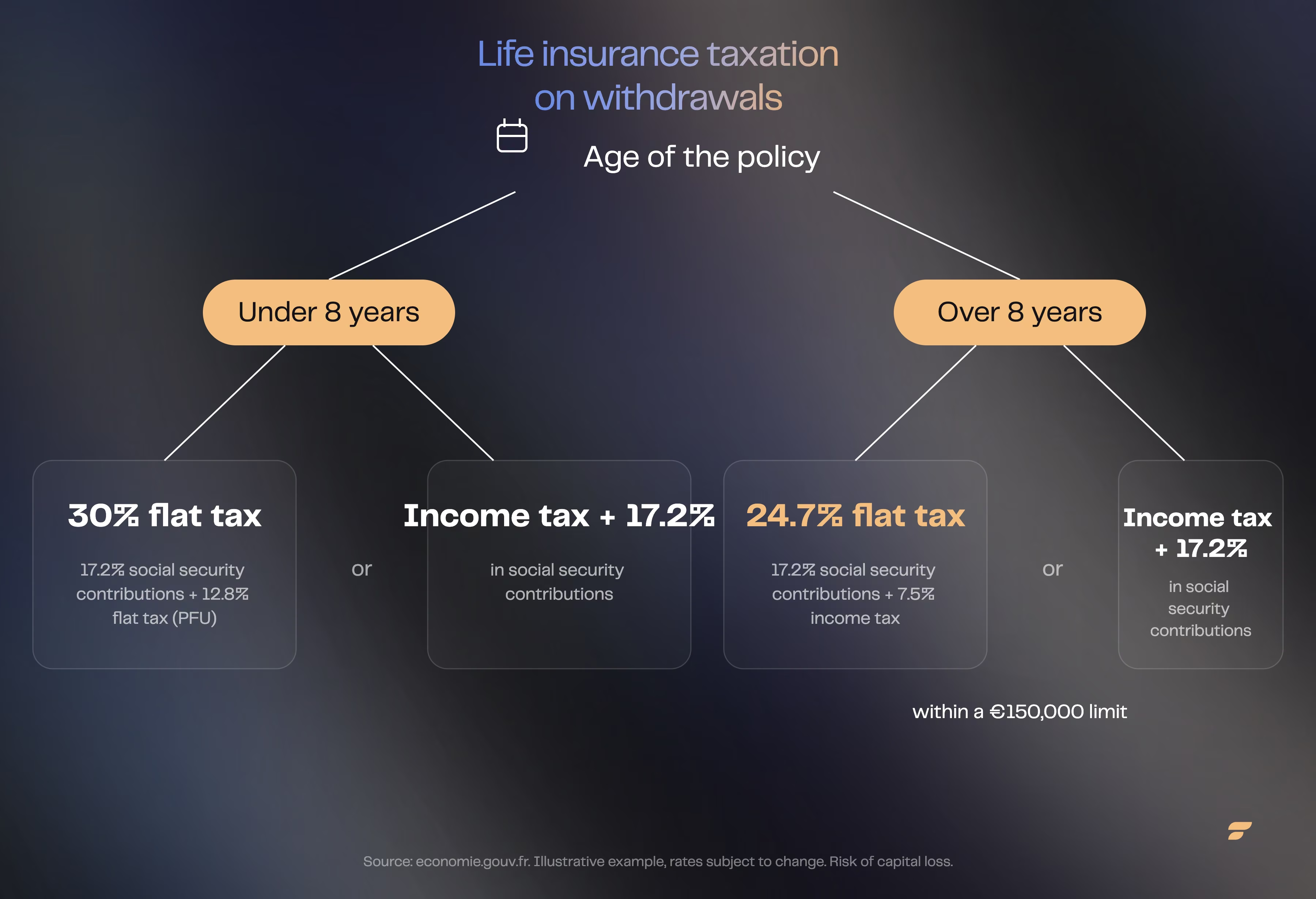
Under French rules, taxation becomes more favourable as the policy ages:
- Before 8 years: flat tax (PFU) of 30% (12.8% income tax + 17.2% social security contributions)
- After 8 years: 24.7% (7.5% income tax + 17.2% social security contributions) on gains from contributions under €150,000, 30% beyond that
These rates apply to contributions made after 27 September 2017. For earlier contributions, specific rules apply depending on the age of the policy.
After 8 years, you benefit from an annual tax allowance of €4,600 for a single person (€9,200 for a couple).
How age affects taxation
The policyholder's age also affects taxation:
- Before age 70: each beneficiary benefits from a €152,500 tax allowance. Beyond that, a 20% rate applies to the portion between €152,500 and €852,500 per beneficiary, then 31.25% beyond that.
- After age 70: the tax allowance is €30,500, shared between all beneficiaries. Only the premiums are taxed, not the interest.
This distinction encourages early saving while limiting late-stage tax optimisation strategies.
More capital invested
Non-contractual document for promotional purposes. Investment in unit-linked funds carries a risk of capital loss, since their value is subject to fluctuation, both upwards and downwards, depending in particular on developments in the financial markets. The insurer commits to the number of units, not to their value, which it does not guarantee. This life insurance policy is an individual life insurance policy, denominated in euros and/or unit-linked funds, underwritten by Generali Vie, a company governed by the French Insurance Code. Finary SAS — 58 rue de Monceau 75380 Paris 8 — Investment Firm authorised by the ACPR no. 19283, ORIAS no. 21001279, member of AMAFI
A concrete example
Marie, 45, opened a life insurance policy 10 years ago. She withdraws €20,000, including €5,000 in capital gains. Thanks to the tax allowance, only €400 is subject to the 24.7% flat-rate levy. She therefore pays around €99 in tax on her withdrawal.
Life insurance taxation improves over time. The longer you keep your policy, the more attractive tax benefits you enjoy.
What day-to-day flexibility does life insurance offer?
Life insurance lets you contribute and withdraw money freely, with no maturity date or penalty, while being able to switch between funds at any time.
Flexible contributions
Life insurance lets you contribute money according to your needs:
- Initial contribution: lets you get started quickly, even with a small amount.
- Free contributions: deposit money whenever you like.
- Scheduled contributions: pay in a fixed amount on a regular basis.
Flexible withdrawals
You can withdraw money from your life insurance policy at any time:
- Partial withdrawal: withdraw part of your savings
- Full withdrawal: recover the entire contents of your policy
- Scheduled withdrawals: receive a regular amount
For example, you can schedule a monthly withdrawal of €500 to supplement your income in retirement.
Switching between funds to optimise your savings
Switching (arbitrage) lets you spread your money across different investment options (euro funds, unit-linked funds) and change that allocation whenever you want.
Some policies offer automatic switching options to secure your gains or make your savings more dynamic.
No maturity date
Unlike other investments, life insurance has no maturity date. You can keep it for as long as you want, whether that's 8 years, 20 years, or even your whole life.
A tool suited to preparing different projects

Life insurance is an investment that can be used for different life projects.
A property down payment
Life insurance can serve as a down payment for a property project. A solid down payment increases your chances of obtaining a loan on favourable terms.
Example: with €50,000 in your life insurance policy, you could use €30,000 as a down payment for a €300,000 house. This reassures your bank and reduces the amount you need to borrow.
Financing your children's education
Life insurance can help finance your children's higher education.
Example: by paying in €100 a month for 18 years, with a hypothetical annual return of 3% (for illustration only, not guaranteed), you can build up €28,500 to finance your child's education. To estimate the growth of your savings, use our life insurance simulator.
Preparing for retirement
Life insurance can be a tool for preparing for retirement:
- Converting capital into a life annuity
- Scheduled withdrawals for a regular income
Unexpected expenses
Life insurance can serve as a safety-net fund for unexpected financial needs, in particular via the portion invested in the euro fund. Accessible at any time, you can make a withdrawal whenever you need to; the funds are paid out within a few weeks (statutory maximum: 2 months).
What investment options does life insurance offer?
A life insurance policy combines the euro fund, with capital guaranteed by the insurer, and unit-linked funds (shares, bonds, SCPI (a French non-listed real-estate investment fund, comparable to a REIT)), which are more dynamic but come with no capital guarantee.
The euro fund: an option with capital guaranteed by the insurer
The euro fund has the following features:
- Capital guaranteed by the insurer (barring exceptional cases provided for by the "Sapin 2" law)
- Secure, steady returns: according to the ACPR, euro funds paid an average rate of 2.6% in 2025, stable compared with 2024
- Ratchet effect: interest earned is locked in permanently each year
Suited to cautious profiles who prioritise security.
Unit-linked funds: to boost your savings
Unit-linked funds offer higher return potential, with increased risk:
- Shares: participation in company growth
- Bonds: loans to governments or companies
- Real estate: investing in property without buying directly (via an SCPI (Société Civile de Placement Immobilier), for example)

Multi-fund life insurance policies
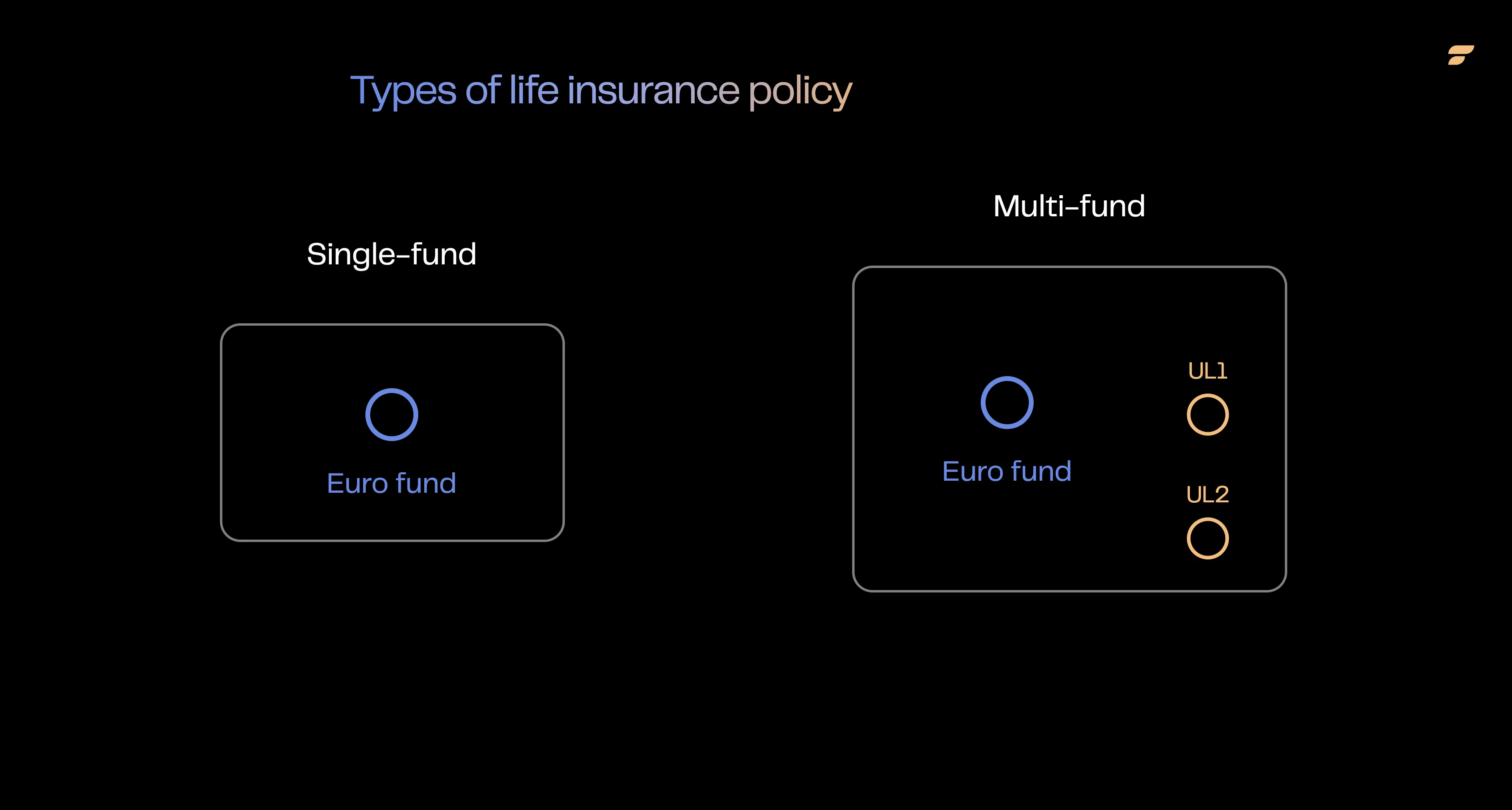
A multi-fund life insurance policy combines the security of the euro fund with the growth potential of unit-linked funds. This type of policy lets you place your savings across different investment options within a single policy, offering flexibility and diversification.
One of the great strengths of a multi-fund policy is the option to choose managed-portfolio, profiled, advised or self-directed management, depending on your level of investment knowledge and how involved you want to be.
- In managed-portfolio management, a fund manager handles the allocation of your assets according to your risk profile and financial goals.
- In profiled management, you choose a risk profile (cautious, balanced or dynamic) and your asset allocation is built automatically as a result, without you having to select each investment option yourself.
- In advised management, you stay in control of your investment decisions, but benefit from recommendations delivered as part of the duty to advise or from a decision-support tool to guide your choices.
- In self-directed management, you are in control, freely choosing and changing your investment options.
How does life insurance make it easier to pass on wealth?
Life insurance lets you freely designate your beneficiaries and pass capital on to them outside standard inheritance rules, with tax allowances of up to €152,500 per beneficiary before age 70.
The freedom to choose your beneficiaries
Life insurance lets you freely choose your beneficiaries:
- Your children
- Other family members
- Charitable organisations
You can designate several beneficiaries and split the amounts as you wish. The beneficiary clause is a key element of this flexibility.
Advantages over a standard inheritance
Compared with a standard inheritance, life insurance offers several notable advantages:
- Lighter taxation: The significant tax allowances and lower tax rates make it possible to pass on large sums with light, or even zero, taxation within the applicable allowance limits.
- Flexibility of the beneficiary clause: You can freely choose and change beneficiaries without having to follow standard inheritance-devolution rules. This offers great flexibility to adapt the transfer at every stage of your life.
- Independence from the estate: The capital paid to life insurance beneficiaries is not part of the estate. This avoids potential conflicts between heirs and simplifies the transfer of your wealth.
The life insurance thresholds for wealth transfer are more favourable than standard inheritance tax, which can reach 45% for large estates.
Life insurance is therefore a tool that can be used as part of passing on wealth, provided it suits your personal situation.
Other benefits and considerations
The option to hold several policies
Another valuable advantage is the option to take out several life insurance policies. This multi-policy strategy can be worthwhile for several reasons:
- Diversifying investment options and management: By holding several policies, you can further diversify your investment options and adopt different management strategies depending on your goals and risk profiles.
- Specific goals: You can dedicate each policy to a particular goal, such as preparing for retirement, buying property, or a future project for your children.
The insurer's duty to advise
The insurer's duty to advise is a protection guarantee for the saver. In accordance with the regulations, your insurer must inform you clearly and transparently about the features of the life insurance products on offer. It must ensure that the recommended investment solutions are suited to your saver profile, your goals and your risk tolerance.
An investment that adapts to every stage of life
Life insurance proves to be a versatile financial tool. It offers many strengths that make it an investment chosen by many savers:
- Favourable taxation, particularly after 8 years of holding
- Great flexibility of use, allowing flexible contributions and withdrawals
- A tool suited to preparing various life projects
- A wide range of investment options to suit every profile
- An effective way to pass on your wealth under favourable tax conditions
Life insurance also has other advantages, such as having no expiry date and the option to take out several policies.
within your reach
Non-contractual document for promotional purposes. Investment in unit-linked funds carries a risk of capital loss, since their value is subject to fluctuation, both upwards and downwards, depending in particular on developments in the financial markets. The insurer commits to the number of units, not to their value, which it does not guarantee. This life insurance policy is an individual life insurance policy, denominated in euros and/or unit-linked funds, underwritten by Generali Vie, a company governed by the French Insurance Code. Finary SAS — 58 rue de Monceau 75380 Paris 8 — Investment Firm authorised by the ACPR no. 19283, ORIAS no. 21001279, member of AMAFI
Frequently asked questions
What are the tax benefits of life insurance after 8 years?
After 8 years of holding, withdrawn gains are taxed at the reduced flat tax (PFU) rate of 24.7% (7.5% income tax + 17.2% social security contributions) on contributions under €150,000, versus 30% before 8 years. An annual tax allowance of €4,600 (€9,200 for a couple) applies on top of that on taxable gains.
Can you withdraw money from a life insurance policy at any time?
Yes. Life insurance is not a locked-in investment: you can make a partial or full withdrawal whenever you want. The funds are paid out within a few weeks, within a statutory maximum of 2 months. Only the tax treatment varies depending on the age of the policy.
What happens to money in a life insurance policy in the event of death?
The capital is passed to the beneficiaries designated in the beneficiary clause, outside standard inheritance rules. Before age 70, each beneficiary benefits from a €152,500 tax allowance. After age 70, a €30,500 tax allowance is shared between all beneficiaries, and only the premiums paid in are taxed.
What is the difference between the euro fund and unit-linked funds?
The euro fund guarantees the capital invested (barring exceptional cases provided for by the "Sapin 2" law) with an average return of 2.6% in 2025 according to France Assureurs/ACPR. Unit-linked funds (shares, bonds, real estate via SCPI…) offer higher performance potential but with no capital guarantee.
Sources
economie.gouv.fr: what taxation applies to life insurance
ACPR, publication no. 179: Life insurance in 2025 (average rate 2.63%)
Regulatory disclaimers: Marketing communication. Investing carries a risk of partial or total capital loss. Past performance is not a reliable indicator of future performance. This article is provided for information and educational purposes only; it does not constitute personalised investment advice, a buy or sell recommendation, or tax advice. The capital guarantee on euro funds is provided by the insurer and depends on its financial strength. In a severe systemic crisis, the French "Sapin 2" law allows withdrawals to be temporarily restricted (liquidity), without affecting the guaranteed capital. Unit-linked funds are not guaranteed and carry a risk of capital loss. Before investing, read the Key Information Document (KID) and, where relevant, consult an authorised adviser. Finary SAS, an investment firm authorised by the ACPR (no. 19283), member of AMAFI. Insurance broker registered with ORIAS (no. 21001279), member of the CNCGP (association approved by the AMF). Crypto-Asset Service Provider (CASP) authorised by the AMF under the MiCA regime, references no. A2026-026 and no. N2026-008.