Luxembourg Life Insurance Taxation for French Residents: The Complete Guide

Updated on 7 August 2026
For a French tax resident, the taxation of Luxembourg life insurance is strictly identical to that of a French policy: the same flat tax (PFU) of 30% (French Tax Code, rate in force as of 7 August 2026) before 8 years, the same allowances after 8 years, thanks to the tax-neutrality principle.

- Tax neutrality adjusts automatically if you move abroad, with no need to close the policy and no withholding tax in Luxembourg.
- PFU of 30% before 8 years, reduced to 7.5% after 8 years on premiums under €150,000, with a tax allowance of €4,600 (or €9,200 for a couple).
- Estate-transfer exemption of up to €152,500 per named beneficiary for premiums paid before age 70.
- Entry ticket typically between €100,000 and €250,000, a segment for substantial wealth that Finary One serves from €1,000,000 in investable assets.
This guide details the taxation that applies to Luxembourg policies for French residents (withdrawals, capital gains, estate transfer), the reduced 7.5% rate on premiums under €150,000, portability if you move abroad, and how it interacts with the IFI wealth tax and the "apport-cession" holding-company mechanism (article 150-0 B ter of the French General Tax Code, or CGI). The 2026 Social Security Financing Act (LFSS) explicitly excludes life insurance from the increase in social security contributions.
What is the taxation of Luxembourg life insurance?
Luxembourg life insurance is attracting a growing number of French investors. Its taxation, while complex, offers significant advantages for optimising wealth while benefiting from enhanced asset protection.
The Tax-Neutrality Principle
At the heart of this mechanism lies the principle of tax neutrality. For a French tax resident, the taxation applied is that of France, not that of Luxembourg. This tax transparency avoids double taxation.
The Asset-Protection Structure
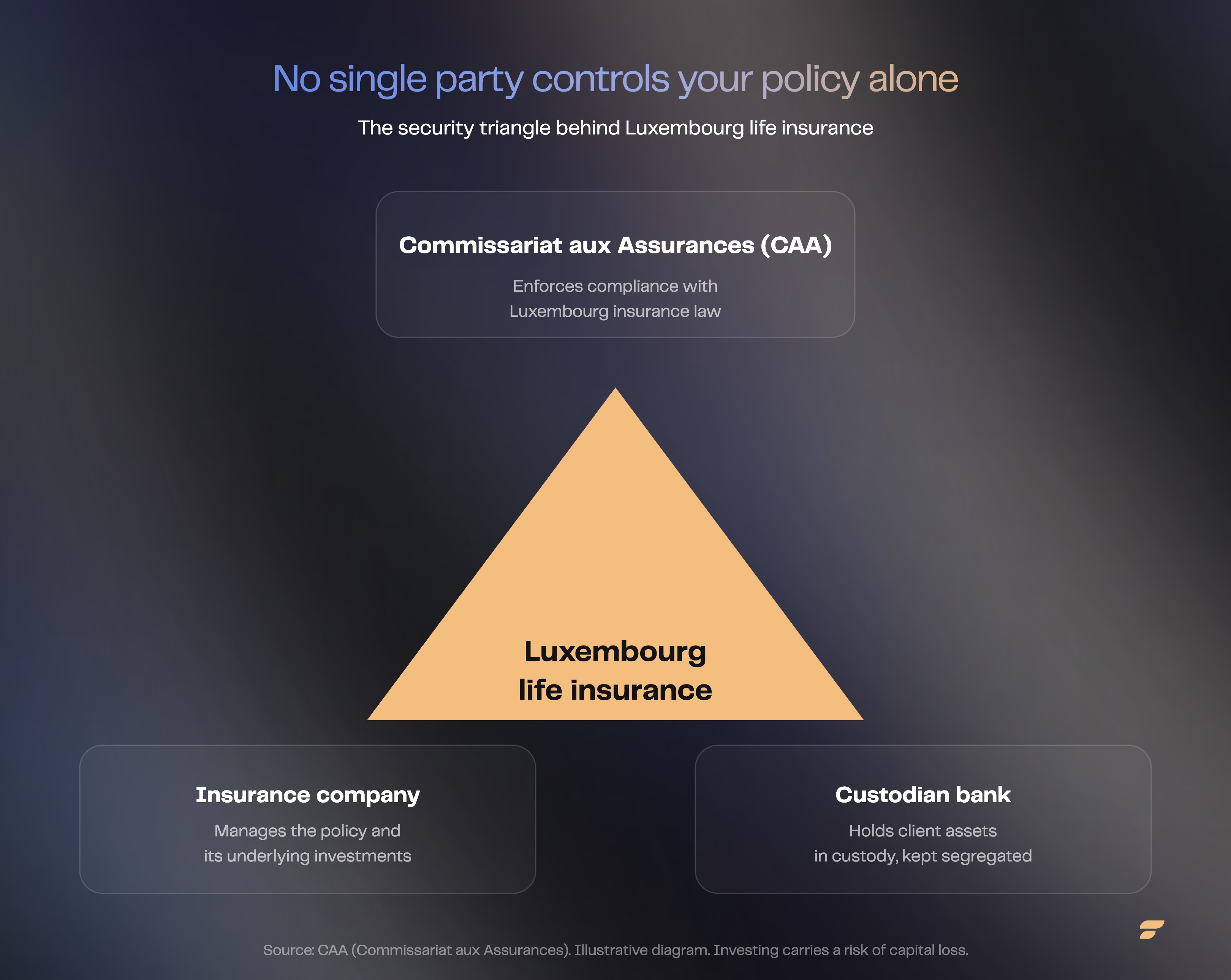
The major difference from French life insurance lies in the asset-protection structure. Luxembourg uses a system called the "security triangle". This system involves:
- the insurer,
- a depositary bank,
- the Commissariat aux Assurances (CAA), Luxembourg's insurance regulator.
This setup ensures a strict separation of assets, unlike in France, where assets are held by the insurer itself.
The "Super Privilege"
Another feature is the "super privilege" granted to policyholders. If the insurer becomes insolvent, holders of Luxembourg policies benefit from first-ranking creditor status. This guarantee is unlimited in Luxembourg. By comparison, it is capped at €70,000 per policyholder and per company in France.
Why Choose Luxembourg Life Insurance?
There are many reasons to choose Luxembourg life insurance:
- Flexibility,
- Security,
- Wealth optimisation.
For a complete overview of the advantages, disadvantages and selection criteria based on your wealth profile, see our dedicated guide: Luxembourg Life Insurance in 2026: Advantages, Disadvantages and How to Choose.
Luxembourg policies offer an open architecture, allowing great freedom in the choice of assets. They also provide multi-currency management within a single policy, a feature useful for international investors.
Exemption from the "Sapin 2" Law
Unlike French policies, Luxembourg life insurance is not subject to the French "Sapin 2" law.
This exemption offers greater management flexibility. It can be a stabilising factor in times of financial stress, subject to the risks inherent in the investment options chosen. Investors therefore benefit from greater flexibility for their investments.
Associated Costs
It should be noted, however, that this sophistication comes at a cost. The entry ticket for Luxembourg life insurance is generally between €100,000 and €250,000, depending on the insurer and the fund type (FAS, FIC, FID).
By comparison, many French policies start at €500. Annual management fees are also higher, although they decrease as assets under management grow.
What is the tax-neutrality principle?

Tax neutrality means that a Luxembourg life insurance policy is fiscally transparent: for a French tax resident, the tax rules applied are exactly those of a policy taken out in France. This principle is the cornerstone of the appeal of Luxembourg life insurance for French tax residents.
In plain terms, tax neutrality means the Luxembourg life insurance policy is fiscally transparent. For a French tax resident, this means the French tax rules in force apply, exactly as if the policy had been taken out with a French insurer.
This arrangement generally avoids double taxation and simplifies tax management for the policyholder.
Benefits for French Tax Residents
French tax residents benefit from the structural advantages of Luxembourg life insurance. This includes enhanced asset protection and investment flexibility, while keeping the French tax framework.
The tax rules on withdrawals, the tax allowances and the estate-transfer taxation remain identical to those of a French policy.
Worked Example
To illustrate the principle, take a French investor taking out a Luxembourg life insurance policy with an initial contribution of €500,000. After 10 years, the value reaches €700,000, and the investor makes a partial withdrawal of €100,000.
In this case, the tax calculation is done exactly as for a French policy:
- Determining the taxable portion: (€100,000 x €200,000) / €700,000 = €28,571
- Applying the €4,600 tax allowance (for a single person): €28,571 - €4,600 = €23,971
- Taxation at the 7.5% rate (policy over 8 years old): €23,971 x 7.5% = €1,798
- Social security contributions of 17.2% on total gains: €28,571 x 17.2% = €4,914
Total taxation would therefore amount to €6,712, exactly the same amount as for an equivalent French policy.
Taxation in the Event of Death
This principle also extends to taxation in the event of death. The €152,500 allowance per beneficiary for contributions made before age 70 applies in the same way as in France.
The Adaptability of Tax Neutrality
This tax neutrality is not fixed. It adapts to changes in French tax legislation. For example, if France changes its tax rules on life insurance policies, those changes apply immediately to Luxembourg policies held by French tax residents.
Flexibility for Expatriates
This flexibility offers an additional advantage to holders of Luxembourg policies. The policy's taxation adjusts automatically when tax residence changes.
This flexibility offers valuable continuity for expatriates. Internationally mobile individuals also benefit from this advantage. The policy therefore follows the holder wherever they move, ensuring simplified tax management.
What taxation applies to a withdrawal from a Luxembourg policy?
A withdrawal from a Luxembourg life insurance policy follows exactly the same tax rules as a withdrawal from a French policy: a 12.8% levy before 8 years, a reduced rate of 7.5% after 8 years (on premiums under €150,000), and 17.2% in social security contributions in all cases.
Withdrawal Before 8 Years
For policies under 8 years old, gains realised on a withdrawal are subject to a flat levy of 12.8%.
For example, a policy taken out 5 years ago with an initial contribution of €100,000 reaches a value of €120,000. A withdrawal of €20,000 generates a taxable gain of €3,333 (€20,000 x €20,000 / €120,000). Income tax therefore amounts to €427 (€3,333 x 12.8%).
Withdrawal After 8 Years
After 8 years, Luxembourg life insurance benefits fully from its tax potential. Gains realised qualify for a reduced tax rate of 7.5%, after applying an annual allowance. This allowance is €4,600 for a single person and €9,200 for a married or civil-union ("pacsé") couple.
Take the example of a 10-year-old policy worth €200,000 for an initial contribution of €150,000. A withdrawal of €50,000 generates a taxable gain of €12,500 (€50,000 x €50,000 / €200,000). After applying the €4,600 allowance, the taxable gain is €7,900, with tax of €592.50 (€7,900 x 7.5%).
For policies with contributions above €150,000, the tax rate rises to 12.8% on the excess portion, to maintain tax fairness.
Social Security Contributions
Whatever the policy's age, social security contributions of 17.2% systematically apply to gains realised on a withdrawal. In the example of the 10-year-old policy, social security contributions would amount to €2,150 (€12,500 x 17.2%).
Tax Optimisation
The favourable taxation of policies over 8 years old encourages a long-term holding strategy. There are techniques for optimising withdrawals before that milestone.
As general information, partial withdrawals rather than a full withdrawal can help smooth taxation. Any strategy should be reviewed with an adviser in light of your own situation.
You can still choose between the flat levy and taxation under the progressive income-tax scale.
To estimate precisely the tax due on your own policy, use the Finary life insurance tax simulator.
For taxpayers whose marginal tax rate is below 12.8%, opting for the progressive scale may, depending on individual circumstances, be more favourable.
Luxembourg Life Insurance Taxation at Finary One
Finary One supports investors with €1,000,000 or more in investable assets in the tax optimisation of their Luxembourg policy according to their situation and objectives (scheduled withdrawals, estate transfer, "apport-cession").
- A dedicated wealth advisor who structures the policy's tax architecture (split-ownership beneficiary clauses, estate planning, the reduced 7.5% income-tax rate on premiums under €150,000).
- An informed selection among 10 Luxembourg insurers, with fee negotiation and access to FID (Fonds Interne Dédié, a dedicated internal fund) from €500,000 in assets.
- A 360° view of your wealth, integrating Luxembourg life insurance taxation, the IFI wealth tax, estate transfer and "apport-cession" into an overall wealth strategy.
Learn more about Finary One → Reserved for investors with €1,000,000 or more in investable assets. Investing carries risks, including the risk of capital loss.

What taxation applies in the event of death?
In the event of death, each named beneficiary receives a €152,500 allowance for premiums paid before the policyholder turns 70, then progressive taxation of 20% to 31.25% beyond that. For premiums paid after age 70, an overall allowance of €30,500 applies across all policies.
Contributions Before Age 70
For sums paid in before the policyholder's 70th birthday, the tax regime is particularly favourable. Each named beneficiary receives a €152,500 allowance. This exemption applies individually to each beneficiary, forming a specific tax framework for estate transfer. Under article 990 I of the French General Tax Code, this €152,500 allowance applies individually to each named beneficiary, regardless of the number of beneficiaries named in the policy.
Beyond this allowance, taxation becomes progressive. The capital transferred is taxed at 20% up to €700,000, then at 31.25% on the portion exceeding that amount (article 990 I of the French General Tax Code, rate in force as of 7 August 2026).
For example, a Luxembourg life insurance policy worth €1,000,000 at the date of death, with two named beneficiaries in equal shares:
- Each receives €500,000.
- After the €152,500 allowance, the amount subject to taxation would be €347,500 per beneficiary.
- Taxation would therefore be €69,500 (20% of €347,500) for each, an effective tax rate of just 13.9%.
Contributions After Age 70
For contributions made after the policyholder's 70th birthday, the tax regime differs. These sums are added back into the estate, but benefit from an overall allowance of €30,500. This allowance applies across all policies held by the deceased, not per beneficiary.
It is crucial to note that only the contributions themselves are affected. The interest and capital gains generated by those contributions remain exempt from estate-transfer duties.
For example, a policy taken out at age 72 with an initial contribution of €200,000 is worth €250,000 at the date of death. Only €169,500 (€200,000 - €30,500) will be subject to estate-transfer duties. The €50,000 in capital gains will escape taxation.
Transferring Capital to Beneficiaries: Steps and Procedures
Transferring the capital to beneficiaries follows a specific process. Here are the main steps:
- Notifying the death to the Luxembourg insurer.
- Providing the required documents (death certificate, beneficiaries' proof of identity, etc.).
- Tax assessment by the insurer.
- Withholding of estate-transfer duties by the insurer, which acts as a collector on behalf of the French tax authorities.
- Payment of the net capital to the beneficiaries.
This process, similar to that of a French policy, often benefits from faster handling thanks to the expertise of Luxembourg insurers.
Optimising Estate Transfer
The favourable taxation of Luxembourg life insurance allows for different estate-transfer approaches, to be reviewed with a professional. For example:
- Naming several beneficiaries can, depending on how the clause is drafted, make use of several €152,500 allowances.
- Splitting contributions before and after age 70 to optimise overall taxation.
It is also possible to include split-ownership beneficiary clauses, separating usufruct and bare ownership of the capital, for estate transfer optimised across several generations.
The flexibility of Luxembourg policies allows the estate-transfer strategy to be adapted as the policyholder's family and wealth situation evolves.
If you would like to know more about the best life insurance policies in Luxembourg, feel free to check out our dedicated article.
Other Tax Advantages
Luxembourg life insurance offers several additional tax features useful for international wealth management.
No Taxation on Switches
One of the major advantages lies in the absence of taxation on switches within the policy. This feature allows dynamic portfolio management with no immediate tax impact.
Investors can therefore:
- Adjust their asset allocation according to market conditions or personal objectives.
- Switch investments from equities to bonds during periods of market turbulence.
- Move back into equities when conditions improve.
All of this without triggering a taxable event. This flexibility is valuable in a volatile financial environment.
No Luxembourg Taxation for Non-Residents
For non-resident holders, the absence of local taxation on life insurance policies is a considerable advantage. Only the taxation of the country of residence applies, avoiding any complexity linked to double taxation.
Adapting to a Change in Tax Residence
Adaptability to changes in tax residence is one of the most remarkable strengths of Luxembourg life insurance. This flexibility is a notable feature in a context where international mobility is increasingly common.
When a holder changes country of residence, their policy's taxation adjusts automatically to comply with the rules of the new country. This adjustment happens with no need to close the policy or open a new one.
Special Exemptions and Specific Situations
Luxembourg life insurance also offers tax advantages in certain situations:
- Withdrawal following redundancy,
- Early retirement,
- Disability or the cessation of self-employed activity.
In these cases, gains may qualify for an exemption from income tax, although social security contributions remain due.
For capitalisation contracts and life insurance policies, only the portion of the policy invested in property-related unit-linked funds (SCPI [a French non-listed real-estate investment fund, comparable to a REIT], SCI, OPCI) is included in the base for the IFI real-estate wealth tax, at its surrender value (article 972 of the CGI): the policy's non-property investment options remain outside the scope of the IFI, which is an advantage for substantial estates.
Luxembourg life insurance combines the Luxembourg structural framework with French taxation. It remains subject to the risk of capital loss for unit-linked investment options.
Frequently Asked Questions
What is the tax treatment of a withdrawal from Luxembourg life insurance before 8 years?
Gains from a withdrawal on a policy under 8 years old are subject to the flat tax (PFU) of 30%, made up of 12.8% income tax and 17.2% social security contributions, with no annual allowance. The taxpayer can opt for the progressive income-tax scale if it is more favourable to their situation.
Is Luxembourg life insurance subject to the "Sapin 2" law?
No. Luxembourg life insurance does not fall within the scope of the French "Sapin 2" law, which only applies to policies governed by French law. The policy's euro funds and unit-linked funds nonetheless remain subject to the risks inherent in their respective investment options.
What is the social security contribution rate applicable in 2026?
The social security contribution rate applicable to life insurance gains remains set at 17.2% in 2026. The 2026 Social Security Financing Act (law no. 2025-1403 of 30 December 2025) raises social security contributions to 18.6% on other investment income, but explicitly excludes life insurance from this increase.
What is the estate-transfer allowance for a Luxembourg policy?
For premiums paid before the policyholder's 70th birthday, each named beneficiary receives a €152,500 allowance, beyond which the capital transferred is taxed at 20% up to €700,000, then at 31.25% beyond that. For premiums paid after age 70, an overall allowance of €30,500 applies, across all policies combined, on the contributions alone (capital gains remain exempt from estate-transfer duties).
What is the minimum entry ticket for Luxembourg life insurance?
The entry ticket for a Luxembourg policy is generally between €100,000 and €250,000, compared with a few hundred euros for many French policies. This positioning reserves Luxembourg life insurance for substantial estates, a segment Finary One serves from €1,000,000 in investable assets.
Sources
French General Tax Code (articles 125-0 A, 990 I, 757 B, 972)
French Monetary and Financial Code (article L.541-8-1)
Law no. 2025-1403 of 30 December 2025 on Social Security Financing for 2026
Commissariat aux Assurances (CAA): Luxembourg's insurance regulator
Regulatory disclaimers: Marketing communication. Investing carries a risk of partial or total capital loss. Past performance is not a reliable indicator of future performance. This article is provided for information and educational purposes only; it does not constitute personalised investment advice, a buy or sell recommendation, or tax advice. The capital guarantee on euro funds is provided by the insurer and depends on its financial strength. In a severe systemic crisis, the French "Sapin 2" law allows withdrawals to be temporarily restricted (liquidity), without affecting the guaranteed capital. Unit-linked funds are not guaranteed and carry a risk of capital loss. Before investing, read the Key Information Document (KID) and, where relevant, consult an authorised adviser. Finary SAS, an investment firm authorised by the ACPR (no. 19283), member of AMAFI. Insurance broker registered with ORIAS (no. 21001279), member of the CNCGP (association approved by the AMF). Crypto-Asset Service Provider (CASP) authorised by the AMF under the MiCA regime, references no. A2026-026 and no. N2026-008.