What are the fees on life insurance?

Updated on 31 July 2026
A life insurance policy costs on average 0.88% a year in policy fees on unit-linked funds, plus 1.60% in internal fund fees, or 2.48% in total according to France Assureurs. This guide breaks down every fee line and compares 13 policies on the market.

- Entry fees range from 0% on online policies to 4.85% at AXA Arpèges, i.e. €485 taken out of €10,000.
- Annual management fees range from 0.50% on the best online policies to nearly 1% at a traditional bank.
- Switching fees, zero at most online providers, reach 0.80% of the amount switched at AXA Arpèges.
- Since 1 July 2022, every insurer must publish an online summary fee table for all of its policies.
- On €100,000 invested for ten years at 4% gross, 0.25 points less in fees yields around €3,400 more.
What are the different types of life insurance fees?
A life insurance policy carries five families of fees: entry and contribution fees, annual management fees, switching fees, withdrawal fees and the internal fees of the underlying funds. The first four are charged by the insurer, the last by the fund management companies.
More capital invested

Non-contractual document for promotional purposes. Investment in unit-linked vehicles carries a risk of capital loss, since their value is subject to fluctuation, both upwards and downwards, depending in particular on developments in the financial markets. The insurer guarantees the number of unit-linked units, not their value, which it does not guarantee. The e-vie life insurance policy is an individual life insurance policy, denominated in euros and/or unit-linked vehicles, underwritten by Generali Vie, a company governed by the French Insurance Code. Finary SAS - 58 rue de Monceau 75380 Paris 8 - Investment Firm authorised by the ACPR under no. 19283, ORIAS no. 21001279, member of AMAFI
Entry and contribution fees
These fees are charged when the policy is opened or on each new contribution. They can reach 5% of the amount invested, cutting into your capital from the outset. Many online policies now charge 0% entry fees.
Annual management fees
Charged every year, these fees pay the insurer for running your policy. They generally range between 0.50% and 1% on euro funds. On unit-linked funds they run from 0.50% on the best online policies to 1% at a traditional bank, for a market average of 0.88% in 2025.
Switching fees
Applied when you switch between investment options, these fees range from 0% to 1% of the amount switched. Some policies include a limited number of free switches each year.
Inheritance taxation: levies, not fees
Contrary to a widespread belief, the insurer charges no specific fee when the policy pays out on death. What is deducted is inheritance tax, under a separate regime depending on whether the premiums were paid before or after the policyholder's 70th birthday. Tax rules may change; specialist advice is recommended.
Withdrawal and exit fees
These fees apply when you take money out of your policy. They are generally zero on modern policies, but can reach 5% on some older ones, in the form of a surrender penalty capped at 5% applicable in exceptional market conditions.
Understanding these fee types helps compare the policies available. The next sections examine each fee category in detail and compare the most competitive offers on the market.
Entry and contribution fees
Entry and contribution fees are charges taken by the insurer when the policy is opened or on each new contribution. They represent a percentage of the amount invested and directly reduce your initial capital.
Typical fee range
These fees traditionally ranged between 2% and 5% of the amount paid in. Sharper competition and the arrival of online policies have brought those rates down considerably.
Comparison of policies with no entry fees
Several providers now offer policies with no entry fees:
- Finary: 0% on Finary Life
- Boursorama: 0% on BoursoVie
- Fortuneo: 0% on Fortuneo Vie
Which insurers are cheapest on entry fees?
Top 3 cheapest insurers:
- Abeille Assurances: 0% on Lucya Abeille
- Yomoni: 0% on Yomoni Vie
- Nalo: 0% on its life insurance policy
Examples
Traditional bank:
- LCL: up to 3.5% on LCL Vie
Traditional insurer:
- AXA: up to 4.85% on Arpèges
These levels appear in the summary fee table that every insurer has had to publish on its website since 1 July 2022.
Online bank:
- Boursorama: 0% on BoursoVie
Online savings platform:
- Finary: 0% on Finary Life
To illustrate the impact of these fees, take an example:
On a €10,000 contribution:
- With 0% fees (Finary Life): €10,000 invested
- With 3.5% fees (LCL): €9,650 invested
- With 4.85% fees (AXA): €9,515 invested
The gap may look small at first, but it widens over time and with successive contributions. The level of entry fees affects the capital initially invested and the net return.
Considering moving your life insurance to a better policy? Use the Finary life insurance simulator to estimate in seconds the savings you could make.
How much do annual management fees cost?
Annual management fees run from 0.50% to 1% of assets depending on the policy and the investment option. They are charged every year on the whole of the capital, whether the policy gains or loses value, which makes them the heaviest fee line over time.
Fees on euro funds
Management fees on euro funds are generally lower than those applied to unit-linked funds. They range between 0.50% and 1% a year.
Top 3 cheapest on euro funds:
- Fortuneo: 0.60% on Fortuneo Vie
- Abeille Assurances: 0.60% on Lucya Abeille
- Boursorama: 0.75% on BoursoVie
Data collected on 31 July 2026 from the insurers' fee pages: Fortuneo, Lucya Abeille and BoursoBank.
Fees on unit-linked funds
Management fees on unit-linked funds are generally higher, from 0.50% on the cheapest online policies to 1% at a traditional bank. The market average stands at 0.88% a year in 2025 according to France Assureurs.
Top 3 cheapest on unit-linked funds:
- Finary: 0.50% on Finary Life
- Linxea: 0.50% on LINXEA Spirit 2
- Abeille Assurances: 0.60% on Lucya Abeille
Which fees apply to a multi-fund policy?
A multi-fund policy applies a different management fee rate depending on the option: 0.50% to 0.80% on unit-linked funds at online providers, against 0.70% to 1% at a bank or a traditional insurer.
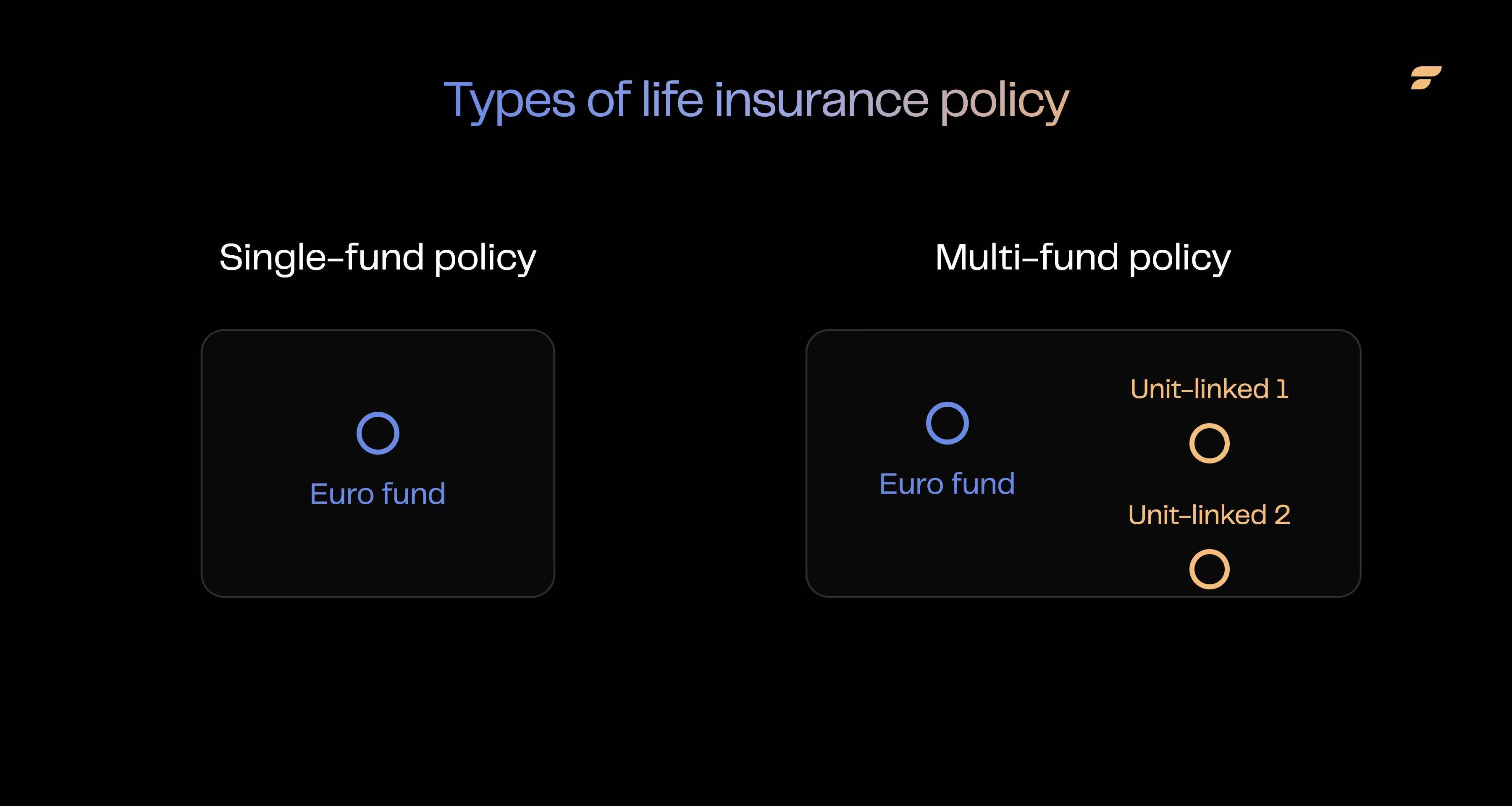
Multi-fund policies can charge different fees depending on the type of option. For example:
Top 3 cheapest on policy management fees (excluding discretionary management fees and fund fees):
- Finary Life: 0.50% on unit-linked funds
- Ramify: 1.2% to 1.4% a year all-in for its managed-portfolio service, fund fees in addition (around 0.2% on ETFs)
- Yomoni: 0.60%
Examples
Traditional bank:
- Caisse d'Épargne: 0.70% on the euro fund and 0.80% on unit-linked funds (Millevie Initiale 2)
Traditional insurer:
- AXA: 0.80% on the euro fund and 0.96% on unit-linked funds (Arpèges)
Online bank:
- Boursorama: 0.75% maximum on the euro fund and unit-linked funds (BoursoVie)
Online savings platform:
- Finary Life: 0.50% on unit-linked funds
To illustrate the impact of these fees, take an example with €100,000 of capital:
- With 0.50% fees (Finary Life): €500 a year
- With 0.60% fees (Abeille Assurances): €600 a year
- With 0.75% fees (Boursorama): €750 a year
Over 10 years, assuming a theoretical annual return of 4% before fees (illustrative simulation; past performance is not a reliable indicator of future performance):
- Finary Life: final capital of €141,060
- Abeille Assurances: final capital of €139,703
- Boursorama: final capital of €137,689
This comparison shows how much management fees matter over the long run. A difference of a few tenths of a percent can translate into thousands of euros over time.

The Finary app automatically analyses your fees and estimates the savings you could make.

How much do switching fees cost?
Switching fees are 0% at almost every online provider and 0.80% of the amount switched at AXA Arpèges. On a €50,000 switch, the gap comes to €400 for a single transaction.
How switching fees work
Switching fees apply when you change how your savings are split across the investment options inside your life insurance policy. Such switches can be essential to adjust your investment strategy as markets move or as your personal objectives change.
Average costs by insurer
Switching fees generally range between 0% and 1% of the amount switched. Some insurers include a limited number of free switches each year.
Top 3 cheapest insurers on switching fees:
- Finary Life: 0% (unlimited free switches)
- Boursorama: 0% (unlimited free switches)
- Fortuneo: 0% (unlimited free switches)
Ways to cut these fees
- Online switches often cost less than switches made by post or by phone.
- Grouping switches can limit their frequency when the policy charges for them.
- Some policies include free switches, in full or in part.
Which insurers offer free switches?
Several insurers offer free switches, including:
- Finary Life: unlimited free switches
- Boursorama: unlimited free switches
- Fortuneo: unlimited free switches
- Abeille Assurances: unlimited free switches
- Linxea Spirit 2: free and unlimited switches
Examples
Traditional bank:
- LCL: 0.7% maximum (0 free switches a year)
Traditional insurer:
- AXA: 0.80% (4 free switches a year)
Online bank:
- Boursorama: 0% (unlimited free switches)
Online savings platform:
- Finary Life: 0% (unlimited free switches)
To illustrate the impact of these fees, take an example with a €50,000 switch:
- With Finary Life (0%): €0 in fees
- With LCL (0.7%): €350 in fees
- With AXA (0.80%, beyond the 4 free ones): €400 in fees
These differences may look small on a single switch, but they add up quickly if you switch several times a year or manage a large portfolio.
Over the long run, the level of switching fees can have a significant impact on the net return of the policy.
Withdrawal and exit fees
These fees apply when you withdraw part or all of your savings. They can vary with the age of the policy and the amount withdrawn.
Top 3 cheapest:
- Finary Life: 0%
- Boursorama: 0%
- Fortuneo: 0%
Comparative examples:
- Traditional bank: La Banque Postale - 0%
- Insurer: AXA - 0%
- Online bank: Boursorama - 0%
- Online savings platform: Finary Life - 0%
Comparing these fee types shows that online banks and online savings platforms tend to offer more competitive terms than traditional banks and insurers.
It remains essential to look at all the fees rather than one type alone when assessing the overall value of a life insurance policy.
This gap underlines the importance of checking the withdrawal terms of your policy, especially an older one. In some cases it can pay to move your life insurance to a newer, cheaper policy.
What are the hidden fees of a life insurance policy?
Hidden fees are the internal fees of the funds the savings are invested in. They do not appear on the annual statement but averaged 1.60% a year in 2025, close to double the management fees charged by the insurer.
Fees on the underlying funds (OPCVM, SICAV, etc.)
Beyond explicit fees, life insurance policies often carry hidden fees, notably on investment options such as OPCVM (French collective investment schemes, comparable to UCITS funds) and SICAV (a French open-ended investment company). These fees vary with the type of fund:
- Bond funds: 0.8% to 1.8%
- SICAV and equity funds: 1.5% to 3%
- Diversified funds: 1.5% to 2.5%
Across all asset classes, France Assureurs measures average internal fees of 1.60% a year on the funds underlying unit-linked options in 2025.
Why reading the KID matters

The Key Information Document (KID, called the DIC in France) is the standardised document that makes it possible to compare the real fees of each investment option. It sets out the ongoing charges, which cover all the fees taken over a year.
The gap between headline fees and real fees
The gap between headline fees and real fees can be significant. For example:
- Headline management fees: 0.60%
- Underlying fund fees: 1.5%
- Total real fees: 2.1%
How to spot hidden fees
- Read the KID of each investment option carefully
- Work out the Total Expense Ratio (TER), which includes every fee
- Compare returns net of fees rather than gross
- Watch out for performance fees
Examples of hidden fees by type of provider:
Traditional bank:
- Caisse d'Épargne (Millevie Initiale 2): management fees on unit-linked funds vary with the type of fund, from 0.37% to 2.04%
Traditional insurer:
- AXA (Arpèges): fees on unit-linked funds, from 1.10% (bonds) to 1.83% (equities) on average
Online savings platform:
- Yomoni (Yomoni Vie): ETF fees of 0.30% a year maximum, plus 0.70% in discretionary management fees and 0.60% in policy fees, i.e. 1.60% all-in
These examples show that hidden fees can vary widely between providers and options. For example, on a €100,000 investment:
- With total fees of 1%: €1,000 a year
- With total fees of 3%: €3,000 a year
Over 10 years, assuming a gross return of 4% a year (illustrative simulation; past performance is not a reliable indicator of future performance), that difference comes to around €23,900 in the final value of the policy. Hence the value of comparing all the fees before choosing a life insurance policy.
How to choose a low-fee life insurance policy
Three lines have to be read together: entry fees, the annual management fees of the policy and the internal fees of the underlying funds. A policy with no entry fees but 1% in management fees costs more after ten years than a policy charging 2% on entry and 0.50% in management fees.
The value of a policy with no entry fees
Choosing a policy with no entry fees puts all of your capital to work from day one, maximising the growth potential of your savings. Over the long run, that difference can add up substantially.
Fee comparison table
| Insurer | Entry fees | Management fees (unit-linked) | Switching fees | Withdrawal fees |
| Finary Life | 0% | 0.50% | 0% | 0% |
| BoursoVie | 0% | 0.75% | 0% | 0% |
| Fortuneo Vie | 0% | 0.75% | 0% | 0% |
| Yomoni Vie | 0% | 0.60% | 0% | 0% |
| LCL Vie | 3.5% max | 0.95% max | 0.7% max | 0% |
| Crédit Agricole (Oriance) | 1% max, 0% online until 31/12/2026 | 0.80% max | 0% | 0% |
| Caisse d'Épargne (Millevie Initiale 2) | 3% max | 0.80% | 1% into the euro fund, 0% into unit-linked funds | 0%, surrender penalty of up to 5% possible on the euro fund during the first 10 years |
| La Banque Postale (Cachemire 2) | 3% max | 0.85% max | 0.50% max | 0% |
| AXA (Arpèges) | 4.85% max | 0.96% | 0.80% | 0% |
| Abeille Assurances (Lucya Abeille) | 0% | 0.60% | 0% | 0% |
| Linxea (Spirit 2) | 0% | 0.50% max | 0% | 0% |
| Nalo | 0% | 1.65% max | 0% | 0% |
| Ramify | 0% | 1.4% max | 0% | 0% |
Data collected on 31 July 2026 from the insurers' official fee pages and from the summary fee tables published under the order of 24 February 2022.
Examples of low-fee policies (for information)
- Finary Life: 0% entry, switching and withdrawal fees. 0.50% in annual management fees on unit-linked funds, the lowest level of the 13 policies compared here. Fee schedule published in full before subscription. Policy underwritten by Generali Vie.
- Fortuneo Vie: 0% entry, switching and withdrawal fees. 0.75% in management fees on unit-linked funds under self-directed management, 0.85% under discretionary management. Good value for money, with a narrower choice of unit-linked options than a specialist broker.
- Boursorama: with 0% fees on almost every line and 0.75% on unit-linked funds, Boursorama remains a very competitive option, available from a mainstream online bank.
within your reach
Non-contractual document for promotional purposes. Investment in unit-linked vehicles carries a risk of capital loss, since their value is subject to fluctuation, both upwards and downwards, depending in particular on developments in the financial markets. The insurer guarantees the number of unit-linked units, not their value, which it does not guarantee. The e-vie life insurance policy is an individual life insurance policy, denominated in euros and/or unit-linked vehicles, underwritten by Generali Vie, a company governed by the French Insurance Code. Finary SAS - 58 rue de Monceau 75380 Paris 8 - Investment Firm authorised by the ACPR under no. 19283, ORIAS no. 21001279, member of AMAFI
Negotiating fees with your adviser
Even though fees are often standardised, negotiation is possible, especially on large amounts. Items that can be discussed contractually:
- A reduction in entry fees
- A cut in management fees
- More free switches
Platforms such as Finary Life publish their fees transparently from the moment of subscription, with no need to negotiate.
On a life insurance policy, fees are the only variable known in advance. The return never is. Comparing fee schedules before subscribing, then reviewing them every two or three years, remains the most reliable lever for improving the net return of a policy.
To go further, read our guide to life insurance returns in 2026 and how to maximise your returns net of fees.
Frequently asked questions
What are the average life insurance fees in 2026?
According to France Assureurs, policies charged an average of 0.73% of assets in 2025. On unit-linked funds alone, policy fees reach 0.88% a year, plus 1.60% in internal fund fees, or 2.48% in total.
Are management fees charged even when the policy loses value?
Yes. Annual management fees are based on the assets held in the policy, not on gains. They are therefore charged every year whatever the performance, including when the value of unit-linked funds falls. Only entry and switching fees depend on the transactions carried out.
Where can you find the detailed fees of a policy before subscribing?
Since 1 July 2022, every insurer must publish on its website a summary fee table for each policy, separating annual fees from transaction fees. The Key Information Document of each unit-linked fund completes that picture with the ongoing charges of the option.
Can you move your life insurance to a cheaper policy?
Yes, but only to another policy with the same insurer. Article 72 of the French 2019 Pacte law allows this transformation while keeping the tax seniority of the original policy. Changing insurer, by contrast, requires a withdrawal, and the loss of that tax seniority.
Do switching fees also apply under a managed-portfolio service?
No, the switches decided by the manager are included in the discretionary management fee. In exchange, the managed-portfolio service adds a layer of annual fees, from 0.30% to 0.85% depending on the provider, stacked on top of the policy fees and the fund fees.
Is a policy with no entry fees always the cheapest?
Not necessarily. A policy with 0% entry fees but 1% in management fees costs more after ten years than a policy charging 2% on entry and 0.50% in management fees. What counts is the total over the holding period.
Sources
France Assureurs, unit-linked life insurance in 2025: policy fees and internal fund fees
Service-public.gouv.fr, life insurance policy: how it works and policy fees
AMF, educational guide: understanding the Key Information Document (DIC)
Finary, full fee schedule for Finary Life
Fortuneo, fees of the Fortuneo Vie policy
BoursoBank, fee terms of the BoursoVie life insurance policy
Lucya, fees of the Lucya Abeille policy (Abeille Assurances)
Linxea, fees of the Linxea Spirit 2 policy
Yomoni, fees of the Yomoni Vie life insurance policy
Ramify, fees of the Ramify managed-portfolio service
BPCE Vie, summary fee table for the Millevie Initiale 2 policy (Caisse d'Épargne)
La Banque Postale, fees of the Cachemire Patrimoine Série 2 policy
Crédit Agricole, fees of the Oriance life insurance policy
Regulatory disclaimers: Marketing communication. Investing carries a risk of partial or total capital loss. Past performance is not a reliable indicator of future performance. This article is provided for information and educational purposes only; it does not constitute personalised investment advice, a buy or sell recommendation, or tax advice. The capital guarantee on euro funds is provided by the insurer and depends on its financial strength. In a severe systemic crisis, the French "Sapin 2" law allows withdrawals to be temporarily restricted (liquidity), without affecting the guaranteed capital. Unit-linked funds are not guaranteed and carry a risk of capital loss. Before investing, read the Key Information Document (KID) and, where relevant, consult an authorised adviser. Finary SAS, an investment firm authorised by the ACPR (no. 19283), member of AMAFI. Insurance broker registered with ORIAS (no. 21001279), member of the CNCGP (association approved by the AMF). Crypto-Asset Service Provider (CASP) authorised by the AMF under the MiCA regime, references no. A2026-026 and no. N2026-008.