


ETF: the complete guide to trackers in 2026

Updated on 31 July 2026
ETF fees range from 0.05% to 0.50% a year depending on the fund, and not all of them are eligible for the PEA (a French tax-advantaged equity savings account). This guide covers the types of ETF, their fees, their taxation by wrapper and how to select them.

- ETF management fees range from 0.05% to 0.50% a year, against roughly 2% for an actively managed fund.
- Over 2025, 71% of actively managed global equity funds in Europe underperformed the S&P World index (source: SPIVA Europe).
- An ETF is held in a PEA (a French equity savings plan), a life insurance policy or an ordinary securities account, each with its own tax treatment.
- In a PEA held for more than 5 years, gains escape income tax but still bear 18.6% in social levies in 2026.
- Investing in ETFs carries a risk of capital loss: past performance is not a reliable indicator of future performance.
The basics to know before choosing an ETF
Quick definition and ISIN code
An ETF, or exchange traded fund, is an index fund listed on a stock exchange that replicates the movement of a stock market index, or of a commodity (via a commodity ETF). Every tracker carries a unique ISIN code, which is useful because several funds have very similar names. These funds are regulated and their management is supervised by the Autorité des marchés financiers (the AMF).
Investing in the stock market through ETFs is what is known as passive investing. You follow the movement of an index as a whole instead of investing in one or several companies. You can, for instance, invest in a CAC 40 ETF and capture the performance of all the French shares that make up the CAC 40.
The different types of ETF
There are several types of tracker, differing mainly in how they treat dividends, or in the type of shares they hold and therefore the benchmark index they replicate. Being able to tell them apart matters before you make an ETF investment. All these funds are instruments listed continuously on various exchanges such as Euronext Paris or the New York Stock Exchange.
One way of telling trackers apart is based on how they treat the dividends they receive from the companies they invest in, and there are two ways of handling dividends.
Accumulating ETF
When the fund receives dividends, it reinvests them directly by buying assets in line with the fund's rules. For example, if you have invested in a CAC 40 ETF, the dividends received are reinvested in shares of CAC 40 companies.
Distributing ETF
When the fund receives dividends, it sets them aside and then pays them out to the fund's investors, usually quarterly or annually.
The big difference between these two types of tracker lies in how dividends are taxed. With a distributing ETF you have to place orders to reinvest the dividends, whereas with an accumulating ETF this is automatic, which means dividends are reinvested without any action on your part. In both cases the dividends come back to you.
Another way of sorting these funds is to look at the index they replicate:
Bond ETF
You can choose to invest in a bond ETF, which bundles government and corporate bonds, either high quality (known as Investment Grade) or high yield and riskier. One example of a bond ETF is the Amundi Index US Corporate SRI UCITS ETF DR (C) (ISIN LU1806495575, 0.14% annual fees), which invests in Investment Grade corporate bonds denominated in US dollars.
Sector ETF
Sector funds replicate the benchmark index of a given industry. You can choose to invest in:
- Real estate via a real estate ETF.
- Artificial intelligence via an AI ETF.
- Investing in water via a water ETF
- Green energy through a renewable energy ETF.
- Or via a hydrogen ETF.
Geographic ETF
You can also invest in geographic ETFs that replicate the stock market index of a country, a continent, or even the whole world. This category of financial instrument is the most widespread on the market, because of the attractive diversification it offers and the ease of investing it represents. It is possible, for example, to invest in shares from all over the world through a single tracker, such as the iShares MSCI World Swap PEA UCITS ETF EUR Acc (BlackRock, ISIN IE0002XZSHO1), also known as a World ETF, which tracks the performance of companies listed in the 23 developed countries covered by the MSCI World index.
Another interesting option is emerging markets ETFs, to gain exposure to emerging market economies.
Geographic funds let you set the granularity of your investment yourself by offering several possible levels. You can choose to invest in a global index, as we have just seen, but you can also choose an index reflecting the performance of US companies, or in more detail that of the companies in the S&P500, by investing for example in the Amundi Core S&P 500 Swap UCITS ETF EUR Dist (ISIN LU0496786574, 0.05% annual fees), which tracks the performance of the 500 largest US companies.

Why does an ETF not try to beat the market?
Because that is not its goal. An ETF aims to replicate its index, not to do better, and that is what separates it from actively managed funds such as SICAV and FCP vehicles (French open-ended and contractual mutual funds). This passive management explains its markedly lower fees, and makes it a common tool in wealth management.
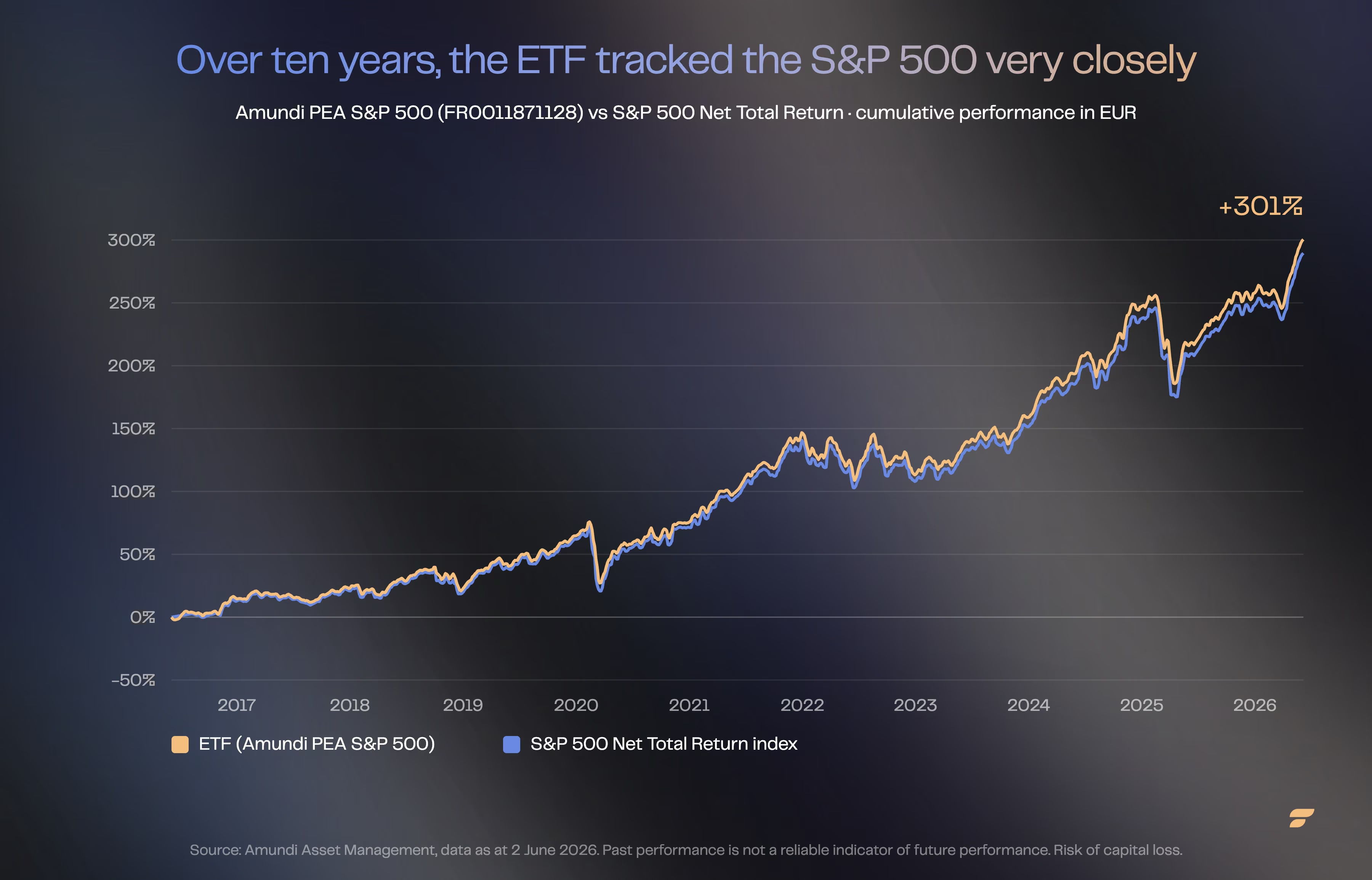
In concrete terms, if you invest in a CAC 40 ETF and the CAC 40 rises by 10%, the CAC 40 ETF will post a very similar performance, less its management fees and its tracking error. This financial instrument lets you invest in the whole CAC 40 in one go and, depending on the type of ETF, you either receive the dividends or they are reinvested in the fund. There are listed trackers for the vast majority of stock market indices and commodities. You can, for example, invest in the CAC 40 by replicating the performance of French shares through a CAC 40 ETF such as the Amundi CAC 40 UCITS ETF Dist (ISIN FR0007052782, 0.25% annual fees). These financial instruments are regulated by the financial markets authority of the country where they are marketed. In France, that is the AMF. The chart below compares the ten-year cumulative performance of the Amundi PEA S&P 500 ETF (ISIN FR0011871128) with that of its index, the S&P 500 Net Total Return.
What are the advantages and risks of ETFs?
ETFs offer three main advantages: access to hundreds of securities in a single order, low management fees and continuous listing. In exchange, they carry a risk of capital loss, a currency risk on funds denominated in a foreign currency, and a tracking error against their index.
Simplicity, low fees and diversification: what defines an ETF
As mentioned above, investing in the stock market through ETFs is relatively simple. They are widely used by retail and institutional investors alike. With a single order, you can invest in an entire stock market index. There is no need to spend time picking the companies to invest in: you can go straight to the tracker best suited to your objectives and your profile and start investing. They are all listed continuously, exactly like shares, so you never miss a trading day with an ETF.
By investing in a tracker you also apply a fundamental principle of stock market investing: diversification. A tracker smooths the performance of all the assets it holds and so reduces the impact of one company performing badly, without removing the risk of capital loss.
Another advantage of index funds is performance. As mentioned in our guide to investing in the stock market, the long-term historical performance of global equities has been around 7% to 9% a year before inflation (source: Curvo, MSCI indices, over long periods; past performance is not a reliable indicator of future performance) and it is all the more attractive over the long run. By investing in these funds you capture the performance of equity markets. Unlike OPCVM vehicles (French collective investment funds, broadly UCITS), which are run by a manager, an ETF is 100% passive. You are therefore not exposed to a manager's poor decisions on stock selection or timing. Some managers post better gross performance, yet their net results remain lower once management fees are deducted. In the end, active funds often fail to justify their higher costs. According to the SPIVA study (Year-End 2025), 71% of global equity funds domiciled in Europe and denominated in euros underperformed the S&P World index over 2025.
The performance of trackers is also explained by their fee advantage over active funds (OPCVM, SICAV, FCP and the like). Investing in a listed tracker costs around 0.20% a year on average, whereas active funds charge 2% in management fees a year on average. You also avoid the financial transaction tax of 0.40% that applies when buying shares in French companies whose market capitalisation exceeds one billion euros.
Finally, you can benefit from French tax advantages by investing in listed trackers. While every ETF is eligible for an ordinary securities account, some trackers are also eligible for the PEA and for certain online life insurance policies. Unlike shares, some ETFs replicating foreign indices can be bought through the two main tax-advantaged investment wrappers, namely PEA or life insurance. You can therefore invest in US shares while benefiting from the favourable taxation of a French wrapper.
within your reach
Non-contractual document for promotional purposes. Investment in unit-linked investment options carries a risk of capital loss, since their value is subject to fluctuation, both upwards and downwards, depending in particular on developments in the financial markets. The insurer commits to the number of units, not to their value, which it does not guarantee. The e-vie life insurance policy is an individual life insurance policy, denominated in euros and/or unit-linked vehicles, underwritten by Generali Vie, a company governed by the French Insurance Code. Finary SAS, 58 rue de Monceau 75380 Paris 8, Investment Firm authorised by the ACPR under no. 19283, member of AMAFI. Insurance broker registered with ORIAS under no. 21001279, member of the CNCGP (association approved by the AMF). Crypto-Asset Service Provider (CASP) authorised by the AMF under the MiCA regime, references no. A2026-026 and no. N2026-008.
Market volatility, exchange rates and tracking error as the main risks
The main risk of investing in a listed ETF is the risk of capital loss. Just like investing in shares, investing in a listed tracker exposes you to losses caused by movements in the benchmark index of the market being followed. Investments should be matched to your financial situation and your time horizon.
It is also important to factor in currency risk for funds listed in a foreign currency. Currency movements are added to the movement of the index itself.
You should also check that the ETF does not drift away from its index, a phenomenon known as tracking error. The more constituents an index has, the harder it is to replicate.
Good to know : over the long term, global equity markets have historically delivered around 7% to 9% a year before inflation (source: Curvo, MSCI indices; past performance is not a reliable indicator of future performance). Reinvested through compound interest, these returns can grow capital significantly over several decades.How do you invest in ETFs?
Choosing the right tax wrapper to invest in ETFs
There are several ways to buy listed trackers. As with investing in shares, you can hold your ETFs in a PEA, a life insurance policy or an ordinary securities account.
Holding your trackers in a PEA
Investing in PEA-eligible trackers lets you capture the performance of the shares they hold. After 5 years, gains in a PEA are exempt from income tax on withdrawal; social levies (18.6% in 2026), however, remain due. The PEA also has relatively low annual management fees compared with other tax wrappers, life insurance in particular.
To invest in a PEA tracker, you need to make sure it is genuinely eligible for the PEA. Unlike shares, ETFs replicating indices outside Europe can be held there, but they must be OPCVM vehicles established in the European Union or the European Economic Area and invest more than 75% of their assets in PEA-eligible securities. In France, firms such as Amundi have specialised in creating ETFs, and it is possible to invest in the S&P500 or the Nasdaq through a PEA by buying their trackers. Note that you can also invest in actively managed collective investment funds through your PEA.
Holding ETFs in life insurance
Holding trackers as unit-linked funds in your life insurance policy is also a good way to invest in index funds. Like the PEA, life insurance allows you, after 8 years, to benefit from an annual tax allowance on gains (€4,600 for a single person, €9,200 for a couple) and reduced taxation; social levies remain due. You do, however, have to factor in the management fees on unit-linked funds inside life insurance. On the most competitive policies, those management fees on unit-linked funds generally sit between 0.50% and 0.80% a year.
As with the PEA, not every tracker is eligible for a life insurance policy, and how many are available, or which index they reflect, depends directly on the insurer and the policy it has set up. Some life insurance policies offer several dozen or even a hundred ETF unit-linked funds, while others offer none. If you want to invest in trackers through life insurance, check with your insurer how many trackers are available and which indices they replicate.
There are several ways to approach ETF investing in life insurance: you can opt for self-directed management and pick the unit-linked funds yourself, or hand the management of your policy to an insurer or an asset manager (what is known as a managed-portfolio service), which will invest your money for you. Be careful, though: not every managed-portfolio life insurance policy allows investment in listed trackers.
Some recent policies give access to a wide choice of ETFs as unit-linked funds. That is the case with Finary Life (underwritten by Generali Vie), available from €300, with 0 entry fees and 0.50% in annual management fees on unit-linked funds.
Investing in an ETF through an ordinary securities account
Again, as with shares, it is also possible to invest in listed ETFs through an ordinary securities account (compte-titres ordinaire, or CTO). Unlike the PEA and life insurance, an ordinary securities account gives access to almost every tracker on the market, but it does not offer the tax advantages found in the other wrappers.
Investing in trackers through an ordinary securities account is very close to buying shares on the stock market. You look up the ETF you want to invest in, then place an order.
Good to know : Your choice of wrapper can be based on your long-term investment objectives and your preferences. While all three wrappers let you build capital over the long run by investing in trackers, the PEA has tax features worth studying. It is currently a wrapper used to invest savings. On top of a clear advantage on management fees and set-up costs, the PEA lets you benefit from attractive tax advantages after 5 years: no more income tax on your gains (social levies remain due). It is also relatively easy to follow and manage tracker investments in a PEA through the various online brokerage platforms. Life insurance is also a suitable solution for investing in trackers. Before choosing a life insurance policy, it is important to look at the list of ETFs it offers. Each insurer picks the trackers it wants to offer on its policies, so the choice can be limited.How do you buy ETFs depending on the wrapper you choose?
The buying process depends on the wrapper: in a PEA or a securities account, you place a stock market order yourself by entering the ETF's ISIN code; in life insurance, you make a switch or a contribution by designating the unit-linked fund you want from the list offered by the insurer. In the video below, Arnaud Gihan, Head of iShares France, explains how ETF investing works.
How do you choose the ETFs in your portfolio?
To choose an ETF, compare four criteria: the index or sector replicated, compatibility with your tax wrapper, the management fees and the issuing company. Here is what to take into account when selecting your index funds.
The stock market index or sector replicated by the ETF
The first criterion to consider before investing in an ETF is the stock market index or the sector the tracker replicates. As we saw in the section on the different types of ETF, you can choose to invest in indices replicating the performance of a geographic area, of various bonds, or of specific industries such as healthcare. It is therefore important to know the basics: which companies are in the fund and why they are represented there, how large they are, and the average performance of recent years.
Choosing one index over another will strongly influence your portfolio's performance. Not every sector or geographic area grows at the same rate and, while equity ETFs have historically delivered solid performance over long periods with no guarantee for the future, some trackers post higher performance than others.
Here is a list of the main stock market indices represented by trackers:
- MSCI World: it brings together around 1,300 large and mid-cap companies worldwide. Made up largely of US, Japanese, British and French companies, investing in the MSCI World is a very good way to diversify.
- S&P 500: it is based on the 500 largest companies listed on the US stock markets. Investing in an ETF replicating the S&P 500 is a good way to invest in US shares.
- CAC 40: it is based on the 40 most highly valued French companies on the stock market. Investing in a CAC 40 ETF lets you invest in French shares while diversifying your portfolio.
How compatible trackers are with your tax wrapper
As we saw above, you can hold your trackers in any of the three French tax wrappers available to you. However, the wrapper you choose determines which ETFs you can hold in it. While you can hold almost every index fund on the market in your ordinary securities account, that is not the case for the PEA or for life insurance.
So make sure the listed tracker you want to invest in is compatible with the tax wrapper you have chosen. As a reminder, a PEA-eligible ETF must be an OPCVM vehicle established in France, in the European Union or in the European Economic Area, and invest more than 75% of its assets in PEA-eligible securities, including through synthetic replication. For life insurance, the number of trackers and their nature will depend on the policy you take out, so make sure it matches your ETF investment strategy.
The management fees attached to the tracker
Low management fees are what makes investing in ETFs attractive, but they still need to be taken into account. Depending on the type of tracker you choose, management fees can range from 0.05% to 0.50% a year. While those fees are relatively low compared with active funds, which sit at around 2% on average, ETFs charging more than 0.50% a year deserve a careful comparison with the alternatives available on the same index.
The ETF's issuing company and the quality of replication
Just as a company going public has had to prove itself to get there, tracker issuers also have to prove themselves on the market for investors to trust them. When choosing an ETF to invest in, it is also important to analyse its issuer, and for that you generally look at assets under management (how much they manage) and the track record of replication quality on the trackers they issue.
Investing in an ETF issued by a solid company with good replication quality is preferable in order to reduce the risk of a wide “spread” or of “tracking error”.
Companies such as Amundi or BlackRock, which specialise in issuing and managing trackers, are often recommended, in particular because their large assets under management support good fund liquidity and therefore a narrower spread (the gap between the tracker's buying and selling price).
Their experience in the field is also a mark of credibility for the quality of index replication, which will be less prone to tracking errors (the gap between the performance of the benchmark index replicated and that of the tracker). It is worth noting, however, that tracking errors can differ from one tracker to another, even when they are issued by the same asset manager.
Good to know : Investing in trackers, and passive investing more broadly, is recognised and valued by investors for its simplicity. That logic can be considered for your portfolio allocation. Since ETFs give you exposure to a set of shares in one go, there is no point multiplying them in your portfolio. The PEA can also be a wrapper to consider for investing in ETFs depending on your situation. Not every tracker is eligible for it, but its low fee level and the tax advantage of this wrapper make it a frequently chosen option for long-term ETF investing, depending on your situation and your time horizon. Here is our list of the best PEA ETFs, with fees ranging from 0.20% to 0.25% a year and all eligible for the PEA. Fees and ISIN codes checked on JustETF on 31 July 2026:
| Segment | ETF | ISIN | Fees |
|---|---|---|---|
| EU large-cap equities | Amundi EURO STOXX 50 II UCITS ETF Acc | FR0007054358 | 0.20% |
| Global equities | iShares MSCI World Swap PEA | IE0002XZSHO1 | 0.20% |
| US equities | Amundi PEA S&P 500 Screened | FR0013412285 | 0.25% |
Here is an illustrative, non-personalised allocation example with exposure to US shares, which outperformed European shares over the past decade, with no guarantee that this will be repeated:
- MSCI World: 40%
- S&P 500: 40%
- European large-cap equities: 20%

Frequently asked questions
What is the difference between an ETF and a traditional investment fund?
A traditional fund (SICAV, FCP) is run by a manager who picks securities to try to beat the market, for fees of around 2% a year. An ETF simply replicates an index, which brings fees down to between 0.05% and 0.50% a year. The ETF is also listed continuously, like a share.
Why invest in ETFs?
Investing in trackers has many advantages. On top of being a relatively simple way to invest in the stock market, ETFs let you diversify your portfolio and invest in dozens or even hundreds of companies in a single order.
Investing in ETFs also proves very effective over the long term, and even outperforms the majority of actively managed funds over long periods, as shown by the SPIVA studies. Management fees are also relatively low compared with other investments, and ETFs can be held in every tax wrapper available to you: an ordinary securities account, a PEA or life insurance.
Can an ETF go bankrupt?
An ETF is a fund whose assets are held by a custodian separate from the asset manager. If the issuer disappears, the fund's securities do not fall into its balance sheet and are returned to holders or transferred to another manager. The real risk remains a fall in the index replicated, and therefore capital loss.
What fees do ETFs charge?
When you invest in listed trackers, you pay the management fees attached to the fund you choose. Those fees vary from one tracker to another, but they generally range from 0.05% to 0.50% a year. Above 0.50% a year, it is worth comparing the ETF with other funds replicating the same index before deciding. ETF fees are relatively lower than those of any active fund, in particular because management is largely automatic.
Does an ETF pay dividends?
It depends on its distribution policy. A distributing ETF pays the dividends it collects into a cash account, generally each quarter or each year. An accumulating ETF reinvests them automatically in the fund, which avoids placing another order and suits a long-term accumulation approach.
What is the difference between a physical ETF and a synthetic ETF?
A physical ETF actually buys the securities in the index, in full or by sampling. A synthetic ETF holds a basket of securities and swaps its performance for that of the index through a swap contract with a bank. Synthetic replication is what allows non-European indices to be held in a PEA.
How long should you hold an equity ETF?
An equity ETF is designed for a long horizon, generally at least eight to ten years, long enough to go through a full market cycle. In a PEA, that period matches the five years that open up the income tax exemption, and the eight years of life insurance.
Sources
AMF, Autorité des marchés financiers: the regulator of ETFs marketed in France
Service-public.fr: taxation of gains in a PEA (plan d'épargne en actions)
Service-public.fr: how income from a life insurance policy is taxed
Légifrance, article 235 ter ZD of the CGI: rate of the financial transaction tax
BOFiP, BOI-RPPM-RCM-40-50-20-20: conditions for OPCVM eligibility for the PEA
S&P Dow Jones Indices, SPIVA Europe Year-End 2025: performance of active funds against indices
JustETF: product pages, management fees and ISIN codes of the ETFs cited
MSCI World Index: composition and countries covered
Curvo: historical average return of global equities, MSCI indices
Regulatory disclaimers: Marketing communication. Investing carries a risk of partial or total capital loss. Past performance is not a reliable indicator of future performance. This article is provided for information and educational purposes only; it does not constitute personalised investment advice, a buy or sell recommendation, or tax advice. Before investing, read the Key Information Document (KID) and, where relevant, consult an authorised adviser. Finary SAS, an investment firm authorised by the ACPR (no. 19283), member of AMAFI. Insurance broker registered with ORIAS (no. 21001279), member of the CNCGP (association approved by the AMF). Crypto-Asset Service Provider (CASP) authorised by the AMF under the MiCA regime, references no. A2026-026 and no. N2026-008.