What is a profiled ETF? The complete guide

Updated on 30 July 2026
A profiled ETF is a listed fund that automatically invests in a basket of other ETFs (equities, bonds, sometimes real estate) according to a predefined allocation, tailored to a specific risk profile or investment horizon. It gives access to diversified, automatically rebalanced management without having to manage several ETFs yourself.

- The TER of profiled ETFs generally ranges from 0.18% to 0.25% at the main providers (Vanguard, iShares, Amundi), versus an average of 1.28% for traditional diversified funds in France in 2025 (AMF).
- There are two main families of profiled ETFs: fixed-allocation ETFs, whose split stays stable, and lifecycle ETFs, which become more conservative as a target date approaches.
- These products limit personalisation and can create asset duplication (overlap) if you already hold other funds or ETFs.
- Choosing the right profiled ETF means knowing your risk profile and investment horizon well, since allocations vary widely from one provider to another.
Profiled ETF: definition and how it works
What is a profiled ETF?
An investor can feel overwhelmed by the complexity of financial markets. They often want a portfolio that adapts to their needs, without having to manage many different products.
The profiled ETF answers this need with an investment solution designed to match a risk profile or a precise time-based objective.
This type of ETF is not an official category, but it has established itself as a practical response from the financial industry.
A profiled ETF works like a listed fund. It invests in a set of other ETFs (equities, bonds, sometimes real estate or commodities) according to a predefined strategy.
This strategy determines the level of risk (cautious, balanced, dynamic) or the investment horizon (for example, retirement in 2040). The investor no longer has to arbitrate between different asset classes: the product automatically manages these choices, following clear rules.
The profiled ETF stands out for its ability to simplify portfolio management while maintaining solid diversification.
Goals
How a profiled ETF works
A “balanced” profiled ETF might allocate 60% of its assets to global equity ETFs and 40% to bond ETFs. This split is not left to chance. It is based on an in-depth analysis of investor profiles and market cycles.
Markets change constantly: sometimes equities outperform bonds, sometimes the reverse. The profiled ETF then regularly adjusts the split. It sells part of the assets that have gained too much and buys back those that have fallen, to return to the target allocation.
This automatic rebalancing applies a mechanical discipline designed to limit the influence of emotional biases, such as the temptation to hold on only to the assets that are rising.
Some profiled ETFs go even further by adjusting their allocation over time.
“Lifecycle” ETFs illustrate this approach: their composition gradually becomes more conservative as the target date approaches. The closer the investor gets to needing their capital, the less they are exposed to volatile assets.
Profiled ETF vs classic ETF
The distinction between a profiled ETF and a classic ETF becomes clear as soon as you look at how they work.
A classic ETF tracks a specific index, such as the CAC 40 or the S&P 500, regardless of the investor's profile.
It offers direct exposure to a market, with no adjustment.
A profiled ETF, by contrast, combines several indices, adjusts the proportions and keeps them consistent with a risk or time objective. The profiled ETF acts like a conductor, while the classic ETF simply follows the score.
Portfolio management is another major difference. With a classic ETF, the investor has to:
- choose several ETFs,
- split the amounts,
- monitor the weightings,
- rebalance regularly.
This takes time, knowledge and rigorous discipline. The profiled ETF automates all these tasks. In a single transaction, the investor gets global diversification, a controlled risk level and dynamic management.
Cost and transparency also deserve attention. Profiled ETFs generally show slightly higher fees than classic ETFs, since they add the “profiled” product's management fees to those of the underlying ETFs.
However, this difference remains moderate, especially compared with the fees of traditional funds or managed-portfolio services. Transparency remains an asset: the portfolio's composition is published regularly, letting the investor know precisely what they are investing in.
What are the different types of profiled ETFs?
There are two main families of profiled ETFs: fixed asset-allocation ETFs, whose equity/bond split stays stable over time, and lifecycle ETFs, whose allocation gradually becomes more conservative as a target date approaches.
Fixed asset-allocation ETF
The fixed asset-allocation ETF works like an autopilot for your portfolio. It follows a path set from the start, without deviating, even when markets become volatile.
This type of ETF combines a precise mix of equities and bonds, for example 60% equities and 40% bonds, and rigorously maintains this split.
The discipline of these ETFs shows up as regular rebalancing of the split. If the equity share exceeds the planned level, the ETF sells some of those equities to buy bonds, and vice versa.
This mechanism, often overlooked by individual investors, imposes a counter-intuitive logic: sell what has performed best and buy what has underperformed.
This method, sometimes frustrating in the short term, proves beneficial over the long term.
However, this rigidity has limits. The ETF does not account for changes in your personal situation or major shifts in the global economy.
It does not adjust if, at 55, your risk tolerance decreases. This tool imposes discipline, but it does not allow for personalisation.
Lifecycle ETF (target-date)
The lifecycle ETF works differently. Its split between equities and bonds evolves over time, following a predefined path called a “glide path”.
The closer the target date gets (often retirement), the more the ETF reduces its equity exposure to favour the safety of bonds.
This model is inspired by American retirement savings plans. Many savers do not know when or how to reduce the risk in their portfolio.
The lifecycle ETF automates this transition, helping to avoid timing mistakes or forgetting to secure your capital as the deadline approaches.
Want to learn more about long-term savings solutions? Discover the benefits of France's PER (retirement savings plan) which can complement your ETF investment strategy.
What are the pros and cons of a profiled ETF?
A profiled ETF combines automatic diversification, low fees and investment discipline, but imposes a standardised allocation that limits personalisation and can create asset duplication with the rest of the portfolio.
Pros of a profiled ETF: diversification, simplicity, cost
Built-in diversification is one of its main features. In a single transaction, you gain exposure to hundreds, sometimes thousands, of securities, spread across several geographic zones and asset classes. It is like entrusting the management of a global portfolio to a team of experts, at generally low fees.
Simplicity is not just a marketing pitch. For many investors, managing a portfolio feels like a tedious task: arbitrating, rebalancing and monitoring the markets takes time and exposes you to emotional mistakes.
Low fees are another feature worth noting. Profiled ETFs follow the logic of passive products: low management fees, no entry or exit commissions, and transparency on the cost structure.
The TER generally ranges from 0.18% to 0.25% at the main providers (data as of end of July 2026, subject to change; check the KID). By comparison, the average ongoing charges for traditional diversified funds in France stood at 1.28% in 2025 (AMF). Over 20 years, this gap can add up to several years' worth of savings.
A less visible but important benefit concerns the “anti-procrastination” effect. Many savers hesitate to invest because of the complexity or the fear of making a mistake. The profiled ETF lowers these barriers and makes it easier to get started.
Cons of a profiled ETF: rigidity, hidden fees
The profiled ETF also has limits. It imposes a standardised allocation - a “one-size-fits-all” solution. If your financial situation is out of the ordinary, or if you have strong preferences (for example, for ESG or against the dollar), the profiled ETF may not meet your expectations. It does not adapt to your personal choices or to changes in your life (inheritance, career change, etc.).
Profiled ETFs focus mainly on listed equities and bonds; they generally do not include alternative assets such as unlisted real estate or private equity.
Fee layering is a point worth watching. Even though the displayed TER stays low, it adds together the profiled ETF's fees and those of the underlying ETFs.
An experienced investor, willing to manage their own allocation, could save a few basis points by building their portfolio by hand. On large amounts or over the long term, the difference can become considerable.
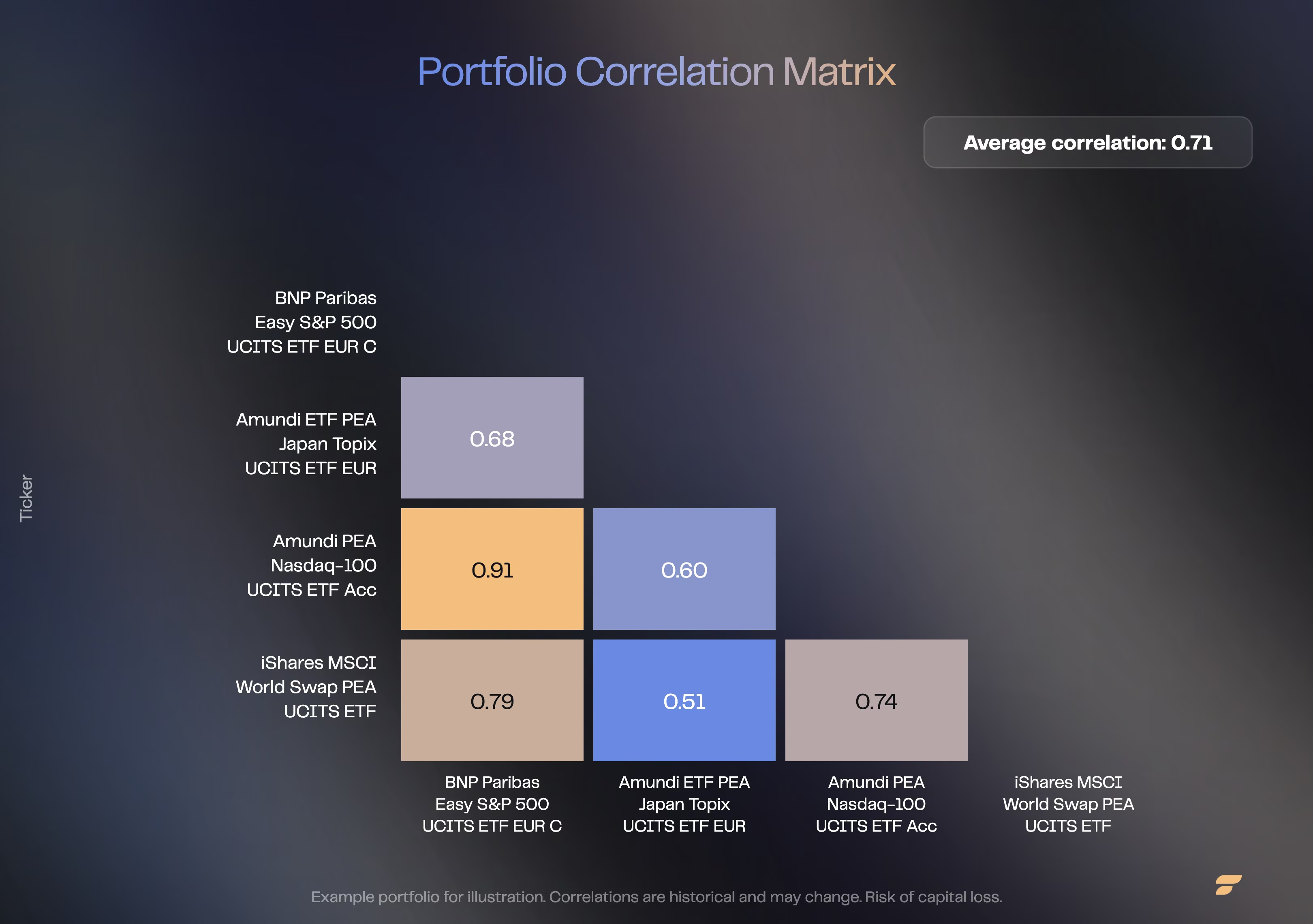
Another risk concerns overlap. If you already hold other funds or ETFs, adding a profiled ETF can create invisible duplication. You think you are diversifying, but you are actually increasing your exposure to certain markets or sectors. This can distort your perception of your real risk. To spot this kind of overlap, tools such as Finary let you aggregate all your ETFs and funds in one place and analyse your portfolio's real composition.
The profiled ETF's strategy stays fixed. It does not react to major market changes or economic news. It follows its roadmap without deviating. This discipline protects against timing mistakes, but it also prevents seizing opportunities or reducing risk in a crisis. For some, this consistency is reassuring; for others, it limits flexibility.
Examples of profiled ETFs
The world of profiled ETFs keeps evolving. Each provider offers its own take on “turnkey” investing. Behind similar names, each range takes a different approach to diversification, risk and management. To understand these differences, you need to look at the structure of each product, beyond the label.
Vanguard LifeStrategy
Vanguard, a pioneer of passive management, offers the LifeStrategy range: “all-in-one” ETFs launched in late 2020 (8 December 2020) that provide diversified exposure to global markets through around 14,500 underlying securities.
There is a profile for everyone, with four allocations mixing equities and bonds, from 20/80% (cautious) to 80/20% (dynamic).
Thanks to automatic rebalancing, the target allocation is maintained at all times, offering disciplined management free of emotional intervention. Another strength: its attractive TER of 0.25%.
iShares Portfolio

BlackRock offers the iShares Portfolio range, actively managed “all-in-one” ETFs that invest in global equities and bonds, with ESG screening applied to at least 80% of assets.
It comes in several risk profiles, including iShares Moderate Portfolio (about 42% equities and 55% bonds) and iShares Growth Portfolio, which is more dynamic and more exposed to equities.
A management team adjusts the allocation while maintaining the target exposure, with management fees of 0.25% per year.
Amundi Lifecycle
At Amundi, the Lifecycle range works differently: each ETF targets a specific target year (2030, 2033, 2036 or 2039).
Equity exposure is high at first, to aim for growth potential, then gradually decreases as the deadline approaches.
Its TER is very low (0.18%). The European version of Amundi Lifecycle is accumulating: all income is automatically reinvested, which favours the long-term snowball effect.
The table below highlights the main differences between these ranges:
| Provider | Range | Strategy | Profiles/Target date | Equities (%) | TER (%) | Distribution | ISIN (example) |
|---|---|---|---|---|---|---|---|
| Vanguard | LifeStrategy | Fixed allocation | 20/40/60/80% equities | 20/40/60/80 | 0.25 | Accumulating | IE00BMVB5K07 (V20A) |
| BlackRock | iShares Portfolio | Flexible allocation (active management, ESG ≥80%) | Moderate/Growth | Variable (~42% equities for the Moderate profile) | 0.25 | Accumulating | IE00BLLZQS08 (MODR) |
| Amundi | Lifecycle | Lifecycle | 2030/2033/2036/2039 | Decreasing | 0.18 | Accumulating | LU2872291948 |
This table does not cover every aspect. For example, two “balanced” ETFs can adopt very different strategies: one favours developed markets, the other includes emerging markets.
Some hedge currency risk, others do not. Profiled ETFs are therefore not interchangeable, even when their names look alike.
Distribution policy is another key point. A distributing ETF pays income (dividends, coupons) into your account, which appeals to those seeking extra income.
An accumulating ETF reinvests income, favouring long-term growth through the effect of compound interest. This choice strongly shapes the investment experience over several years.

How to choose a profiled ETF?
Determine your investor profile
Quick questionnaires are not enough to define your investor profile. Understanding your risk tolerance requires personal reflection that takes into account your emotions, your experience and your constraints.
To optimise your investment strategy with profiled ETFs, good budget management is essential. Discover the 50-30-20 rule to structure your finances and free up regular investment capital.
A cautious investor is not only avoiding volatility. They may want to protect their children's future or balance the risk already taken in their business. Conversely, a dynamic investor is not always young. A retiree with substantial wealth may accept more fluctuations in order to pass on more to their heirs.
To move forward, ask yourself two specific questions:
- How much can you lose without panicking or selling at the wrong time?
- What is the real purpose of this money?
This exercise takes honesty and sometimes courage. A profiled ETF will never make up for poor self-knowledge.
Understand your financial goals
Every financial goal influences the choice of your profiled ETF. Preparing for retirement, funding a child's education, buying a second home or changing your life at 50: each project comes with its own investment horizon, liquidity needs and tolerance for volatility.
A lifecycle ETF suits those with a specific deadline. But life holds surprises: redundancy, an opportunity abroad, divorce... Plans change.
Before choosing, ask yourself:
- Can you leave this money invested for 10 or 20 years without touching it?
If not, a fixed-allocation ETF may be worth considering, as some investors find it offers more flexibility to adjust the risk level.
Choosing the right risk level
Labels such as “cautious”, “balanced” or “dynamic” vary from one provider to another. The real risk level lies in the portfolio's composition, not in the product's name.
For example, a “balanced” ETF might hold 60% equities at one provider and 50% at another. Some include emerging-market bonds, others do not.
To assess risk, look at:
- The KID and the prospectus
- Geographic and sector split
- The share of US equities
- Whether currency hedging is in place
Risk is not limited to volatility. It also includes concentration, currency and interest-rate risk.
Profiled ETF vs managed-portfolio service
A managed-portfolio service works like a service where you delegate the management of your portfolio to professionals. You define your risk profile and goals, then the team regularly adjusts your portfolio's composition based on market conditions.
The profiled ETF, on the other hand, offers an automated approach. You select a risk level (cautious, balanced, dynamic), and the portfolio follows a predefined allocation, with no human intervention for the duration of the investment.
Want to go further with automated management of your savings? Discover our guide on managed-portfolio life insurance to understand all its benefits.
The main difference between these two methods concerns flexibility and cost.
- A managed-portfolio service continuously adjusts your asset split. For example, the manager can reduce the equity share during volatility, add real estate or private equity, or seize one-off opportunities.
- This active management comes with extra fees: on top of the fees on the underlying investment options, managed-portfolio fees often run to 1% to 2% per year, sometimes more. Over the long term, these fees significantly reduce your portfolio's performance.
The profiled ETF, for its part, applies a strict strategy:
- Fixed allocation based on the chosen profile
- Automatic rebalancing
- No tactical adjustment during a crisis
- No access to unlisted asset classes
This mechanical discipline offers two major advantages: very low fees and the absence of emotional bias. However, it does not allow you to react to exceptional market events.
For many investors, this simplicity is an asset:
- No decisions to make along the way
- No temptation to change strategy based on the news
- Full transparency on the portfolio's composition and management
An often-overlooked point: managed-portfolio services promise deep personalisation, but in reality, most managed portfolios remain very similar, especially for standard profiles. Profiled ETFs embrace this standardisation, but at a much lower cost.
For an investor looking for a solid, transparent and cost-effective solution, the profiled ETF can be an option worth considering, depending on their personal situation.
The right profiled ETF is the one that matches your profile
Faced with such a broad range of investment products, the key question is no longer ‘which product is best?’, but ‘which product best matches my needs, here and now?’.
The profiled ETF, thanks to its simplicity, invites this personal reflection.
These products combine the advantages of classic ETFs, such as low fees, greater transparency and exposure to many markets, with an asset allocation that is already structured.

Frequently asked questions
What is the difference between a profiled ETF and a classic ETF?
A classic ETF replicates a single index, such as the CAC 40 or the S&P 500, regardless of the investor's profile. A profiled ETF combines several equity and bond indices according to a predefined allocation, tailored to a specific risk level or investment horizon.
What are the fees of a profiled ETF?
The TER generally ranges from 0.18% to 0.25% at the main providers (Vanguard, iShares, Amundi), versus an average of 1.28% for traditional diversified funds in France in 2025, according to the AMF. These fees add together those of the profiled product and those of the underlying ETFs.
Is a profiled ETF eligible for the PEA?
The profiled ETFs cited in this article (Vanguard LifeStrategy, iShares Portfolio, Amundi Lifecycle) combine global equities and bonds and are generally not eligible for the PEA (a French tax-advantaged equity savings account), which reserves the wrapper for securities and funds invested in European equities. Always check a fund's PEA eligibility on its KID before investing.
What is overlap risk between profiled ETFs?
Overlap occurs when an investor already holds other ETFs or funds whose composition overlaps with that of the profiled ETF. This can create unintentionally higher exposure to certain markets or sectors than it appears, distorting the perception of the portfolio's real risk.
Should you prefer a profiled ETF or managed-portfolio life insurance?
The profiled ETF applies a fixed or evolving allocation with no human intervention, at very low fees. Managed-portfolio services actively adjust the portfolio based on market conditions, but generally charge 1% to 2% in additional annual fees. The choice depends on your budget and your need for active adjustment.
Sources
JustETF, Vanguard LifeStrategy 20% Equity UCITS ETF Accumulating factsheet (IE00BMVB5K07)
JustETF, iShares Moderate Portfolio UCITS ETF EUR Acc factsheet (IE00BLLZQS08)
JustETF, Amundi Lifecycle 2030 UCITS ETF Acc factsheet (LU2872291948)
AMF, glossary: trackers or ETFs
AMF, study on the characteristics and risks of ETFs on the French market
Regulatory disclaimers: Marketing communication. Investing carries a risk of partial or total capital loss. Past performance is not a reliable indicator of future performance. This article is provided for information and educational purposes only; it does not constitute personalised investment advice, a buy or sell recommendation, or tax advice.
Before investing, read the Key Information Document (KID) and, where relevant, consult an authorised adviser.
Finary SAS, an investment firm authorised by the ACPR (no. 19283), member of AMAFI. Insurance broker registered with ORIAS (no. 21001279), member of the CNCGP (association approved by the AMF). Crypto-Asset Service Provider (CASP) authorised by the AMF under the MiCA regime, references no. A2026-026 and no. N2026-008.