


NASDAQ ETFs: how to compare them (2026)

Updated on 3 August 2026
Nasdaq ETFs are index funds that track the Nasdaq 100, the 100 largest non-financial companies listed on the Nasdaq, dominated by technology. This article covers the main Nasdaq ETFs available, their eligibility for the PEA (a French tax-advantaged equity savings account) and the points to check before investing. Investing in a Nasdaq ETF carries a risk of capital loss.

- A Nasdaq ETF tracks the Nasdaq 100, which brings together the 100 largest non-financial companies listed on the Nasdaq, heavily weighted towards technology.
- Only one fund is eligible for a PEA: the Amundi PEA Nasdaq 100 (ticker PUST), with 0.30% annual fees.
- Outside a PEA, UCITS-compliant alternatives include Invesco EQQQ (0.30%), iShares Nasdaq 100 (0.30%) and Xtrackers Nasdaq 100 (0.20%).
- Investing in a Nasdaq ETF carries a risk of partial or total capital loss.
What is the Nasdaq 100 index?
The Nasdaq 100 index brings together the 100 largest non-financial companies listed on the Nasdaq, heavily weighted towards technology. Several ETFs let you invest in this index, with different fee levels and replication methods.
Sector breakdown
The NASDAQ 100 is a stock market index made up of the 100 largest non-financial companies listed on the NASDAQ stock market. Its sector breakdown is dominated by technology, which accounts for around 56% of total market capitalisation (May 2026). Other significant sectors include healthcare, consumer discretionary and communication services. Several Nasdaq 100 ETFs let investors track the performance of this index.
Historical performance
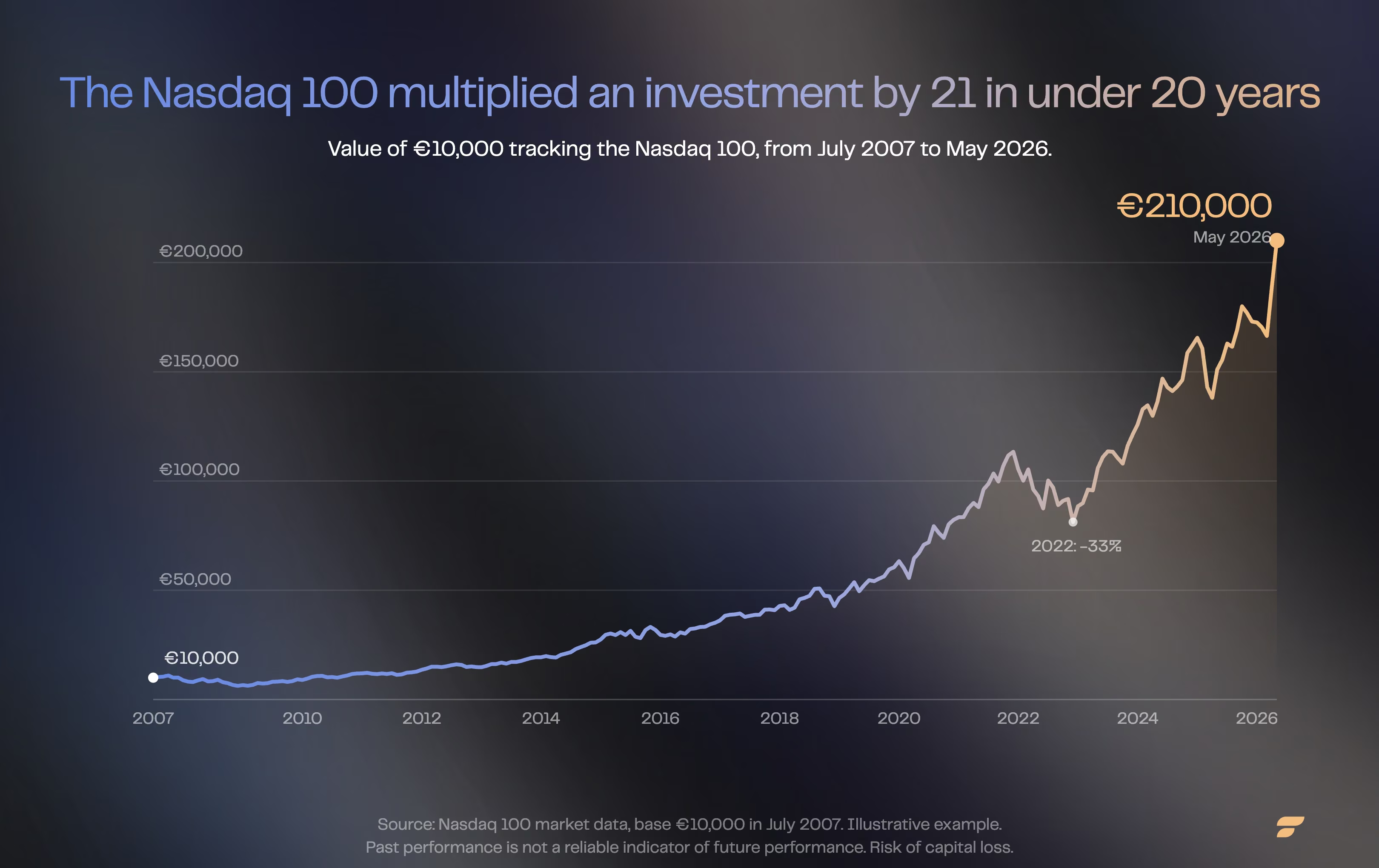
The NASDAQ 100 index has historically posted significant growth (past performance is not a reliable indicator of future performance). Since its creation on 31 January 1985, the index has delivered a compound annual return of 14.25%, a cumulative gain over four decades well above 1,000%. Technology giants such as Apple, Microsoft, Amazon, Meta and Alphabet (Google) drove that sustained growth. Several Nasdaq 100 ETFs give investors exposure to the index. Past performance is not a reliable indicator of future performance.
An index that leaves dividends out
The Nasdaq 100 index most often quoted is a price index: it does not count the dividends paid by its constituent companies. ETFs hold those shares and receive their dividends. An accumulating ETF reinvests them in the fund, so its performance includes them, unlike the price index; a distributing ETF pays them out to investors periodically. Because the Nasdaq 100 dividend yield remains low (0.44% as of 3 August 2026) and is partly absorbed by management fees, the gap with the price index stays limited.

Why invest in a NASDAQ ETF?
Investing in a NASDAQ ETF offers investors several advantages. First, it gives easy access to a broad range of leading technology companies, such as Amazon, Apple, Google and Nvidia. These companies have historically grown strongly, with no guarantee of future performance.
A NASDAQ ETF spreads assets across many companies, which brings diversification. Instead of concentrating on a single share, it holds a basket of securities, reducing the risk tied to the volatility of any one stock. NASDAQ ETFs also generally charge lower management fees than actively managed funds, which can improve long-term returns.
Another advantage is the option to receive or accumulate dividends, depending on the companies held. Dividend yields are never guaranteed, but they do represent additional income. NASDAQ ETFs are also often highly liquid, which makes buying and selling on the market easier.
Investors may also take comfort from the fact that NASDAQ ETFs are generally run by well-established asset managers. Assets under management (AUM) indicate how popular a product is and how much trust investors have placed in it.
In short, a NASDAQ ETF offers diversified exposure to leading technology companies while spreading risk, with benefits such as dividends and high liquidity. It is one way to gain exposure to the technology sector, keeping in mind the risks of sector concentration. Apps like Finary let you track how your Nasdaq ETFs perform alongside the rest of your portfolio, across every broker.
What are the main Nasdaq ETFs available?
The Amundi PEA NASDAQ-100 UCITS ETF - EUR (C) is frequently cited among the options for gaining exposure to the Nasdaq 100 inside a PEA. It uses synthetic replication and charges competitive fees of 0.30% a year (TER, Total Expense Ratio) while remaining PEA-eligible. On returns, it tracks the Nasdaq 100 closely, with no leverage.
| Fund (index) | ISIN | Ticker | TER | Distribution | Replication | Fund size | Domicile | PEA eligibility |
|---|---|---|---|---|---|---|---|---|
| Amundi PEA Nasdaq 100 UCITS ETF – Acc | FR0011871110 | PUST | 0.30% | Accumulating | Synthetic | €1.1 billion | France | Yes |
| Invesco EQQQ Nasdaq-100 UCITS ETF | IE0032077012 | EQQQ | 0.30% | Distributing | Physical | €11.2 billion | Ireland | No |
| iShares Nasdaq 100 UCITS ETF | IE00B53SZB19 | CNDX | 0.30% | Accumulating | Physical | €23.0 billion | Ireland | No |
| Xtrackers Nasdaq 100 UCITS ETF 1C | IE00BMFKG444 | XNAS | 0.20% | Accumulating | Physical | €2.1 billion | Ireland | No |
| Amundi Nasdaq 100 UCITS ETF EUR (C) | LU1681038243 | ANX | 0.23% | Accumulating | Synthetic | €1.5 billion | Luxembourg | No |
The popular US ETF Invesco QQQ Trust (ticker QQQ) cannot be marketed to French retail investors: without a Key Information Document (KID) compliant with the PRIIPs regulation, in force in Europe since 2018, US-domiciled ETFs cannot be offered to European savers. Invesco runs a UCITS-compliant version, the Invesco EQQQ Nasdaq-100 UCITS ETF (ticker EQQQ), which tracks the same index with a regulatory document valid for European investors.
Can you hold a NASDAQ ETF in a PEA?
Yes. Some Nasdaq ETFs are PEA-eligible provided they are domiciled in France and track the index through a swap: that is the case of the Amundi PEA Nasdaq 100, the only Nasdaq fund currently eligible.
Advantages of NASDAQ ETFs
NASDAQ ETFs offer several advantages, particularly for investors looking to diversify their portfolio. With a PEA-eligible NASDAQ ETF, you can take part in the growth of technology companies that rank among the world leaders, such as Amazon, Apple or Google.
- Diversification: a NASDAQ ETF invests in many companies at once, which makes diversifying a portfolio simpler.
- Returns: the index has historically posted high performance, which is no indication of future performance.
- Dividends: some NASDAQ ETFs also pay dividends, which can appeal to long-term investors.
Drawbacks of NASDAQ ETFs
It is still worth weighing the potential drawbacks of investing in NASDAQ ETFs through a PEA:
- Risk: a NASDAQ ETF can be riskier than other types of ETF, mainly because of its concentration in technology companies.
- PEA eligibility: not every NASDAQ ETF is PEA-eligible, so check before investing.
- Costs: management fees on some NASDAQ ETFs are higher than on others, so compare the fees involved before making an investment decision.

What are the alternatives to a NASDAQ ETF?
Other index-based ETFs can be considered, notably:
- ETFs tracking the S&P 500
- ETFs tracking emerging markets
- ETFs tracking the MSCI World
They can help diversify a portfolio. Past performance is not a reliable indicator of future performance.
Frequently asked questions
Which Nasdaq ETFs are PEA-eligible?
The choice of a PEA-eligible Nasdaq ETF is narrow: only the Amundi PEA Nasdaq 100 UCITS ETF (fees of 0.30% a year) qualifies. Always check PEA eligibility before investing, because most Nasdaq ETFs are not eligible.
How do you choose a Nasdaq 100 ETF for a PEA?
Compare four criteria in this order: PEA eligibility, the TER (management fees), the replication method and the fund's liquidity. Past performance does not guarantee future performance.
What is the difference between an accumulating and a distributing Nasdaq 100 ETF?
An accumulating ETF automatically reinvests dividends in the fund, which increases the value of each share. A distributing ETF pays the dividends into your account. In a PEA or with a long-term horizon, the accumulating version saves you from reinvesting manually.
Is a Nasdaq 100 ETF risky?
Yes. The index is highly concentrated in technology and in a handful of large stocks (Apple, Microsoft, Nvidia…), which amplifies volatility. A Nasdaq ETF carries a risk of capital loss, to be weighed against your investment horizon and risk tolerance.
Sources
AMF, Trackers or ETFs (Exchange Traded Funds)
AMF, ETFs and associated risks: a look at the French market
Service-public.fr, Plan d'épargne en actions (PEA)
AMF, application of the PRIIPs regulation to US products
JustETF, Amundi PEA Nasdaq-100 UCITS ETF Acc profile (FR0011871110)
JustETF, iShares Nasdaq 100 UCITS ETF Acc profile (IE00B53SZB19)
JustETF, Xtrackers Nasdaq 100 UCITS ETF 1C profile (IE00BMFKG444)
JustETF, Amundi Nasdaq-100 Swap UCITS ETF EUR Acc profile (LU1681038243)
JustETF, Invesco EQQQ Nasdaq-100 UCITS ETF profile (IE0032077012)
Nasdaq, Celebrating 40 Years of the Nasdaq-100 Index
StockAnalysis, Invesco QQQ Trust dividend yield
Regulatory disclaimers: Marketing communication. Investing carries a risk of partial or total capital loss. Past performance is not a reliable indicator of future performance. This article is provided for information and educational purposes only; it does not constitute personalised investment advice, a buy or sell recommendation, or tax advice. Before investing, read the Key Information Document (KID) and, where relevant, consult an authorised adviser. Finary SAS, an investment firm authorised by the ACPR (no. 19283), member of AMAFI. Insurance broker registered with ORIAS (no. 21001279), member of the CNCGP (association approved by the AMF). Crypto-Asset Service Provider (CASP) authorised by the AMF under the MiCA regime, references no. A2026-026 and no. N2026-008.