


Defense ETFs: the best choices in 2026

Updated 31 July 2026
A defense ETF is a listed fund that tracks a basket of arms, aerospace and cybersecurity companies. This guide compares the four main defense ETFs available from France in 2026, their fees, their size and their eligibility for the PEA (Plan d'Épargne en Actions, France's equity savings plan).

- The VanEck Defense, the HANetf Future of Defence and the iShares Global Aerospace & Defence are the three largest UCITS defense ETFs on the market.
- None of those three is PEA-eligible: their US exposure exceeds the 25% cap on securities from outside the European Economic Area.
- The BNP Paribas Easy Bloomberg Europe Defense (GUARD, ISIN LU3047998896) is the only option that can be held in a PEA among the four funds compared here.
- Annual management fees range from 0.23% to 0.55%, on top of the brokerage fees charged by your broker.
- The sector is benefiting from rising military budgets, but a defense ETF still carries a risk of capital loss.
Why invest in defense in 2026?
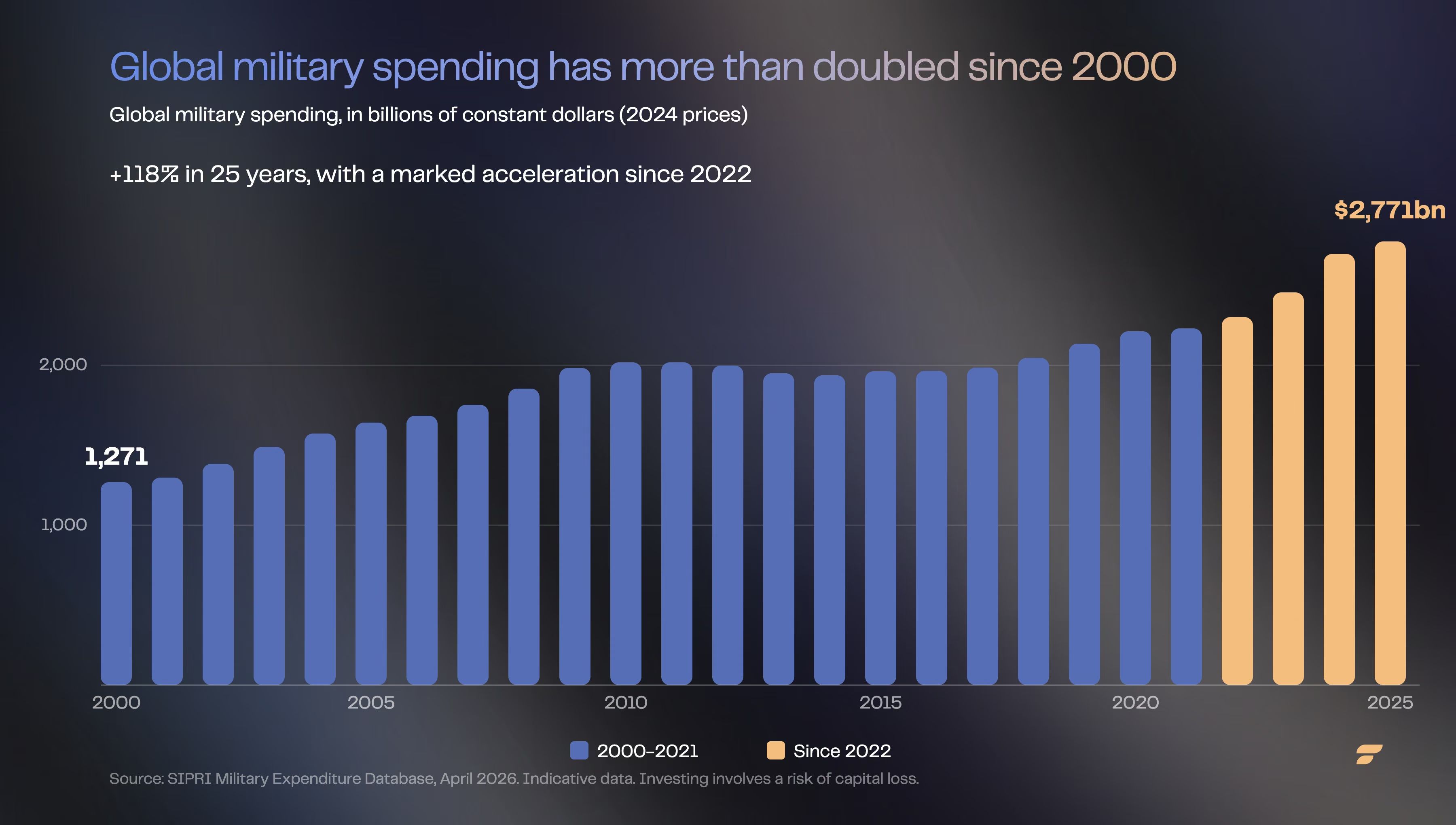
Defense attracts investors because public procurement in the sector is structurally rising. According to SIPRI, global military spending reached $2,887 billion in 2025, rising for the eleventh year in a row. That momentum supports the order books of the sector's manufacturers, without guaranteeing the future performance of their shares.
The defense ETFs compared here are all accumulating: the dividends paid by the companies held are reinvested in the fund instead of being distributed, which makes them a tool for sector diversification rather than a source of income. These companies generally see steady demand for their products and services, driven by the need to maintain a high level of security in an increasingly uncertain world.
The defense sector spans a variety of industries, from military equipment manufacturing to surveillance and security companies, as well as makers of weapons and war machinery. Investing in defense also supports technological innovation in these fields, helping to ensure that new solutions are developed for national security.
The visibility of public budgets has historically made the sector less sensitive to the economic cycle than other cyclical sectors, though that is no protection: a defense ETF still carries a risk of capital loss.

What are the best defense ETFs in 2026?
Four UCITS ETFs cover the sector for a French investor: the VanEck Defense, the HANetf Future of Defence and the iShares Global Aerospace & Defence, which can be held in a securities account, and the BNP Paribas Easy Bloomberg Europe Defense (GUARD), the only one of the four that is PEA-eligible. The table below compares their fees, their size and their main holdings.
| Fund | ISIN | Ticker | Top holdings | TER | Income treatment | Replication | Fund size | Domicile | PEA eligibility |
|---|---|---|---|---|---|---|---|---|---|
| HANetf Future of Defence UCITS ETF | IE000OJ5TQP4 | ASWC | Safran, Lockheed Martin, RTX, BAE Systems | 0.49% p.a. | Accumulating | Full | €2,729m | Ireland | No |
| VanEck Defense UCITS ETF A | IE000YYE6WK5 | DFNS | Palantir, RTX, Thales, Leonardo | 0.55% p.a. | Accumulating | Full | €6,102m | Ireland | No |
| iShares Global Aerospace & Defence UCITS ETF USD (Acc) | IE000U9ODG19 | DFND | The Boeing Co., GE Aerospace, Rolls-Royce, RTX | 0.35% p.a. | Accumulating | Full | €1,625m | Ireland | No |
| BNP Paribas Easy Bloomberg Europe Defense UCITS ETF | LU3047998896 | GUARD | Airbus, Rheinmetall, Safran, Rolls-Royce | 0.23% p.a. | Accumulating | Full | €574m | Luxembourg | Yes |
Fund sizes as at 29 July 2026 (sources: justETF and issuer factsheets). These assets under management change daily; the TER shown is the total annual expense ratio, excluding brokerage fees.
How to invest in defense with ETFs
To choose an ETF in defense, it is important to examine the composition of its portfolio and its past performance. Past performance is not a reliable indicator of future performance, but it does tell you about the make-up of the fund and about how the sector behaves in different market phases. The main holdings in a defense ETF are generally leading companies in aeronautics, electronics, cybersecurity or defense services.
When investing in a defense ETF, it is essential to bear in mind that the fund's net asset value (NAV) and its return can fluctuate with market conditions. Defense ETFs carry a degree of risk, like all stock market investments.
PEA eligibility is a criterion in its own right: after five years of holding, gains withdrawn from a PEA are exempt from income tax, with social levies still due.

Finally, tracking the performance of your chosen ETF regularly lets you adjust the portfolio over time: apps such as Finary bring that monitoring together across all your brokers. Current and past performance data can be consulted on the websites of ETF providers or of online investment platforms. You should also factor in the management fees and the brokerage commissions that can affect the net return on investments made in defense ETFs.

Frequently asked questions
What are the advantages of investing in a defense ETF?
Investing in a defense ETF has several advantages. First, companies in the defense sector benefit from sustained demand, driven by long-term public contracts. That does not remove the risk: like any equity investment, a defense ETF carries a risk of capital loss and its value can swing sharply.
Second, ETFs let investors spread their investment across several defense companies, reducing the risks that come with investing in a single company. ETFs are also generally cheaper than buying individual shares, which can be an advantage for investors looking to reduce transaction costs.
Finally, defense ETFs can give investors a way to access international markets that might not be easily available by other means.
Are there aerospace ETFs eligible for a PEA?
The PEA is a French securities account restricted to European shares and funds, with a tax advantage after five years. An ETF can be held in one if it invests more than 75% of its assets in securities of companies headquartered in the European Union or the European Economic Area, whatever the market capitalisation of the companies held.
Yes, but the choice is narrow: most aerospace and defense ETFs are invested mainly in the United States and therefore breach the 25% cap on securities from outside the European Economic Area. Among the funds compared here, only the BNP Paribas Easy Bloomberg Europe Defense (GUARD, LU3047998896) is PEA-eligible.
Do defense ETFs carry risks?
Yes. Despite the sector's sustained demand, a defense ETF remains an equity investment subject to the risk of capital loss. Its value depends on military budgets, the geopolitical backdrop and company results. The sector's sharp recent rise can also lead to phases of correction.
What fees does a defense ETF charge?
Defense ETFs carry management fees (TER) of between 0.23% and 0.55% a year depending on the fund. On top of that come the brokerage fees charged by your broker when buying and selling. These costs reduce the net return, so it is worth comparing them before investing.
Sources
SIPRI, April 2026 press release: global military spending in 2025
SIPRI Military Expenditure Database, historical series of global military spending
Service-public.gouv.fr, securities eligible for the equity savings plan (PEA)
justETF, factsheet for the VanEck Defense UCITS ETF A (IE000YYE6WK5)
justETF, factsheet for the HANetf Future of Defence UCITS ETF (IE000OJ5TQP4)
justETF, factsheet for the iShares Global Aerospace & Defence UCITS ETF (IE000U9ODG19)
justETF, factsheet for the BNP Paribas Easy Bloomberg Europe Defense UCITS ETF (LU3047998896)
HANetf, Future of Defence UCITS ETF fund page, holdings and assets under management
Regulatory disclaimers: Marketing communication. Investing carries a risk of partial or total capital loss. Past performance is not a reliable indicator of future performance. This article is provided for information and educational purposes only; it does not constitute personalised investment advice, a recommendation to buy or sell, nor tax advice. Before investing, read the Key Information Document (KID) and, where relevant, consult an authorised adviser. Finary SAS, an investment firm authorised by the ACPR under no. 19283, member of AMAFI. Insurance broker registered with ORIAS under no. 21001279, member of the CNCGP (association approved by the AMF). Crypto-Asset Service Provider (CASP) authorised by the AMF under the MiCA regime, references no. A2026-026 and no. N2026-008.