


Emerging Markets ETFs: investing in developing countries

Updated 16 July 2026
An Emerging Markets ETF is a fund that replicates the performance of stock markets in developing countries, holding companies such as Taiwan Semiconductor, Tencent or Samsung. This guide reviews the main indices, example ETFs, their fees, and whether they can be held in a PEA (a French tax-advantaged equity savings account), bearing in mind the risk of capital loss.

- The MSCI Emerging Markets index covers 1,178 stocks across 24 countries, with Taiwan Semiconductor, Samsung Electronics and Tencent among its largest holdings.
- Emerging market ETFs typically charge management fees between 0.15% and 0.30% per year, depending on the replication method.
- More volatile than developed markets, these ETFs carry a higher risk of capital loss.
- Only synthetic replication ETFs are PEA-eligible, since the wrapper requires at least 75% European equities.
Understanding ETFs and emerging markets
What defines an emerging market
Emerging markets are countries experiencing rapid economic growth whose financial markets show high volatility. They hold significant growth potential but carry higher risks than developed markets. The BRICS (Brazil, Russia, India, China, South Africa) are the best-known emerging countries, but there are many others, such as Mexico, Malaysia, Indonesia and Thailand. Russia has been excluded from the MSCI EM index since 2022, after MSCI reclassified its Russia indices as standalone markets on 9 March 2022.
Emerging markets are often characterised by strong economic growth, a young population and rapid urbanisation. These factors help drive domestic demand and create investment opportunities in sectors such as technology, financial services and consumer goods. That said, emerging markets can also face challenges such as unstable regulation, insufficient infrastructure and political risk, unlike regions such as Europe or the United States.
The benchmark indices for emerging market ETFs
There are many benchmark indices for emerging market ETFs, among them the MSCI Emerging Markets index, the FTSE Emerging Markets index and the more recent MSCI Emerging Markets ESG Leaders. ESG indices (Environmental, Social and Governance) select the companies that perform best on the environment, human rights and sound governance.
Investors can also choose ETFs tracking more specific indices, such as sector or dividend indices. These products can offer more targeted exposure to particular industries or companies.
What is the MSCI Emerging Markets index?
The MSCI Emerging Markets is a stock index representing emerging markets. It was created by the financial services firm MSCI and brings together shares from 24 different countries, with 1,178 stocks making up the index. It offers broad exposure to these growing economies and is an essential tool for investors looking to diversify their portfolio.
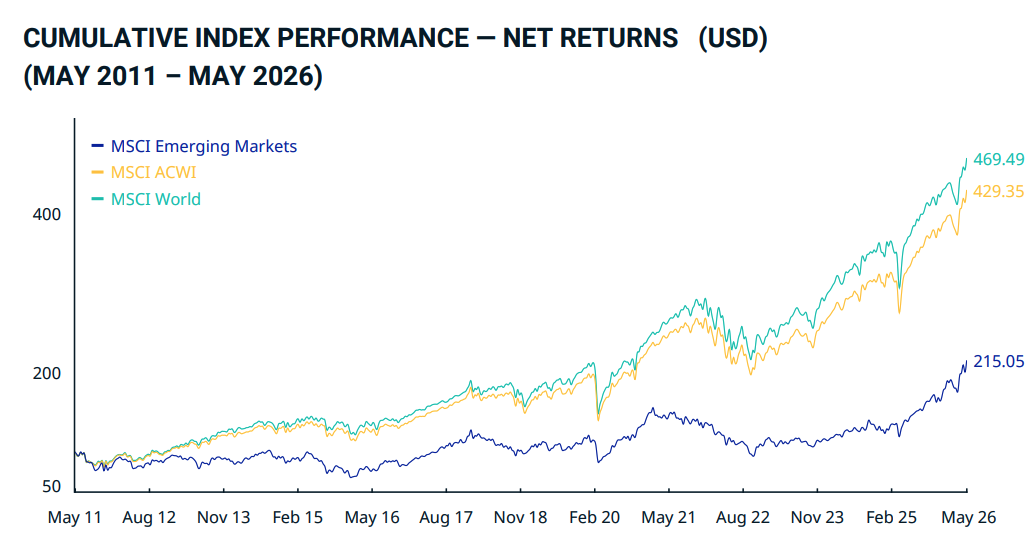
The index's largest holdings are currently Taiwan Semiconductor (TSMC, 15.1%), Samsung Electronics (8.2%), SK Hynix (7.7%), Tencent Holdings (2.7%), Alibaba Group (1.6%), MediaTek (1.6%), Delta Electronics (1.0%), Samsung Electronics preference shares (0.9%), SK Square (0.8%) and Hon Hai Precision / Foxconn (0.8%). According to MSCI, the index covers around 85% of the free-float-adjusted market capitalisation of each emerging market (MSCI factsheet, 30 June 2026).
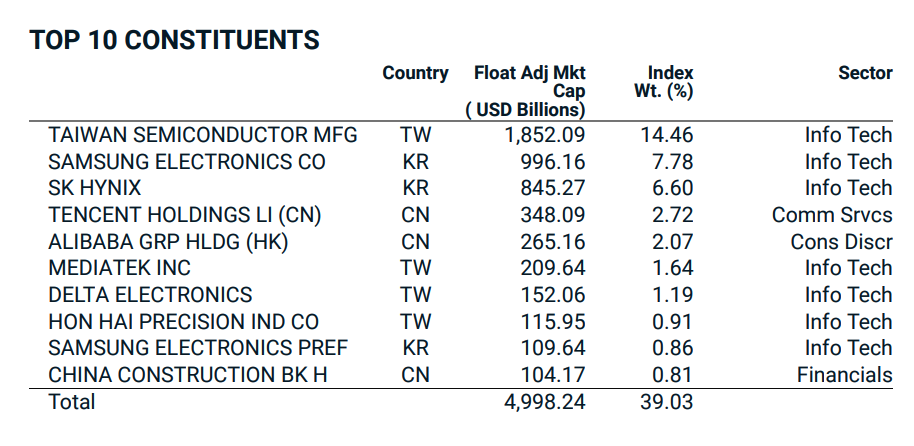
The best Emerging Markets ETFs include those tracking this index. These funds give investors easy access to a diversified basket of emerging market shares, without having to buy each share individually.
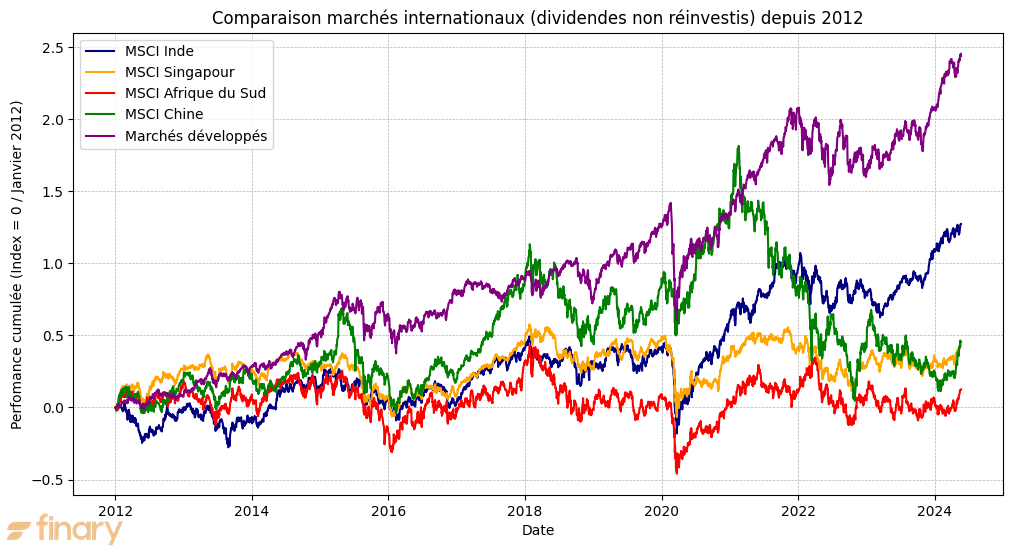
Below is a selection of the most widely followed emerging markets with their respective performance.
Why invest in Emerging Markets ETFs?
Investing in an Emerging Markets ETF diversifies your portfolio and targets faster economic growth than in Europe or the United States, in exchange for higher volatility and a higher risk of capital loss. Here are the main advantages to know before investing.
- Diversification: investing in emerging markets ETFs diversifies your portfolio by including assets from different parts of the world. This can help reduce overall risk and improve potential returns.
- Economic growth: emerging countries generally grow faster than developed ones, which can translate into better long-term market performance. When investing in these markets, that potential nonetheless comes with increased volatility and risk of capital loss.
- Attractive valuations: shares in emerging countries often trade at lower valuations than those in developed countries, which means they may offer different entry points, with no guarantee of future gains.
- Commodity exposure: many emerging markets are rich in natural resources such as oil, gold, and precious and industrial metals; this offers useful exposure to swings in the global commodities market.
- Technological innovation: some key sectors such as technology and healthcare are very dynamic within emerging economies, which represents strong potential for investors looking to benefit from that innovation.

How to choose an emerging markets ETF?
Choosing an Emerging Markets ETF means comparing management fees, fund size, replication method, liquidity and currency risk exposure. The following criteria help refine that choice according to your investor profile:
- Investment objective - investors should determine their objective before choosing an ETF. If the aim is to maximise short-term returns, a fund with lower management fees may be the better option. For a longer investment horizon, a fund with higher management fees could be the better choice.
- ESG criteria - more and more investors factor environmental, social and governance (ESG) criteria into their decision-making. An ETF that meets ESG criteria signals a commitment to sustainable and ethical practices.
- Liquidity: a liquid ETF makes trading easier and lets you enter or exit the market quickly without significantly affecting the price.
- Management fees - fees can vary considerably from one fund to another, and these costs matter before investing. As an example, the iShares Core MSCI EM IMI UCITS ETF (ISIN IE00BKM4GZ66) is among the low-fee emerging market ETFs available in Europe.
- Volatility - emerging markets are often more volatile than developed markets, so a fund's volatility is worth considering before making an investment decision. Choose a fund that suits your risk tolerance.
- Currency risk - investors should factor in currency risk when investing in emerging markets. Exchange rate swings can have a considerable impact on returns. Choose a fund that offers currency hedging if this concerns you.
- Past performance - while past performance should not be the only selection criterion, it can give an idea of how a fund has behaved. Look at performance over a longer period to get a better sense of it.
Examples of available Emerging Markets ETFs
Here are some examples of available emerging markets ETFs, for information only, with their performance, management fees, fund size, replication method and ISIN code (to compare, if useful, with our selection of the best World ETFs).
Examples of Emerging Markets ETFs with notable recent performance
By way of illustration, here are three MSCI Emerging Markets ETFs that recorded notable performance over the last 3 years. Past performance is not a reliable indicator of future performance.
| Name | 3-year performance (EUR) | Management fees | Fund size | Replication method | Income treatment | ISIN |
|---|---|---|---|---|---|---|
| UBS Core MSCI EM UCITS ETF USD dis | +70.47% | 0.15% / year | €2.7 billion | Physical | Distributing | LU0480132876 |
| State Street SPDR MSCI Emerging Markets UCITS ETF USD | +70.64% | 0.18% / year | €1.9 billion | Physical | Accumulating | IE00B469F816 |
| HSBC MSCI Emerging Markets UCITS ETF USD | +68.88% | 0.15% / year | €3.8 billion | Physical | Distributing | IE00B5SSQT16 |
Source: JustETF, fund size, management fees and performance as at 16 July 2026.
The most popular Emerging Markets ETFs
The most popular MSCI Emerging Markets ETFs are popular for good reason: investors are looking to diversify their portfolio and gain exposure to these markets. The three most popular MSCI Emerging Markets ETFs are the following:
| Name | 3-year performance (EUR) | Management fees | Fund size | Replication method | Income treatment | ISIN |
|---|---|---|---|---|---|---|
| Xtrackers MSCI Emerging Markets UCITS ETF 1C | +70.06% | 0.18% / year | €11.8 billion | Physical | Accumulating | IE00BTJRMP35 |
| iShares MSCI EM UCITS ETF (Dist) | +69.43% | 0.18% / year | €9.1 billion | Physical | Distributing | IE00B0M63177 |
| iShares MSCI EM UCITS ETF (Acc) | +70.35% | 0.18% / year | €8.5 billion | Physical | Accumulating | IE00B4L5YC18 |
Source: JustETF, fund size, management fees and performance as at 16 July 2026.
PEA-eligible Emerging Markets ETFs
It can also be worth looking at PEA-eligible Emerging Markets ETFs in order to benefit from the tax advantages of the PEA.
| Name | 3-year performance (EUR) | Management fees | Fund size | Replication method | Income treatment | ISIN |
|---|---|---|---|---|---|---|
| Amundi PEA Emergent (MSCI Emerging) ESG Transition UCITS ETF Acc - broad emerging exposure | +67.53% | 0.30% / year | €843 million | Synthetic | Accumulating | FR0013412020 |
| Amundi PEA Asie Emergente (MSCI Emerging Asia) Screened UCITS ETF Acc - emerging Asia only | +77.39% | 0.30% / year | €745 million | Synthetic | Accumulating | FR0013412012 |
Source: JustETF, fund size, management fees and performance as at 16 July 2026.

How to invest in emerging markets with ETFs?
- Learn and research: understanding the risks and opportunities of emerging countries is essential before investing. That includes studying local economies, political conditions and market dynamics.
- Choose a trading platform: pick a platform that gives access to a range of international ETFs. Make sure it is regulated by a trusted financial authority, such as the Autorité des marchés financiers (AMF) in France.
- Select your target ETFs: several ETFs target emerging countries. They can be based on a specific index, an industry or a geographic region.
- Diversification: avoid putting all your eggs in one basket. Spread your investment across several ETFs to reduce risk.
- Ongoing monitoring: reviewing your investments regularly and adjusting your portfolio accordingly is essential.

Why hold an emerging markets ETF in a PEA?
Holding an Emerging Markets ETF in a PEA combines exposure to developing economies with a favourable tax framework. Two things to keep in mind (see also our guide to PEA-eligible European ETFs):
- Eligibility: only synthetic replication (swap) ETFs are PEA-eligible, because the wrapper requires at least 75% European equities in the portfolio.
- Taxation: after 5 years of holding, gains withdrawn from a PEA are exempt from income tax. Social levies (around 18.6% in 2026) nonetheless remain due.
Frequently asked questions
What is an emerging markets ETF?
An emerging markets ETF is an exchange-traded fund designed to replicate the performance of financial markets in developing countries. These funds give investors access to a diversified basket of shares or bonds from those economies.
Why invest in an emerging markets ETF?
Investing in an emerging markets ETF has several advantages, notably diversified exposure to fast-growing economies, risk pooling through geographic and sector spread, and management fees that are generally lower than those of traditional funds.
What is an MSCI Emerging Markets ETF?
An MSCI Emerging Markets ETF is a particular type of ETF that tracks the MSCI Emerging Markets Index, made up of more than 1,000 shares representing the main companies operating in emerging markets. That index covers around 85% of the total stock market of developing economies.
What share of a global portfolio should go to Emerging Markets ETFs?
The ideal share depends mainly on your investor profile and your financial objectives. A common recommendation is to allocate between 10% and 30% of the overall portfolio to emerging market assets. It is worth reviewing that allocation regularly to adjust it as the global macroeconomic picture evolves.
Sources
AMF, Trackers (ETFs): understanding listed index funds
MSCI, Emerging Markets Index factsheet (30 June 2026)
MSCI, Russia reclassification press release (March 2022)
Service-Public, Plan d'épargne en actions (PEA)
JustETF, ETF screener and factsheets (data as at 16 July 2026)
Regulatory disclaimers: Marketing communication. Investing carries a risk of partial or total capital loss. Past performance is not a reliable indicator of future performance. This article is provided for information and educational purposes only; it does not constitute personalised investment advice, a buy or sell recommendation, or tax advice. Before investing, read the Key Information Document (KID) and, where relevant, consult an authorised adviser. Finary SAS, an investment firm authorised by the ACPR under no. 19283, member of AMAFI. Insurance broker registered with ORIAS under no. 21001279, member of the CNCGP (association approved by the AMF). Crypto-Asset Service Provider (CASP) authorised by the AMF under the MiCA regime, references no. A2026-026 and no. N2026-008.