Agricultural ETFs: 2026 investment guide

Updated on 27 July 2026
An agricultural ETF gives exposure to the global food chain in a single line: seed producers, fertiliser and machinery manufacturers, grain traders. Driven by population growth (close to 9.7 billion people expected by 2050 according to the UN) and by the need to produce more, the sector is one avenue for diversification, with no guarantee of performance.

- Two families coexist: agribusiness ETFs, which hold shares in the sector, and agricultural commodity ETCs, which are more volatile.
- The iShares Agribusiness UCITS ETF (TER 0.55%) remains close to 47% concentrated on the United States, through physical replication.
- The Rize Sustainable Future of Food UCITS ETF (TER 0.45%) targets the food transition, with modest assets of around €54 million.
- The WisdomTree Agriculture ETC (0.49% fees) gives direct exposure to agricultural commodities, at the cost of high volatility.
- Almost no agricultural ETF is eligible for the PEA (a French tax-advantaged equity savings account), because the sector's major groups are headquartered outside the European Union.
How does an agricultural ETF work?
An agricultural ETF brings together, in a single listed share, dozens of companies or commodities from the sector, with a value that moves in real time with markets, harvests, weather and geopolitics.
How agricultural ETFs work
Agricultural ETFs bundle many companies and commodities from the farming sector into a single listed share. They cover a wide range of players: agri-industry giants, fertiliser manufacturers, wheat and soybean producers.
Unlike a conventional basket, the value of an agricultural ETF moves in real time. It fluctuates with stock markets, harvests, weather conditions and geopolitical tensions.
According to the FAO, global food production will have to rise by around 70% by 2050 to feed a fast-growing population, which sustains long-term interest in the sector.
There are two broad types of agricultural ETF: some focus on the sector's companies (agribusiness), while others track the performance of agricultural commodities, mainly through futures contracts.
This distinction directly drives risk and return.
Pros and cons of agricultural ETFs
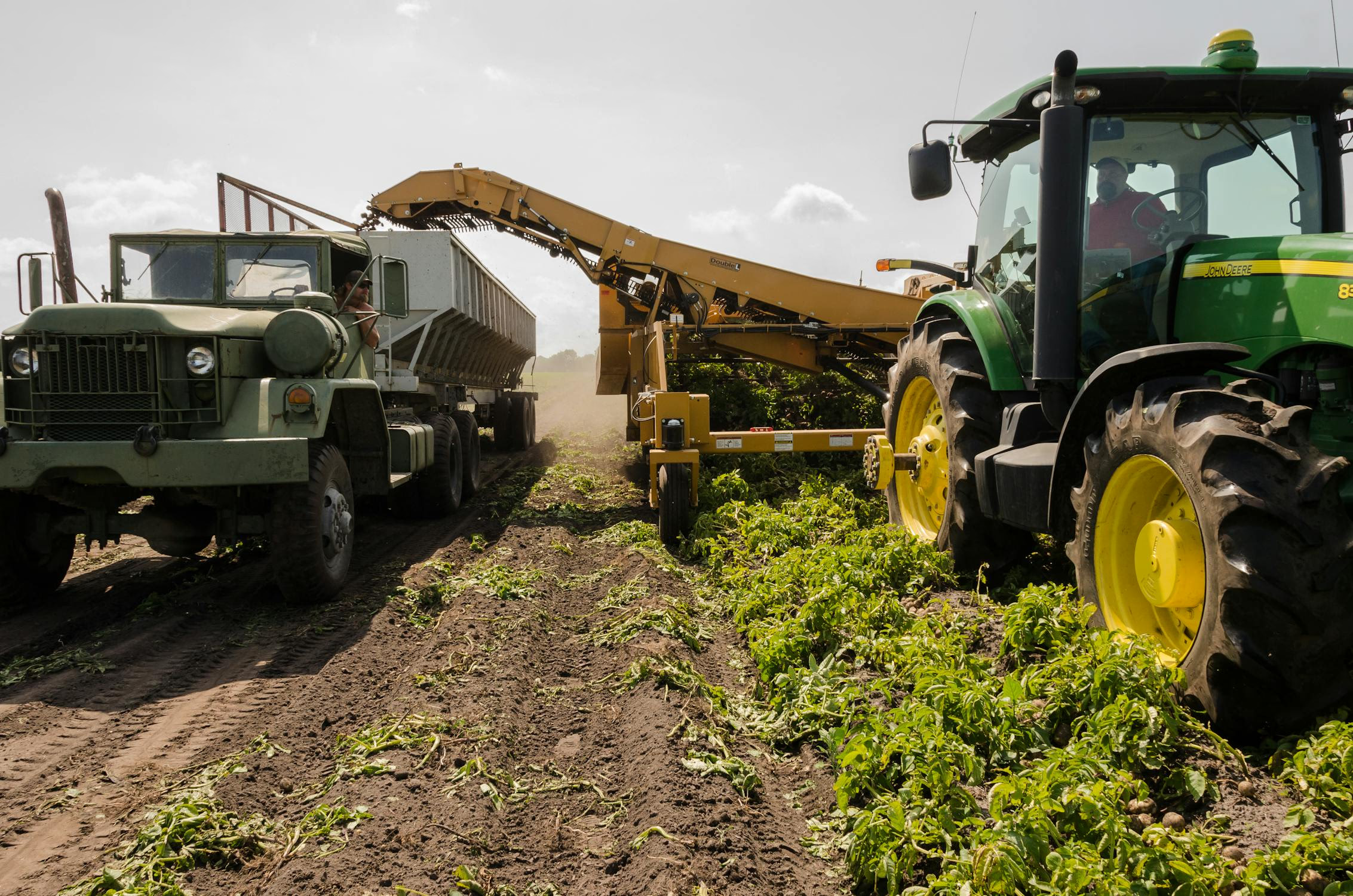
Agricultural ETFs give easy access to the global food chain. In a single trade, you invest in US seed producers, European processing groups and Brazilian sugar producers. This diversification can help soften the risk tied to a single company or region, without removing it.
That diversification can be misleading, though. Many agricultural ETFs concentrate on a handful of large US or Canadian companies, overlooking emerging markets and niche markets.
Some commodity-based ETFs also have their own quirks: the “roll yield”, for instance, can eat into performance when futures contracts are rolled over in contango.
Only a handful of genuinely agricultural ETFs are available to retail investors. That makes selection critical, since each product has its own features and risks.
How to select an agricultural ETF (TER, AUM, liquidity)
Choosing an agricultural ETF means reviewing several key criteria:
- TER (Total Expense Ratio): management fees weigh on long-term performance. Watch not only the TER, but also hidden costs such as swap fees or the impact of the spread.
To go deeper into how ETFs work, read our complete guide to ETFs.
- AUM (assets under management): an ETF holding more than €100 million in assets attracts liquidity, limits the risk of closure and makes trading easier. Smaller funds can suffer from wider spreads and a lack of interest from institutional investors.
- Liquidity: a liquid ETF can be bought or sold easily, even when agricultural markets swing hard. Liquidity depends on daily volume, order-book depth and the stability of the bid/ask spread.
Other factors come into play: the replication method (physical or synthetic), the geographic and sector mix, and the provider's transparency. A solid agricultural ETF balances all of these criteria.

Agricultural ETFs as an inflation hedge
Inflation worries many investors. Under certain conditions, agriculture can offer some diversification against inflation, with no guarantee. When the cost of living rises, agricultural commodity prices may adjust, with no guaranteed correlation. Markets react to shifts in supply and demand, to weather conditions and to geopolitical tensions.
Agricultural ETF examples: a detailed review
iShares Agribusiness UCITS ETF

The iShares Agribusiness UCITS ETF (ISIN IE00B6R52143) invests in the main players in global agri-industry. The fund is not limited to a few farming stocks: it targets the companies that structure the food chain, from seed producers to farm machinery manufacturers.
The fund's composition stands out for the diversity of the businesses represented. Its main holdings include:
- Corteva, a specialist in seeds and crop protection
- Deere & Co, a farm machinery manufacturer
- ADM, a leader in grain trading
- Nutrien, the Canadian fertiliser giant
- Kubota, the Japanese farm equipment manufacturer
This spread gives exposure to farming cycles, food demand and innovation (precision agriculture, biotechnology).
The fund remains heavily exposed to the United States, though: close to half of its assets sit in the US market. That concentration brings sensitivity to the dollar and to US market momentum.
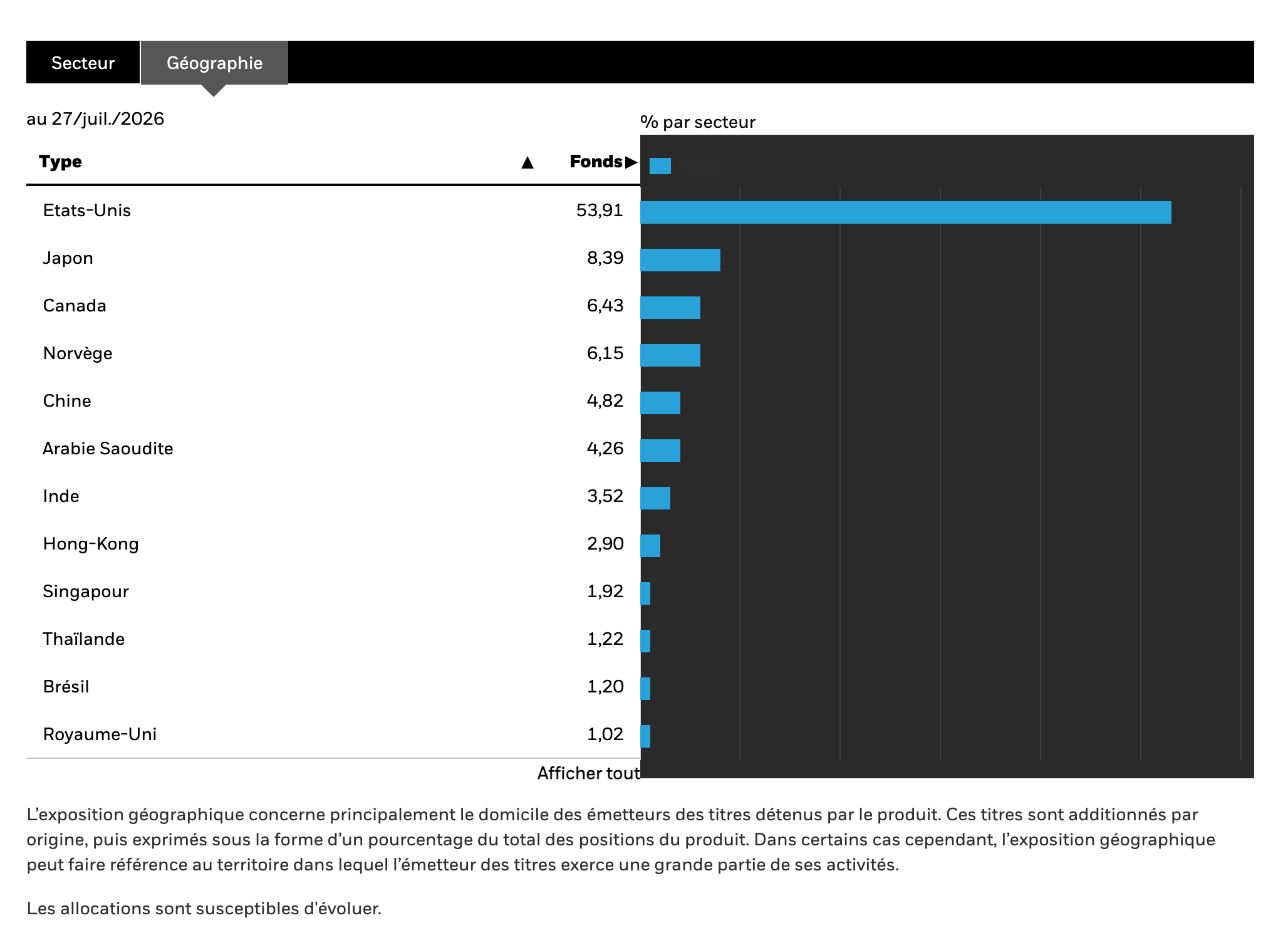
European companies are present but remain a minority. For an investor seeking global exposure to agriculture, that tilt can be an advantage.
The TER of 0.55% is competitive for a specialised sector ETF.
Physical replication guarantees portfolio transparency: the fund holds the shares directly, with no complex instruments involved.
Rize Sustainable Future of Food UCITS ETF

The Rize Sustainable Future of Food UCITS ETF (ISIN IE00BLRPQH31) takes a different approach. It does not simply ride population growth or rising farm yields. It bets on the transformation of how food is produced and consumed.
Its stock selection reflects that focus:
- Yara International, a specialist in sustainable fertilisers
- SIG Group, a player in eco-friendly packaging
- Givaudan, a producer of natural flavourings
The fund also invests in adjacent sectors: cold-chain logistics, food safety, water technology. Agriculture thus extends to the supply chain, data management and responsible packaging.
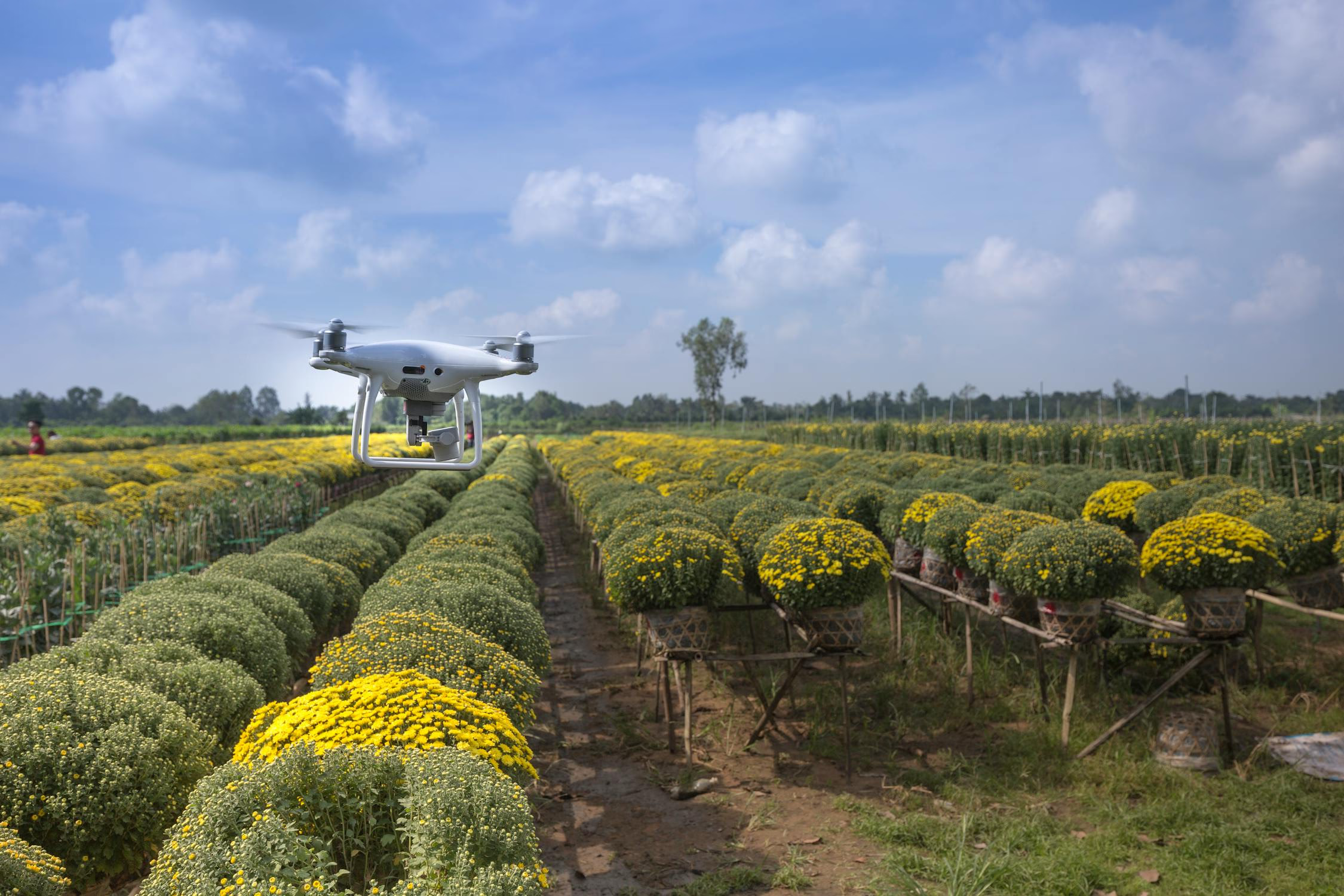
This strategy captures the structural trends of the food sector, beyond farm production alone.
In return, geographic diversification stays limited, the fund remains small (around €54 million as at 31 January 2026), and volatility can be sharper. The 0.45% TER is competitive, but the investment universe is still young and sometimes escapes coverage by traditional analysts.
This fund targets people who see agriculture as a field for innovation rather than a plain cyclical sector. Funds of this kind are rare on the European market and may appeal to investors drawn to the food transition theme.
To go further on responsible investing, see our selection of the best ESG ETFs and learn how to reconcile performance with environmental impact.
WisdomTree Agriculture ETC

This product takes a different route: it does not bet on companies, but on the commodity itself. The WisdomTree Agriculture ETC (Exchange Traded Commodity, ISIN GB00B15KYH63) tracks global agricultural markets directly. Wheat, corn, soybeans, coffee: it follows futures prices, without going through equities.
That choice means significant volatility. Agricultural commodities react sharply to weather conditions, geopolitical tensions and traders' decisions.
A hurricane in the Midwest or a drought in Brazil can send prices soaring or tumbling. Investors have to accept that instability and understand the “roll yield”: the cost or gain from rolling futures contracts, often overlooked by beginners.
An ETC is a debt security, not a fund: it depends on the issuer's financial strength. The 0.49% fees do not cover everything: check the other costs in the KID (Key Information Document) too.
It does offer a rare advantage: direct access to agricultural commodities from Europe, without resorting to complex structured products.
Within this trio, each product offers a distinct take on agriculture: industrial muscle, the sustainable transition, or direct exposure to the commodity itself (high risk). No product is perfect, and each has its limits. Each corresponds to a different exposure logic, to be assessed against your own objectives.
Criteria for selecting an agricultural ETF
Management fees (TER) of agricultural ETFs
The TER shows the annual management cost of an agricultural ETF, but it is only one side of the real cost: a low figure can hide extra costs and thin liquidity. Always weigh the TER against replication quality, market depth and the index tracked.
Assets under management (AUM) of agricultural ETFs
AUM shows an ETF's size: a fund that is too small risks closing, while a very large one can lose flexibility. Favour a mid-sized fund with good liquidity across several European exchanges.
Liquidity of agricultural ETFs
Good liquidity makes an agricultural ETF easy to trade; look at order-book depth, the presence of market makers and the regularity of trading to avoid hidden costs when you buy or sell.
Replication (physical or synthetic) of agricultural ETFs
Replication, physical or synthetic, affects transparency and PEA eligibility: physical replication is reassuring but limits access, while synthetic replication widens the choice, with a counterparty risk to understand before investing.
Composition and diversification of agricultural ETFs
Check that the agricultural ETF's composition matches your expectations: favour sector and geographic balance, to avoid excessive concentration or exposure to the farm chain that is too diluted.
In short, selecting an agricultural ETF is not just about comparing the label or the price. You need to understand the index tracked, the replication method, the fund's size and, above all, to analyse its real liquidity and composition. Seasoned investors know that the real value hides in the details, far from the obvious points highlighted in sales brochures.
Are agricultural ETFs eligible for the PEA?
In the vast majority of cases, no. The PEA attracts many French investors thanks to its favourable tax treatment and its flexibility. Investing in agriculture through a PEA, however, is made complex by the rules.
The PEA requires at least 75% of a fund's holdings to come from companies headquartered in the European Union or the European Economic Area. This often-overlooked rule sharply limits access to global agriculture.
Agribusiness operates on an international scale. Most large farming companies are based in the United States, Canada, Japan or Switzerland.
Alternatives for investing in agriculture through a PEA
Faced with these restrictions, investors can adapt their strategy to gain indirect exposure to the farming sector. Several options exist, even if none gives direct exposure:
- Pick European champions of the farming sector: listed European companies in food processing and agricultural distribution.
- Choose PEA-eligible sector ETFs that include companies linked to agriculture, even if their weight stays limited.
- Invest in diversified European groups with part of their business in agriculture.
These approaches capture part of the farming sector's momentum while respecting the PEA's constraints. Here are a few examples.
PEA-eligible “consumer staples” sector ETFs
PEA-wrapped “consumer staples” sector ETFs offer a simple way into indirect food-industry exposure. The Amundi PEA S&P US Consumer Staples Screened, for example, is a PEA-eligible synthetic ETF tracking the US consumer staples sector (Procter & Gamble, Coca-Cola, Walmart). Exposure to agriculture stays indirect, but the sector's defensive profile limits volatility.
Even though exposure to pure agriculture stays limited, this kind of ETF mirrors the food chain's dynamics, from production to distribution.
Listed French stocks, the core of the PEA
To target agri-industry directly, buying French stocks remains essential. Danone, Bonduelle, Avril and Groupe Soufflet represent European agriculture, from production to processing.
These companies pay dividends, benefit from global food demand and are fully PEA-eligible. This strategy lets you build a bespoke portfolio, picking the companies most exposed to farm growth or food innovation. Apps such as Finary bring the tracking of these positions together, across all brokers, alongside the rest of your net worth.
European thematic ETFs, indirect exposure
Some thematic ETFs, while not exclusively focused on agriculture, cover related issues: water management (Amundi PEA Eau), renewable energy or infrastructure. Agriculture consumes a great deal of water and energy, which lets these funds capture part of the sector's trends.
This exposure stays partial, but it is sometimes the only option within a PEA.
Want to diversify your portfolio further? See also our selection of the best PEA ETFs to optimise your stock market investments.

What are the risks of agricultural ETFs?
Agricultural ETFs stack three main risks: price volatility, weather hazards and geopolitical tensions, plus the risk of capital loss inherent to any investment in equities or commodities.
Volatility of the farming market
The farming sector goes through very pronounced price cycles. Wheat, corn or soybean prices can climb or slump within weeks, often because of factors outside traditional financial markets.
Agricultural ETFs, whether they track agribusiness stocks or commodities, are exposed to that instability. In this sector, weather and geopolitics sometimes move prices more than corporate earnings do. Double-digit swings over a year, up or down, are not unusual.
For investors, that calls for patience and resilience in the face of swings. Agriculture does not reward impatience.
Climate and environmental risks
Agriculture remains highly vulnerable to weather hazards. Droughts, floods, late frosts, heatwaves and emerging diseases create fresh uncertainty every year. Climate models are becoming less predictable, which directly affects farm yields, the profits of the sector's companies and commodity prices.
Even a diversified agricultural ETF offers no protection against a global climate shock. A major climate event such as El Niño can hit several continents at once. Geographic diversification is therefore not always enough.
Environmental pressures add to these risks:
- Pesticide regulations
- Water restrictions
- Sustainability requirements
Companies that fail to anticipate these shifts risk seeing their profitability fall, or even their business model called into question. Agriculture is changing fast, and ETFs that ignore this transition can lose their appeal.
Geopolitical risks
Agriculture depends heavily on political decisions and international relations. Embargoes, trade wars, export quotas or massive subsidies can shift the market balance overnight. The invasion of Ukraine in 2022 showed how strategic wheat and corn can become.
Even the largest food groups remain vulnerable:
- An export tax in Argentina
- An import ban in India can force the whole supply chain to adapt.
Agriculture is also part of a wider balance of international power.
Agricultural ETFs, a bet on the unpredictable
Investing in agricultural ETFs means accepting an environment where predictability is rare. The risks are not only financial or technical: they are systemic, often unexpected, and sometimes impossible to anticipate.
That complexity is what makes the farming sector both distinctive and difficult. For the informed investor, these risks can also open opportunities, provided the influence of natural and political factors on this market is never underestimated.
Despite regulatory and tax constraints such as PEA eligibility, these funds give exposure to some deep-seated trends: population growth, technological innovation and food security.
Goals
Frequently asked questions
Are agricultural ETFs eligible for the PEA?
In the vast majority of cases, no. The PEA requires at least 75% of a fund's holdings to come from companies headquartered in the European Union or the EEA, whereas the large farming groups are mostly American, Canadian or Japanese. Only a few PEA-wrapped synthetic ETFs offer indirect exposure.
What is the difference between an agribusiness ETF and a commodity ETC?
An agribusiness ETF holds shares in the sector's companies (seeds, fertilisers, machinery). An ETC directly tracks the price of agricultural commodities through futures contracts. The ETC is more volatile and exposes you to the issuer's counterparty risk, since it is a debt security and not a fund.
What is roll yield on an agricultural ETC?
Roll yield is the gain or the cost from rolling futures contracts at expiry. In contango, when far-dated contracts cost more than near-dated ones, that roll erodes the ETC's performance, regardless of how the price of the underlying commodity moves.
Do agricultural ETFs protect against inflation?
They can offer diversification against inflation, with no guarantee. Farm prices sometimes adjust to a general rise in prices, but they depend above all on supply, demand, weather and geopolitics, which makes their correlation with inflation unstable from one year to the next.
How many agricultural ETFs are available to European investors?
The offering is narrow: only a handful of ETFs and ETCs genuinely target agriculture while being available to retail investors in Europe. That scarcity makes selection all the more important, as each product has its own composition, replication method and risk level.
Sources
UN, World Population Prospects 2024: world population projection to 2050
FAO, How to Feed the World in 2050: 70% more food production needed
JustETF, iShares Agribusiness UCITS ETF factsheet (IE00B6R52143)
JustETF, Rize Sustainable Future of Food UCITS ETF factsheet (IE00BLRPQH31)
JustETF, WisdomTree Agriculture ETC factsheet (GB00B15KYH63)
Service-public.fr, plan d'épargne en actions (PEA): conditions and eligible securities
JustETF, Amundi PEA S&P US Consumer Staples Screened UCITS ETF factsheet (FR001400KE06)
Regulatory disclaimers: Marketing communication. Investing carries a risk of partial or total capital loss. Past performance is not a reliable indicator of future performance. This article is provided for information and educational purposes only; it does not constitute personalised investment advice, a buy or sell recommendation, or tax advice. Before investing, read the Key Information Document (KID) and, where relevant, consult an authorised adviser. Finary SAS, an investment firm authorised by the ACPR (no. 19283), member of AMAFI. Insurance broker registered with ORIAS (no. 21001279), member of the CNCGP (association approved by the AMF). Crypto-Asset Service Provider (CASP, "PSCA" in French) authorised by the AMF under the MiCA regime, references no. A2026-026 and no. N2026-008.