


Accumulating ETF or distributing ETF: which one should you choose?

Updated on 31 July 2026
An accumulating ETF automatically reinvests dividends in the fund; a distributing ETF pays them out to you in cash, usually every quarter. The accumulating format targets a long horizon, the distributing one a regular income. This article compares the two according to your wrapper (PEA, France's tax-advantaged equity savings account, life insurance, ordinary securities account) and your need for liquidity.

- In a PEA, the dividends of a distributing ETF stay inside the wrapper with no immediate tax: only the 18.6% social levies apply on withdrawal.
- In an ordinary securities account (CTO), the dividends of a distributing ETF are subject each year to the flat tax (PFU) of 31.4%.
- The fund's name states its policy: “Acc” or “C” for accumulating, “Dist” for distributing.
- The range listed in life insurance policies is overwhelmingly accumulating: a distributing ETF remains harder to find there.
- For a given distribution policy, it is the ongoing charges (TER) and the replication method that weigh most on net performance.

What is the difference between an accumulating ETF and a distributing ETF?
The difference lies solely in how dividends are handled. An accumulating ETF reinvests them in the fund, which raises the value of the share; a distributing ETF pays them into the investor's account. Otherwise, the two formats track the same benchmark index, such as the S&P 500 or the MSCI World, and give exposure to the same market, with the same risk of capital loss.
What is an accumulating ETF?
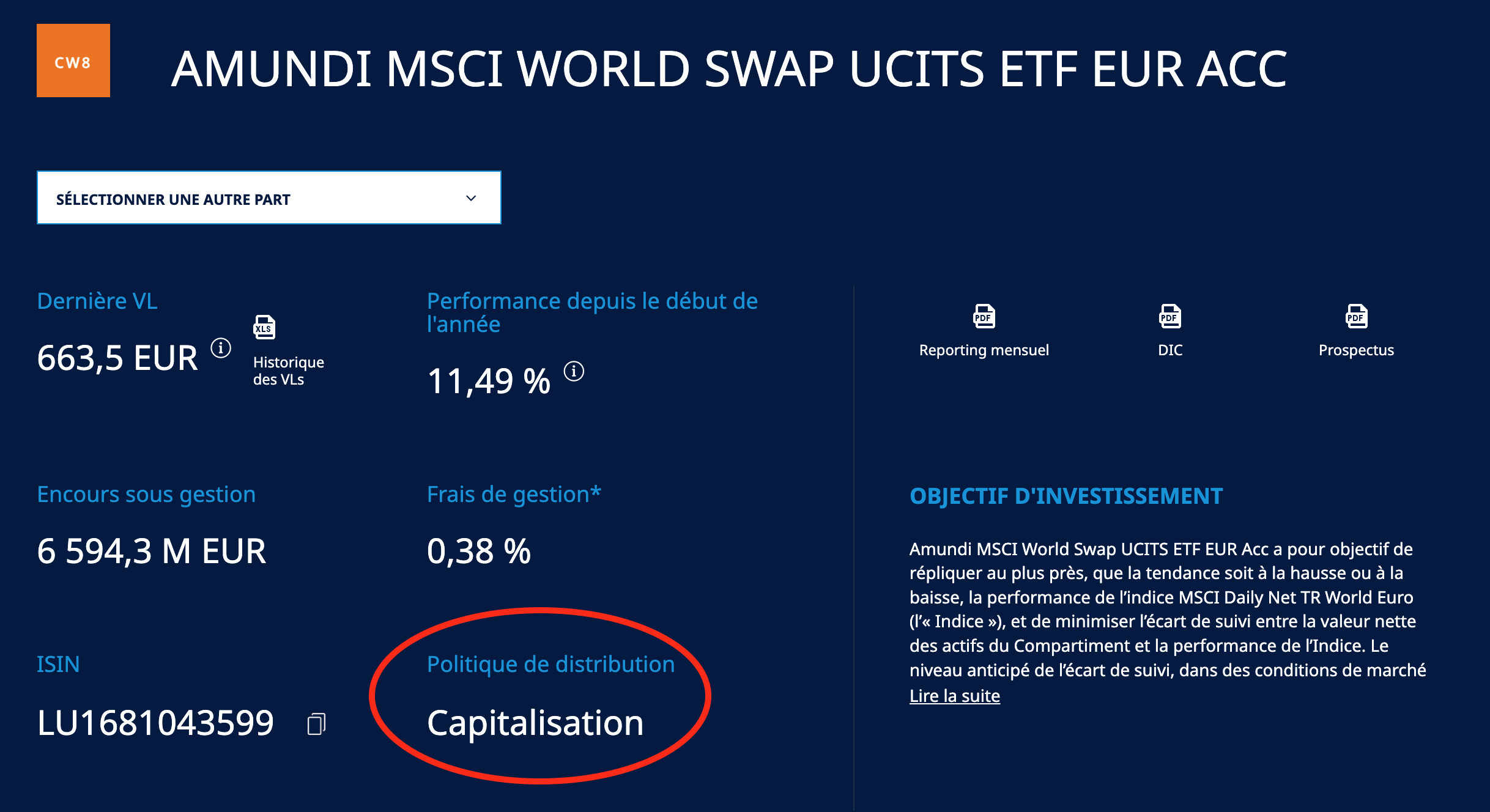
An accumulating ETF automatically reinvests the dividends received on the shares it holds in its portfolio. The main advantage of this strategy is the effect of compound interest, which grows the amount of capital invested over time. These ETFs are therefore particularly suited to long-term investors seeking to maximise the growth of their investment. Accumulating ETFs are often eligible for the PEA (plan d'épargne en actions) and can also be held in a life insurance policy.

| ISIN code | LU1681043599 |
| Ticker | CW8 |
| Dividend treatment | Accumulating |
| Type | ETF |
| Currency | EUR |
| Management fees (TER) | 0.38% |
| Assets under management | ~€6.3 billion |
| Replication type | Synthetic |
| PEA-eligible | YES |
| PEA-PME eligible | NO |
Source: JustETF (Amundi MSCI World Swap UCITS ETF EUR Acc), data as at 31 July 2026.
What is a distributing ETF?
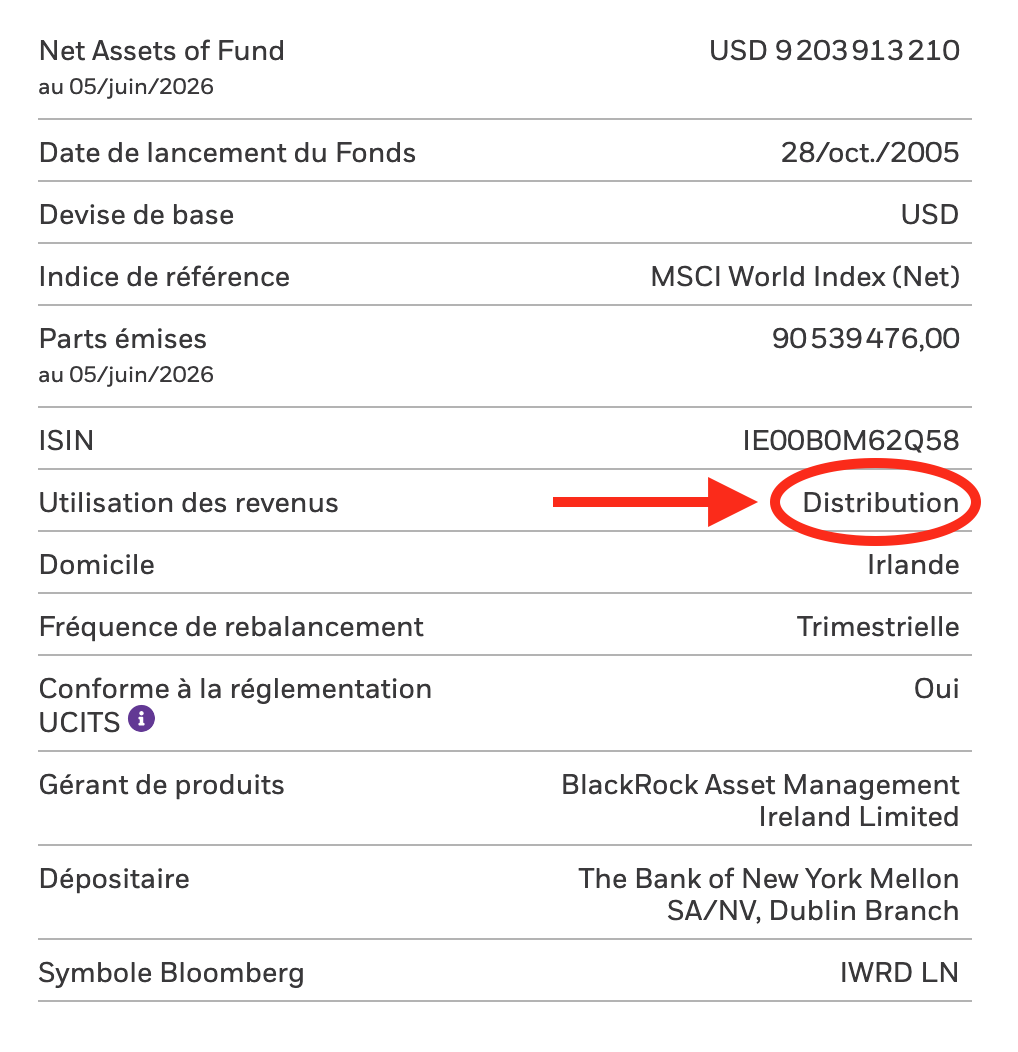
Conversely, a distributing ETF regularly pays the dividends it receives to investors as a distribution. This strategy suits investors looking for a regular income from their portfolio. Held in a PEA or a life insurance policy, dividends may benefit from a specific tax framework, subject to conditions and to the applicable caps and holding periods. Taxation depends on each investor's individual situation.
| ISIN code | IE00B0M62Q58 |
| Ticker | IWRD |
| Dividend treatment | Distributing |
| Type | ETF |
| Currency | USD |
| Management fees (TER) | 0.50% |
| Assets under management | ~€8.0 billion |
| Replication type | Physical |
| PEA-eligible | NO |
| PEA-PME eligible | NO |
Source: JustETF (iShares MSCI World UCITS ETF Dist), data as at 31 July 2026.
Risks and performance
Accumulating and distributing ETFs carry risks linked to the performance of the index tracked and to the quality of the fund's management. Trackers may also use synthetic replication to track the benchmark index, which can add a further risk.
What are the advantages and disadvantages of an accumulating ETF?
The main advantage of an accumulating ETF is the effect of compound interest, obtained without order fees or annual tax on dividends. Its main drawback is that no income is paid out: to get cash, you have to sell shares.
Advantages of accumulating ETFs
- Automatic reinvestment of dividends: Unlike distributing ETFs, which pay dividends straight to investors, accumulating ETFs automatically reinvest dividends in the fund. This captures the effect of compound interest and increases the value of your investment over time.
- Tax efficiency: In some countries, dividends are taxed at a higher rate than capital gains. By reinvesting dividends, accumulating ETFs let investors limit their tax obligations and optimise the taxation of their portfolio. In France, the tax framework of the PEA or of life insurance can, subject to conditions, be more favourable than that of the CTO.
- Compatibility with the PEA: Many accumulating ETFs are eligible for the Plan d'Épargne en Actions (PEA) (see our selection of PEA-eligible ETFs), which gives access to an income tax exemption after 5 years, with the social levies (18.6% in 2026) still due.
Disadvantages of accumulating ETFs
- No regular income: Unlike distributing ETFs, accumulating ETFs generate no regular income in the form of dividends. For investors seeking periodic income, distributing ETFs may be more appropriate.
- Potentially lower liquidity: Accumulating ETFs can be less liquid than their distributing counterparts, especially on secondary markets. This means it can be slightly harder for investors to sell their accumulating ETF shares.
- Harder to compare trackers: Because accumulating ETFs reinvest dividends, their performance can be harder to compare with that of distributing ETFs or of benchmark indices that include dividends. Portfolio tracking apps such as Finary make it possible to line up the performance of your ETFs against that of their index, across all brokers.
What are the advantages and disadvantages of a distributing ETF?
The main advantage of a distributing ETF is the payment of a regular income, usually quarterly. Its main drawbacks are the annual taxation of dividends in an ordinary securities account and reinvestment left to the investor, with the order fees that come with it.
Advantages of distributing ETFs
- Regular dividends: Distributing ETFs let you collect dividends, which can be useful for generating a regular income.
- PEA eligibility: Some distributing ETFs, in particular those that track European indices, are eligible for the Plan d'Épargne en Actions (PEA).
- UCITS framework: Like accumulating ETFs, distributing ETFs marketed in France generally fall under the European UCITS regulation, which imposes harmonised rules on diversification, liquidity and investor disclosure.
- Diversification: Distributing ETFs offer geographic and sector diversification through their exposure to different benchmark indices, such as the S&P 500, the MSCI World or the FTSE All World.
Disadvantages of distributing ETFs
- Market risk: Like any stock market investment, distributing ETFs carry a risk linked to the performance of the index tracked.
- Managing the dividends: Receiving regular dividends can be an advantage, but it also takes some management to reinvest the money: you may have to pay order fees again on any new investment inside your wrapper.
- Comparison with the accumulating ETF: Unlike accumulating ETFs, distributing ETFs do not reinvest dividends automatically, which can amount to a shortfall that builds up over time.
- Not eligible for life insurance: Unlike accumulating ETFs, distributing ETFs that are eligible for life insurance policies are often hard to find.
In short, distributing ETFs are a useful option for those who want regular dividends and want to diversify their investments, but they also come with drawbacks to weigh up. It is important to understand your investment objectives clearly and to compare the characteristics of distributing ETFs with those of accumulating ETFs before making a decision.

Here is a summary table of the differences between distributing ETFs and accumulating ETFs:
| Features | Distributing ETF | Accumulating ETF |
|---|---|---|
| Dividends | Paid out | Reinvested |
| PEA eligibility | Yes (depending on the index) | Yes (depending on the index) |
| Life insurance eligibility | Harder to find | Common |
| Compound interest effect | Not optimised | Optimised |
Accumulating or distributing: how to decide based on your profile
The choice comes down to two questions: do you need income now, and which wrapper will the ETF be held in? Here are the reference points.
- Accumulating ETF: The dividends generated by the shares held in the ETF are reinvested automatically. This captures the movement of benchmark indices such as the MSCI World and the FTSE All World while benefiting from the effect of compound interest. Accumulating ETFs are often favoured by investors with long-term investment horizons.
- Distributing ETF: Dividends are paid to the ETF's holders, usually once or several times a year. This type of ETF can suit investors looking for a regular income and with immediate liquidity needs.
Here are a few factors to consider when selecting your ETF:
- PEA and life insurance eligibility: UCITS status is not enough. According to Service-public.gouv.fr, a fund is only PEA-eligible if it invests at least 75% of its assets in shares of companies headquartered in the European Union or the European Economic Area. That is why a physically replicated MSCI World ETF stays outside the PEA, while a synthetic version can qualify. In life insurance, eligibility depends on the policy's list of investment options.
- Performance and risks: the tracking difference between the ETF and its benchmark index measures the quality of the replication, bearing in mind that past performance is not a reliable indicator of future performance. Risk varies with the underlying asset (equities, commodities, emerging markets) and with the replication method, physical or synthetic.
- Ongoing charges (TER): they are taken each year from the fund's assets and come straight off net performance. On an MSCI World ETF, the gap between two funds can exceed 0.3 percentage point a year.
- Composition: the breakdown by country, by sector and the weight of the top ten holdings determine the portfolio's real exposure, sometimes very far from what the fund's name suggests.
- Asset manager: the size and financial strength of the issuer weigh on the fund's liquidity and on its longevity. The main issuers present in Europe include Amundi ETF, iShares (BlackRock), Vanguard, Xtrackers (DWS) and SPDR (State Street).
Accumulating or distributing changes neither the index tracked nor the risk carried: it only changes when the money comes back to your account, and the tax that comes with it.
Frequently asked questions
Can a distributing ETF be held in a PEA?
Yes, provided the fund meets the 75% quota of European shares required by the PEA. The dividends paid then stay inside the PEA, with no immediate tax, and can be reinvested there. A distributing ETF that physically replicates the MSCI World is not eligible, however.
Does an accumulating ETF perform better than a distributing ETF?
With the same index and the same fees, total performance is identical: only the path differs. The gap observed over time comes from reinvestment, automatic and free of order fees with the accumulating format, manual with the distributing one, and from the tax applied to dividends depending on the wrapper.
How do you assess the performance of an ETF?
The analysis rests on several criteria: management fees, the quality of the replication, diversification, and performance history (bearing in mind that past performance is not a reliable indicator of future performance).
How do you select a distributing ETF?
The relevant criteria include the index tracked, the frequency of distributions, the fees, PEA and life insurance eligibility, and the fit with your profile. This information does not constitute personalised advice.
Accumulating or distributing: which is more tax-efficient?
In a CTO, the distributing ETF is taxed each year on the dividends paid out (the flat tax, PFU, at 31.4% in 2026), whereas the accumulating one only triggers tax on sale. In a PEA or life insurance, the wrapper largely erases that gap.
How can you tell whether an ETF is accumulating or distributing?
The KID (Key Information Document) and the issuer factsheet state it. The fund's name often contains “Acc” / “C” (accumulating) or “Dist” / “D” (distributing).
Sources
Service-public.gouv.fr, taxation of PEA withdrawals after 5 years
Service-public.gouv.fr, social levies on wealth and investment income
Service-public Entreprendre, change in the flat tax (PFU) rate to 31.4%
BOFiP, BOI-RPPM-RCM-40-50-20-20, management of the plan d'épargne en actions
JustETF, Amundi MSCI World Swap UCITS ETF EUR Acc factsheet (LU1681043599)
JustETF, iShares MSCI World UCITS ETF Dist factsheet (IE00B0M62Q58)
Amundi ETF, product factsheet for the Amundi MSCI World Swap UCITS ETF EUR Acc
BlackRock, product factsheet for the iShares MSCI World UCITS ETF (Dist)
Regulatory disclaimers: Marketing communication. Investing carries a risk of partial or total capital loss. Past performance is not a reliable indicator of future performance. This article is provided for information and educational purposes only; it does not constitute personalised investment advice, a buy or sell recommendation, or tax advice. Before investing, read the Key Information Document (KID) and, where relevant, consult an authorised adviser. Finary SAS, an investment firm authorised by the ACPR (no. 19283), member of AMAFI. Insurance broker registered with ORIAS (no. 21001279), member of the CNCGP (association approved by the AMF). Crypto-Asset Service Provider (CASP) authorised by the AMF under the MiCA regime, references no. A2026-026 and no. N2026-008.