Best Cybersecurity ETFs in 2026: Comparison and Fees

Updated on 28 July 2026
The main cybersecurity ETFs available in Europe are L&G Cyber Security (ISPY), iShares Digital Security (LOCK), First Trust Nasdaq Cybersecurity (CIBR) and WisdomTree Cybersecurity (WCBR). None is eligible for the PEA (a French tax-advantaged equity savings account): they are bought through a securities account. In March 2024, the cyberattack on France Travail, which exposed 43 million people, was a reminder of how much this sector matters.

- Five UCITS ETFs shape the European offering: ISPY (the pioneer, launched in 2015), LOCK, CIBR, WCBR and the recent ICBR from Invesco.
- Annual fees range from about 0.35% (ICBR) to 0.69% (ISPY); a lower TER alone is not enough to choose between two funds.
- Portfolios remain heavily exposed to the United States, often above 80%, for lack of listed European leaders of comparable size.
- These ETFs are volatile: they jumped by more than 45% in 2020, for example, before falling by more than 30% in 2022.
- Their size varies widely, from about €3 billion for ISPY to a few million for the newest funds.
An investment opportunity in a fast-growing sector
Why look at cybersecurity ETFs in 2026
The digital world keeps expanding, and every new app or connected device needs more protection. Cybersecurity has become critical infrastructure of the 21st century.
Cybersecurity ETFs give diversified exposure to the sector, reducing the specific risk tied to a single company (without removing it). Instead of betting on one company, these funds provide diversified exposure to the businesses that strengthen our digital security.
Understanding the cybersecurity market and its potential
The cybersecurity sector is resilient to traditional economic cycles. Even in a recession, companies have to maintain their digital defences. Ransomware attacks cost an average of $2.73 million in recovery costs for affected organisations, which makes cybersecurity spending essential.
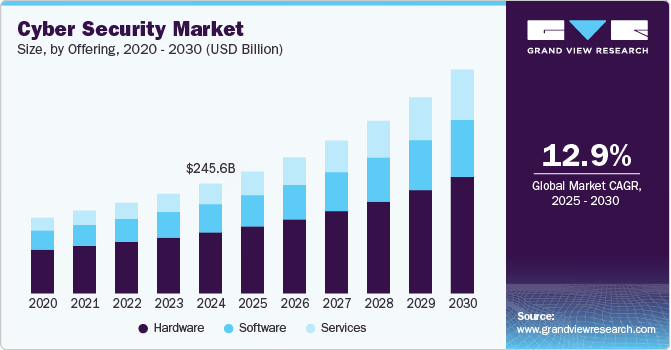
The rise of artificial intelligence creates new opportunities and challenges. While AI can enable sophisticated cyberattacks, it is also crucial in countering them. Companies that embed AI in their solutions are seeing their valuations rise.
The advantages of ETFs for investing in the cybersecurity sector
Investing through ETFs has several advantages in this technical sector:
- Removes the need to pick the winners in a field where technologies move fast. An ETF adjusts its portfolio to include promising new players.
- Protects against company-specific risk through diversification. A major breach can temporarily hit one company's share price, but an ETF spreads that risk across several companies.
- Fees: the sector's main ETFs charge between 0.35% and 0.69%, which makes the investment more accessible, especially for those without the technical expertise for in-depth fundamental analysis.
What are the best cybersecurity ETFs available in Europe?
L&G Cyber Security UCITS ETF (ISPY): the sector pioneer

With about €3.1 billion in assets under management (at 27 July 2026), ISPY has led the European cybersecurity ETF landscape since 2015. Its first-mover position gives it a clear liquidity advantage, something to weigh when entering and exiting positions.
Its diversified portfolio holds about 100 stocks, giving balanced exposure to the sector. Individual weights are capped at around 6%, with CrowdStrike (6.1%), Broadcom (5.8%) and Rubrik (5.6%) at the top. This approach avoids excessive concentration in a handful of giants while keeping significant exposure to market leaders.
The CrowdStrike incident of July 2024, which paralysed millions of computers worldwide, showed how critically we depend on these often invisible cybersecurity companies. From hospitals to airports, everything stopped, underlining how vital they are.
It does, however, charge 0.69% a year, among the highest in its category. Legal & General justifies that premium price by the depth of its research and its ability to identify emerging players in the sector.
iShares Digital Security UCITS ETF (LOCK): competitive fees

LOCK stands out for its broader take on digital security. It includes companies specialising in data-centre security and access control. That wider view translates into more balanced weightings than the sector average.
At a contained 0.40%, LOCK is among the lowest-cost options of the sector's large ETFs. Its dual listing (accumulating and distributing share classes) offers useful flexibility for investors with different income objectives.
First Trust Nasdaq Cybersecurity UCITS ETF (CIBR)

CIBR takes a more concentrated approach, with only around thirty holdings. That concentration shows up in larger individual weights: CrowdStrike accounts for 8.8% of the portfolio, followed by Broadcom at 7.8% and Palo Alto Networks at 7.7%.
The fund relies on the expertise of Nasdaq to select only companies deriving a significant share of their revenue from cybersecurity. This pure-play approach can amplify both gains and losses, making CIBR more volatile than its diversified peers.
WisdomTree Cybersecurity UCITS ETF (WCBR): Team8 expertise

WCBR stands out for its partnership with Team8, a think tank specialising in cybersecurity. That sector expertise shapes portfolio construction, favouring companies at the forefront of specific sub-sectors such as cloud security or authentication.
The fund balances innovation and stability with 40 to 50 holdings. Weights hover around 5% to 6% for the main positions such as CrowdStrike (6.0%), Zscaler (5.3%) and Fortinet (5.2%). Its moderate 0.45% fee puts it in the middle of the market.
The newcomers: Invesco Cybersecurity and other specialist ETFs

Invesco's arrival with ICBR marks a new step in opening up the sector. At just 0.35%, this new entrant offers some of the lowest fees on the market. Its approach uses artificial intelligence to identify the "core" players in cybersecurity.
The Cybersecurity & Data Privacy fund (CYBR, formerly Rize, now ARK Invest Europe, about €136 million in assets) stands out for its focus on data privacy, while L&G ASPY specifically targets innovation with a mid-cap tilt. These niche ETFs, though less liquid, can usefully complement a core cybersecurity allocation.
A comparison of the main characteristics:
| ETF | Assets (€M, at 27/07/2026) | Fees | Number of holdings | Distinctive feature |
|---|---|---|---|---|
| ISPY | ≈ 3,150 | 0.69% | several dozen | Pioneer, highly liquid |
| LOCK | ≈ 1,527 | 0.40% | ~100 | Broader approach |
| CIBR | ≈ 1,293 | 0.60% | ~40 | Concentrated pure-play |
| WCBR | ≈ 407 | 0.45% | ~25 | Team8 expertise |
| ICBR | ≈ 9 | 0.35% | ~50 | New, attractive pricing |
Interested in a broader investment strategy? Read our complete guide to World ETFs to diversify your portfolio beyond the cybersecurity sector.
How do you choose the best cybersecurity ETF for your portfolio?
To choose a cybersecurity ETF, compare above all the size of the fund (and therefore its liquidity), the annual fees, the number of holdings and how concentrated the largest positions are. No single criterion decides on its own: a low TER can be cancelled out by index tracking differences or by weaker liquidity.
Key criteria for selecting a strong cybersecurity ETF
Choosing a cybersecurity ETF is not just about comparing ratios. The cybersecurity ecosystem moves fast, and an ETF that performs well today can become obsolete without an adaptive index methodology.
Some investors go for the largest funds such as ISPY (about €3.1 billion in assets) or LOCK (about €1.5 billion). That approach can hide opportunities in smaller funds such as WCBR or CYBR. Smaller funds can have a different composition, at the cost of lower liquidity.
Fees and their impact on long-term performance
The impact of fees is crucial, but avoid jumping to conclusions. A TER (Total Expense Ratio, the ongoing annual charges) of 0.69% for ISPY may look high next to ICBR's 0.35%. That 0.34% gap has to be weighed against several factors:
- Large ETFs often offer tighter trading spreads, which can offset higher fees.
- Better index tracking quality can justify higher fees.
- Internal transaction costs vary with portfolio turnover.
Want to deepen your understanding of ETFs and investment strategies? Our complete guide will help you make informed decisions and optimise your portfolio.

Composition and diversification: which companies each ETF holds
Each ETF follows an investment philosophy that shows up in its composition. LOCK, for instance, includes data security and digital identity companies, while CYBR concentrates on companies specialising in privacy. ASPY bets on innovation with investments in emerging companies.
One often overlooked aspect is the concentration of holdings. For example, if CrowdStrike accounts for 8.8% of CIBR against only 2.9% of ICBR, news about that company will affect the two ETFs very differently.
Performance ratios to consider for the best cybersecurity ETFs
Beyond the Sharpe ratio, other sector-specific indicators matter. Beta against the Nasdaq-100 shows sensitivity to moves in the technology sector. The capture ratio shows how the ETF reacts to swings in the cybersecurity market.
One crucial point often ignored is the correlation with other technology holdings in your portfolio. A cybersecurity ETF may look like a diversifier, yet it can increase your exposure if you already hold significant investments in the technology giants.
Alignment between your investment strategy and the specific features of each ETF is essential.
The choice between a large ETF (more liquid) and a specialist ETF (more targeted) depends on each investor's strategy and profile.
Performance and outlook for cybersecurity ETFs
Comparing the historical performance of the best cybersecurity ETFs
Cybersecurity ETFs have grown impressively, with sharp rises and significant falls. ISPY, one of the first in the sector, showed a cumulative return of more than 300% since its launch in 2015 (source: JustETF, at 27 July 2026). Past performance is not a reliable indicator of future performance. These figures hide a more complex reality, though.
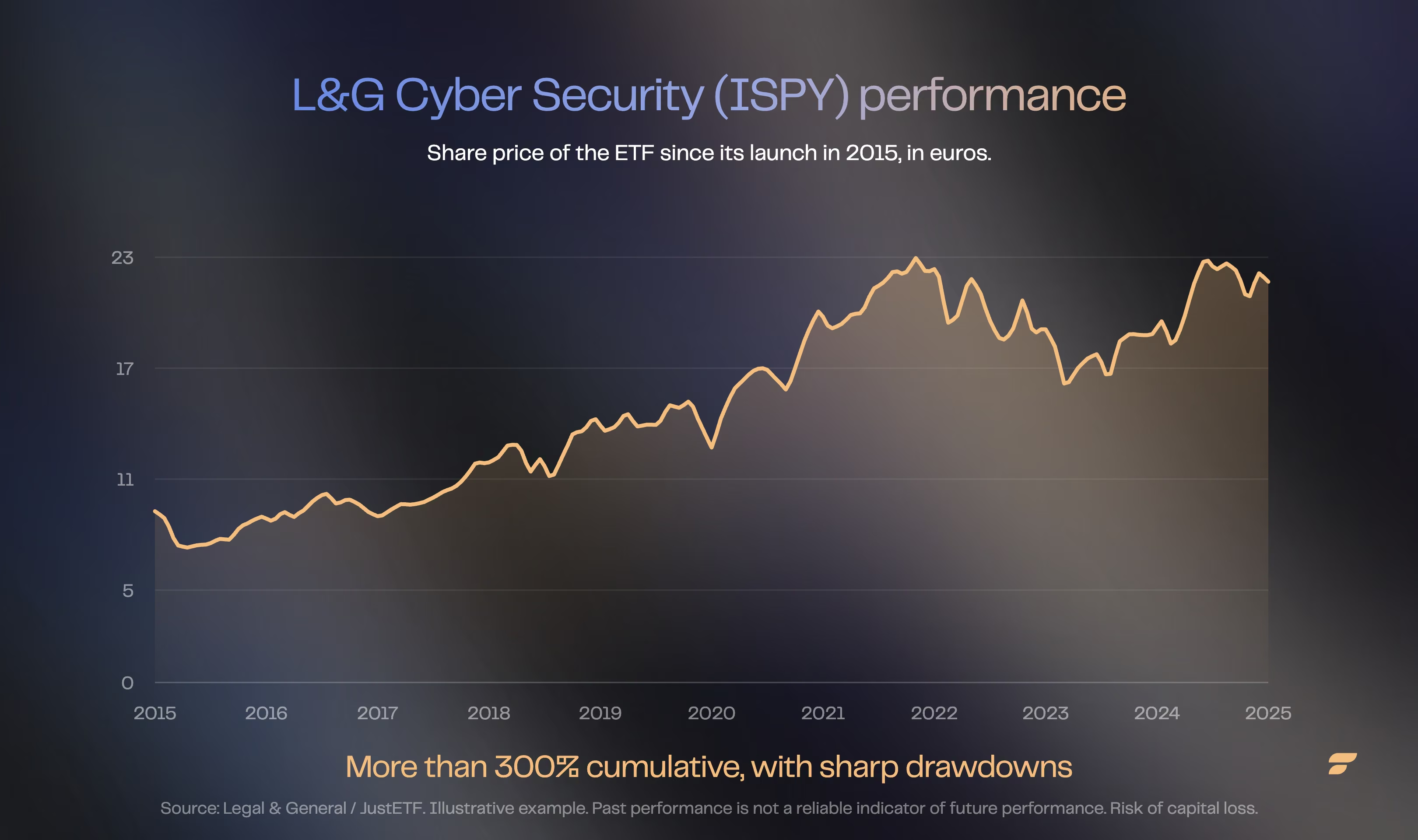
Volatility is a defining feature of these ETFs. In 2020, during the pandemic, ISPY and LOCK climbed more than 45%, driven by the accelerated shift to digital. In 2022, however, some funds saw their value drop by more than 30%.
Geographic breakdown and exposure to different markets
The United States dominates the cybersecurity market, but other regions matter too. ISPY and LOCK, for example, invest more than 80% in US companies, while CYBR holds about 12% Israeli companies in its portfolio.
That breakdown reflects the innovation ecosystem, where large US companies and innovative Israeli firms such as Check Point stand out. Japan, with companies such as Trend Micro, is also a key player.
The cybersecurity sub-sectors represented in the ETFs
Cybersecurity covers several sub-sectors, each represented differently across the ETFs. For example:
- LOCK concentrates on data-centre security.
- CYBR focuses on personal data protection.
- WCBR, influenced by Team8, emphasises disruptive innovation.
Future trends in the cybersecurity sector
Future cybersecurity trends revolve around two main themes:
- Artificial intelligence improves threat detection, as its growing use at Palo Alto Networks shows.
- Cloud computing is redrawing the boundaries of security, which explains the growing popularity of Zscaler.
These shifts feed directly into ETF performance. Funds such as ISPY and LOCK, with their diversified portfolios, are better equipped to handle the change.
How do you invest in cybersecurity ETFs from France?
From France, cybersecurity ETFs are bought through a securities account with an online broker; since none is eligible for the PEA, that wrapper remains the only route to the sector.
How to buy cybersecurity ETFs from France
To buy cybersecurity ETFs, you need to open a securities account with a broker. Platforms such as Degiro, Fortuneo or Trade Republic offer these ETFs with brokerage fees often below 1 euro per trade. Once the units are held, apps such as Finary let you track how these ETFs perform alongside the rest of your portfolio, across every broker.
The question of PEA eligibility for cybersecurity ETFs
At present, no cybersecurity ETF is eligible for the PEA. This restriction stems from the concentration of the cybersecurity sector's market capitalisation outside the European Union, with leaders based mainly in the United States or Israel, such as CrowdStrike and Palo Alto Networks.
It underlines the challenge for Europe of building global cybersecurity leaders, despite a few notable players, including Darktrace, which left the London market in late 2024 after its acquisition by Thoma Bravo.
Alternatives for investors looking for PEA-compatible exposure
To work around this limit, investors can consider several strategies:
- Invest in PEA-compatible European technology ETFs, which include cybersecurity companies such as Dassault Systèmes or Atos.
- A fraction (say 10% to 15%, purely for illustration) can be allocated to cybersecurity ETFs outside the PEA, with the rest kept in tax-advantaged wrappers.
- Combine both approaches for broader diversification.
Fitting a cybersecurity ETF into a diversified investment strategy
Adding cybersecurity ETFs to a portfolio has to match the investor's profile. Some investors consider, purely as an illustration and without personalised advice, an allocation of between 5% and 15%; every situation has to be assessed individually against its own risk profile.
Because of their high volatility, these ETFs are often used as a complement to a more stable core portfolio. Periodic rebalancing can be considered to keep a consistent target allocation.

Frequently asked questions
Can you hold a cybersecurity ETF in a PEA?
No. No cybersecurity ETF is eligible for the PEA, because the sector is dominated by US and Israeli companies. To get exposure, you have to use a securities account, whose gains are taxed under the standard French rules for securities.
Which cybersecurity ETF is the cheapest?
Among the large funds, Invesco Cybersecurity (ICBR) has the lowest fees, at 0.35% a year, against 0.69% for the pioneer L&G Cyber Security (ISPY). Lower fees, however, guarantee neither the best liquidity nor the best index tracking quality.
Are cybersecurity ETFs risky?
They are sector ETFs concentrated in technology stocks, so more volatile than a diversified global ETF. They fell by more than 30% in 2022, for example. Investing carries a risk of capital loss, and past performance is not a reliable indicator of future performance.
How much of a portfolio should go to cybersecurity?
There is no universal rule. Given their volatility, these ETFs are generally used as a complement to a diversified portfolio, often as a minority holding. Every allocation has to be set against your own horizon and risk profile, with no personalised advice implied.
Which cybersecurity ETF has the largest assets?
L&G Cyber Security (ISPY) remains the largest, with about €3.1 billion in assets at 27 July 2026, ahead of iShares Digital Security (LOCK). High assets support better liquidity and tighter bid-ask spreads, both when buying and when selling.
Cybersecurity: a growth bet to size carefully
For more active investors, building up units in ETFs such as ISPY or LOCK through monthly contributions can be one approach. That method (DCA) aims to smooth timing risk; it does not guarantee performance. The cybersecurity ETFs reviewed here point to a growing but volatile sector, whose future performance cannot be guaranteed.
Sources
France Travail, press release on the March 2024 cyberattack
Sophos, The State of Ransomware 2024: recovery costs and ransoms
JustETF, L&G Cyber Security UCITS ETF (ISPY) profile
JustETF, iShares Digital Security UCITS ETF (LOCK) profile
JustETF, First Trust Nasdaq Cybersecurity UCITS ETF (CIBR) profile
JustETF, WisdomTree Cybersecurity UCITS ETF (WCBR) profile
JustETF, Invesco Cybersecurity UCITS ETF (ICBR) profile
Regulatory disclaimers: Marketing communication. Investing carries a risk of partial or total capital loss. Past performance is not a reliable indicator of future performance. This article is provided for information and educational purposes only; it does not constitute personalised investment advice, a buy or sell recommendation, or tax advice. Before investing, read the Key Information Document (KID) and, where relevant, consult an authorised adviser. Finary SAS, an investment firm authorised by the ACPR (no. 19283), member of AMAFI. Insurance broker registered with ORIAS (no. 21001279), member of the CNCGP (association approved by the AMF). Crypto-Asset Service Provider (CASP) authorised by the AMF under the MiCA regime, references no. A2026-026 and no. N2026-008.