


World ETF: which are the best?

Updated on 31 July 2026
A World ETF is an index fund that tracks a global equity index, most often the MSCI World, and gives access in a single order to around 1,300 large companies across 23 developed countries. This guide compares the main World trackers, their fees and their wrapper: a securities account (CTO), a PEA (a French tax-advantaged equity savings account) or life insurance.

- Two index families dominate: MSCI (World, ACWI) and FTSE Russell (Developed, All-World), with different scopes and different country classifications.
- Three World trackers are PEA-eligible thanks to synthetic replication: iShares Swap PEA, Amundi PEA Monde and CW8.
- Management fees on World ETFs range from around 0.12% to 0.45% a year depending on the issuer and the wrapper.
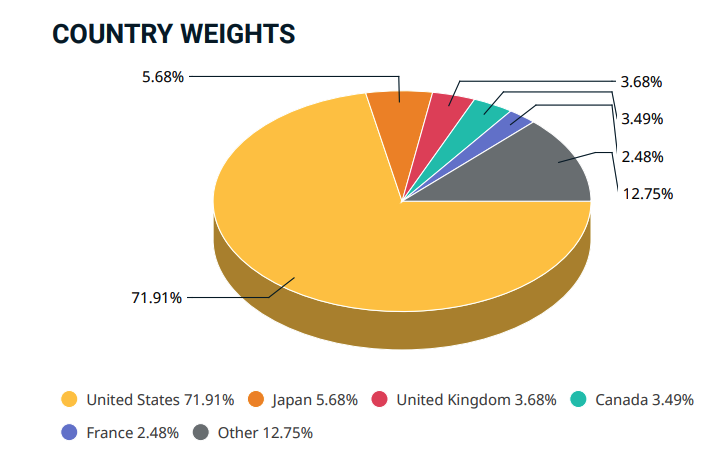
- The MSCI World remains heavily concentrated in the United States, which accounts for 72.45% of the index as at 30 June 2026.
- A World equity ETF carries a risk of capital loss, with no guarantee on the amount invested.
What is a World ETF?
An ETF is an index fund that mirrors the performance of a benchmark index and trades like a share. In a single order, you invest in every listed company inside the chosen index. It does not aim to beat its index, only to replicate it.
Given the number of companies involved, a World ETF diversifies your portfolio widely, which reduces both risk and management fees. Where the CAC 40 gives you access to 40 French companies, the MSCI World gives you close to 1,300, across 23 developed countries. It is most often held with a long-term horizon, in exchange for a risk of capital loss.

A World ETF also lets you buy, in effect, a stake in every holding in the index at once. You are then exposed neither to a single sector nor to a single region. That matters, because it again minimises your risk.
If you cannot tolerate volatility, a capital-protected product such as a euro fund may be a worthwhile alternative. A World ETF, by contrast, carries a risk of capital loss.
The most widely used global index is the MSCI World. According to the official index factsheet published by MSCI as at 30 June 2026, the MSCI World holds 1,283 constituents and covers around 85% of the free-float market capitalisation of each of the 23 developed countries it represents. The MSCI ACWI, which includes emerging markets, is also available; the FTSE Developed World and the FTSE All World are two further indices close to the MSCI World. Over 15 years, from June 2011 to June 2026, the index rose by more than 410% in gross returns (USD), around 11.5% a year. Past performance is not a reliable indicator of future performance.

What are the different types of World ETF?
The World ETF market is currently dominated by two players: MSCI (Morgan Stanley Capital International) and FTSE Russell (Financial Times Stock Exchange). Both are index providers: they design and calculate the stock market indices that ETFs replicate. MSCI is a US financial services company; FTSE Russell is a subsidiary of the London Stock Exchange Group.
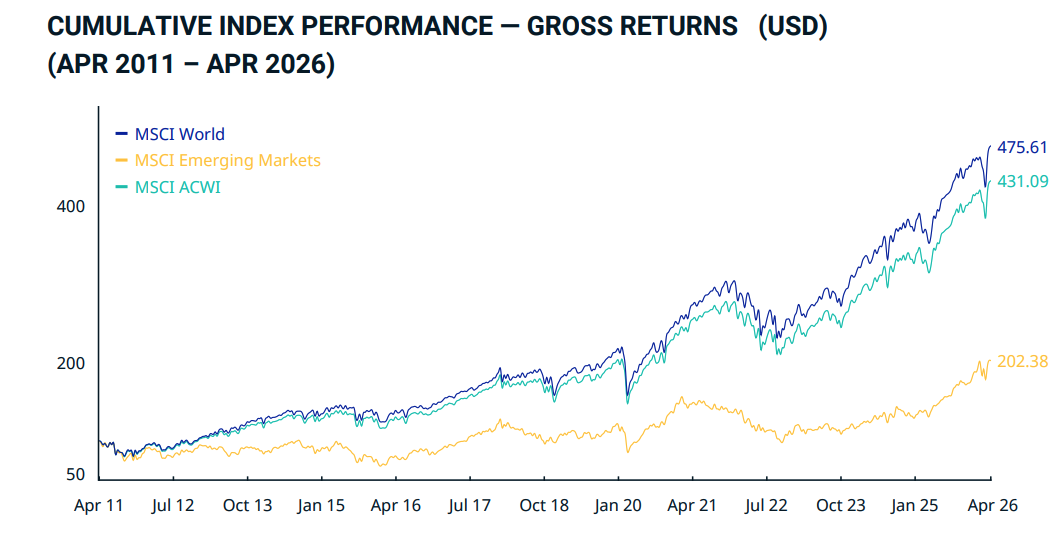
The two have one thing in common: they offer funds focused on the shares of developed countries, or on developed and emerging countries as in the chart above.
Developed-market World trackers
Whether it tracks the MSCI World or the FTSE Developed World, this kind of tracker bundles a set of holdings across 23 developed countries. MSCI gives access to 1,283 companies, with 72.45% exposure to the United States and 5.69% to Japan as at 30 June 2026. The index is therefore predominantly North American.
The FTSE Developed index gives access to 1,975 companies (large and mid caps) as at 30 June 2026. Asia weighs more heavily here, at around 10% (Japan, South Korea and Hong Kong).
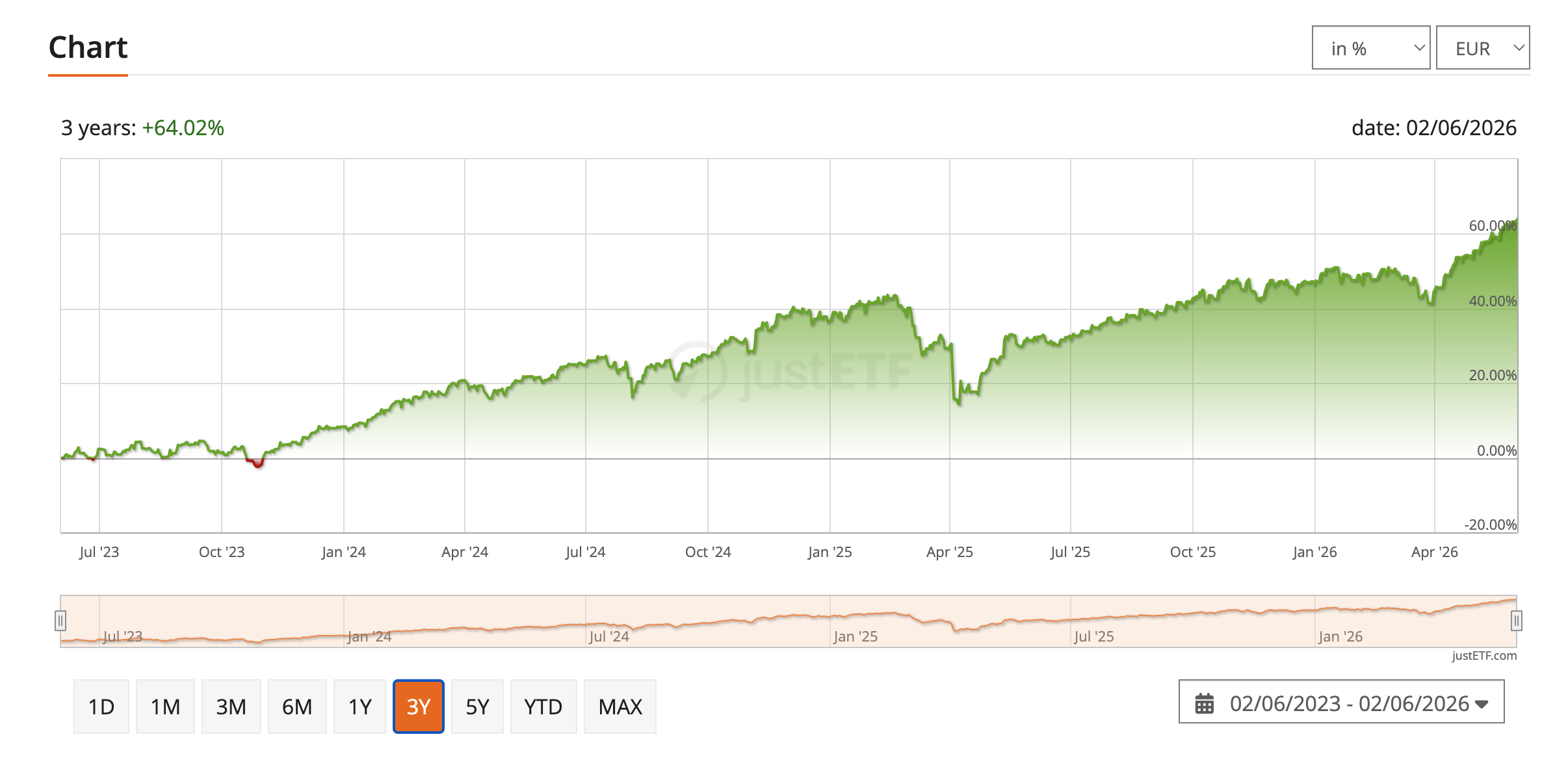
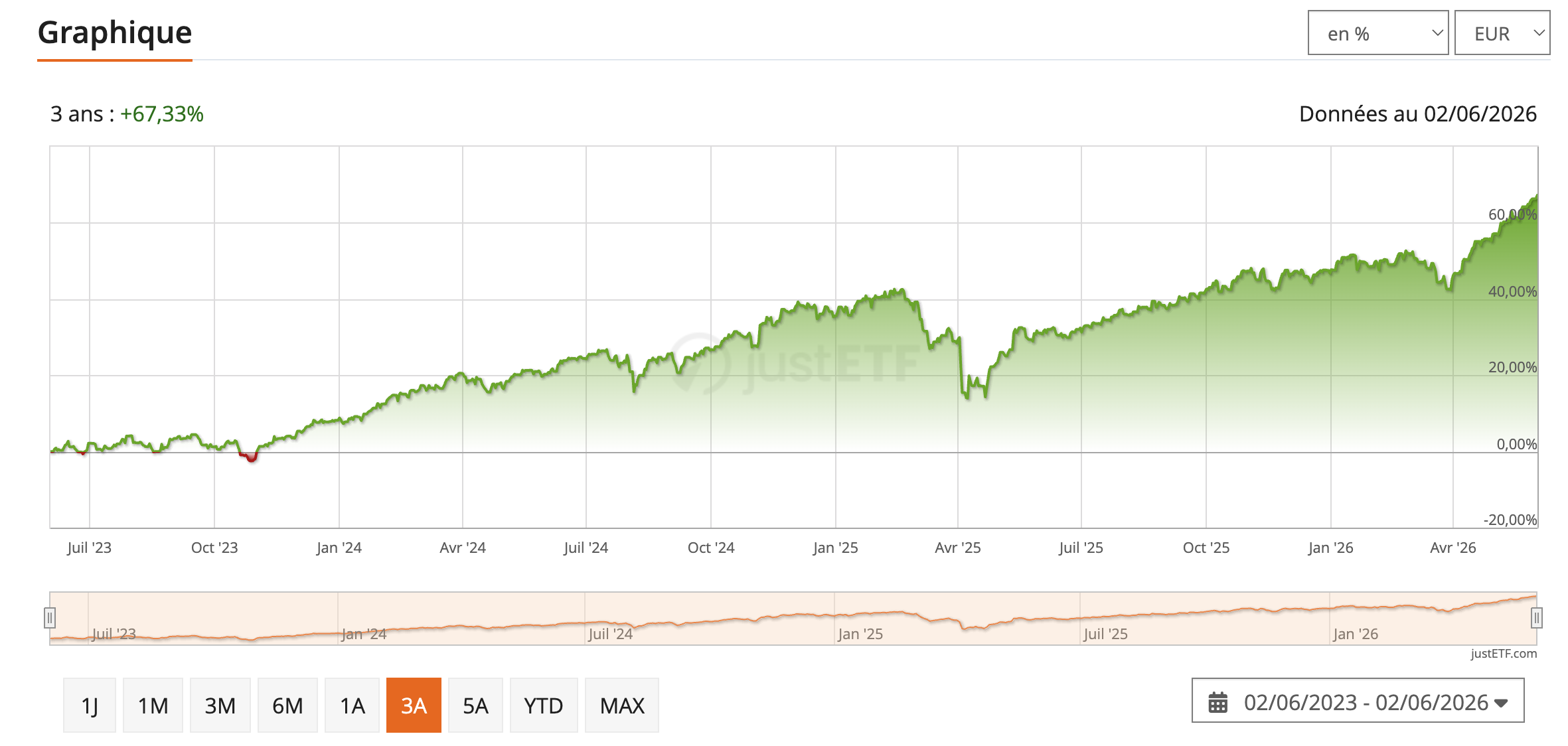
The performance of the MSCI World and of the FTSE Developed World is very close. Over the window from 2 June 2023 to 2 June 2026, in euros, the iShares Core MSCI World (IE00B4L5Y983) rose by +64%, almost 18% a year, against +67% for the Vanguard FTSE Developed World (IE00BKX55T58), around 18.7% a year. Past performance is not a reliable indicator of future performance. The gap stays small, since the two indices overlap heavily. They are therefore frequently used in dynamic wealth management, in exchange for a risk of capital loss.
Emerging-market World trackers
Emerging countries also have a role in global ETFs. At MSCI, two indices include those markets:
- the MSCI ACWI, which covers 23 developed countries plus 24 emerging countries (47 in total), in large and mid caps;
- the MSCI ACWI IMI, which covers the same geographic scope but adds small caps (smaller companies).
At FTSE, the FTSE All-World index is the equivalent of the MSCI ACWI: it holds 4,265 companies across 48 developed and emerging markets as at 30 June 2026.
The table below summarises the characteristics of each index, along with the available ETFs:
| Index | Currency | Region | Number of companies | Example ETF (ISIN) |
|---|---|---|---|---|
| MSCI World | EUR or USD | 23 developed countries | 1,283 | iShares MSCI World Swap PEA (IE0002XZSHO1) |
| MSCI ACWI | USD | 23 developed countries + 24 emerging countries | 2,461 | SPDR MSCI ACWI UCITS ETF (IE00B44Z5B48) |
| MSCI ACWI IMI | USD | 23 developed countries + 24 emerging countries | 8,195 (MSCI ACWI constituents + small caps) | SPDR MSCI ACWI IMI UCITS ETF (IE00B3YLTY66) |
| FTSE Developed | USD | Developed markets (FTSE classification) | 1,975 | Vanguard FTSE Developed World UCITS ETF (IE00BKX55T58) |
| FTSE All-World | USD | Developed + emerging markets (48 markets, FTSE classification) | 4,265 | Vanguard FTSE All-World UCITS ETF (IE00B3RBWM25) |
Sources: MSCI and FTSE Russell index factsheets as at 30 June 2026, justETF ETF factsheets accessed on 31 July 2026. The number of constituents changes at each review.
Good to know : trackers offer a wide variety of investment options well suited to the long term. Watch their composition and their currency: exchange rates affect a tracker's performance. Each provider also classifies countries differently. South Korea, for instance, is classified as a developed country by FTSE while it remains classified as an emerging country by MSCI following its June 2026 annual review.
Which wrapper for which World ETF?
A World ETF sits in one of three wrappers in France: the securities account (CTO), the most flexible, the PEA, tax-efficient after 5 years, or life insurance. So the choice comes down to a securities account (CTO), a PEA or life insurance?
The securities account (CTO) for a World ETF
Every World ETF is available through a securities account (CTO). It is the most flexible wrapper: it gives access to every tracker on the market, with no restriction on the replication method. You could, for instance, choose the iShares Core MSCI World (IE00B4L5Y983), valued for its low fees (0.20% a year), its deep liquidity and its €123 billion in assets as at 31 July 2026, a common choice for topping up once a PEA has reached its ceiling. Vanguard ETFs are also available and offer equivalent global exposure at even lower fees: 0.12% a year for the FTSE Developed World, 0.14% for the FTSE All-World. When positions are spread across several wrappers, apps such as Finary bring the tracking together, across all brokers.
The PEA for a World ETF
Several World trackers are PEA-eligible thanks to synthetic replication:
- iShares MSCI World Swap PEA (BlackRock, ISIN IE0002XZSHO1): 0.20% in management fees a year, unit price around €6.78 as at 30 July 2026.
- Amundi PEA Monde (MSCI World) (ISIN FR001400U5Q4): 0.20% in management fees a year as well, unit price around €6.00 as at 30 July 2026.
Both now charge the same fees (0.20%), among the lowest on the market.
The CW8, now marketed as the Amundi MSCI World Swap UCITS ETF EUR Acc (LU1681043599), is also PEA-eligible. It stands apart with higher fees (0.38% a year) and a much pricier unit (around €673 as at 30 July 2026). Older and very large, with €6.3 billion in assets, it is still widely held, but new investors often prefer these recent “PEA” versions, cheaper and easier to buy. All these ETFs use synthetic replication, a mechanism explained in the next paragraphs.
Life insurance for a World ETF
The range of World ETFs inside a life insurance policy depends on the policy and the insurer: some list a single World tracker, others several (iShares, Amundi, Vanguard and more). You therefore need to check your policy's list of unit-linked funds to see which are available. Like any unit-linked investment option, a World equity ETF carries no capital guarantee: its value moves up and down with equity markets, so it carries a risk of loss. Several of these ETFs, including some Amundi versions, work through synthetic replication.
within your reach
Non-contractual document for promotional purposes. Investment in unit-linked vehicles carries a risk of capital loss, since their value is subject to fluctuation, both upwards and downwards, depending in particular on developments in the financial markets. The insurer guarantees the number of unit-linked vehicles, not their value. The e-vie life insurance policy is an individual life insurance policy, denominated in euros and/or unit-linked vehicles, underwritten by Generali Vie, a company governed by the French Insurance Code. Finary SAS, 58 rue de Monceau 75380 Paris 8, Investment Firm authorised by the ACPR under no. 19283, member of AMAFI. Insurance broker registered with ORIAS under no. 21001279, member of the CNCGP (association approved by the AMF). Crypto-Asset Service Provider (CASP) authorised by the AMF under the MiCA regime, references no. A2026-026 and no. N2026-008.
Good to know : the wrapper for your ETFs should be chosen to fit your needs and your goals. Do not overlook the tax treatment of each one, nor the fees charged on buying market products outside the euro area. Both weigh on your portfolio's performance. The PEA stands out for its flexible taxation for a long-term investor (5 years minimum), but it does narrow your choice.
Does a World ETF guarantee enough diversification?
Largely yes: a World ETF gives exposure to around 1,300 companies in 23 developed countries, but real diversification also depends on the replication method. Every investor knows diversification is the cornerstone of a sound portfolio. An ETF curbs volatility while still tracking the index's return. You also keep brokerage fees down by buying one index rather than hundreds of individual shares, especially outside the European market.
Building a diversified portfolio means multiplying underlying assets across several regions. MSCI World ETFs, whose geographic breakdown is shown below, fit that purpose since they give access to every continent and every developed country.
However, the international composition of these trackers alone is not enough to guarantee optimal portfolio diversification. The replication method of global ETFs also matters. BlackRock PEA and Amundi PEA are synthetic ETFs: they hold highly liquid physical assets unrelated to the index, topped up by a “swap”, an exchange, with another financial counterparty. This type of replication is generally seen as the one that stays closest to the benchmark index.
The ETFs offered by Vanguard or SPDR use physical replication, but do not necessarily buy every security in an index. SPDR uses optimised physical replication, a sampling of securities designed to stay as close as possible to the index. The replication method can therefore affect how well diversified your portfolio really is, especially if the World ETF holds only part of the available securities.
Good to know : to get the most out of World ETFs, it is worth picking funds in developed countries without overlooking emerging ones, which account for a large share of global GDP. Including them in your portfolio gives you full exposure to those holdings while adding new regions. A synthetic ETF is often needed to reach those parts of the world. This diversification aims to spread risk better over the long term, with no guarantee of performance.
Frequently asked questions
Which is the best global ETF?
The iShares MSCI World Swap PEA and the Amundi PEA Monde both charge 0.20% a year, among the lowest for a World ETF inside a PEA. The choice then comes down to assets under management, replication quality and liquidity rather than fees.
Which World ETFs are PEA-eligible?
Several World ETFs are PEA-eligible thanks to synthetic replication: the iShares MSCI World Swap PEA (BlackRock) and the Amundi PEA Monde, both charging 0.20% in management fees, plus the CW8 (Amundi MSCI World) at 0.38%. A PEA normally accepts only the securities of companies headquartered in the European Union or the European Economic Area (EEA); synthetic replication works around that limit and delivers global exposure.
Why invest in a World ETF?
Trackers are an asset for anyone who wants to invest in the stock market at low cost. They are passively managed, inexpensive, and closely track their index. World ETFs also diversify your portfolio globally.
What are the fees on a World ETF?
Management fees (TER) on a World ETF generally range from 0.12% to 0.45% a year depending on the issuer and the wrapper. Add any brokerage fees charged by your intermediary and, inside life insurance, the policy's own fees. Over the long term, those gaps weigh on net performance.
Physical or synthetic replication for a World ETF: what is the difference?
Physical replication means actually holding the index's shares (sometimes a sample). Synthetic replication goes through a swap with a counterparty, which is what makes a World ETF PEA-eligible. Synthetic replication introduces counterparty risk, governed by the UCITS rules.
World ETF or S&P 500 ETF?
A World ETF offers global diversification across 23 developed countries, whereas an S&P 500 ETF concentrates on US large caps. Since the MSCI World is already around 72% exposed to the United States, the two overlap heavily, but the World version reduces dependence on a single market.
Sources
MSCI, MSCI World index factsheet as at 30 June 2026
MSCI, MSCI ACWI index factsheet as at 30 June 2026
MSCI, MSCI ACWI IMI index factsheet as at 30 June 2026
MSCI, developed and emerging market classification
FTSE Russell, FTSE All-World, FTSE Developed and FTSE Emerging index factsheet as at 30 June 2026
FTSE Russell, equity country classification
justETF, iShares Core MSCI World UCITS ETF factsheet (IE00B4L5Y983)
justETF, iShares MSCI World Swap PEA UCITS ETF factsheet (IE0002XZSHO1)
justETF, Amundi PEA Monde (MSCI World) UCITS ETF factsheet (FR001400U5Q4)
justETF, Amundi MSCI World Swap UCITS ETF EUR Acc factsheet, formerly CW8 (LU1681043599)
justETF, Vanguard FTSE Developed World UCITS ETF factsheet (IE00BKX55T58)
justETF, Vanguard FTSE All-World UCITS ETF factsheet (IE00B3RBWM25)
AMF, glossary: trackers or ETFs (Exchange Traded Funds)
AMF, ETF (Exchange Traded Funds) resource pages
Service-public.fr, plan d'épargne en actions (PEA)
Regulatory disclaimers: Marketing communication. Investing carries a risk of partial or total capital loss. Past performance is not a reliable indicator of future performance. This article is provided for information and educational purposes only; it does not constitute personalised investment advice, a buy or sell recommendation, or tax advice. Before investing, read the Key Information Document (KID) and, where relevant, consult an authorised adviser. Finary SAS, an investment firm authorised by the ACPR (no. 19283), member of AMAFI. Insurance broker registered with ORIAS (no. 21001279), member of the CNCGP (association approved by the AMF). Crypto-Asset Service Provider (CASP) authorised by the AMF under the MiCA regime, references no. A2026-026 and no. N2026-008.