Bitcoin ETF: The Complete Guide to Investing in 2026

Updated on 3 August 2026
A Bitcoin ETF is an exchange-traded fund that tracks the price of Bitcoin, so you can invest in it from an ordinary securities account without holding any cryptocurrency. In France, retail investors mostly reach it through European ETPs (Exchange Traded Products) or ETNs (Exchange Traded Notes), as US spot ETFs are largely out of their reach.

- Management fees range from 0.19% (Franklin EZBC) to 1.5% (Grayscale GBTC), averaging 0.25% at the main issuers.
- In France, capital gains on Bitcoin ETFs fall under the flat tax (PFU) at 31.4%, with no option to defer the tax, unlike buying cryptocurrency directly.
- The total spot Bitcoin ETF market stood at around $96 billion at the end of May 2026, driven mainly by BlackRock (IBIT) and Fidelity (FBTC).
- Spot Bitcoin ETFs physically hold bitcoin, unlike the older futures-based ETFs, which rely on derivative contracts.
What is a Bitcoin ETF, and where does the market stand in 2026?
A Bitcoin ETF is a listed fund that tracks the price of Bitcoin. From its launch in January 2024 the market grew to roughly $96 billion in total assets by May 2026, after a phase of heavy inflows followed by a correction since late 2025.
A new era for crypto investing
The story of Bitcoin ETFs turned decisively on 11 January 2024, when the SEC approved 11 spot Bitcoin ETFs at once.
That historic decision came after more than ten years of refusals, starting with the first application filed by the Winklevoss twins in 2013. BlackRock stood out in particular with its "IBIT" ETF, which set a record by gathering $3.5 billion in its first month of trading.
Fast, large-scale adoption
The success of spot Bitcoin ETFs was quickly confirmed. Close to $96 billion in assets is now under management across all the approved funds (source: SoSoValue, as at 27 May 2026).
BlackRock's iShares Bitcoin Trust currently leads the market with $59 billion in assets. The Fidelity Wise Origin Bitcoin Trust follows with $13.7 billion. These figures reflect institutional appetite for regulated Bitcoin exposure.
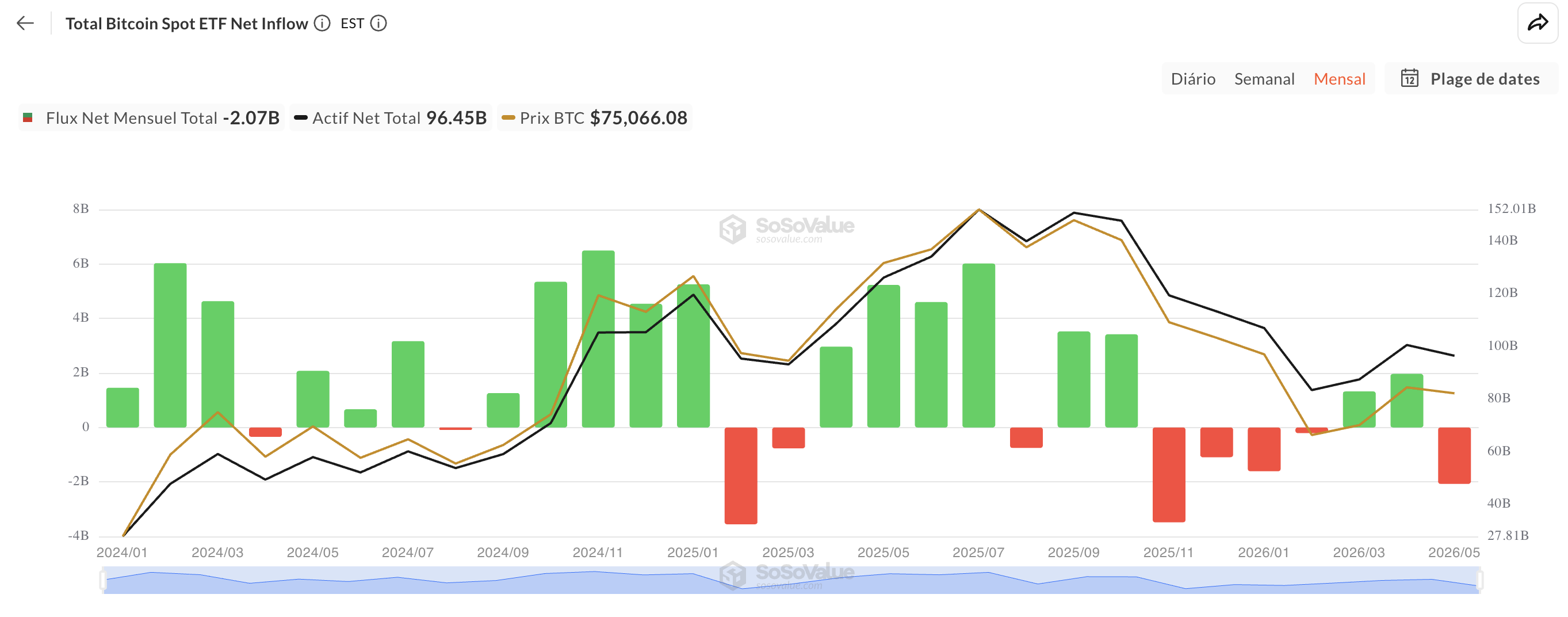
That momentum is clear from the way assets have moved since the SEC approved spot Bitcoin ETFs in January 2024. After a phase of continuous inflows that took the total above $150 billion in the summer of 2025, the market has been correcting since late 2025, bringing total assets back to around $96 billion in May 2026. Monthly flows now alternate between inflows and outflows, the sign of a more mature market that is more sensitive to the Bitcoin cycle.
Structure and mechanics
Spot Bitcoin ETFs differ from futures-based ETFs in that they must physically hold bitcoin. Unlike derivative products, these funds have to buy and sell Bitcoin on the market as investors move in and out.
Management fees vary widely. They run from 0.19% for the Franklin Bitcoin ETF to 1.5% for the Grayscale Bitcoin Trust. The average sits around 0.25% at the main players such as BlackRock and Invesco.
Impact on the crypto market
The arrival of Bitcoin ETFs marks traditional finance's first major move into the world of cryptocurrency.
ETF managers now have a direct interest in promoting Bitcoin, since their revenue is tied to management fees. That new dynamic could significantly influence the price of Bitcoin, although the first days of trading showed a moderate market reaction.
Bitcoin ETF or buying Bitcoin directly: what is the difference?
A Bitcoin ETF gives you a share in a regulated fund you can buy from an ordinary securities account, while buying directly gives you full ownership of the bitcoin but leaves you to secure it yourself. The table below compares the two approaches on five criteria.
| Criterion | Bitcoin ETF | Purchase on a centralised exchange | Self-custody via a hardware wallet |
|---|---|---|---|
| Ownership | A share of the fund | Full ownership | Full ownership |
| Platforms | Conventional trading platforms | Centralised exchange | Personal storage |
| Costs | Fees at every step | Few fees | No custody fees after purchase |
| Regulation & security | Oversight by financial regulators | Hacking risk, no regulation | Stronger security depending on use, outside regulation |
| Taxation | Standard capital-gains regime (31.4% with the flat tax) | Tax flexibility | Tax flexibility |

Buying process and accessibility
Investing in a Bitcoin ETF works much like buying traditional shares. A simple securities account is enough to reach these products through conventional brokerage platforms.
That simplicity contrasts with buying Bitcoin directly, which means opening accounts on specialist exchange platforms, setting up digital wallets and managing private keys.
Security and custody of the assets
Security is a fundamental difference between the two approaches. Bitcoin ETFs benefit from the institutional protection of regulated professional custodians.
Buying directly, by contrast, puts the responsibility for securing the assets on you. Losing your private keys can mean the bitcoin is gone for good, a different risk from the one ETFs carry.
Regulatory framework and tax implications
In France, Bitcoin ETFs are taxed under the standard regime for capital gains on securities, with a systematic 31.4% charge through the flat tax.
For more on this, we have written a full guide to cryptocurrency taxation.
Buying directly offers more tax flexibility. Investors can reinvest gains into stablecoins or other cryptocurrencies without triggering a taxable event, which is impossible with an ETF.
Cost structure
The fees attached to Bitcoin ETFs include annual management charges, ranging from 0.19% to 1.5%, on top of which come brokerage fees.
Buying directly mainly generates one-off transaction fees, often between 0.4% and 0.6%, with no recurring holding cost (those fees vary a great deal from one platform to another). Over the long run, direct investment can therefore work out cheaper.
Liquidity and ease of trading
Bitcoin ETFs offer liquidity comparable to traditional shares, with trading possible only during market hours.
Bitcoin held directly trades 24/7 on exchange platforms, but liquidity can vary significantly from one platform and trading pair to another.
Control and use of the assets
Holding a Bitcoin ETF does not let you use the cryptocurrency itself for transactions. Investors who hold Bitcoin directly keep full control of their assets, free to transfer, trade or spend them as they see fit.
Market impact
Bitcoin ETF managers have to buy and sell bitcoin in line with investment flows, creating a new market dynamic.
That institutional influence could gradually dilute the decentralised character of Bitcoin, originally designed as an alternative to the traditional financial system.
The different types of Bitcoin ETF available
Spot Bitcoin ETFs: the new benchmark
Spot Bitcoin ETFs are the most direct form of Bitcoin exposure through traditional markets. These products physically hold bitcoin, unlike their futures-based counterparts.
BlackRock dominates this segment with its iShares Bitcoin Trust (IBIT), charging 0.25% in management fees on $59 billion of assets under management. Fidelity is close behind with its Wise Origin Bitcoin Trust (FBTC), running $13.7 billion at management fees in line with IBIT, at 0.25%.
Futures-based Bitcoin ETFs: the forerunners
Before spot ETFs were approved, futures-based ETFs were the only regulated option in the United States. These products rely on futures contracts rather than on holding Bitcoin directly.
That structure spares issuers the challenges of crypto custody. It does, however, add risks tied to rolling the contracts and to potential divergence from the spot price of Bitcoin.
Bitcoin ETNs: the European answer
Across Europe, Exchange Traded Notes (ETNs) are a popular alternative. These unsecured debt securities track the price of Bitcoin without necessarily holding the underlying asset.
That feature sets them fundamentally apart from spot ETFs. Investors have to trust the solvency of the issuer to underpin the value of their investment.
Bitcoin ETPs: the regulatory middle ground
Exchange Traded Products are a broader category covering various types of Bitcoin-linked financial instrument.
In Europe, the Physical Bitcoin ETP from Bitwise (formerly ETC Group) has become one of the largest products of its kind, fully backed by physical assets, subject to issuer risk. These products are listed on several regulated European exchanges.
How to choose and invest in a Bitcoin ETF
Choosing a Bitcoin ETF rests mainly on three criteria: management fees, the size of assets under management and replication quality (tracking error), before opening a securities account with a broker offering the equivalent European products (ETPs, ETNs).
The essential selection criteria
Choosing a Bitcoin ETF starts with the management fees. The Franklin Bitcoin ETF stands out with the lowest rate on the market at 0.19%, while the Grayscale Bitcoin Trust charges 1.5%.
The size of assets under management is another crucial indicator. BlackRock runs $59 billion through IBIT, which points to strong liquidity and investor confidence. Tracking error is another decisive factor, measuring how precisely the ETF replicates the price of Bitcoin.
Investment platforms available in France
Access to US spot Bitcoin ETFs is generally restricted for EU retail investors because of the PRIIPs regulation (Packaged Retail and Insurance-based Investment Products, which requires a key information document for products sold to European retail investors). European alternatives (ETPs, ETNs) are available through traditional brokers. These platforms let you buy ETF shares as easily as shares, straight from an ordinary securities account.
The process calls for no technical knowledge of cryptocurrency, unlike buying Bitcoin directly on specialist exchanges.
The buying process, step by step
Buying a Bitcoin ETF starts with opening a securities account at an authorised broker. Once the funds are deposited, the investor can place limit orders during market hours, generally between 9:30 a.m. and 4:00 p.m. on US exchanges.
For more detail, here is our in-depth guide to buying ETFs.
The purchase price is the market value of the ETF at the moment of execution, plus any brokerage fees.
Analysing the total cost
The total cost of owning a Bitcoin ETF goes beyond the headline management fee. Brokerage fees apply on every buy or sell.
The bid-ask spread, the gap between the buying and the selling price, is a further hidden cost. Over a year, an investment in the BlackRock ETF with 0.25% fees and two transactions will cost around 0.35% once brokerage fees are included.

Recommended investment strategies
Investing in a Bitcoin ETF can fit into a regular investment strategy (known as DCA). Buying small amounts on a regular basis smooths out the impact of Bitcoin volatility.
Scheduled orders make that disciplined approach easier. To keep costs down, favour the ETFs with the lowest management fees and trade less often, so that brokerage fees weigh less.
French tax considerations
In France, gains on listed ETFs are generally subject to the flat tax (PFU) of 31.4%; taxation depends on your situation and may change. That rate follows the increase in the social-contribution share of the flat tax on 1 January 2026 (it was 30% before), as the Ministry of the Economy states on service-public.gouv.fr.
This differs from the treatment of Bitcoin bought directly, which is more flexible. Investors must declare their gains in their annual income tax return (form 2042 and its capital-gains schedule), with no scope for tax optimisation through deferral strategies.
Monitoring and rebalancing the portfolio
The performance of a Bitcoin ETF calls for regular monitoring. Tracking error against the spot price of Bitcoin should be watched to make sure the product is doing its job.
Rebalancing follows the target allocation set at the outset and the way the relative value of Bitcoin moves within the overall portfolio.
Tools such as Finary let you follow the performance of a Bitcoin ETF alongside your other assets (shares, cryptocurrencies, real estate) in one place, which makes that monitoring and rebalancing easier.
The main Bitcoin ETFs on the market
The US giants dominate the market

BlackRock is among the largest players by assets with its iShares Bitcoin Trust (IBIT). Its $59 billion of assets under management and competitive 0.25% fee make it the market benchmark.

Fidelity completes the leading pair with its Wise Origin Bitcoin Trust (FBTC): $13.7 billion of assets under management at fees in line with IBIT, at 0.25%. These two major players alone account for more than half of the assets invested in spot Bitcoin ETFs.
The innovative challengers
ARK 21Shares charges 0.21%. Its ETF (ARKB) runs $2.48 billion of assets under management, showing the appeal of a lean cost structure.
Franklin Templeton, for its part, offers the lowest fees on the market with its EZBC ETF at 0.19%, although its assets under management remain more modest at $435 million.
The transformation of Grayscale

The Grayscale Bitcoin Trust (GBTC), a pioneer of institutional Bitcoin investing, still holds a significant position with $10.99 billion in assets.
Its high 1.5% management fee, however, contrasts sharply with the new generation of ETFs. Its tracking error of +26.59 basis points is also the largest on the market.
The European players
WisdomTree stands out in the European market with its Bitcoin Trust (BTCW). Its management fee is 0.25%, temporarily cut to 0.15% until 31 December 2026, which positions it well against its US competitors. Its listing on the Swiss Exchange makes it more accessible to European investors.
Comparing the products
The table below summarises the key features of the main Bitcoin ETFs:
| ETF | Fees | Assets ($bn) | Tracking error | |
|---|---|---|---|---|
| IBIT | 0.25% | 59.48 | +1.05 bps | |
| FBTC | 0.25% | 13.69 | - | |
| ARKB | 0.21% | 2.48 | - | |
| GBTC | 1.5% | 10.99 | +26.59 bps | |
| EZBC | 0.19% | 0.435 | 0.0158% |
Source: SoSoValue, data as at 27 May 2026.
Regional availability
Availability of these ETFs varies significantly by region. US spot ETFs remain out of reach for European investors, who have to turn to local alternatives such as ETPs or ETNs.
That geographic segmentation directly shapes which products are available and underlines how important it is to understand the regulatory restrictions specific to each market.
Advantages and drawbacks of Bitcoin ETFs
The main benefits for the investor
Accessibility is the chief advantage of Bitcoin ETFs. You invest through a traditional securities account, avoiding the technical complexity of crypto platforms.
Institutional security adds a layer of protection, as the assets are held by regulated professional custodians. Liquidity during market hours and price transparency also reassure traditional investors.
The specific risks to weigh
Counterparty risk remains, even with reputable issuers. Should an ETF provider fail, the liquidation process can prove long and complex.
Operational disruptions can temporarily affect trading or the valuation of the assets. Synthetic ETFs that use derivatives carry additional risks if their counterparties run into financial difficulty.
The European framework has also been strengthened by the MiCA regulation (Markets in Crypto-Assets), which has applied to crypto-asset service providers in France from 2024 to 2026 depending on the chapter. Finary, for example, obtained its Crypto-Asset Service Provider authorisation from the AMF in July 2026 (AMF white list of crypto-asset service providers). That framework governs the authorisation of crypto-asset issuers and service providers at European level, without changing the tax treatment of Bitcoin ETFs themselves.
Tax impact in France
The taxation of Bitcoin ETFs in France lacks flexibility. The systematic 31.4% flat tax on gains contrasts with the optimisation that direct investment allows.
Being unable to reinvest gains without triggering a taxable event limits tax-management strategies. The mandatory entry in the annual income tax return adds a further administrative constraint.
The decentralisation question
The mass arrival of Bitcoin ETFs raises fundamental questions about the decentralised nature of Bitcoin. The growing influence of traditional financial players could gradually reshape market dynamics.
ETF managers, driven by revenue tied to management fees, are becoming major players in promoting and shaping Bitcoin.
How the institutional market is evolving
The integration of Bitcoin into traditional finance through ETFs marks a new phase of maturity. The impressive inflows into the first spot ETFs show the appetite of institutional investors.
Some analysts believe that shift could influence price dynamics and bring wider recognition of Bitcoin as an asset class in its own right.
What lies ahead
The expansion of the Bitcoin ETF market opens the way to new products. Growing interest in Ethereum ETFs and other cryptocurrencies points to a wider range on offer in future.
Regulatory change and the potential harmonisation of legal frameworks across regions could also make these products easier to access globally.
Bitcoin ETFs are a major step forward in making cryptocurrency accessible to traditional investors, with total assets above $96 billion according to SoSoValue (data as at 27 May 2026).
While these products offer simplified Bitcoin exposure through familiar investment vehicles, investors should weigh their objectives carefully, understand the tax implications and consider the wider impact on the crypto ecosystem before choosing between a Bitcoin ETF and direct investment.
Frequently asked questions
What is a Bitcoin ETF?
A Bitcoin ETF is an exchange-traded fund that tracks the price of Bitcoin, either by holding the cryptocurrency directly (spot ETFs) or through futures contracts. It lets you invest from an ordinary securities account, with no crypto wallet to create and no private keys to manage.
Can you buy a US spot Bitcoin ETF from France?
Access to US spot Bitcoin ETFs such as IBIT or FBTC is generally restricted for European Union retail investors because of the PRIIPs regulation, which requires a UCITS-compliant key information document. European investors therefore turn to equivalent ETPs or ETNs, such as those from Bitwise or WisdomTree.
How are Bitcoin ETFs taxed in France?
Gains on a listed Bitcoin ETF fall under the regime for capital gains on securities, taxed at the flat rate (PFU) of 31.4% (12.8% income tax and 18.6% social contributions), with no deferral option, unlike buying cryptocurrency directly.
Bitcoin ETF or buying Bitcoin directly: which is the better option?
It depends on your profile: a Bitcoin ETF offers simplicity and institutional security through an ordinary securities account, with recurring management fees of 0.19% to 1.5%. Buying directly gives you full control of the assets and more tax flexibility, but you have to secure your own private keys.
What criteria should you use to compare Bitcoin ETFs?
The three main criteria are annual management fees, assets under management, which reflect liquidity, and tracking error, which measures how precisely the price of Bitcoin is replicated. The fund domicile and its regulatory eligibility in Europe matter too.
Are Bitcoin ETFs risky?
As with any investment in volatile assets, Bitcoin ETFs carry a risk of partial or total capital loss. On top of that come counterparty risk tied to the issuer or the custodian and, for synthetic products, an additional risk should the counterparty fail.
Sources
Service-public.fr, Entreprendre: the flat tax (PFU) rises to 31.4% on 1 January 2026
SoSoValue, dashboard of flows and assets of US spot Bitcoin ETFs
BlackRock, iShares Bitcoin Trust ETF (IBIT) product page
AMF, white list of crypto-asset service providers, Finary SAS entry
WisdomTree, WisdomTree Physical Bitcoin (BTCW) product page
Impots.gouv.fr, income tax return form no. 2042
Regulatory disclaimers: Marketing communication. Investing carries a risk of partial or total capital loss. Past performance is not a reliable indicator of future performance. This article is provided for information and educational purposes only; it does not constitute personalised investment advice, a buy or sell recommendation, or tax advice. Crypto-assets are highly volatile and carry a risk of total capital loss. They are covered by no capital guarantee, and by no deposit-guarantee or investor-compensation scheme. Before investing, read the Key Information Document (KID) and, where relevant, consult an authorised adviser. Finary SAS, an investment firm authorised by the ACPR (no. 19283), member of AMAFI. Insurance broker registered with ORIAS (no. 21001279), member of the CNCGP (association approved by the AMF). Crypto-Asset Service Provider (CASP) authorised by the AMF under the MiCA regime, references no. A2026-026 and no. N2026-008.