Top Japan ETFs for a PEA and a brokerage account in 2026

Updated on 17 July 2026
The Amundi PEA Japon TOPIX (FR0013411980) is the only Japan ETF eligible for a PEA (a French tax-advantaged equity savings account) in 2026. In a CTO (an ordinary French brokerage account), the iShares Core MSCI Japan IMI and the Amundi Prime Japan give broad exposure from 0.05% in annual fees.
Many French investors still concentrate their portfolio on the United States, while the Japanese market is going through a deep economic transformation. Toyota, Sony and Keyence illustrate that shift towards industrial and technological innovation.

- Four indices dominate the Japanese market: the TOPIX, the Nikkei 225, the MSCI Japan and the JPX-Nikkei 400, each with a different weighting method.
- Hedging currency risk (yen/euro) costs around 0.28% in extra annual fees, but protects against a fall in the yen.
- Japan accounts for about 5% of global market capitalisation: a 5% to 10% portfolio allocation is usually enough to capture its potential.
- In a CTO, physical ETFs domiciled in Ireland or Luxembourg give access to the Japanese market with no cap, unlike the PEA, which is capped at €150,000.
Understanding Japanese stock market indices

Topix: the index that best represents the Japanese market
The Topix gives an overview of the Japanese market. It is not limited to large industrial or technology companies. It also includes lower-profile but dynamic firms.
Its free-float market-cap weighting closely mirrors the reality of the market. Unlike some European indices, the Topix prevents a handful of large companies from driving the trend.
It therefore offers a balanced split between industry, consumer goods and technology. To invest in Japan without a sector bias, the Topix offers a diversified approach.
Nikkei 225: the index of Japan's 225 largest companies
The Nikkei 225 remains the most widely covered index. It brings together 225 large Japanese companies, but its weighting method is surprising: it is based on share prices, not on real economic weight.
A high-priced share can therefore weigh heavily in the index, even if the company is modest in size.
Fast Retailing, for instance, sometimes takes a disproportionate share, ahead of giants such as Toyota. This method means less diversification and market moves that are at times hard to anticipate.
MSCI Japan: a popular index for ETFs
The MSCI Japan attracts many international investors. It covers about 85% of the Japanese market, focusing on large and mid caps.
Its free-float market-cap weighting ensures a faithful representation of the market. The MSCI Japan fits easily into a global geographic allocation, alongside indices such as the MSCI Europe or the MSCI USA.
ETFs often use it for its liquidity, its transparency and its ability to move with the Japanese economy. Investors looking for simplicity and robustness value it in particular.
JPX-Nikkei 400: the index focused on profitability and governance
The JPX-Nikkei 400 stands out for its selection criteria. It looks not only at company size, but also at profitability, governance and transparency.
The index rewards companies that adopt sound management practices and attract foreign capital. Launched in 2014, it acts as a mark of excellence for Japanese companies.
Which Japan ETFs are eligible for a PEA?
In 2026, the Amundi PEA Japon (TOPIX) UCITS ETF (FR0013411980) is the only Japan ETF genuinely eligible for a PEA. Its synthetic replication lets it track the TOPIX while meeting the 75% European-securities quota required by PEA rules.
Amundi PEA Japan Topix ETF

The range of Japanese ETFs eligible for a PEA (Plan d’Épargne en Actions, the French tax-advantaged equity savings account) remains very limited. The Amundi PEA Japan Topix (FR0013411980) stands out as the obvious reference.
This fund does not hold Japanese shares directly. It uses synthetic replication: the ETF holds a basket of European shares and swaps their performance for that of the TOPIX.
Thanks to this mechanism, French investors gain the performance of the Japanese market while complying with the rules of the PEA. The TOPIX brings together the largest companies on the Tokyo Stock Exchange, such as Toyota, Sony and Mitsubishi UFJ, plus a wide range of industrial and technology groups.
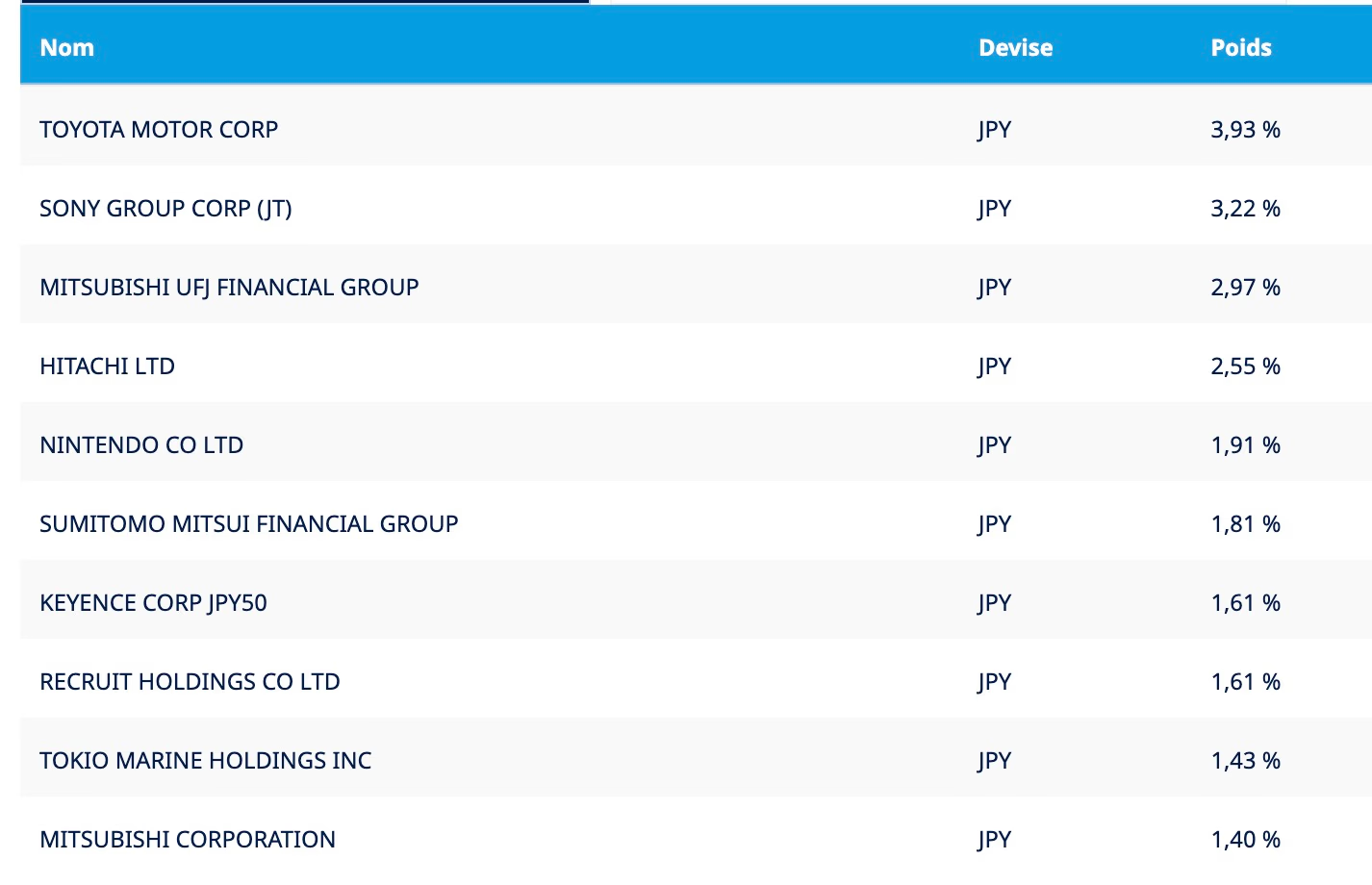
The Amundi ETF therefore gives diversified exposure, without overweighting any single sector.
Management fees come to 0.20%. That level stays competitive for a synthetic ETF, especially in a segment where there is almost no competing product.
Amundi PEA Japan Topix ETF - Daily Hedged EUR
To limit the impact of yen swings, the “Daily Hedged EUR” version (FR0013411998) applies daily currency hedging. This option protects the portfolio against adverse moves between the euro and the yen.
Currency hedging brings annual fees of 0.48%. That cost may look high, but it pays for the protection offered. Over the past five years, the yen’s fall against the euro has heavily penalised unhedged ETFs.
As at 17/07/2026, the hedged version showed a 5-year performance of +142.24%, against +61.91% for the unhedged version (source: JustETF), which says nothing about future moves. If the yen strengthens, however, hedging means missing out on that move.
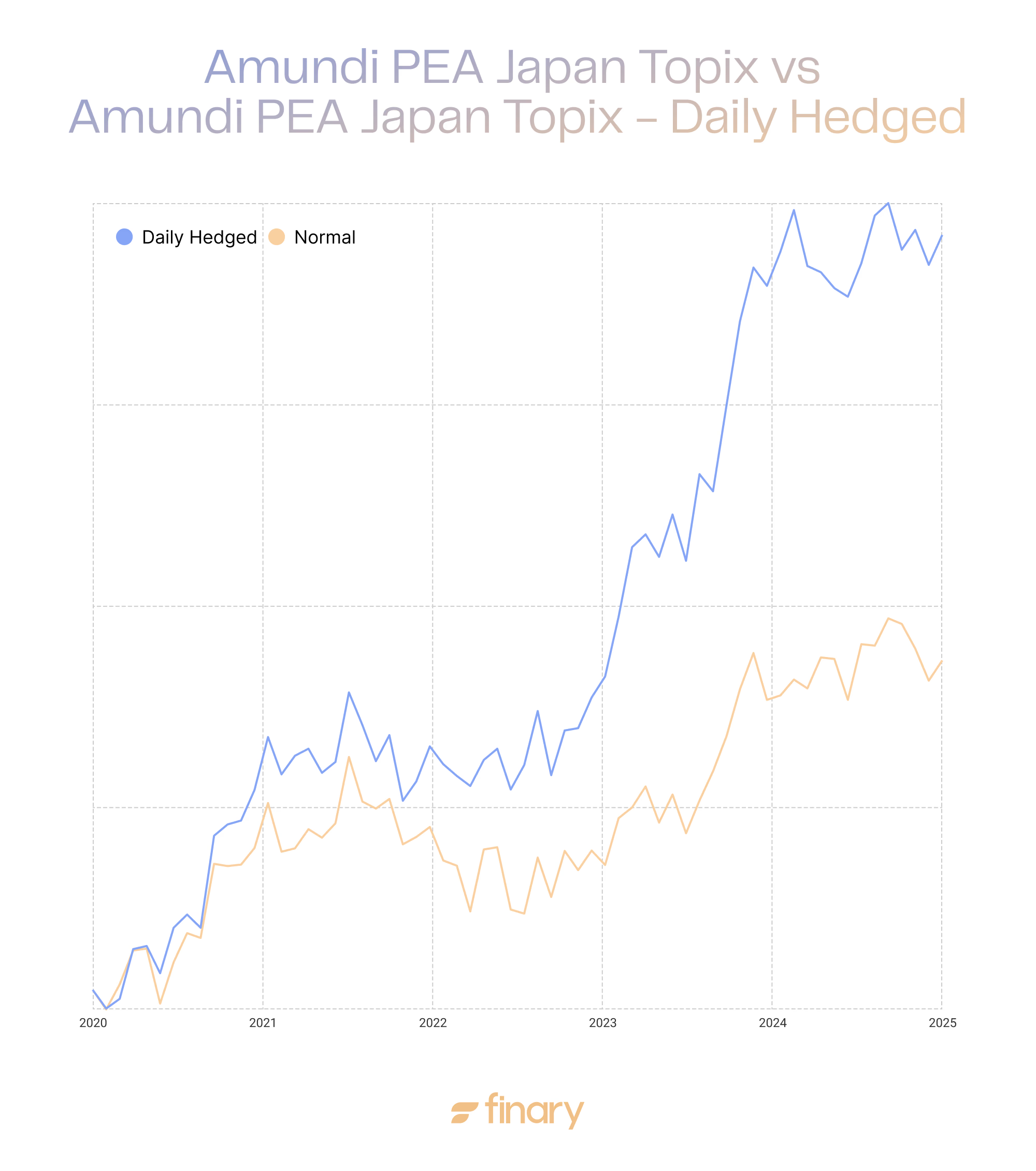
The fund remains modest in size, around €61 million. That can limit liquidity, but for a retail investor the spread generally stays reasonable.
Synthetic replication makes it possible to invest outside Europe through a PEA, but it exposes the investor to counterparty risk. If the ETF’s partner bank runs into trouble, the index performance may not be delivered in full. This risk is limited and regulated, but it is not zero.
Managing currency risk remains a personal choice. Some investors prefer direct exposure to Japanese shares. Others would rather avoid currency swings to limit exchange-rate volatility. There is no universal solution, only the one that fits your profile.
Want to diversify your portfolio further internationally? Explore our full guide to emerging market ETFs to complement your Asian exposure.

Which are the best Japan ETFs for a CTO?
For a brokerage account, physical ETFs such as the iShares Core MSCI Japan IMI, the Amundi MSCI Japan or the Amundi Prime Japan give broad exposure to the Japanese market, with management fees of between 0.05% and 0.12% a year.
iShares Core MSCI Japan IMI UCITS ETF

The iShares Core MSCI Japan IMI (ISIN: IE00B4L5YX21) offers very broad exposure to the Japanese market. The fund is not limited to large companies: it also includes mid and small caps, covering nearly 99% of the investable market.
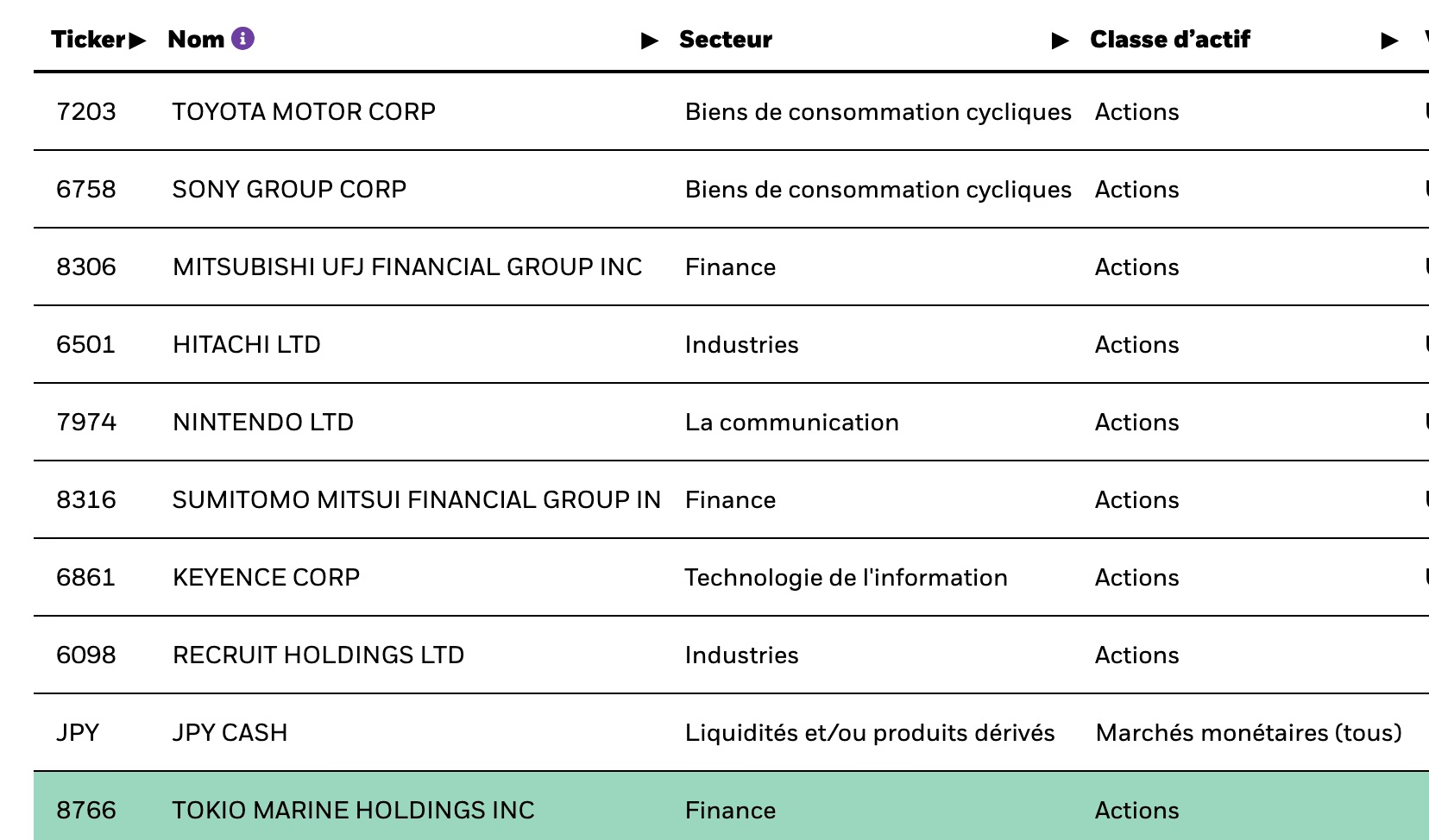
This approach captures the momentum of smaller Japanese companies, often absent from narrower indices. Over the long term, they can offer unexpected growth opportunities.
With a TER of 0.12%, the fund combines broad coverage and efficiency. Its size, over €7 billion under management, ensures excellent liquidity, even in periods of heavy trading. It may suit investors looking for broad market coverage.
Amundi MSCI Japan UCITS ETF
The Amundi MSCI Japan (ISIN: LU1781541252) targets large and mid caps, about 85% of the market. That choice reduces exposure to the most volatile companies while keeping solid sector diversification.
Its 0.12% TER puts the fund among the low-cost options. Amundi, a European manager, offers a credible alternative to the Anglo-American giants. For French residents, dividend taxation can prove more favourable.
The fund suits investors who want to avoid the dispersion of micro caps without sacrificing performance.
To learn more about the profitable investment options that can sit alongside your Japanese ETFs, read our guide to the main types of financial investment.
Xtrackers MSCI Japan UCITS ETF

The Xtrackers MSCI Japan (ISIN: LU0274209740) stands out for full physical replication and a high level of transparency. Fees of 0.12% and high liquidity reassure even institutional investors.
The fund is aimed at investors who prefer direct exposure, without synthetic replication. Xtrackers’ German management brings a rigour that investors value.
One point to note: the dividend distribution policy varies by share class, which makes it possible to adapt the tax strategy to your needs. For investors who want a simple long-term solution, Xtrackers offers peace of mind.
Vanguard FTSE Japan UCITS ETF

The Vanguard FTSE Japan UCITS ETF (ISIN: IE00BFMXYX26) shows a TER of 0.10%, among the lowest in this comparison. It offers strictly passive management, with full physical replication.
The FTSE Japan index, less widespread than the MSCI, has a different composition, at times more focused on certain industrial sectors. Vanguard favours simplicity and transparency, true to its reputation.
The fund attracts investors who want to diversify their exposure to Japan using an alternative approach.
Xtrackers Nikkei 225 UCITS ETF 1D
The Nikkei 225, often compared to the Dow Jones, remains an emblematic Japanese index. The Xtrackers Nikkei 225 UCITS ETF (ISIN: LU0839027447) gives access to the main Japanese blue chips, with one quirk: weighting by share price, not by market capitalisation.
This method gives some companies a large weight, which can amplify volatility. With a TER of 0.09%, the fund is among the cheapest on the market.
It suits investors who want a more tactical strategy or who want to bet on the big Japanese brands. Sector concentration and the weighting method do, however, call for particular care when adding it to a portfolio.
Amundi Prime Japan UCITS ETF
The Amundi Prime Japan comes in two share classes: distributing (LU1931974775, €2.6 billion in assets) and accumulating (LU2089238385, €627 million in assets). Both carry ultra-competitive management fees of 0.05%.
It tracks the Solactive GBS Japan Large & Mid Cap index, a proprietary index with little media coverage that nonetheless offers broad exposure and robust sector diversification.
The fund particularly appeals to investors who watch fees closely.
Its growing size shows clear interest, especially among younger investors looking for simplicity and efficiency.
| ETF | ISIN | Index | TER | Replication | AUM (€bn) | Market coverage | Domicile |
|---|---|---|---|---|---|---|---|
| iShares Core MSCI Japan IMI | IE00B4L5YX21 | MSCI Japan IMI | 0.12% | Physical | 7.0 | Broad (99%) | Ireland |
| Amundi MSCI Japan | LU1781541252 | MSCI Japan | 0.12% | Physical | 5.5 | Broad (85%) | Luxembourg |
| Xtrackers MSCI Japan | LU0274209740 | MSCI Japan | 0.12% | Physical | 5.9 | Broad (85%) | Luxembourg |
| Vanguard FTSE Japan | IE00BFMXYX26 | FTSE Japan | 0.10% | Physical | 1.4 | Broad | Ireland |
| Xtrackers Nikkei 225 1D | LU0839027447 | Nikkei 225 | 0.09% | Physical | 2.1 | Blue chips | Luxembourg |
| Amundi Prime Japan | LU1931974775 | Solactive GBS Japan | 0.05% | Physical | 2.6 | Broad | Luxembourg |
Management fees all converge below 0.15%. The ETFs listed cover varied index philosophies: some favour broad coverage, others focus on more selective or emblematic stocks.
Liquidity remains an essential criterion. A large ETF means tight spreads and reliable execution, even in volatile periods.
One often overlooked aspect is dividend taxation.
ETFs domiciled in Ireland generally benefit from reduced withholding tax on Japanese dividends, which can improve net performance for a French investor. This detail, absent from product factsheets, can have a significant impact over ten years.
Every ETF in this comparison uses physical replication. That reassures investors who want to avoid the counterparty risk tied to synthetic replication.
The choice of ETF should above all reflect the investor’s objective:
- Capture Japan’s structural growth
- Benefit from a sector rotation
- Diversify a portfolio already exposed to US and European equities
Consistency with the overall strategy matters more than simply hunting the lowest TER.
Investment strategies and portfolio allocation
Why diversification matters
The Japanese market can enrich a portfolio, but it should never be its foundation. Diversification protects a portfolio against shocks and crises.
Japan accounts for about 5% of global market capitalisation. Devoting 5% to 10% of a portfolio to it captures that potential while keeping risk in check.
Some investors get carried away when the Nikkei rallies. Yet a portfolio’s strength rests on its ability to withstand crises, not to follow fashions. Adding a Japan ETF brings resilience, because the Japanese economy moves differently from Europe or the United States.
Managing currency risk
The yen moves sharply. It reassures during global crises, then falls when the Bank of Japan surprises the markets.
For a French investor, currency risk can wipe out or amplify returns over several years. Hedged ETFs neutralise that risk, but they add fees. Over ten years, an extra 0.28% in fees can significantly reduce performance.
Tax considerations for French investors
The PEA offers a significant tax advantage for French investors, but it comes with constraints: only synthetic ETFs domiciled in France are eligible for investing in Japan.
Physical ETFs, often cheaper and more liquid, remain excluded from the PEA. In a CTO (Compte-Titres Ordinaire, an ordinary brokerage account), investment freedom is total, but taxation is heavier: the flat tax (PFU) on capital gains, tax on dividends, extra paperwork.
Some investors choose between a PEA and a CTO depending on their horizon, their marginal tax rate or the room left in their plan. Others favour simplicity, even if that means paying more tax.
Investing in Japan is not just adding a line to a portfolio. It means accepting complexity, nuance and sometimes uncertainty. For the investor who takes the time to think it through, Japan is a region worth considering as part of a diversification strategy.
How to invest in Japan ETFs in practice
Investing in Japan ETFs takes three steps: define your risk profile, choose the ETF that fits your account (PEA or CTO), then monitor your allocation regularly.
Three steps to invest in Japan
To invest effectively in Japan ETFs, follow these three simple steps:
- Define your investor profile
- Set your investment horizon.
- Assess your tolerance for currency risk.
- Check whether your portfolio needs international exposure.
- Choose the ETF that fits your situation
- If you invest through a PEA, go for the Amundi TOPIX ETF, the only genuinely eligible option.
- For a CTO, the comparison criteria include fees, the replication method and the index tracked.
- Simulate and track your investments
- Use Finary to bring together and track your investments.
- Set up alerts on your Japan ETFs.
- Review your portfolio allocation every year.
Editorial guidance: sizing exposure to the Japanese market
Keep exposure to the Japanese market to 5-10% of your portfolio. The allocation choice depends on each investor’s profile and objectives.

Frequently asked questions
Which is the best Japan ETF for a PEA?
The Amundi PEA Japon (TOPIX) UCITS ETF (FR0013411980) is the only option genuinely eligible for a PEA to invest in Japan. Its synthetic replication tracks the TOPIX index while meeting the 75% European-securities quota imposed by PEA rules.
Can you invest in Japan with a physical ETF inside a PEA?
No. Physically replicated ETFs that invest directly in Japanese shares do not meet the 75% European-securities quota required by the PEA. Only synthetic ETFs domiciled in the European Union, such as the Amundi PEA Japon TOPIX, are eligible.
Should you choose a Japan ETF hedged against currency risk?
That depends on your horizon and your risk tolerance. A hedged ETF neutralises yen moves but costs around 0.28% in extra annual fees. Over a period of yen depreciation, the hedged version has historically outperformed, with no guarantee that this will happen again.
What share of my portfolio should go to Japan ETFs?
As Japan accounts for about 5% of global market capitalisation, a 5% to 10% portfolio allocation captures its growth potential without unbalancing a diversified international allocation.
What is the difference between the TOPIX and the Nikkei 225?
The TOPIX weights companies by free-float market capitalisation and gives a broad view of the Japanese market. The Nikkei 225 weights by share price, which can overweight stocks such as Fast Retailing at the expense of giants like Toyota.
Sources
Amundi PEA Japon TOPIX, JustETF factsheet
Amundi PEA Japon TOPIX Daily Hedged EUR, JustETF factsheet
iShares Core MSCI Japan IMI, JustETF factsheet
Amundi MSCI Japan, JustETF factsheet
Xtrackers MSCI Japan, JustETF factsheet
Vanguard FTSE Japan, JustETF factsheet
Xtrackers Nikkei 225 UCITS ETF 1D, JustETF factsheet
Amundi Prime Japan, JustETF factsheet
MSCI ACWI Screened Index Factsheet, 30/06/2026
Plan d'épargne en actions (PEA), Service-Public.fr
Regulatory disclaimers: Marketing communication. Investing carries a risk of partial or total capital loss. Past performance is not a reliable indicator of future performance. This article is provided for information and educational purposes only; it does not constitute personalised investment advice, a buy or sell recommendation, or tax advice. Before investing, read the Key Information Document (KID) and, where relevant, consult an authorised adviser. Finary SAS, an investment firm authorised by the ACPR (no. 19283), member of AMAFI. Insurance broker registered with ORIAS (no. 21001279), member of the CNCGP (association approved by the AMF). Crypto-Asset Service Provider (CASP) authorised by the AMF under the MiCA regime, references no. A2026-026 and no. N2026-008.