Are ETFs the New Bubble?

Updated on 30 July 2026
ETFs are not a speculative bubble in the traditional sense, but their growing weight on stock markets concentrates gains in a handful of stocks and weakens price formation in the event of a market shock. Here's why, backed by figures and studies.

- The share of active US investors fell from 81.4% to 59.5% between 2000 and 2020, in favour of index investing.
- Well-known fund managers such as Michael Burry compare the concentration of passive flows to the mechanisms that amplified the 2008 financial crisis.
- The small-cap segment remains largely neglected by index funds for liquidity reasons, leaving room for active managers.
- In the event of a sharp market downturn, index funds could be forced to sell, which would amplify the drop in valuations.
- The global ETF market crossed $20 trillion in assets under management in early 2026, confirming a continued growth trend.
The outperformance of index funds
Index investing has fundamentally changed the dynamics of global stock markets. Unlike active management, which seeks to outperform through a specific selection of stocks (stock-picking), passive investing provides broad, undifferentiated exposure to the market.
This shift has led to a situation where the vast majority of diversified active portfolios underperform the main indices such as the S&P 500, as shown by the SPIVA study. In particular, a significant share of the S&P 500's gains in 2024 can be attributed to a single stock: NVIDIA. The mechanism of index investing amplifies the effect of such moves, since index funds must buy rising stocks to stay aligned with the indices, which pushes prices up further. This is what's known as the momentum effect, the inertia inherent to stock markets.
The decline in active investors
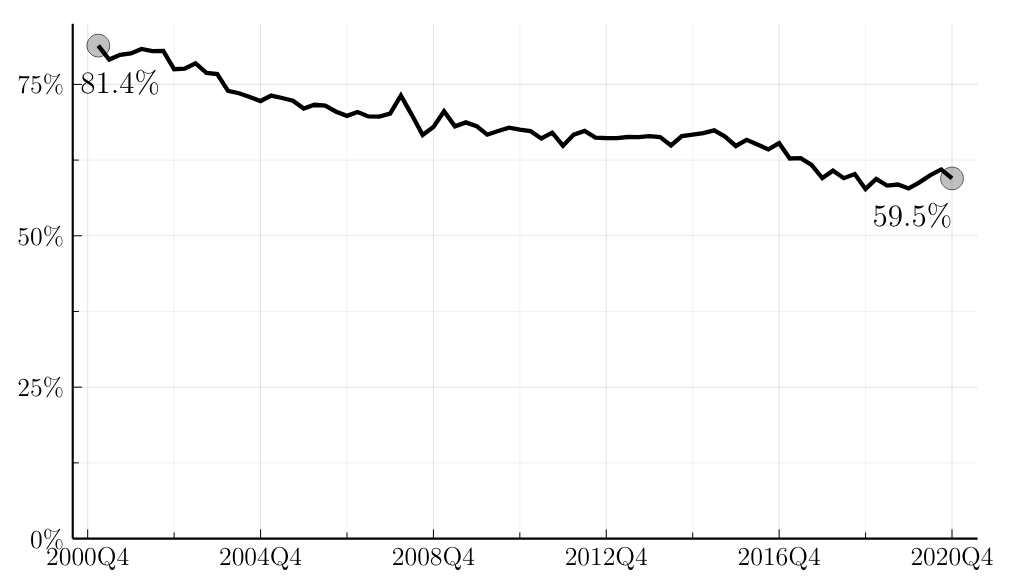
Looking across the Atlantic, in just 20 years the share of active investors shrank from 81.4% in 2000 to 59.5% in 2020, a drop of -27%!
De facto, according to Bloomberg Intelligence, a company in the S&P 500 has, on average, 21.25% of its float held by index funds.
This situation even prompted a reaction from John Bogle, widely regarded as the inventor of index funds and founder of Vanguard Group, one of the industry's leaders.

In 2018, he stated “If historical trends continue, a handful of giant institutional investors will one day hold voting control over practically every major American corporation. Public policymakers cannot ignore this growing dominance and must weigh its impact on financial markets, corporate governance, and regulation. These will be major issues in the era ahead.”
As a reminder, in 2023 BlackRock's index-fund arm, iShares, reported $3.352 trillion in assets under management, more than France's entire GDP.

The impact of index funds on stock market prices
The dominance of index funds in the markets is not without major impact on the asset price-formation system.
Let's take an example: imagine a world where the only market participants were Value stock-pickers, who only buy a stock when they judge its price consistent with the company's intrinsic quality (fundamental analysis). In this simplified world, prices would be perfectly efficient. This picture is deliberately simplified, but it allows for the conceptual analysis that follows. Now imagine a market dominated by passive index investing: every stock in an index is bought regardless of the intrinsic quality of the company it represents. This means the gap between market valuations and fundamental ones can widen significantly. Money flows in abundance into a limited number of companies, creating an upward bias.
Michael Burry, famous hedge fund manager and founder of Scion Capital (played by Christian Bale in The Big Short), told Bloomberg that the growth of index funds reminded him of the CDO bubble (collateralised debt obligations backed by synthetic assets) before the 2008 financial crisis. His fear: price formation would be driven by massive capital flows rather than fundamental analysis at the level of each individual security.

In March 2024, three researchers from Stockholm University, UCLA and the University of Minnesota showed that the price elasticity of stocks on the US market had fallen by 11% since 2004. Elasticity here measures how sensitive stocks are to supply and demand: its decline, driven by the exponential growth of index funds, makes markets potentially less efficient than before.
What would happen in a crisis?
If markets were to fall abruptly, the momentum effect could work this time against investors. Index funds would find themselves forced to sell in order to maintain the proportions of companies within the indices they track, worsening the drop in valuations. Market behaviour would then resemble that of a bursting speculative bubble, similar to the Dot-Com bubble in 2000.
The fact is that we have not yet experienced a major economic crisis in which index funds dominated the stock market to this extent. The consequences are all the harder to foresee.
Is criticising index funds too easy?
A parallel can be drawn between today's criticism of index funds and the criticism levelled at mutual and active funds in the 1970s. Whenever a new player reshuffles the cards of an existing market, the “old guard” always criticises the “new” entrants. All the more so since index funds beat the vast majority of active funds, which have seen their assets under management and fees shrink in favour of new index-fund giants such as BlackRock, Vanguard and Amundi. Finance, then, is a market like any other, where every player seeks to defend its own interests and its own turf of investors.

What's more, the small-cap segment is completely neglected by index funds, which cannot invest there for regulatory liquidity reasons. It's precisely within this segment that we find the few active managers who outperform, such as Indépendance AM and Moneta, whose managers were hosted by Finary on Talks.
More broadly, if index funds were to disappear, they would automatically be replaced by a new investment vehicle, since the stock market cannot disappear – if it did, that would mark the end of the capitalist model, which remains highly unlikely.
What is the future of index funds?
The index-fund market has never been more dynamic: in the US alone, 496 new index funds launched in 2023, up 40% from 2022.
Lastly, American households, who hold $160.8 trillion in assets, are particularly fond of index funds for their retirement savings, the famous 401(k) plans. From here on, barring an economic catastrophe, they are very likely to keep investing frenetically in these funds, which could support valuations, with no guarantee of future gains and without ruling out the risk of a correction. This means an increasingly significant part of our economic system will rely on these index funds to fund the retirement of millions of Americans and, certainly, millions of Europeans.
Are index funds already too big to fail?

Frequently asked questions
What is a speculative bubble in ETFs?
A speculative bubble refers to a surge in prices disconnected from the real value of assets, followed by a sharp collapse. ETFs themselves do not create artificial value, but their growing weight can amplify the price movements of the stocks they track, without guaranteeing a crash.
Why is it said that index funds concentrate the markets?
Index funds automatically buy stocks that are rising in order to stay aligned with their index, which reinforces the rise of already-dominant stocks. This mechanism, called the momentum effect, concentrates gains in a small number of companies, such as US tech stocks.
Is a physical or synthetic ETF riskier in the event of a market shock?
A physically-replicated ETF actually holds the securities in the index, whereas a synthetic ETF uses a swap agreement with a banking counterparty. In the event of a market shock, the synthetic ETF adds a counterparty risk that the physical one does not have.
Are there alternatives to traditional ETFs to limit concentration?
Smart beta ETFs apply selection criteria (quality, value, low volatility) rather than simple market-cap weighting, which can reduce concentration in a few dominant stocks while keeping the benefits of passive management.
How can you invest in ETFs without being exposed to the concentration effect?
It's possible to diversify your exposure across several geographic regions and index methodologies rather than concentrating on a single cap-weighted index. Tracking the actual breakdown of your portfolio, across all holdings, helps you measure this concentration risk.
Sources
ETF Stream, Bloomberg Intelligence data on the share of S&P 500 float held by index funds
Bloomberg, "Watch Out for the Market’s First Real Test of the Index-Investing Era"
iShares (BlackRock), Investor Progress Report: assets under management of index funds
Bloomberg, interview with Michael Burry on the parallel between index funds and CDOs
Bloomberg, "The Boom and Bust Fund Cycle Is Getting Intense": new ETF launches in the United States
Reuters, US household wealth, Federal Reserve data, Q1 2024
Regulatory disclaimers: Marketing communication. Investing carries a risk of partial or total capital loss. Past performance is not a reliable indicator of future performance. This article is provided for information and educational purposes only; it does not constitute personalised investment advice, a buy or sell recommendation, or tax advice. Before investing, read the Key Information Document (KID) and, where relevant, consult an authorised adviser. Finary SAS, an investment firm authorised by the ACPR (no. 19283), member of AMAFI. Insurance broker registered with ORIAS (no. 21001279), member of the CNCGP (association approved by the AMF). Crypto-Asset Service Provider (CASP) authorised by the AMF under the MiCA regime, references no. A2026-026 and no. N2026-008.