Lombard loan: pros and cons in France

In France, a Lombard loan can provide quick access to cash backed by a financial portfolio, subject to eligibility and its inherent risks (margin call, capital loss).
Contrary to popular belief, borrowing against your financial wealth is not a sign of desperation but a sophisticated wealth strategy that seasoned investors have used since the Middle Ages.
Yet this little-known solution remains the preserve of a financial elite, hiding behind its apparent simplicity some complex mechanisms that can turn wealth into a lever for growth... or expose it to significant risk if markets fall.
Understanding the Lombard loan and how it works
Lombard loan definition: a loan secured by your financial assets
A Lombard loan lets you obtain cash by using your share portfolio as collateral, while keeping your investments and the income they generate.
Inspired by Italian bankers in the Middle Ages, this system today relies on the value of your assets rather than your repayment capacity. It simplifies access to funds, transforms the relationship between saving and borrowing, and lets you tap into the potential of your assets without giving them up.
How a Lombard loan works: pledge, LTV and calculating the amount you can borrow
A Lombard loan relies on a pledge. Your financial assets are pledged as collateral to secure your commitment. You keep all your ownership rights, including the right to receive dividends and interest.
The LTV (loan-to-value) ratio determines how much you can borrow relative to the value of your assets. The more stable an asset is, the more a bank is willing to lend. For example:
- A euro fund, whose guarantee depends on the insurer (the FGAP cap of €70,000, French “Sapin 2” law), can offer a high LTV.
- Equities, which are more volatile, generally offer an LTV of between 30% and 50%.
This method protects the bank against market fluctuations. If the value of your shares falls, the lending institution can absorb this risk without compromising its stability.
Who can benefit from a Lombard loan, and which assets are eligible?
A Lombard loan is aimed mainly at investors with substantial financial wealth, generally more than €100,000.
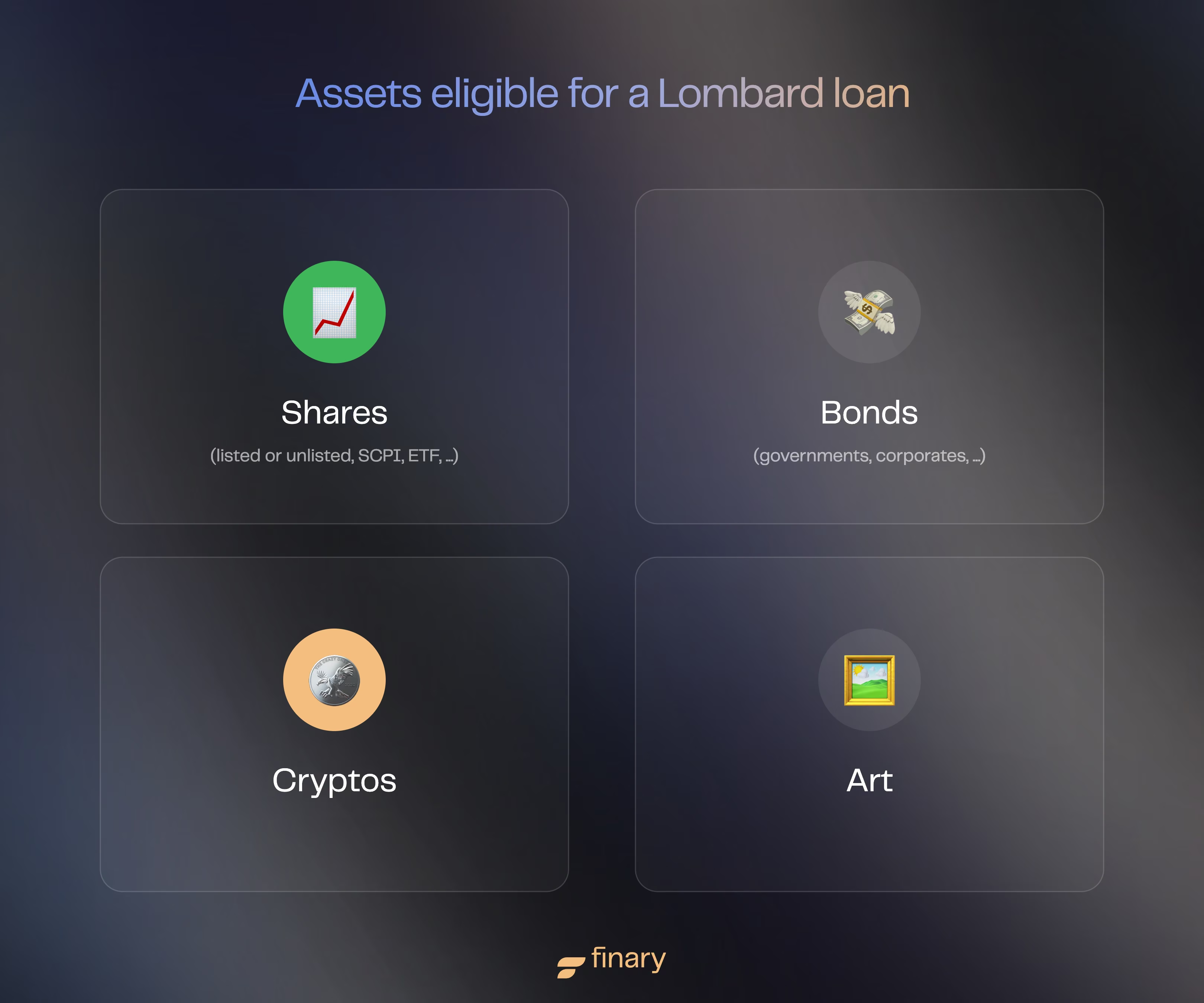
The eligible assets are varied but carefully selected. They include:
- Shares listed on major stock exchanges
- Bonds issued by governments or highly rated corporations
- Diversified UCITS funds
- Certain unit-linked life insurance policies
Note, however, that some innovative banks now accept alternative assets as collateral, such as cryptocurrencies or artworks.
Want to take out a Lombard loan but do not know which institution to choose? Check out our comparison of the best banks for a Lombard loan and their specific terms.
The main benefits of a Lombard loan for growing your wealth
Keeping your investment strategy intact and continuing to earn income from your assets with a Lombard loan
Say you hold a share portfolio generating 5% in annual dividends and you need €200,000 for a property. The conventional solution is to sell part of your holdings. That sale means losing future income and paying capital gains tax.
A Lombard loan offers an effective alternative. Your shares stay in your portfolio, keep generating dividends, and you get the cash you need. This mechanism preserves the integrity of your asset allocation while maintaining your passive income stream.
This mechanism temporarily separates holding assets from using them as a source of financing. Your portfolio keeps generating returns and can benefit from capital appreciation, while you fund your projects without interrupting that dynamic.
This approach proves especially useful in rising markets. Rather than selling at the wrong time, you keep your exposure while monetising part of your wealth. This timing choice does carry a risk, however, if markets reverse.
Using the leverage of a Lombard loan to seize new investment opportunities
The leverage effect of a Lombard loan goes beyond simply obtaining cash. It turns your wealth into an engine of opportunity.
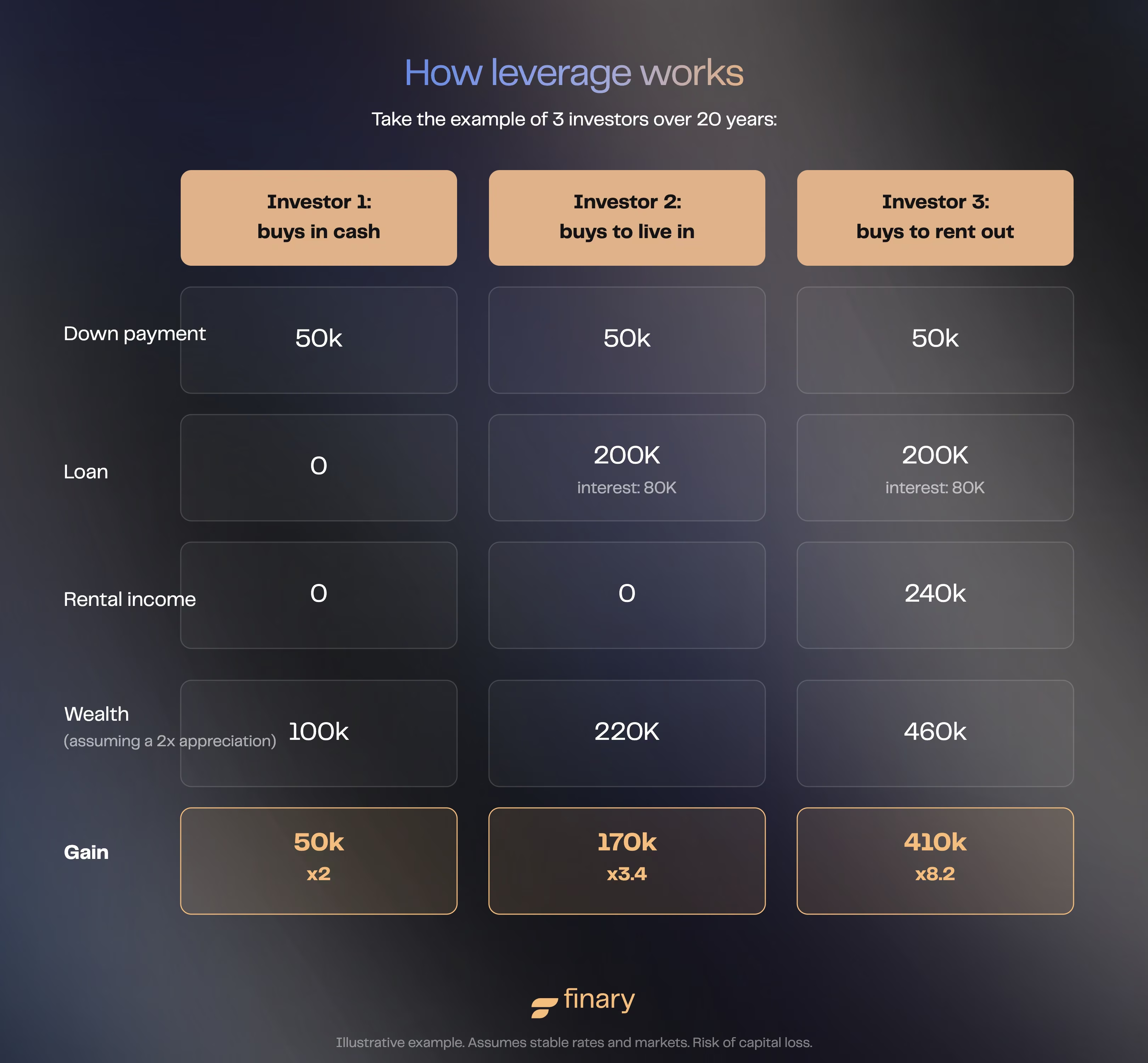
For example, an investor holding €500,000 in government bonds might spot a listed real estate fund offering an 8% annual return. By borrowing €400,000 at a rate of 2.5% through a Lombard loan, they invest that amount in the real estate fund.
In this illustrative scenario, a theoretical yield gap of 5.5% would generate a potential gain of €22,000; this assumes stable markets and rates, and a downturn can lead to losses greater than the expected gain. This strategy amplifies potential gains but also potential losses if the pledged assets fall in value.
Using leverage during a market correction increases the risk of a margin call if markets keep falling. Such a strategy should be assessed with an adviser in light of your risk tolerance.
Tax advantages of a Lombard loan
The tax treatment of a Lombard loan creates an interesting asymmetry. Unlike selling assets, which immediately triggers capital gains tax, a Lombard loan lets you defer that tax event. This deferral can represent substantial savings depending on the size of the estate.
For example, a business owner holding shares worth €1 million, with an unrealised capital gain of €600,000, would face a €180,000 tax bill at the 30% rate if they sold. With a Lombard loan, they can raise €500,000 in cash without that immediate tax charge.
The optimisation goes further: depending on the situation, and under strict conditions set out in the French General Tax Code (CGI), the interest may be deductible when it finances taxable income; an analysis by a tax adviser is essential. This deductibility reduces the cost of the loan and the investor’s overall tax bill.
Depending on the jurisdiction and personal situation, structures combining a Lombard loan with tax-advantaged wrappers may be considered; they require specialist support given their complexity and risks.
How quickly a Lombard loan gives you access to cash
A Lombard loan gives you access to cash far faster than traditional financing. Where a mortgage can take several months, a Lombard loan can be set up within days.
An entrepreneur can therefore seize an acquisition opportunity without waiting to liquidate their investments or finalise a conventional loan. This responsiveness is a major asset in negotiations where financing speed makes the difference.
The flexibility in how the borrowed funds can be used is also remarkable. Unlike an earmarked loan, the cash obtained through a Lombard loan can fund:
- an investment,
- a personal project,
- or serve as a precautionary cash reserve.
This versatility meets investors’ evolving needs.
Actively managing a Lombard loan allows for real-time adjustments. An investor can partially repay their loan when they receive an exceptional cash inflow, then draw on it again as future needs arise. This flexibility makes it a wealth cash-management tool that demands rigorous monitoring and a good understanding of the risks.

The drawbacks and risks of a Lombard loan
Exposure to financial market volatility
A Lombard loan exposes your portfolio to rapid financial market swings. Unlike a mortgage, where the value of the property moves slowly, the value of your shares can fall sharply. This difference makes this type of financing riskier than traditional loans.
A margin call can happen without warning. The bank may require a cash top-up or the sale of part of your assets, often under unfavourable market conditions. This situation frequently occurs during market downturns, making the sale of assets particularly disadvantageous.
Concentration in the pledged assets increases this risk. If you have pledged shares from a single sector and that sector collapses, your borrowing capacity drops sharply. This sector concentration, often underestimated, can become a trap in turbulent periods.
Often restrictive access conditions and the exclusive nature of the Lombard loan
A Lombard loan is aimed mainly at a wealthy clientele. Banks set high access requirements, such as a minimum of several hundred thousand euros in eligible assets.
Administrative complexity is another obstacle. Applications require detailed documentation, including an appraisal of each asset and a complete wealth analysis.
Asset acceptance remains highly selective. Certain categories, such as units in family SCPI (a French non-listed real-estate investment vehicle, comparable to a REIT) funds, cryptocurrencies, or unexercised stock options, are generally excluded. This selectivity limits access to Lombard loans, even for wealthy investors.
Meanwhile, private banks add a relational dimension to this selection, favouring their long-standing clients. Access then depends as much on your network as on your wealth, reinforcing how exclusive this type of financing is.
The risk of over-indebtedness and the need for rigorous management when using a Lombard loan
The leverage effect of a Lombard loan amplifies potential gains, but also potential losses. Many people underestimate this mechanism, thinking that borrowing to reinvest is risk-free.
Easy access to cash can encourage excessive risk-taking, in the hope of covering the cost of the loan. This dynamic can lead to an uncontrolled escalation, especially if markets move unfavourably.
Managing a portfolio under a Lombard loan requires constant vigilance. You need to monitor the ratios, anticipate market movements, and maintain cash reserves to handle potential margin calls.
Additional costs, such as switching commissions, valuation fees, or custody fees on securities, can add up and reduce the profitability of the transaction, especially for smaller amounts.
The potential impact of interest-rate changes on the real cost of your Lombard loan
Lombard loan interest rates vary with monetary conditions. Unlike mortgages, which are often fixed-rate, a Lombard loan generally tracks Euribor. Every central bank decision therefore directly affects your financing cost.
The low-rate environment long masked this risk. But when rates rise suddenly, the cost of the loan can increase rapidly, turning previously profitable strategies into sources of losses.
Rising rates often coincide with falling markets, which complicates matters. When rates rise, the value of your collateral can fall, pushing up the cost of the loan at the very moment your wealth is losing value.
Bank margins add further uncertainty. In periods of stress, banks can widen their spreads, which pushes up the cost of the loan independently of how Euribor moves. This additional volatility must be factored into any strategy involving a Lombard loan.
A strategic decision that calls for careful thought and guidance
A Lombard loan turns your financial wealth into a lever of opportunity, letting you access significant cash without ever parting with your investments.
This unique ability to preserve your wealth strategy while financing your projects is its major advantage over traditional financing solutions.
The equation remains a delicate one, however. The tax benefits and flexibility of use rightly appeal to seasoned investors, but market volatility can quickly turn this tool into a financial burden. A margin call gives no warning, and market corrections test the strength of your strategy.
Professional support then becomes decisive for three essential reasons: a personalised analysis of your wealth situation, the optimal structuring of the transaction based on your goals, and above all the proactive management of market risk that avoids unpleasant surprises. A wealth manager or a family office brings this essential technical expertise to help you navigate with confidence.

Regulatory disclaimers:
Marketing communication. Investing carries a risk of partial or total capital loss. Past performance is not a reliable indicator of future performance. This article is provided for information and educational purposes only; it does not constitute personalised investment advice, a buy or sell recommendation, or tax advice.
Borrowing amplifies losses as well as gains and can lead to a loss greater than the capital invested (you remain liable for the loan). Complex, high-risk product.
Before investing, read the Key Information Document (KID) and, where relevant, consult an authorised adviser.
Finary SAS, an investment firm authorised by the ACPR (no. 19283), member of AMAFI. Insurance broker registered with ORIAS (no. 21001279), member of the CNCGP (association approved by the AMF). Crypto-Asset Service Provider (CASP) authorised by the AMF under the MiCA regime, references no. A2026-026 and no. N2026-008.