How to manage your salary in France: the complete guide

Updated on 7 August 2026
Managing your salary well in France rests on four habits: build a monthly budget, then trim your fixed expenses. Next, build an emergency fund covering 3 to 6 months of spending, before investing the surplus in line with your goals. This article walks you through it step by step, from budget to investment.

- The 50/30/20 rule splits your salary into 50% for essential needs, 30% for wants and 20% for savings.
- An emergency fund must stay immediately available, on a Livret A for instance, so you can absorb a job loss or an unexpected bill.
- Cancelling unused subscriptions and renegotiating your contracts (mobile, insurance) often frees up several tens of euros of headroom every month.
- Once the emergency fund is in place, the surplus can be invested through a PEA (a French tax-advantaged equity savings account) or a life insurance policy, depending on your horizon and the risk you accept.
How do you build a detailed monthly budget?
Building a detailed monthly budget means listing your income and your fixed expenses, working out your disposable income, then splitting the surplus between savings and leisure with a clear rule such as 50/30/20.
How do you calculate your disposable income after fixed expenses?
Disposable income is the central concept when managing a salary. Put simply, it is the money left once you have paid every fixed expense. Those include rent, bills, insurance and subscriptions. To calculate it, subtract them from your total monthly income.
For example, if your net salary is €2,500 a month and your fixed expenses come to €1,500, your disposable income is €1,000. That is the amount to keep under control to run your finances better.
For more detail, we have put together a guide on how to manage your budget.
Which spending categories should you watch to cut costs?

We all have small leaks in our budget. Spotting and cutting this unnecessary spending saves money over the long run. Here are a few categories to watch closely:
- Unused subscriptions: magazines, streaming platforms, paid apps you never open.
- Food: impulse shopping and eating out push the bill up fast.
- Transport: rethinking how you travel saves money, whether through car sharing or public transport.
- Mobile and internet: compare offers and do not hesitate to negotiate better rates with your providers.
How do you make sure nothing is missing from your budget?
Building a detailed budget is a bit like writing a complete shopping list without forgetting anything. Start by grouping your spending into categories: housing, food, transport, leisure and so on. Then go back over your bank statements for the past few months.
That review surfaces the irregular and seasonal expenses that would otherwise slip through. A budgeting app helps you leave nothing out and set up more precise tracking.

Is the 50/30/20 rule right for every situation?
The 50/30/20 rule is a popular guide for splitting income in a balanced way:
- 50% for essential needs (housing, food and so on)
- 30% for leisure and wants
- 20% for savings and debt repayment.
The rule is an excellent starting point, but it is not universal. If you live in a large city where the cost of living is high, you may have to adjust the percentages.
Adapt the split to your personal situation and your financial goals. Flexibility is what turns the rule into a genuine ally in managing your salary.
How do you build an emergency fund?
Building an emergency fund means setting aside roughly 3 to 6 months of everyday spending on a liquid, immediately available investment option such as the Livret A, before considering any other investment.
How much money should you set aside each month?
An emergency fund is your financial parachute, the one that lets you absorb the unexpected without panicking. But how much should you set aside each month to build that reserve? Ideally, around 3 to 6 months of everyday spending.
According to Insee, the savings rate of French households stood at 17.9% of gross disposable income in the first quarter of 2026, against 17.7% the previous quarter (Insee, quarterly national accounts).
For example, if your monthly spending comes to €1,500, your emergency fund should sit between €4,500 and €9,000. To get there without upending your daily life, start by saving 10% to 15% of your salary each month.
Simulate your budget
Use our budget calculator to picture your spending categories. You also get your disposable income, your current savings rate and more.
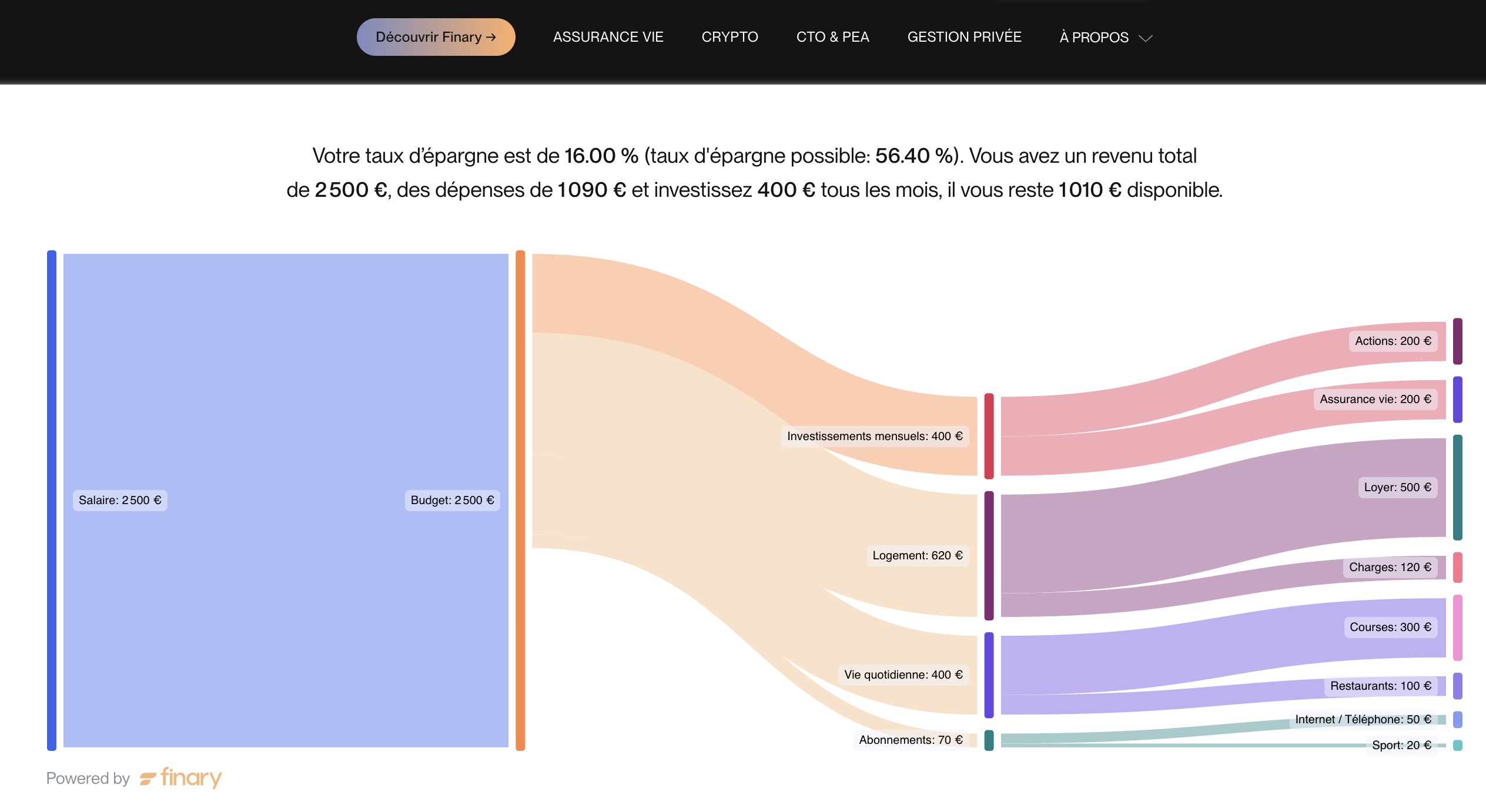
Where does your income go each month?
Non-contractual document for promotional purposes. Indicative estimate. Finary SAS - 58 rue de Monceau 75380 Paris 8 - ORIAS no. 21001279.
Where should you keep your emergency fund to protect it?
To protect an emergency fund, keep it on liquid, immediately available options such as the Livret A, the LDDS or a standard savings account, rather than on risky investments.

Safety comes first for an emergency fund. The point is not to invest this money in risky assets, but to keep it liquid and accessible. Here are a few recommended options:
- Livret A: rate set by the French state, capital protected up to the regulatory ceiling.
- Livret de Développement Durable et Solidaire (LDDS): much like the Livret A, with a remit to fund sustainable development projects.
- Savings account: pick an account that gives quick, easy access to your money while paying interest.
When should you dip into this fund?
An emergency fund is not there for impulse purchases or dream holidays. Keep it for genuine emergencies: job loss, major unplanned home repairs, a medical emergency or another critical situation.
Before dipping in, make sure you cannot cover the expense another way. That discipline is what keeps your financial peace of mind intact.

Trimming your expenses
Which unnecessary expenses should you cut first?
Getting rid of pointless spending is a bit like a spring clean. Here are a few examples of unnecessary expenses to cut first:
- Forgotten subscriptions: you may be paying for services you never use. Review them and cancel the ones that bring you no value.
- Takeaway coffee: one takeaway coffee a day can cost up to €50 a month. A good coffee machine at home makes a real difference.
- Grocery shopping: impulse buys and non-essential products shrink with a strict shopping list and a meal before you shop.
How do you negotiate better rates with your providers?
Negotiating with your providers can feel intimidating, but it is easier than you think. Take your mobile or internet plans. A single call saying you are thinking of switching often produces an immediate discount. A few tactics:
- Comparison sites: use them to check you really are on the best rate.
- Rewarded loyalty: play on how long you have been a customer. Companies usually prefer keeping an existing client to winning a new one.
- Competing offers: quote rival deals to strengthen your bargaining power.
Are there apps to help me track my spending?
Technology can be an ally here. Budgeting apps let you track your finances in real time and understand your habits better. See our guide to the best budgeting apps.
Increasing your income
How do you showcase your skills to negotiate a pay rise?
Asking for a pay rise can feel intimidating, but good preparation improves your odds. Here is how to showcase your skills:
- Do your research: knowing the market rate for your role tells you what you can reasonably ask for. Sites such as Glassdoor or LinkedIn carry current data.
- Show your value: prepare a file setting out your quantitative and qualitative achievements. For example, "I grew sales by 20% by streamlining the sales process."
- Pick the right moment: favour good windows, such as just after a major win or during the annual review.
- Be assertive but flexible: put your case clearly and professionally. Be ready to negotiate other benefits (training, remote work) on top of, or instead of, an immediate rise.
What side activities can you run alongside your job?
Diversifying your income sources is a smart way to grow your wealth. A few side activities worth considering:
- Freelancing: put your skills to work on platforms such as Upwork or Malt. Writing, design, web development, marketing: the scope is wide.
- Consulting: if you have solid expertise in a specific field, advisory work can be very lucrative.
- Tutoring: private lessons, academic or musical, generate extra income.
How do you put your property assets to work?
Monetising property is an effective way to lift your passive income. A few strategies:
- Short-term letting: renting part of your home on platforms such as Airbnb can generate income, provided you follow local rules (registration with the town hall, caps on the number of nights).
- Subletting: subject to the owner's written authorisation and to the applicable legal framework; if you rent a flat but are rarely there, or while you are away on holiday, subletting can generate income, subject to the landlord's prior written agreement (article 8 of the French 1989 act).
- Investing in rental property: buying a home to let it can generate rental income, subject to the risks (rental voids, unpaid rent, taxation, market swings).
Raising your income takes initiative and strategy. By showcasing your skills, exploring side activities and putting property to work, you can create new income streams and strengthen your financial security.
Saving for your goals
Which investments should I choose for my goals?
The right investment depends on your specific financial goals, whether short, medium or long term. A few options to consider:
- Short-term goals (under 3 years): for a holiday or an emergency fund, liquid options work best, such as the Livret A or the LDDS.
- Medium-term goals (3 to 5 years): for a new car or a change of life, term deposits or the euro fund of a life insurance policy are worth studying. They offer a degree of stability while allowing a return above that of standard regulated savings accounts.
- Long-term goals (over 5 years): for retirement or buying a home, stock market investments through a PEA or a unit-linked life insurance policy can be attractive. They offer higher return potential, in exchange for a risk of capital loss. An online life insurance policy such as Finary Life (insured by Generali Vie) gives access to a euro fund and to unit-linked funds (ETFs, funds).
More capital invested

Non-contractual document for promotional purposes. Investment in unit-linked vehicles carries a risk of capital loss, since their value is subject to fluctuation, both upwards and downwards, depending in particular on developments in the financial markets. The insurer commits to the number of units, not to their value, which it does not guarantee. The e-vie policy is an individual life insurance policy, denominated in euros and/or unit-linked vehicles, underwritten by Generali Vie, a company governed by the French Insurance Code. Finary SAS, 58 rue de Monceau 75380 Paris 8, ORIAS no. 21001279.
How much should I save each month to reach my goals?
Splitting your savings across your goals needs a clear plan. The basic rule: the further away the goal, the more risk you can afford. A simple approach:
- Set the amount needed for each goal.
- Work out the time frame to reach it.
- Divide the amount by the number of months until the deadline to find how much to save each month.
For example, if you want to buy a car in three years and need €10,000, you will have to save around €278 a month (€10,000 / 36 months).
How do you make the most of the tax benefits?
The tax framework applying to each wrapper can offer benefits, subject to the conditions in force. A few routes worth knowing:
- Regulated savings accounts: interest on the Livret A and the LDDS is tax exempt, so you can build savings with no tax admin.
- PEA: after five years, capital gains are exempt from income tax (social contributions still apply), under the tax framework in force.
- Life insurance: after eight years, gains are lightly taxed and annual tax allowances apply (€4,600 for a single person and €9,200 for a couple, confirmed on 07/08/2026 by service-public.gouv.fr). You can estimate the tax impact of a withdrawal from your policy with the Finary life insurance simulator.
Combining these strategies makes your saving effort go further. Adapt your investments to your personal situation, your horizon and your risk tolerance. The tax framework described here can change.
Frequently asked questions
How should you split your salary each month?
A simple method is the 50/30/20 rule: 50% for essential needs, 30% for wants, 20% for savings and debt repayment. Adapt the percentages to your cost of living and your goals.
What share of your salary should you save?
Aim for 10% to 15% of your net salary each month. Build an emergency fund of 3 to 6 months of expenses first, on a liquid option such as the Livret A, then invest the rest for the longer term.
Where should you keep your emergency fund?
Favour liquid, safe options whose interest is tax exempt, such as the Livret A and the LDDS. The aim is not performance but having the money available the moment you need it.
How do you manage a variable salary?
Base your budget on your leanest months and move the surplus from good months into your emergency fund. That smooths your spending and keeps the quiet periods manageable.
Should you repay debt or save first?
Clear expensive debt first, consumer credit above all, whose rate usually beats the return on your savings. Still keep a small safety reserve so you do not borrow again at the first surprise.
Sources
Insee, quarterly national accounts, household savings rate Q1 2026
Service-public.fr, life insurance taxation after eight years
Regulatory disclaimers: Marketing communication. Investing carries a risk of partial or total capital loss. Past performance is not a reliable indicator of future performance. This article is provided for information and educational purposes only; it does not constitute personalised investment advice, a buy or sell recommendation, or tax advice. Before investing, read the Key Information Document (KID) and, where relevant, consult an authorised adviser. Finary SAS, an investment firm authorised by the ACPR (no. 19283), member of AMAFI. Insurance broker registered with ORIAS (no. 21001279), member of the CNCGP (association approved by the AMF). Crypto-Asset Service Provider (CASP, "PSCA" in French) authorised by the AMF under the MiCA regime, references no. A2026-026 and no. N2026-008.