


5 mistakes that are stopping you from saving

Updated on 28 July 2026
The French are among the best savers in the world. Yet most leave their money sitting where it loses value.
Saving is the first step towards building wealth, but five mistakes come up again and again and stall your progress. Whether you earn €1,500 or €6,000 a month, the right habits are the same.
Here are those five mistakes, and how to fix them.

- Leaving your savings in a regular savings account or a current account often costs you purchasing power: invested, it benefits from compound interest.
- Without a specific target or an allocation rule (such as the 50/30/20 rule), the saving effort rarely lasts.
- You cannot optimise what you do not track: knowing your income and expenses is the starting point.
- Not all expenses are equal; distinguishing discretionary from strategic spending helps you cut the excess without sacrificing everything.
- The most effective rule is to pay yourself first, through an automatic transfer at the start of the month.
Mistake 1: Not understanding why saving matters
Many people underestimate how much the way you save matters. The French save a lot (around 20% of their income), but they direct only about a third of that saving towards financial investments: savings accounts and current accounts remain the preferred vehicles.
This creates two problems. The first is inflation. In 2023, with inflation running at around 4.9%, a Livret A paying 3% still meant losing about 1.9% of purchasing power a year. On a current account, the interest rate is zero, and it is your bank that invests the money instead of you.
The second is the missed potential of compound interest, the mechanism by which gains go on to generate further gains. In a phrase often attributed to Einstein, "those who understand it earn from it, and those who don't, pay for it."
One example speaks for itself. By setting aside about €400 a month for 40 years, you accumulate €192,000 under the mattress. Invested at 6% a year, the same amount theoretically reaches €742,857. Past performance is not a reliable indicator of future performance.
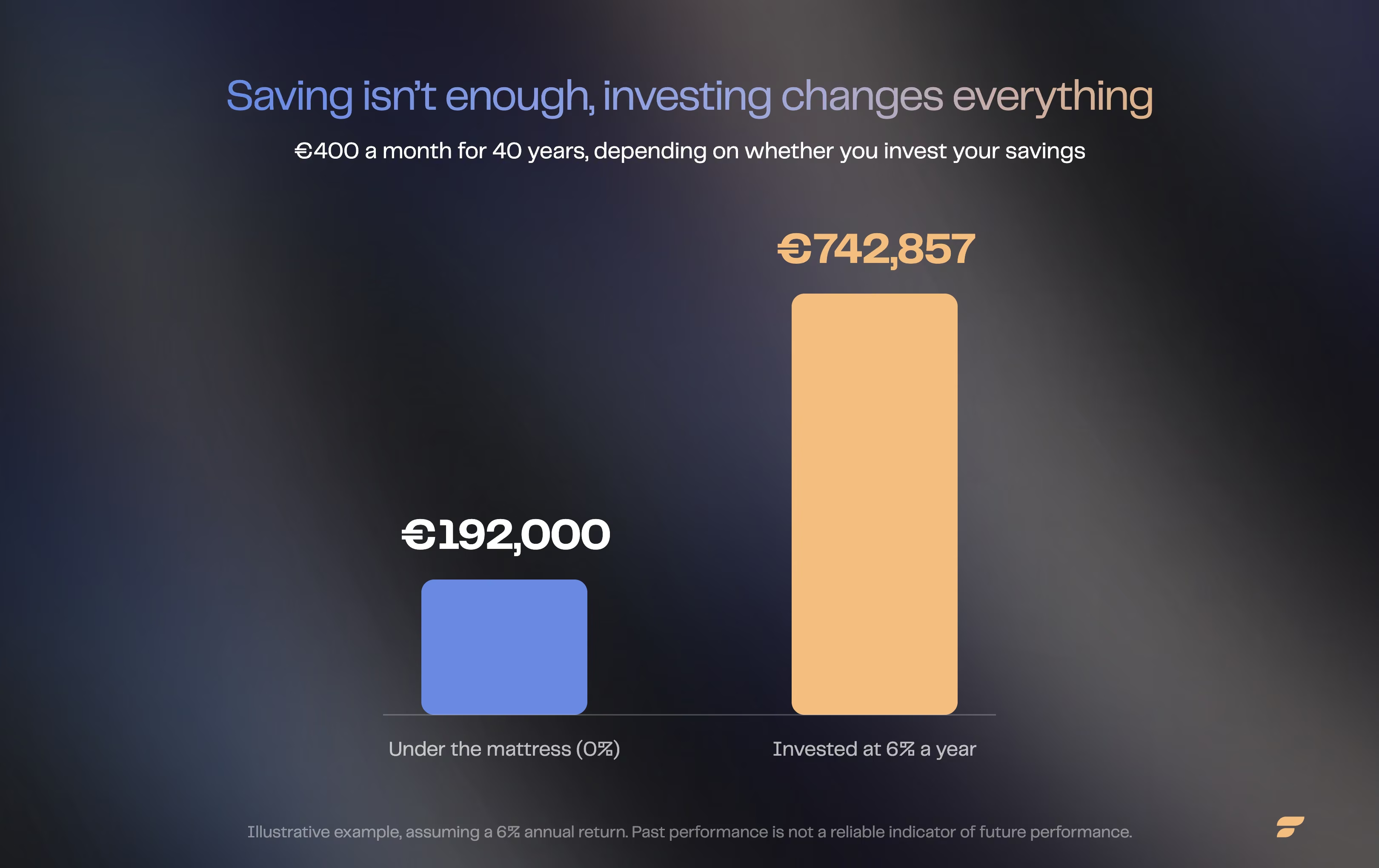
What matters, then, is not so much investing a lot as investing early and regularly.
Mistake 2: Not setting a goal or a system
Without a clear reason to save, the effort does not last. The solution is to start from a specific target, or to adopt a simple allocation rule.
First approach: the concrete target. If you want a €50,000 down payment for a property purchase in 5 years, you need to save about €755 a month invested at 5%. You then know why you are setting that amount aside, and it becomes easier to stick to it.
Second approach: a ready-made rule, such as the 50/30/20 rule, which splits your income into three blocks.
| Share of income | Category | Examples |
|---|---|---|
| 50% | Essential needs | Housing, food, healthcare |
| 30% | Wants | Shopping, dining out, entertainment |
| 20% | Savings | Safety cushion, investing |
You can adjust these proportions (for example 40/40/20) to fit your situation. Just one limit: aim for at least 15% in savings.
Mistake 3: Not tracking your budget
You cannot optimise what you do not measure. Without a clear view of what comes in and goes out, you cannot steer your finances.
Tracking your budget lets you control where your money goes, spot forgotten subscriptions or small invisible expenses, avoid overdrafts and reach your goals more easily. It is not about self-surveillance, it is about staying in control and cutting the excess.
Three solutions exist: write everything down in a notebook, use a spreadsheet, or use a budgeting app. This last option takes the least effort, because tracking is automatic and retroactive: your expenses are categorised on their own.
Where does your income go each month?
Non-contractual document for promotional purposes. Indicative estimate. Finary SAS - 58 rue de Monceau 75380 Paris 8 - ORIAS no. 21001279.
Mistake 4: Not keeping control of your spending
Not all expenses are equal. To make sense of them, you can sort them into two categories.
The discretionary expenses bring immediate pleasure but no long-term benefit: a trendy piece of clothing, consumer credit, a delivered fast-food order, a drink on a terrace. The easiest way to cut them is to review your recurring expenses, subscriptions especially.
The strategic expenses, meanwhile, are not essential but are useful in the long run: eating healthily, education (as Warren Buffett put it, "the more you learn, the more you earn"), exercise, or spending that buys you back time.
The idea is not to cut everything: some spending is good. The goal is to consciously choose where each euro goes.
Mistake 5: Not paying yourself first
This is the costliest mistake: waiting until the end of the month to save whatever is left. In practice, almost nothing is left, because seeing an available balance in your account pushes you to spend it.
This bias has a name: the illusion of wealth. Nobel economics laureate Richard Thaler theorised it as mental accounting: depending on where the money sits, we do not assign it the same value. Money in a current account "feels" made to be spent; money in an investment account does not.
The right habit is to reverse the order: pay yourself first. Set up an automatic transfer to your investment account at the start of each month. You will not see the money go, so you will not be tempted to spend it. The less friction there is to invest, the more you invest.

Frequently asked questions
How much should you save each month?
There is no universal amount, but a benchmark: aim for at least 15% of your income. The 50/30/20 rule suggests devoting 20% to it. What matters most is setting a realistic, sustainable rate, then increasing it gradually.
What is the 50/30/20 method?
It is a rule for allocating income: 50% for essential needs (housing, food, healthcare), 30% for wants (leisure, shopping) and 20% for savings and investing. It can be adjusted, for example to 40/40/20, depending on your situation.
Should you save or invest?
Both, but not in the same place. An emergency fund stays in a readily available savings account. The rest is better off invested: left in a savings account or a current account, money often loses purchasing power to inflation. Past performance is not a reliable indicator of future performance.
How do you stick to your savings every month?
The most effective method is to pay yourself first: an automatic transfer to an investment account at the start of the month, before any spending. By cutting the friction, you save without thinking about it and without being tempted to spend the money.
Sources
AMF - Baromètre de l'épargne et de l'investissement 2023
Banque de France - la culture financière des Français
Statista - taux d'épargne des ménages dans le monde
Regulatory disclaimers: Marketing communication. Investing carries a risk of partial or total capital loss. Past performance is not a reliable indicator of future performance. This article is informative and educational in nature; it does not constitute personalised investment advice, a buy or sell recommendation, or tax advice. Before investing, read the Key Information Document (KID) and, where relevant, consult an authorised adviser. Finary SAS, an investment firm authorised by the ACPR under no. 19283, member of AMAFI. Insurance broker registered with ORIAS under no. 21001279, member of the CNCGP (association approved by the AMF). Crypto-Asset Service Provider (CASP) authorised by the AMF under the MiCA regime, under references no. A2026-026 and no. N2026-008.