


Securities account in France: the complete guide

Updated on 20 July 2026
The compte-titres ordinaire, or ordinary securities account (CTO), lets you invest in France without any contribution limit in shares, bonds, ETFs and funds worldwide. Unlike the PEA (a French tax-advantaged equity savings account), it offers no specific tax benefit: capital gains and dividends are taxed from the very first euro. This article explains how it works, its taxation, its advantages and its limits.

- The CTO sets no contribution cap and lets you invest in shares, bonds, ETFs and funds worldwide.
- Capital gains and dividends are taxed at the flat tax (PFU) rate of 31.4%, with no exemption based on holding period, unlike the PEA.
- Capital losses can be carried forward against gains for the following ten years, a tax option not available with the PEA.
- On the holder's death, unrealised capital gains are wiped clean for tax purposes, although inheritance tax remains due.
What is a securities account?
The ordinary securities account (CTO) is the basic tool for any stock market investor. It lets you hold different financial instruments. Unlike the PEA, the CTO gives access to a wide range of financial instruments.
A rich, varied range of investment options
The CTO stands out for its versatility in terms of investment options:
- French and international shares, letting you invest in US tech giants such as Apple or leading Asian industrial companies.
- Bonds issued by companies or governments.
- Investment funds (UCITS) and ETFs (trackers) for exposure to baskets of assets in a single transaction.
CTO vs PEA: close cousins with sharply different features
Although the CTO and the PEA share some similarities, their differences are crucial. The PEA offers appealing tax benefits but is limited to European shares and comes with a contribution cap.
The CTO, meanwhile, lets you invest without any contribution limit and reaches into more distant markets.
They differ mainly on two points: taxation and portfolio diversification. Each has its own advantages and constraints for the investor.
While the PEA offers attractive tax benefits, it is limited to European shares and comes with a contribution cap. The CTO, by contrast, lets you invest without limit in a wider range of assets, including international shares and bonds.
What are the conditions to open an ordinary securities account?
You can open an ordinary securities account from age 18 as an individual, or earlier for a minor via their legal representative, provided you are a French tax resident. Legal entities must also provide their articles of association and a recent K-bis extract (the French company registration certificate).
For individuals: broad but regulated access
For individuals, the conditions are generally flexible:
- Age of majority: you must be at least 18 years old to open an account in your own name.
- Minors: a CTO can be opened in a child's name, with their parents or legal representative acting on their behalf.
- Nationality and residency: French nationality is not required, but French tax residency is generally necessary, because of the tax implications of holding a CTO.
For legal entities: an essential financial management tool
For companies, associations and other legal entities, the CTO becomes an indispensable tool:
- Required documents: the company's articles of association, a recent K-bis extract, and proof of identity for the directors and anyone authorised to manage the account.
- Corporate purpose: the bank or broker will check that investing on the stock market is consistent with the company's stated corporate purpose.
How does an ordinary securities account work?

An ordinary securities account works around two linked pockets: a securities sub-account that holds the assets (shares, bonds, funds, ETFs) and a cash sub-account that receives contributions, dividends and coupons, and funds purchases of securities.
The interplay between the securities account and the cash account
At the heart of the CTO lies a fundamental duality: the securities account and the cash account.
- Securities account: it acts as a digital vault, holding your shares, bonds and other financial instruments.
- Cash account: it acts as an interface, receiving your initial contributions, the dividends from your shares and the coupons from your bonds. It also serves as a reserve for your future purchases of securities and receives the proceeds from any sales.
This two-part structure offers great transparency in managing your cash flows. You can easily track the cash available for new investments and get a clear view of your portfolio's composition.
Choosing a custodian: traditional banks vs online brokers
Where to hold your assets is a crucial question, with two main options: traditional banks and online brokers.
- Traditional banks: they offer the advantage of proximity and a personalised service, with face-to-face advice. However, they often charge higher fees for account management and transactions.
- Online brokers: they offer lower brokerage fees and user-friendly interfaces. Some offer discretionary management. Pricing varies from broker to broker (check their official websites).
Fee structure: a key factor to consider
The fees associated with a CTO can affect your long-term performance. They fall into several categories:
- Brokerage fees: applied to each transaction, they vary considerably from one provider to another.
- Account-keeping fees: these tend to disappear with online brokers but can persist at some banks.
- Currency-exchange fees: for investments in foreign currencies, these fees can add up quickly.
- Inactivity fees: some providers charge these if you do not carry out a minimum number of transactions per year.
Comparing these fees against your investor profile is essential. An active trader will favour low transaction fees, while a long-term investor may accept slightly higher transaction fees if account-keeping fees are zero.
Operational flexibility
The CTO is defined by its operational flexibility. Unlike other investment wrappers, the CTO allows contributions and withdrawals without penalty.
This freedom is valuable for investors who want to stay highly responsive to market opportunities or who need liquidity.
You can transfer your CTO between providers. This transfer takes place without selling your positions. As a result, you benefit from the best offers on the market. You also avoid the tax consequences of a liquidation.

Advantages of the securities account
The CTO stands out for a range of advantages that make it a tool used by many investors. Its versatility means it can be adapted to different investment strategies.
A wide diversity of investments
The CTO gives access to a wide range of financial instruments. Unlike the PEA, which is limited to European shares, the CTO opens the door to investing worldwide.
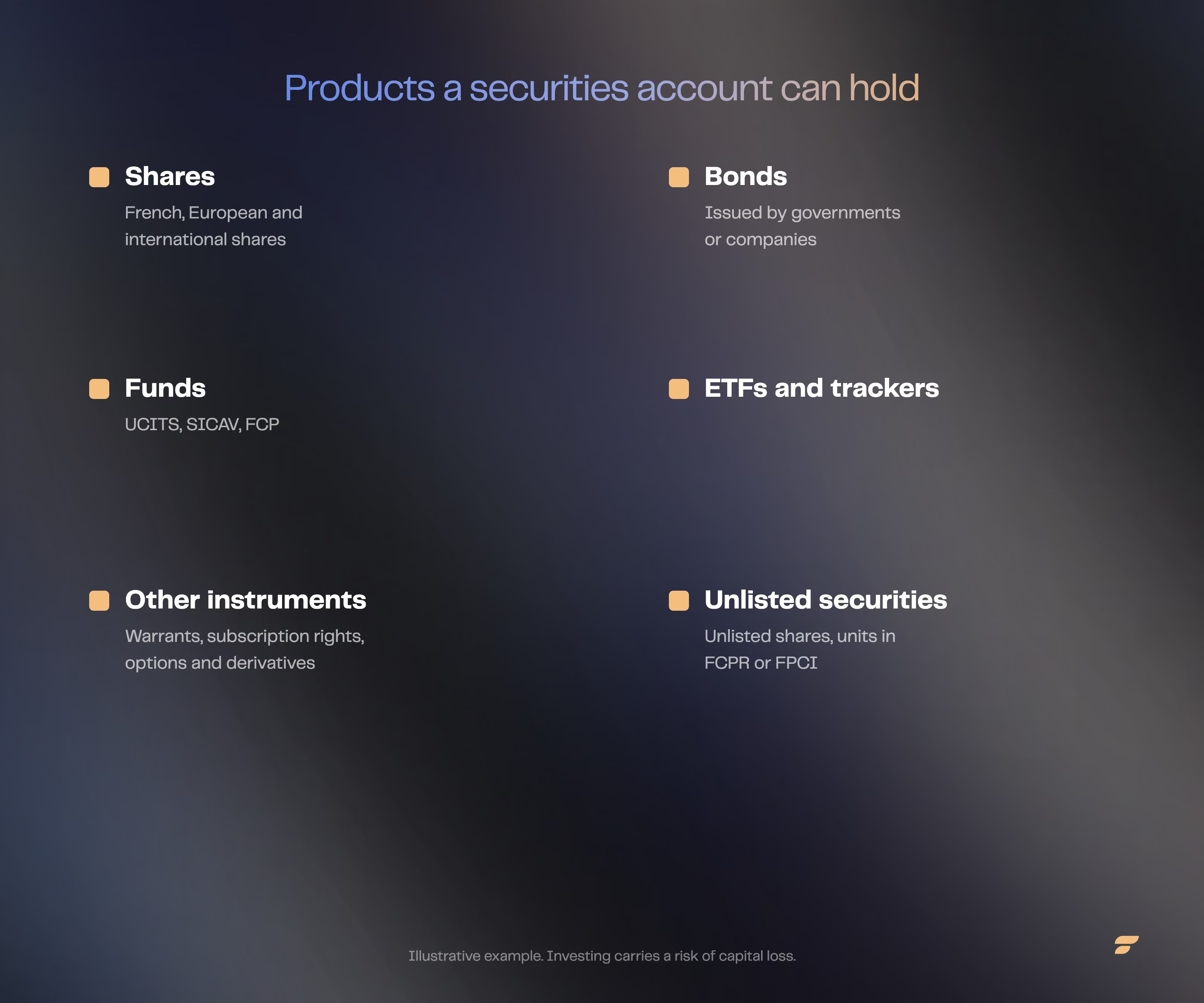
This lets you build a diversified portfolio with:
- International shares
- Government and corporate bonds
- Investment funds
- ETFs
Investing at the same time in large US caps (a non-exhaustive example, not a recommendation), European industrial leaders and emerging Asian companies lets you spread risk geographically. For the informed investor, this opens up global growth opportunities.
Flexible, uncapped contributions
The CTO has no contribution cap, unlike other investment wrappers. This feature makes it a particularly suitable tool for investors with substantial capital.
The ordinary securities account imposes no investment cap. This flexibility allows you to invest substantial sums without limit.
Entrepreneurs and people with variable income particularly value this advantage. It lets them adjust their investments according to their cash inflows.
Multiple accounts: an advanced diversification strategy
Another significant advantage of the CTO is the ability to hold as many securities accounts as you want, either with the same provider or across different brokers. This flexibility enables sophisticated portfolio management strategies:
- One account dedicated to a long-term investment strategy.
- Another for more speculative, short-term investments.
- A third focused on income, via high-dividend shares.
This separation makes it easier to track the performance of each strategy and allows for more precise tax management.
An asset for estate planning
When it comes to estate planning, the CTO offers a significant advantage. On the holder's death, unrealised capital gains are "wiped clean" for capital-gains-tax purposes (inheritance tax remains due), meaning they are not subject to capital gains tax. Heirs receive the securities at their value on the date of death, resetting the tax counter to zero.
This feature is particularly advantageous for an intergenerational wealth transfer strategy.
High liquidity
The CTO offers flexible cash management, allowing withdrawals at any time without penalties. This liquidity is an advantage for dealing with the unexpected or quickly seizing investment opportunities.
In addition, being able to partially sell positions gives you fine-grained control over your cash management.
Drawbacks of the securities account
The ordinary securities account (CTO) offers great flexibility, but comes with significant drawbacks to consider. These can affect the profitability of your investments and the management of your wealth.
No specific tax benefits
Unlike investment wrappers such as the PEA or life insurance, the CTO does not benefit from any preferential tax regime. This lack of tax benefits can be a real drawback, especially for long-term investors.
For example, the PEA offers an exemption from income tax on capital gains after five years of holding (excluding social security contributions). The CTO, by contrast, offers nothing comparable. Every capital gain realised, whatever the holding period, is subject to tax.
That said, there is still a tax advantage at the point of transfer, thanks to the capital-gains purge. On the holder's death, unrealised capital gains are exempt from tax.
This difference can translate into significantly lower net performance over the long term.
Systematic taxation of capital gains and dividends
One of the most restrictive aspects of the CTO lies in its tax treatment. Every transaction that generates a gain is immediately subject to tax, which can quickly erode your portfolio's performance.
- Capital gains: taxed when the securities are sold, they are subject to the flat tax (PFU) at 31.4%, made up of 12.8% income tax and 18.6% social security contributions since 1 January 2026. Opting for the progressive income tax scale is possible, but rarely advantageous.
- Dividends: are also taxed immediately, reducing the amount actually received by the investor. This systematic taxation can slow the growth of your capital, especially if you follow a dividend-reinvestment strategy.
The risk of capital loss
Like any stock market investment, the CTO exposes the investor to a risk of capital loss. Unlike regulated savings accounts (the Livret A, guaranteed up to the legal caps), the value of your investments in a CTO can fall, sometimes significantly.

The complexity of taxing foreign securities
Investing in foreign securities through a CTO can be tax-complex, particularly regarding dividends. Double taxation is a frequent issue: dividends can be taxed once in the company's home country, then a second time in France.
Although tax treaties exist to reduce this effect, applying them often requires additional administrative steps.
For example, to recover part of the tax withheld at source on US dividends, you will need to complete form 2047. This can be a time-consuming and complex task for many investors.
This complexity can discourage some investors from diversifying their portfolio internationally, limiting their investment opportunities and potentially their overall return.
The active management it requires
The CTO requires active management, unlike some "turnkey" savings products. This means selecting investments, tracking their performance, rebalancing the portfolio and handling the tax aspects.

How is an ordinary securities account taxed?
The ordinary securities account is taxed at the flat tax (PFU) rate of 31.4% on capital gains and dividends (12.8% income tax and 18.6% social security contributions since 1 January 2026), or, by election, at the progressive income tax scale.
Taxation of capital gains
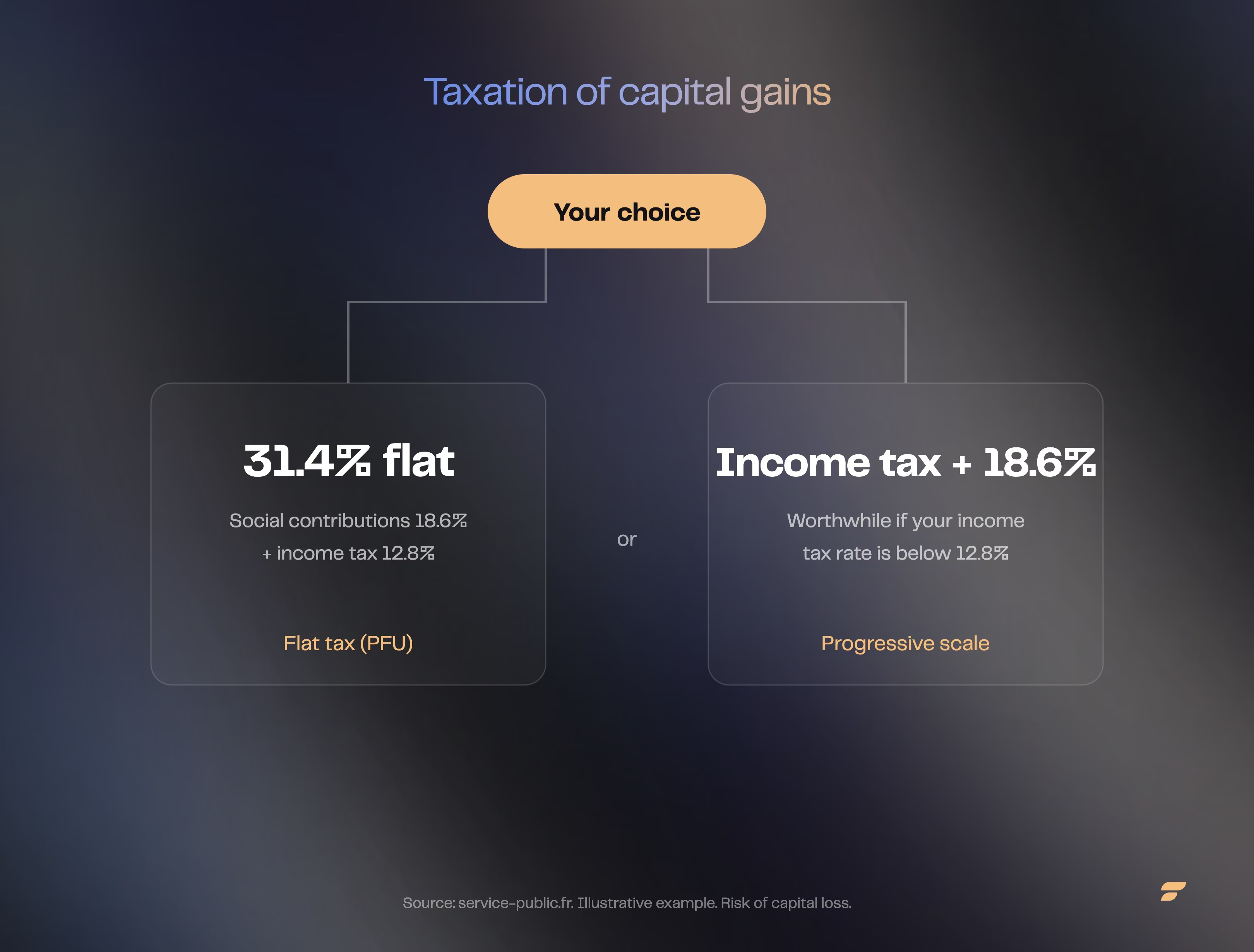
Capital gains realised within a CTO are subject to immediate taxation. Since 2018, the flat tax (PFU) has applied by default.
The PFU taxes capital gains at 31.4%, made up of 12.8% income tax and 18.6% social security contributions. This tax applies from the very first euro of gain. According to the official Service-Public.fr website, the social security contribution rate on investment income rose from 17.2% to 18.6% on 1 January 2026, taking the overall PFU rate from 30% to 31.4%.
For example, if you make a capital gain of €1,000 by selling shares, you will owe €314 in tax (PFU at 31.4%), leaving a net gain of €686.
That said, the French tax system offers an alternative: opting for the progressive income tax scale. This option can be advantageous for taxpayers whose marginal tax rate is below 12.8%. It also allows you to benefit from holding-period tax allowances on certain securities acquired before 2018, which can reach up to 65% after eight years of holding.
Managing capital losses

Managing capital losses is an often-overlooked but crucial aspect of CTO taxation. Unlike capital gains, which are taxed immediately, capital losses offer a tax optimisation opportunity.
- Offsetting: capital losses can be offset against capital gains made in the same year. If, at year-end, your losses exceed your gains, you can carry the loss forward to later years.
- Carry-forward: losses not offset can be carried forward against capital gains for the following ten years. This reduces the tax on future gains, improving your portfolio's overall performance.
This carry-forward option offers useful flexibility for managing your portfolio's tax position. For example, if you realise a large capital loss in one year, you might consider realising some unrealised gains in later years to "absorb" them for tax purposes.
Choosing between the PFU and the progressive scale
The decision to opt for the PFU or the progressive income tax scale is important and should be reassessed every year. This choice applies to all investment income (dividends, capital gains, interest) and cannot be made selectively.
- PFU: generally advantageous for taxpayers with a marginal tax rate above 12.8%. It also offers welcome simplicity, avoiding complex allowance calculations.
- Progressive scale: can be more advantageous in several cases:
- For taxpayers in the lowest tax brackets
- For holders of securities eligible for holding-period allowances
- For those receiving substantial dividends, thanks to the 40% allowance
Taxation of foreign securities
Investing in foreign securities through a CTO adds a layer of tax complexity. Foreign dividends are often subject to withholding tax in their country of origin, in addition to French taxation.
To avoid double taxation, France has signed tax treaties with many countries. These agreements generally allow you to recover part of the tax withheld abroad, either as a tax credit or through reduced taxation in France.
However, applying these treaties often requires additional administrative steps. For example, for US dividends, you will need to complete form 2047 in your tax return to benefit from the tax credit corresponding to the withholding tax.
Scenarios where the CTO is more advantageous
Depending on the investor's objectives, the CTO can be a good fit in certain scenarios:
- International diversification: for an investor looking to expose their portfolio to US, Asian or emerging markets, the CTO can be a good fit.
- Active management: traders or investors who frequently rotate their portfolio will find the CTO offers great flexibility.
- Large amounts: for investors who have used up the PEA and life-insurance caps, the CTO lets them keep investing without limit.
- Hedging strategies: the CTO allows the use of options and derivatives to hedge a portfolio, an option unavailable with the PEA and limited within life insurance.
The ordinary securities account offers great versatility for investing. It provides unmatched freedom within the world of financial investments. Its taxation is less favourable than the PEA's or life insurance's. However, its flexibility and lack of a cap can make it a relevant addition to your wealth strategy, depending on individual circumstances.
The CTO can suit investors seeking global exposure. It also meets the needs of active management or specific requirements not covered by other investment wrappers.
Frequently asked questions
What is the difference between a CTO and a PEA?
The ordinary securities account has no contribution cap and gives access to shares, bonds, ETFs and funds worldwide. The PEA is limited to European shares with a cap of €150,000, but offers an income tax exemption after five years of holding, excluding social security contributions.
Is an ordinary securities account risky?
Yes, investing through a CTO carries a risk of capital loss: the value of the shares, bonds or ETFs held can fall, unlike a regulated savings account such as the Livret A. Diversifying your portfolio helps limit this risk, though it never eliminates it entirely.
Can you hold several securities accounts?
Yes, an investor can open as many CTOs as they want, with a single provider or across several. This makes it possible, for example, to separate a long-term strategy from a more speculative pocket, making it easier to track the performance of each wrapper.
How are capital losses on a securities account taxed?
Capital losses realised on a CTO are not refunded, but they can be offset against capital gains made in the same year, then carried forward against gains for the following ten years if not fully offset in the first year.
What happens to an ordinary securities account when the holder dies?
Unrealised capital gains are wiped clean for tax purposes on the date of death: heirs receive the securities at their value on that date, with no tax on gains accrued before then. Inheritance tax, however, remains due on the value transferred.
Sources
Service-public.fr, Income from savings and investments
BOFiP, RPPM - Capital gains on intangible movable property
Regulatory disclaimers: Marketing communication. Investing carries a risk of partial or total capital loss. Past performance is not a reliable indicator of future performance. This article is provided for information and educational purposes only; it does not constitute personalised investment advice, a buy or sell recommendation, or tax advice.
Before investing, read the Key Information Document (KID) and, where relevant, consult an authorised adviser.
Finary SAS, an investment firm authorised by the ACPR (no. 19283), member of AMAFI. Insurance broker registered with ORIAS (no. 21001279), member of the CNCGP (association approved by the AMF). Crypto-Asset Service Provider (CASP) authorised by the AMF under the MiCA regime, references no. A2026-026 and no. N2026-008.

