


Should You Invest in Gold in France?

Updated on 16 July 2026
Gold is the most expensive asset in the world, and for investors in France it is also an unproductive one: holding it pays no dividend, no interest and no rent. Over the very long run, it builds far less wealth than stocks. It still has a use as a diversification tool, in small doses and for the right reasons.

- Gold is an unproductive asset: its value depends only on what another buyer is willing to pay, not on any return it produces.
- Over 211 years, gold has returned about 0.6% a year in real terms, against 6.7% a year for stocks.
- Its price depends on three factors: the type of crisis, interest rates and the value of the dollar.
- An allocation of 0% to 5% of one's wealth is enough to add diversification, with expert consensus capping around 5% to 10%.
- To start with physical gold, the Napoléon 20-franc coin remains the reference, with a premium often close to 0%.
Is Gold Really a Good Investment?
Over the very long term, no: gold does not build wealth the way stocks do. Looking back 211 years, gold has generated about 0.6% a year in real terms, while stocks have generated 6.7% a year.
Let's start with a paradox. What is the most expensive asset in the world? You probably think of Apple or Nvidia. In reality, it's gold, with a market value of $32 trillion. That's the GDP of the United States, and 14 times Bitcoin's market cap.
Yet gold has a strange trait for an investment: holding it pays nothing.
- Holding a stock makes you a shareholder, eligible for dividends.
- Holding a bond makes you a creditor, who earns interest.
- Holding real estate makes you an owner, who collects rent.
When you buy gold, you store it and wait for someone else to buy it back, ideally at a higher price. Its price therefore rests on speculation alone. This is what's called an unproductive asset. Warren Buffett has long criticised gold for this reason.
To judge gold, you have to compare it with stocks. The table below sets the price of gold against the American stock index, the S&P 500, over three time horizons.
| Horizon | Gold | S&P 500 |
|---|---|---|
| 26 years | x15 (in dollars) | x5 |
| 36 years | about x13 | x20 |
| 211 years (annual real return) | 0.6% a year | 6.7% a year |
Past performance is not a reliable indicator of future performance.
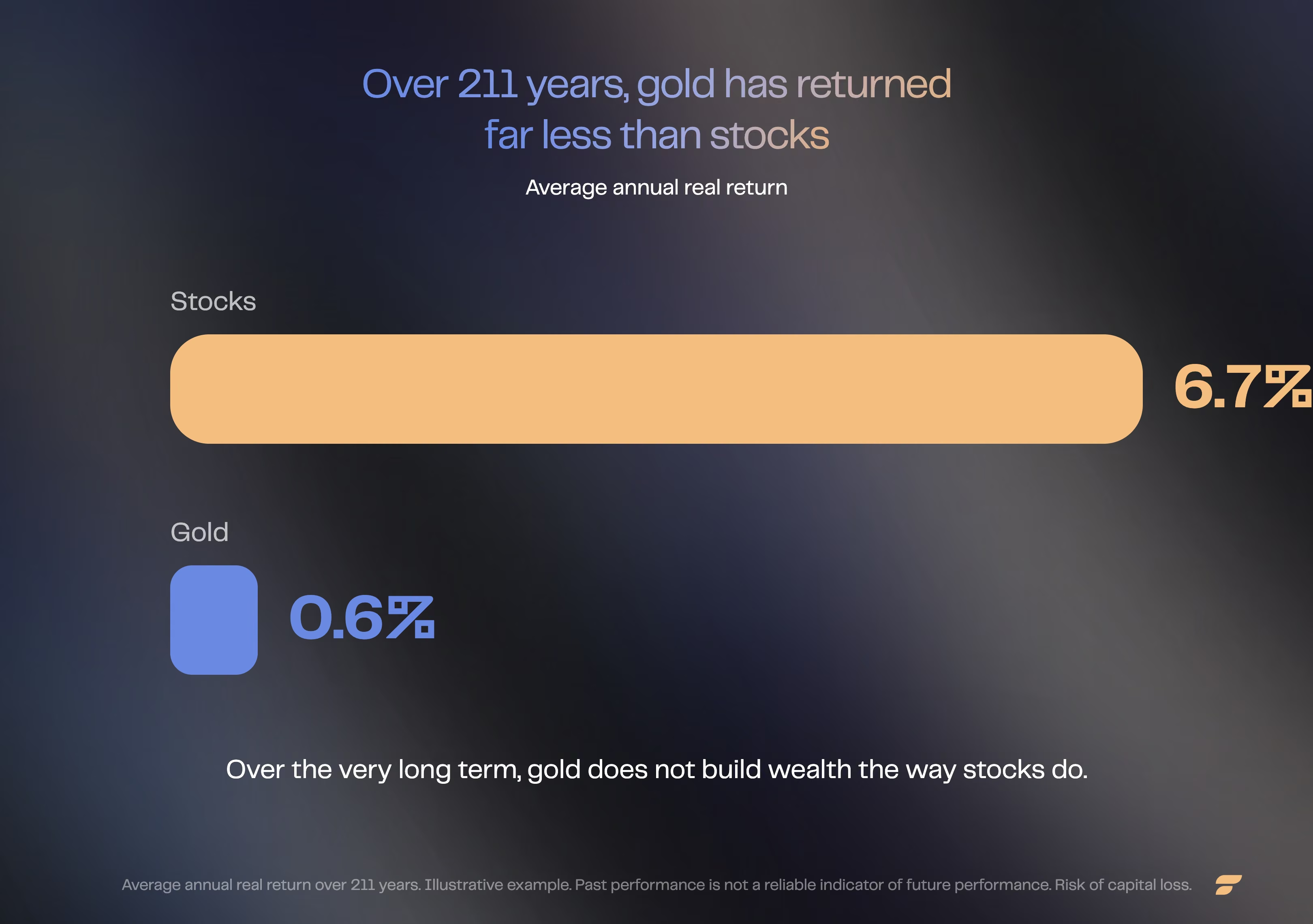
Over 26 years, gold does better. But as soon as the horizon lengthens, the balance swings clearly in favour of stocks. Over the very long term, gold does not build wealth. Should it be ignored altogether, then? Not necessarily, and to understand why, you need to see what actually moves its price.
Why Does the Price of Gold Rise?
Because gold is scarce and its supply is nearly fixed, while money can be printed without limit. When confidence in a currency erodes, gold mechanically gains value against it.
Gold has been tied to humanity for millennia, first as a medium of exchange, then as a symbol of wealth. The pharaohs' gold buried 3,000 years ago is still pure today. In early 2026, the gold price hovers around $5,000 a troy ounce (31.10 grams). That's a 140-fold increase since the 1971 Nixon shock.
Before that date, every dollar could be exchanged for real gold: this was the gold standard. An ounce was then always worth exactly $35. But the Vietnam War was expensive. The US central bank printed more dollars than it held in gold reserves. Some countries, including France, started exchanging their dollars for the yellow metal. On 15 August 1971, Nixon severed the link between the dollar and gold.
Since then, banknotes have been worth only as much as the trust placed in them. This is fiat money, from the Latin fiducia, meaning trust. Voltaire understood this well:
“Paper money eventually returns to its intrinsic value, which is zero!”
Voltaire
You can print banknotes without limit, but not gold: the world's stock is nearly fixed, at 216,265 tonnes in circulation. Gold therefore mechanically gains value against currencies that can, in theory, fall back to zero. Beyond this baseline, the gold price responds to three factors.
The Type of Economic Crisis
Gold doesn't react the same way to every crisis. In 2008, when Lehman Brothers, the fourth-largest US investment bank, collapsed, gold lost nearly a third of its value from its March peak. Investors sold all their assets, including gold, to raise cash immediately: that's a liquidity crisis.
From 2008, central banks launched quantitative easing programmes, the technical name for printing money. Investors lost confidence in the value of money and feared future inflation. Between 2009 and 2011, gold rose 160%. Past performance is not a reliable indicator of future performance.
Interest Rates
In 2022, inflation reached 5% in France, 7% in Germany, 8% in the United States. Gold should normally have risen. But it stagnated that year. Why? Because the US central bank raised its rates to 4% within a few months. Investors then preferred to lend their money at attractive, low-risk rates, and turned away from gold.
The Value of the Dollar
Gold is priced in dollars on international markets. When the dollar is strong, gold becomes more expensive for international buyers, who must spend more euros, yen or yuan: demand falls, and so does the price. When the dollar is weak, gold becomes cheaper in local currencies, demand rises, and so does the price.
When these three factors align, a weak dollar, falling rates and distrust in the system, gold can rise sharply. But nothing guarantees the trend will last.
Does Gold Really Protect Against Inflation?
Not automatically, at least not over short periods. Gold is supposed to preserve purchasing power when prices rise, but history shows several clear counter-examples. Past performance is not a reliable indicator of future performance.
In 1980, the gold ounce hit a record $850. In 2007, it was still worth roughly the same. Over a quarter century, an investor gained nothing, and their money even lost half its value to inflation. Gold reached another peak in 2011, at $1,900 an ounce, in the middle of the eurozone crisis. Over the following nine years, it stagnated.
The figures make the point clearly. €10,000 invested in gold at its 2011 high was still worth no more in 2022. The same €10,000 invested at the same time in a global stock index was worth just over €30,000 in 2022, about twice the rate of inflation over the period.
The gold-inflation link is even more counter-intuitive over the short term:
- Between 1980 and 1982, inflation in France averaged 13% a year. During this period, gold fell.
- Between 1994 and 1998, inflation was more moderate, at 2% a year. Yet gold lost 30% of its value.
Over short periods, gold is therefore not an automatic hedge against the loss of purchasing power.

How Much Gold Should You Hold?
An allocation of 0% to 5% can be appropriate to add diversification, with expert consensus at around 5% to 10% at most. Gold's appeal has nothing to do with its return, but with its near-zero correlation with stocks: it moves independently of the stock market, which can cushion a portfolio.
At Finary, we favour long-term investing. In that logic, gold remains a complement, never the core of a portfolio. Two mistakes are worth avoiding.
Mistake 1: buying at record prices. When gold makes the front page, even in general-interest media that don't usually cover money, retail investors buy heavily out of FOMO (fear of missing out). Historically, retail investors tend to arrive late in the cycle: they are the ones buying at the very top, just before a correction sets in. Caution is warranted.
Mistake 2: putting too much into gold. Articles about gold sometimes talk of collapse, crisis, financial survival. This pessimistic narrative is often spread by professional gold dealers. They are not bound by the same warning obligations as regulated financial intermediaries. Some use fear to make you buy more, and earn more commission. As the saying goes, trees don't grow to the sky.
How to Invest in Gold?
Three routes exist: physical gold (coins and bars), paper gold (a listed product that tracks the price) and mining company stocks. Each has its own logic for holding, fees and taxation. Gold is part of the commodities asset class, a category of its own.
Physical Gold: The Napoléon 20-Franc Coin
The Napoléon 20-franc coin is the reference for getting started. In the event of a major breakdown of the financial system, it remains within reach. Why this coin rather than another? Because 515 million Napoléon coins are in circulation. This market depth makes reselling easier: specialist dealers never hesitate over a Napoléon 20-franc coin, whereas they fear counterfeits on lesser-known coins. Its size also lets you buy in small amounts.
When you buy physical gold, you sometimes pay a premium, the difference between the coin's price and the gold it contains. For the Napoléon 20-franc coin, this premium is often close to 0%.
Some formats are best avoided:
- One-gram mini-bars often cost 15% to 20% more than pure gold. You lose 15% to 20% from day one.
- Jewellery contains alloys: an 18-carat gold piece contains only 75% pure gold.
- Large bars lack flexibility. A one-kilogram bar is worth around €148,000, and you can't sell just part of it.
- Collector coins belong to a different market, numismatics, where the price depends on rarity and condition, not gold weight.
For storage, a few thousand euros of gold can stay at home, as long as you stay discreet. A bank safe-deposit box becomes worthwhile up to €50,000-€100,000 of gold, for a cost of €100 to €200 a year. Beyond that, a specialist private vault may be needed.
Where to buy? Through specialist online platforms or physical counters. Banks charge a commission of 2% to 4%, specialist shops and websites 1% to 4%. In every case, your coins should be sealed with a duplicate of the purchase invoice: this avoids damaging the coin and disappointments on resale. This point isn't cosmetic, it's decisive for taxation.
How Is Physical Gold Taxed?
At purchase, there's no VAT. At sale, two regimes coexist, and you can choose the more advantageous one if you've kept your records.
| Regime | Tax base | Rate | Condition |
|---|---|---|---|
| Flat-rate tax on precious metals | Total sale price | 11.5% | No proof required |
| Actual capital-gains regime | Capital gain realised | 37.6%, 5% allowance per year from the 3rd year, exemption after 22 years | Proof of purchase date and price required |
Let's take an example. You buy an ounce for €4,000 and sell it four years later for €4,200, a €200 capital gain.
- Without proof of purchase, you're subject to the flat-rate tax: 11.5% of €4,200, or €483 in tax. With a capital gain of only €200, you lose money.
- With proof of purchase, you opt for the capital-gains regime. After 4 years, the allowance is 10%, your taxable gain drops from €200 to €180, and the tax comes to 37.6% of €180, or €67.
Coins minted before 1800 are a special case: treated as collectibles, they're exempt if the sale is under €5,000, and taxed at 6.5% above that. To navigate these options, a tax expert or accountant can help.
Paper Gold: ETCs
There's a listed product that tracks the gold price without holding it physically: paper gold. If gold rises 2%, this product rises by about 2%, give or take a small gap called tracking error. Amundi Physical Gold is one example: its management fee is 0.12% a year and its tracking error 0.15% a year, negligible over the long run. It holds real gold, stored at HSBC in London.
This type of product is an ETC (Exchange-Traded Commodity). You don't own the gold yourself: you hold a claim on it. To buy one, you need to open a securities account. To understand this wrapper, see our guide on the securities account (CTO). Paper gold held in a CTO is subject to the flat tax (PFU) of 31.40% on capital gains, a fixed rate that applies by default unless you opt for the progressive income tax scale. To compare paper-gold products, their fees and how they replicate the price, see our dedicated article on gold ETFs, part of the wider commodity ETFs.
Mining Stocks
The last route: investing in the companies that mine gold. Their revenues are correlated with the gold price, but the tracking is imperfect, and their volatility is much higher: their prices swing more, and less predictably, than gold itself. These companies face variable extraction costs depending on the deposit, and, like any business, operational challenges. This indirect approach therefore carries more risk.

Frequently Asked Questions
Is Gold a Productive Asset?
No. Gold generates no dividend, no interest and no rent, unlike a stock, a bond or real estate. Its value rests solely on the price another buyer is willing to pay. This is called an unproductive asset, whose price depends on speculation.
What Share of Your Wealth Should You Put in Gold?
An allocation of 0% to 5% can add diversification, thanks to gold's near-zero correlation with stocks. Expert consensus puts the ceiling around 5% to 10%. Gold remains a diversification tool, not the core of a portfolio.
What Is the Best Gold Coin to Start With?
The Napoléon 20-franc coin is the reference for getting started. With 515 million coins in circulation, it resells easily and its premium is often close to 0%. Specialist dealers accept it without hesitation, whereas lesser-known coins raise fears of counterfeiting.
How Is Physical Gold Taxed When You Sell It?
Two regimes coexist. The flat-rate tax on precious metals stands at 11.5% of the total sale price, with no proof required. The actual capital-gains regime taxes only the gain at 37.6%, with a 5% allowance per year from the 3rd year and an exemption after 22 years, on proof of purchase.
Does Gold Protect Against Inflation?
Not automatically. Between 1980 and 1982, despite inflation of 13% a year in France, gold fell. Between 1994 and 1998, it lost 30% of its value. Over short periods, gold is not a reliable hedge against the loss of purchasing power.
Sources
impots.gouv.fr - Flat-rate tax on the sale of precious metals (form 2091-SD)
impots.gouv.fr - Taxation of capital gains on securities (PFU)
AMF - ETFs (trackers): features and risks
Regulatory disclaimers: Marketing communication. Investing carries a risk of partial or total capital loss. Past performance is not a reliable indicator of future performance. This article is for information and educational purposes only; it does not constitute personalised investment advice, a buy or sell recommendation, or tax advice. Before investing, read the Key Information Document (KID) and, where relevant, consult an authorised adviser. Finary SAS, an investment firm authorised by the ACPR under no. 19283, member of AMAFI. Insurance broker registered with ORIAS under no. 21001279, member of the CNCGP (association approved by the AMF). Crypto-Asset Service Provider (CASP) authorised by the AMF under the MiCA regime, under references no. A2026-026 and no. N2026-008.