


How much does 200,000 euros earn per month?

Updated 28 July 2026
€200,000 invested earns between €433 and €1,500 per month depending on the option chosen: around 2.6% a year in a life insurance euro fund, 4% to 6% in rental property, 7% to 9% on average in equities or ETFs, with a risk of capital loss on the latter.

- Life insurance euro funds returned 2.6% on average in 2025, against 1.5% for the Livret A and the LDDS (1.7% from 1 August 2026).
- The Livret A is capped at €22,950 and the LDDS at €12,000 per person, excluding accumulated interest.
- Interest and gains remain subject to the flat tax of 31.4% since 2026, apart from exceptions such as life insurance or a PEA after 5 years.
- The longer the holding period, the more compound interest widens the gap between secure and higher-risk options.
- Simulations at 7% to 10% on equities and ETFs are assumptions with no guarantee, never promises of return.
How much does €200,000 invested earn per month?
A €200,000 investment earns, as an order of magnitude, between €5,200 and €18,000 a year depending on the option chosen: regulated savings accounts and euro funds for safety, equities, ETFs or rental property for higher return potential, with a risk of capital loss depending on the option. The return also depends on the holding period, prevailing rates and market conditions.
To work out how much €200,000 invested earns per month, several factors matter: the type of investment, the holding period, the interest rate and the associated risks.
On the type of investment, there are many options such as life insurance, savings accounts, equity savings plans (PEA) and retirement savings. Each has its own characteristics and risk level. Savings accounts, for example, are generally less risky than equity investments, but they also deliver lower returns.
The interest rate is a key element in determining how much €200,000 invested earns per month. Rates vary with the type of investment and the economic environment. Life insurance euro funds, for instance, returned 2.6% on average in 2025 according to France Assureurs, for the third year running, whereas a PEA can reach higher levels depending on how equities perform.
The holding period also matters when working out what an invested amount earns. The longer the period, the more compound interest lets the capital grow. A long-term investment generally generates larger gains than a short-term one. A compound interest calculator can help here.
The risk of loss must also be taken into account when assessing the return on an investment. Some investments, such as equities and investment funds, carry a risk of capital loss. It is therefore important to assess your own risk tolerance before choosing an investment.
Finally, it is important to factor in the taxation that applies to the gains generated. In France, the "flat tax" applies to investment income and has been set at 31.4% since 1 January 2026 (12.8% income tax and 18.6% social levies), apart from exceptions such as life insurance or a PEA after 5 years.

It is worth stressing that this example is simplified and does not account for changes in interest rates, inflation or any management fees.
Why is it so hard to know how much €200,000 invested earns per month?
The estimate is difficult because returns vary widely with the option chosen, its taxation and inflation, and no guarantee applies to the non-secure options.
The variability of returns on non-guaranteed investments
Working out how much €200,000 invested generates per month is complex, because non-guaranteed investments come with variable returns. This means past performance is not a reliable indicator of future performance, which makes any forecast difficult. Equity investments such as the Nasdaq, for example, are subject to volatility and market swings.
The risks attached to the different types of investment
Another factor that complicates working out the monthly gain is the risks attached to the different types of investment. Bonds, for example, offer lower but more stable returns, whereas equities carry a risk of capital loss but also potentially higher returns.
The principles of compounding and how it works
Understanding compound interest, or compounding, is essential to assessing the return on a €200,000 investment per month. The basic principle is that the gains generated by an investment are reinvested, which gradually increases the value of the capital and generates more passive income.
The tax consequences of the various investments and wrappers
Taxation also affects how profitable an investment is. Some investments, such as SCPIs (French real estate investment trusts) or life insurance, offer tax advantages, whereas others are subject to tax on capital gains or income. Rent received from property, for example, is taxable, which can reduce the net return.
Factoring inflation into financial assessments
Finally, inflation is a key element to take into account when estimating the return on an investment. Rising inflation can reduce the real value of a monthly gain if the investment's returns do not keep pace. To preserve purchasing power, inflation should therefore be built into your assessments.
In short, assessing how much €200,000 invested earns per month means taking many factors into account: the variability of returns, the risks, taxation and inflation. Investors therefore need to establish their investor profile and their appetite for risk before choosing an investment.

How much does €200,000 earn by type of investment?
The monthly gain varies widely with the option chosen: from a few hundred euros for savings accounts to several thousand euros for equity or ETF investments held over a long period, with no certainty of return.
How much can €200,000 earn on the stock market?
Investing on the stock market offers high return potential, but also a degree of volatility. Equities are generally regarded as risky investments, and returns can vary considerably depending on the companies and market conditions. For €200,000 invested in equities, the monthly gain will depend on the annual rate of return, which can be hard to predict.
€200,000 in listed equities (hypothetical return 7% (not guaranteed))
| Period (years) | Monthly gains (€) | Annual gains (€) | Total gains (€) |
|---|---|---|---|
| 5 | 1,341.84 | 16,102.07 | 80,510.35 |
| 10 | 1,611.92 | 19,343.03 | 193,430.27 |
| 15 | 1,954.48 | 23,453.75 | 351,806.31 |
| 20 | 2,391.40 | 28,696.84 | 573,936.89 |
| 25 | 2,951.62 | 35,419.46 | 885,486.53 |
| 30 | 3,673.48 | 44,081.70 | 1,322,451.01 |
€200,000 in an S&P 500 ETF (hypothetical return 10% (not guaranteed))
| Period (years) | Monthly gains (€) | Annual gains (€) | Total gains (€) |
|---|---|---|---|
| 5 | 2,035.03 | 24,420.40 | 122,102.00 |
| 10 | 2,656.24 | 31,874.85 | 318,748.49 |
| 15 | 3,530.28 | 42,363.31 | 635,449.63 |
| 20 | 4,772.92 | 57,275.00 | 1,145,499.99 |
| 25 | 6,556.47 | 78,677.65 | 1,966,941.19 |
| 30 | 9,138.56 | 109,662.68 | 3,289,880.45 |
€200,000 in a World ETF (hypothetical return 8% (not guaranteed))
| Period (years) | Monthly gains (€) | Annual gains (€) | Total gains (€) |
|---|---|---|---|
| 5 | 1,564.43 | 18,773.12 | 93,865.62 |
| 10 | 1,931.54 | 23,178.50 | 231,785.00 |
| 15 | 2,413.52 | 28,962.25 | 434,433.82 |
| 20 | 3,050.80 | 36,609.57 | 732,191.43 |
| 25 | 3,898.98 | 46,787.80 | 1,169,695.04 |
| 30 | 5,034.81 | 60,417.71 | 1,812,531.38 |
The rates shown in these tables (7%, 8%, 10%) are simulation assumptions based on the average historical returns of equity markets (MSCI World, +8.1%/year over 1990-2025); they are not a guarantee of future performance.
How much can €200,000 earn in property?
Property investment is a more stable alternative for investing €200,000. By holding a rental property, you could generate regular rental income and potentially benefit from a capital gain if you resell. Profitability depends on several factors, including the property's location, the purchase price and interest rates. For a €200,000 property investment, the monthly gain depends on the rent received and the costs of managing the property.
€200,000 in rental property (hypothetical return 4% (not guaranteed))
| Period (years) | Monthly gains (€) | Annual gains (€) | Total gains (€) |
|---|---|---|---|
| 5 | 722.18 | 8,666.12 | 43,330.58 |
| 10 | 800.41 | 9,604.89 | 96,048.86 |
| 15 | 889.94 | 10,679.25 | 160,188.70 |
| 20 | 992.60 | 11,911.23 | 238,224.63 |
| 25 | 1,110.56 | 13,326.69 | 333,167.27 |
| 30 | 1,246.33 | 14,955.98 | 448,679.50 |
€200,000 in SCPIs (hypothetical return 5% (SCPI, not guaranteed, illiquid))
| Period (years) | Monthly gains (€) | Annual gains (€) | Total gains (€) |
|---|---|---|---|
| 5 | 920.94 | 11,051.26 | 55,256.31 |
| 10 | 1,048.16 | 12,577.89 | 125,778.93 |
| 15 | 1,198.81 | 14,385.71 | 215,785.64 |
| 20 | 1,377.75 | 16,532.98 | 330,659.54 |
| 25 | 1,590.90 | 19,090.84 | 477,270.99 |
| 30 | 1,845.52 | 22,146.28 | 664,388.48 |
How much can €200,000 earn in savings accounts?
Savings accounts offer a safe, low-risk option for investing a sum such as €200,000.
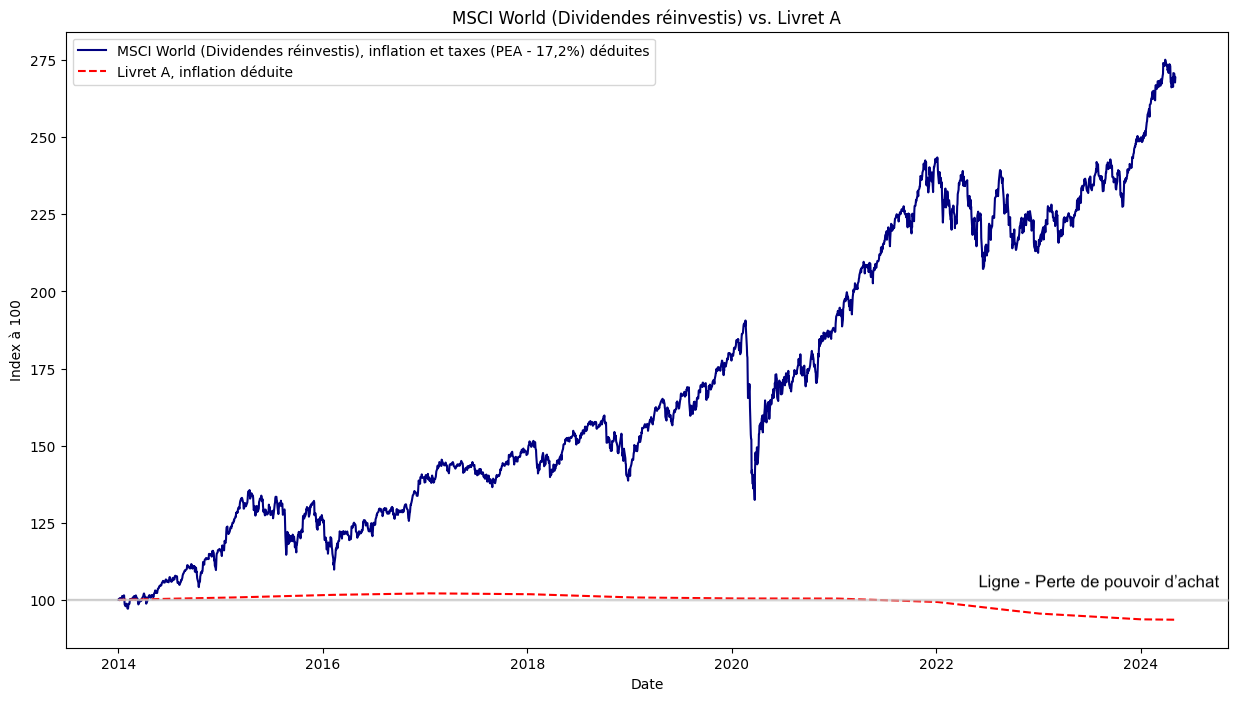
For a higher return, you could combine regulated savings accounts with money market funds, although the return generally remains lower than that of equities or property. Monthly gains from savings accounts depend mainly on the prevailing interest rate and the total amount deposited across the various accounts.
Goals
Frequently asked questions
How can you optimise a €200,000 investment in 2026?
To consider investing €200,000 in 2026, diversification can be examined across several options, such as equities, bonds, property and guaranteed-rate investments. Take your investment horizon, your risk aversion and your personal objectives into account.
An authorised financial adviser can help you analyse your wealth situation. This article does not constitute personalised investment advice.
What income can €200,000 generate?
The income you can obtain from a €200,000 investment depends on several factors, such as the type of investment, the holding period, the rate of return and market swings. If you invest in a financial product offering an annual interest rate of 3%, for example, you could in theory receive around €6,000 a year, or €500 a month. This is an indicative estimate; neither the capital nor the return is guaranteed, depending on the option chosen.
It is worth noting, though, that the actual return on your investment can vary and that the income generated may be higher or lower depending on the parameters mentioned above.
Can you place €200,000 in a single Livret A or LDDS?
No, the Livret A is capped at €22,950 and the LDDS at €12,000 of deposits per person, excluding accumulated interest. To place €200,000 in regulated accounts, you have to spread it across several holders or combine it with other investments such as life insurance.
What is the best risk-free investment for €200,000?
Life insurance euro funds and regulated savings accounts (Livret A, LDDS) offer the most safety, with capital protected by the insurer or the state. Their return remains modest: around 1.5% for savings accounts, with an increase to 1.7% planned for 1 August 2026, and 2.6% on average for euro funds in 2025, according to France Assureurs.
Sources
France Assureurs: 2025 life insurance report, euro fund returns
Service-public.fr: Livret de Développement Durable et Solidaire (LDDS)
Service-public.fr: taxation of equity income
Regulatory disclaimers: Marketing communication. Investing carries a risk of partial or total capital loss. Past performance is not a reliable indicator of future performance. This article is provided for information and educational purposes only; it does not constitute personalised investment advice, a recommendation to buy or sell, nor tax advice.
Before investing, read the Key Information Document (KID) and, where relevant, consult an authorised adviser.
Finary SAS, an investment firm authorised by the ACPR under no. 19283, member of AMAFI. Insurance broker registered with ORIAS under no. 21001279, member of the CNCGP (association approved by the AMF). Crypto-Asset Service Provider (CASP) authorised by the AMF under the MiCA regime, references no. A2026-026 and no. N2026-008.