


How much does 100,000 euros earn per month?

Updated 28 July 2026
€100,000 invested earns between €217 and €750 per month depending on where it sits: around 2.6% per year in a life insurance euro fund, 4 to 6% in rental property or SCPIs, 7 to 9% on average in equities or ETFs, with a risk of capital loss. This guide sets out the returns by type of investment, from the Livret A (1.5%, then 1.7% on 1 August 2026) to equities and ETFs, taking in rental property and SCPIs along the way.

- Regulated savings accounts (Livret A, LDDS) are capped at €22,950 and €12,000, far too low to hold €100,000 in full.
- Diversifying between equities, property and euro funds spreads the risks and lets you adjust the return/risk balance to your profile.
- Taxation (the flat tax of 31.4% in 2026) and inflation reduce the real return achieved: both must be factored into any simulation of gains.
- A wealth simulator lets you test several scenarios before investing €100,000 over your chosen period.
Why is it so hard to know how much €100,000 earns per month?
Working out the monthly returns on €100,000 invested can prove complex, because they are affected by multiple factors such as market volatility, taxation and inflation. Understanding these drivers is essential to running an accurate simulation.
The variability of returns on investments without a capital guarantee
Investments without a capital guarantee, such as shares or mutual funds, are subject to high volatility. The level of risk and the potential return on these investments can vary significantly from one month to the next. Market conditions, company results and geopolitical events can all influence investment performance and, as a result, the return on the capital invested.
The risks attached to different forms of investment
Each type of investment carries its own levels of risk and conditions. Riskier corporate bonds might offer a higher return but come with a higher level of default risk. Conversely, savings accounts offer a more stable but generally lower return. Understanding these nuances is crucial to any financial simulation.
How compounding works and its basic rules
Compounding refers to the accumulation of interest generated by the capital invested, which is reinvested to produce further interest. The compounding frequency, whether monthly, quarterly or annual, influences the total return. The higher the compounding frequency, the more the potential return can grow, always within the applicable tax rules.

How tax bites depending on the type of investment and account
Taxation affects the net return on any investment. Interest, dividends and capital gains are often taxed at rates that vary with the type of investment account (such as the PEA, a French tax-advantaged equity savings account, or life insurance) and with the tax law in force.
Different investment vehicles such as life insurance or savings accounts offer varied tax advantages, often tied to the length of the investment. These taxes must be factored into any simulation of investment returns to get a clear view of the real gains.
Including the impact of inflation in your financial assessment
Inflation reduces the purchasing power of money over time and must be included when assessing investments. An investment may look profitable on paper, but if the inflation rate exceeds the return, the investor's real purchasing power falls. That is why it is important to consider inflation in any analysis of returns.
These interconnected factors make calculating investment returns a nuanced and complex task.
How much does €100,000 earn per month by type of investment?
Investing €100,000 can generate different levels of return depending on the type of investment chosen, the length of the investment and market conditions. Each type of investment offers unique advantages and carries specific risks.
How much can €100,000 earn per month on the stock market?
On the stock market, the performance of the €100,000 invested will depend heavily on the shares and ETFs chosen, as well as on the portfolio's diversification.
€100,000 in listed shares (estimated return 7%)
| Duration (years) | Monthly gains (€) | Annual gains (€) | Total gains (€) |
|---|---|---|---|
| 5 | 670.92 | 8,051.03 | 40,255.17 |
| 10 | 805.96 | 9,671.51 | 96,715.14 |
| 15 | 977.24 | 11,726.88 | 175,903.15 |
| 20 | 1,195.70 | 14,348.42 | 286,968.45 |
| 25 | 1,475.81 | 17,709.73 | 442,743.26 |
| 30 | 1,836.74 | 22,040.85 | 661,225.50 |
Assumption based on the historical performance of the major equity indices (source: JustETF, MSCI World). Past performance is not a reliable indicator of future performance.
€100,000 in an S&P 500 ETF (estimated return 10%)
| Duration (years) | Monthly gains (€) | Annual gains (€) | Total gains (€) |
|---|---|---|---|
| 5 | 1,017.52 | 12,210.20 | 61,051.00 |
| 10 | 1,328.12 | 15,937.42 | 159,374.25 |
| 15 | 1,765.14 | 21,181.65 | 317,724.82 |
| 20 | 2,386.46 | 28,637.50 | 572,749.99 |
| 25 | 3,278.24 | 39,338.82 | 983,470.59 |
| 30 | 4,569.28 | 54,831.34 | 1,644,940.23 |
The S&P 500 delivered around 14%/year over 5 years and 11.8%/year since 2010; the 10% assumption used here is deliberately cautious (source: JustETF, iShares Core S&P 500). Past performance is not a reliable indicator of future performance.
€100,000 in a World ETF (estimated return 8%)
| Duration (years) | Monthly gains (€) | Annual gains (€) | Total gains (€) |
|---|---|---|---|
| 5 | 782.21 | 9,386.56 | 46,932.81 |
| 10 | 965.77 | 11,589.25 | 115,892.50 |
| 15 | 1,206.76 | 14,481.13 | 217,216.91 |
| 20 | 1,525.40 | 18,304.79 | 366,095.71 |
| 25 | 1,949.49 | 23,393.90 | 584,847.52 |
| 30 | 2,517.40 | 30,208.86 | 906,265.69 |
The MSCI World index delivered around 12.5%/year over 5 years; the 8% assumption used here is cautious (source: JustETF, iShares Core MSCI World). Past performance is not a reliable indicator of future performance.
The rates shown in these tables (7%, 8%, 10%) are simulation assumptions based on the average historical performance of equity indices (JustETF, MSCI World; JustETF, S&P 500); they are not a guarantee of future performance.
On average, shares can generate an average annual rate of return of 7% to 10%, thanks to compound interest, subject to market swings. Liquidity is also high, allowing quick access to funds, and diversification is possible through mutual funds or bonds.
A longer investment period is often an advantage in reducing the impact of volatility. Putting €100,000 into a PEA, for instance, could potentially offer tax advantages and moderate liquidity.
How much can €100,000 earn per month in property?
For property, and rental property in particular, the yield can vary with location and the type of asset. An initial investment of €100,000 could generate a monthly income through rents, while also benefiting from a possible capital gain on resale as the asset appreciates over the long term
€100,000 in rental property (estimated return 4%)
| Duration (years) | Monthly gains (€) | Annual gains (€) | Total gains (€) |
|---|---|---|---|
| 5 | 361.09 | 4,333.06 | 21,665.29 |
| 10 | 400.20 | 4,802.44 | 48,024.43 |
| 15 | 444.97 | 5,339.62 | 80,094.35 |
| 20 | 496.30 | 5,955.62 | 119,112.31 |
| 25 | 555.28 | 6,663.35 | 166,583.63 |
| 30 | 623.17 | 7,477.99 | 224,339.75 |
Estimate corresponding to an average gross rental yield (before costs and tax) observed in France (source: Notaires de France).
€100,000 in SCPIs (estimated return 5%)
| Duration (years) | Monthly gains (€) | Annual gains (€) | Total gains (€) |
|---|---|---|---|
| 5 | 460.47 | 5,525.63 | 27,628.16 |
| 10 | 524.08 | 6,288.95 | 62,889.46 |
| 15 | 599.40 | 7,192.85 | 107,892.82 |
| 20 | 688.87 | 8,266.49 | 165,329.77 |
| 25 | 795.45 | 9,545.42 | 238,635.49 |
| 30 | 922.76 | 11,073.14 | 332,194.24 |
Average SCPI distribution rate: 4.91% in 2025 (source: ASPIM). Past performance is not a reliable indicator of future performance.
Property investments can offer attractive returns thanks to the rents received and the asset's potential appreciation.
SCPIs (Sociétés Civiles de Placement Immobilier, French non-listed real-estate investment funds) posted an average distribution rate of 4.91% in 2025, ranging from 4.2% to 6% by category according to ASPIM.
Property does, however, often involve lower liquidity and requires active management to maintain the investment's performance.
How much can €100,000 earn per month in regulated savings accounts?
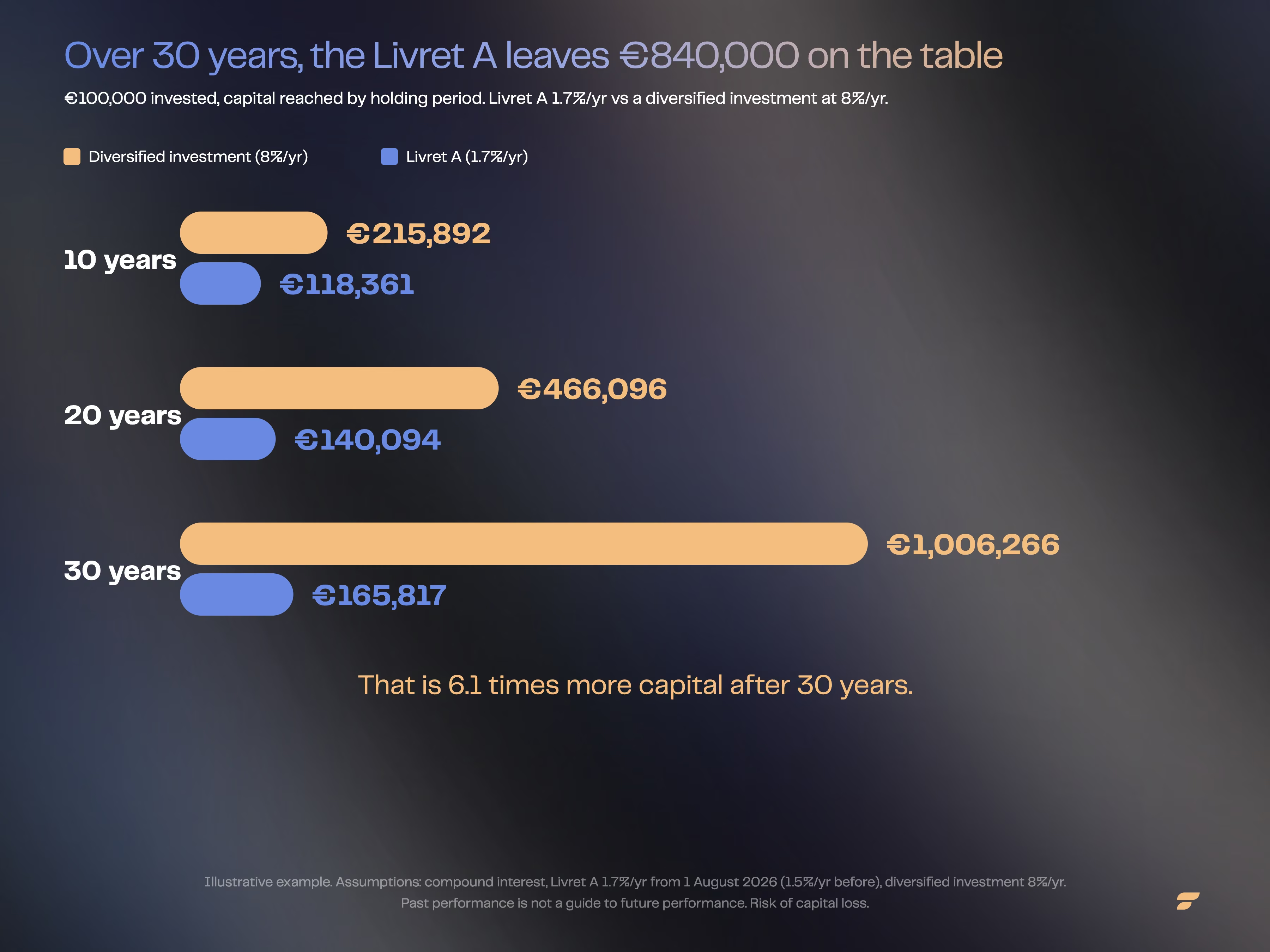
Regulated savings accounts, such as the Livret A or the euro funds in a life insurance policy, are considered secure investments with high liquidity. Their returns are more modest, however, often below the rate of inflation. The Livret A, for example, offers a rate of return of 1.5% since February 2026 (rising to 1.7% from 1 August 2026), meaning the interest earned on €100,000 would be relatively low but with no risk of capital loss. The Livret A is also capped at €22,950. The chart below compares, over 30 years, €100,000 left in a Livret A at 1.7% against the same amount invested in a diversified holding at 8% per year: the gap reaches nearly €850,000 (return not guaranteed).
Investment vehicles and their tax advantages
Investing €100,000 can benefit from various tax advantages depending on the financial vehicles chosen. A PEA (Plan d'Épargne en Actions, a French tax-advantaged equity savings account) allows listed shares to be held with lighter taxation after five years, offering substantial tax benefits on the capital gains realised.
In life insurance, a sensible allocation can be made within euro funds, known for their security and stability. They offer a favourable tax framework, notably after eight years of holding, through allowances on the interest received. Life insurance also makes it possible to invest in ETFs or responsible finance funds, combining potential return with social or environmental impact.
More capital invested

Non-contractual document for promotional purposes. Investment in unit-linked vehicles carries a risk of capital loss, since their value is subject to fluctuation, both upwards and downwards, depending in particular on developments in the financial markets. The insurer guarantees the number of units, not their value. The e-vie life insurance policy is an individual life insurance policy, denominated in euros and/or unit-linked vehicles, underwritten by Generali Vie, a company governed by the French Insurance Code. Finary SAS, 58 rue de Monceau 75380 Paris 8, insurance broker registered with ORIAS no. 21001279.
Rental property is another option, with the possibility of deducting loan interest and management costs, as well as certain tax relief measures under the schemes in force, which can change from year to year. That reduces income tax while building assets.
Savers can also choose the Livret A to secure part of their capital; the interest is tax-free, although returns are generally low.
Since the introduction of the flat tax, interest, dividends and capital gains on securities are taxed at a flat rate of 31.4% (12.8% income tax + 18.6% social levies), but holdings in life insurance or a PEA can benefit from lower taxation after their respective holding periods. Those focused on preparing for retirement can opt for retirement savings products, which offer tax advantages during the contribution phase.
Optimisation and long-term investment strategies
When considering investing €100,000, the investment period plays a central role in determining potential gains. Over the long run, invested savings can generate a stable monthly income, provided you adopt optimised investment strategies.
- Investment period: opt for an extended horizon, ideally more than 5 years.
- Monthly income and expected return: look for investment vehicles offering an attractive rate of interest to maximise returns.
Investors should also weigh the different levels of risk. Low-risk investments, such as government bonds or regulated savings accounts, offer security but generally at lower rates of interest. Conversely, high-risk assets such as shares or local investment funds (FIPs) have the potential to deliver a higher return, but with a greater risk of loss.
For those who want their investments to reflect their personal convictions, SRI funds (Socially Responsible Investment) may be worth exploring. They combine financial performance with social or environmental impact, following strict ethical criteria.
Any investment strategy should be aligned with the investor's personal investment horizon, taking into account their liquidity needs and their appetite for risk.
Frequently asked questions
When it comes to investing €100,000, investors often look to maximise the return while minimising the risks. This section answers key questions about secure investment options and strategies for generating a monthly income.
What are the options for a low-risk investment of €100,000?
For a low-risk investment of €100,000, investors can consider regulated savings accounts such as the Livret A or the LDDS (Livret de Développement Durable et Solidaire), which offer a capital guarantee. Government bonds are also a secure alternative, with a lower return but a state guarantee.
Which investments are often used to generate a monthly income with €100,000?
To generate a monthly income, the investments often considered include SCPIs (subject to illiquidity and entry fees), which allow investment in rental property without the management burden, or a euro-denominated life insurance policy, designed to preserve capital and provide a regular income through accumulated interest.
Which investments are considered lower risk for placing a substantial amount such as €100,000?
For a €100,000 investment, government bonds and euro-fund life insurance policies are often considered prudent: the euro fund offers capital protection (before fees), whereas the PER (France's retirement savings plan) is only guaranteed on its euro-fund portion, with unit-linked funds carrying a risk of capital loss.
How do you obtain a monthly income from initial capital of €100,000?
To turn €100,000 of capital into a monthly income, you can look at buying a life annuity from an insurance company or investing in holdings that generate periodic income, such as share dividends or bond interest.
Sources
Service-Public.fr, Livret A: rate, cap and how it works
JustETF, iShares Core MSCI World
Regulatory disclaimers: Marketing communication. Investing carries a risk of partial or total capital loss. Past performance is not a reliable indicator of future performance. This article is provided for information and educational purposes only; it does not constitute personalised investment advice, nor tax advice.
Before investing, read the Key Information Document (KID) and, where relevant, consult an authorised adviser.
Finary SAS, an investment firm authorised by the ACPR under no. 19283, member of AMAFI. Insurance broker registered with ORIAS under no. 21001279, member of the CNCGP (association approved by the AMF). Crypto-Asset Service Provider (CASP) authorised by the AMF under the MiCA regime, references no. A2026-026 and no. N2026-008.