


How much does 10,000 euros earn per month in France?

Updated on 29 July 2026
€10,000 invested in France earns between €22 and €75 per month depending on where it sits: around 2.6% per year in a life insurance euro fund, 4 to 6% in rental property, 7 to 9% on average in equities or ETFs, with a risk of capital loss. This guide sets out the returns by type of investment.
Returns vary considerably depending on the type of investment chosen. For example, safer options such as savings accounts and bonds typically offer lower returns than equities or property investments. Investors should therefore weigh the pros and cons of each type of investment against their objectives and risk tolerance.

- The results of a €10,000 investment depend on the option chosen, the investment horizon and the return/risk trade-off selected.
- Diversifying across equities, property and euro funds spreads the risk and lets you adjust the return/risk trade-off to your profile.
- Tax and inflation reduce the real return you get: both must be factored into any simulation of gains.
- A wealth simulator lets you test several scenarios before investing €10,000 over your chosen horizon.
Why is it so hard to know how much €10,000 invested earns per month?
The variable returns of assets without a capital guarantee
It is hard to pin down how much €10,000 invested earns per month, because returns on assets without a capital guarantee, such as equities, are variable. The performance of listed shares depends on the market and the investment strategy used. Volatility and the risks tied to these investments also make profitability difficult to forecast.
The risk linked to different types of investment
The risks tied to different types of investment, such as equities, bonds and rental property, vary widely. Taking your investor profile and risk tolerance into account is essential for gauging the potential return on your capital. These risks can significantly affect annual and monthly gains.
How compounding works
Compounding, or compound interest, is key to understanding the return on an investment over a given period. The capital invested generates interest, and that interest in turn generates further interest. This process grows the amount invested, but it also makes profitability harder to calculate over an extended period. To help estimate this effect, using a compound interest calculator can be useful.
Taxation depending on the investment and the wrapper
The tax treatment applied to investments varies depending on the type of product, such as life insurance, SCPIs (a French non-listed real-estate investment fund, comparable to a REIT), the PEA (a French tax-advantaged equity savings account) or the Livret A. Taxes levied on gains, such as the flat tax, can affect the net return. The tax advantages offered by certain wrappers, such as life insurance, can also play a role in the final return on the investment.
Factoring inflation into the calculation
Rising inflation affects the profitability of investments. It is therefore important to factor inflation into the calculation of a real return. The purchasing power of the capital invested and the gains made can be eroded by inflation, which makes calculating the final amount even more complex.

How much can €10,000 earn on the stock market?
Investing on the stock market carries risk and the potential volatility tied to equities. That said, equity investments can offer a variable average annual return for investors who understand the market and use a suitable investment strategy. Calculating stock-market gains depends on the amount invested, the investment horizon, share volatility, dividends and taxes.
€10,000 in listed shares (estimated 7% return - an illustrative assumption based on the CAC 40's long-term historical average)
| Period (years) | Monthly gains (€) | Annual gains (€) | Total gains (€) |
|---|---|---|---|
| 5 | 67.09 | 805.10 | 4,025.52 |
| 10 | 80.60 | 967.15 | 9,671.51 |
| 15 | 97.72 | 1,172.69 | 17,590.32 |
| 20 | 119.57 | 1,434.84 | 28,696.84 |
| 25 | 147.58 | 1,770.97 | 44,274.33 |
| 30 | 183.67 | 2,204.09 | 66,122.55 |
€10,000 in an S&P 500 ETF (estimated 10% return)
| Period (years) | Monthly gains (€) | Annual gains (€) | Total gains (€) |
|---|---|---|---|
| 5 | 101.75 | 1,221.02 | 6,105.10 |
| 10 | 132.81 | 1,593.74 | 15,937.42 |
| 15 | 176.51 | 2,118.17 | 31,772.48 |
| 20 | 238.65 | 2,863.75 | 57,275.00 |
| 25 | 327.82 | 3,933.88 | 98,347.06 |
| 30 | 456.93 | 5,483.13 | 164,494.02 |
€10,000 in a World ETF (estimated 8% return - an illustrative assumption based on the MSCI World's long-term average)
| Period (years) | Monthly gains (€) | Annual gains (€) | Total gains (€) |
|---|---|---|---|
| 5 | 78.22 | 938.66 | 4,693.28 |
| 10 | 96.58 | 1,158.92 | 11,589.25 |
| 15 | 120.68 | 1,448.11 | 21,721.69 |
| 20 | 152.54 | 1,830.48 | 36,609.57 |
| 25 | 194.95 | 2,339.39 | 58,484.75 |
| 30 | 251.74 | 3,020.89 | 90,626.57 |
In these tables, monthly and annual gains were calculated by dividing the total gains by the respective number of months and years in each period. Total gains represent the difference between the future value of the investment and the initial amount.
The rates shown in these tables (7%, 8%, 10%) are simulation assumptions based on the average historical returns of equity markets (MSCI World, +8.1%/year over 1990-2025) and are not a guarantee of future performance.
How much can €10,000 earn in property?
As an asset class, property can be a profitable investment, though it also carries risk and requires active management. When investing in rental property, the return comes from the rent collected, minus maintenance, insurance and management costs, as well as taxes. Leverage, obtained by financing the purchase with a loan, can increase the return on the investment. The return on property depends on the investment horizon, the quality of the asset, rental demand and taxation.
€10,000 in rental property (estimated 4% net return - excluding vacancy, non-payment and maintenance risk)
| Period (years) | Monthly gains (€) | Annual gains (€) | Total gains (€) |
|---|---|---|---|
| 5 | 36.11 | 433.31 | 2,166.53 |
| 10 | 40.02 | 480.24 | 4,802.44 |
| 15 | 44.50 | 533.96 | 8,009.44 |
| 20 | 49.63 | 595.56 | 11,911.23 |
| 25 | 55.53 | 666.33 | 16,658.36 |
| 30 | 62.32 | 747.80 | 22,433.98 |
€10,000 in SCPIs (estimated 5% return)
| Period (years) | Monthly gains (€) | Annual gains (€) | Total gains (€) |
|---|---|---|---|
| 5 | 46.05 | 552.56 | 2,762.82 |
| 10 | 52.41 | 628.90 | 6,288.95 |
| 15 | 59.94 | 719.29 | 10,789.28 |
| 20 | 68.89 | 826.65 | 16,532.98 |
| 25 | 79.55 | 954.54 | 23,863.55 |
| 30 | 92.28 | 1,107.31 | 33,219.42 |
How much can €10,000 earn in savings accounts?
Savings accounts such as the Livret A or the PEL, are safe investments offering a lower return than the stock market or property. Their main advantage is the capital guarantee, the absence of any risk of loss and, for the Livret A, tax-free interest. The return on a savings account is based on the amount deposited, the interest rate and the investment horizon. Compound interest also plays a role in growing gains over a long-term investment. Since 1 February 2026, the Livret A and the LDDS (Livret de Développement Durable et Solidaire) have paid 1.5%, a rate due to rise to 1.7% on 1 August 2026.
€10,000 in a Livret A (1.5% from 1 February 2026, rising to 1.7% on 1 August 2026)
| Period (years) | Monthly gains (€) | Annual gains (€) | Total gains (€) |
|---|---|---|---|
| 5 | 12.88 | 154.57 | 772.84 |
| 10 | 13.38 | 160.54 | 1,605.41 |
| 15 | 13.90 | 166.82 | 2,502.32 |
| 20 | 14.45 | 173.43 | 3,468.55 |
| 25 | 15.03 | 180.38 | 4,509.45 |
| 30 | 15.64 | 187.69 | 5,630.80 |
€10,000 in an LDDS (1.5% from 1 February 2026, rising to 1.7% on 1 August 2026)
| Period (years) | Monthly gains (€) | Annual gains (€) | Total gains (€) |
|---|---|---|---|
| 5 | 12.88 | 154.57 | 772.84 |
| 10 | 13.38 | 160.54 | 1,605.41 |
| 15 | 13.90 | 166.82 | 2,502.32 |
| 20 | 14.45 | 173.43 | 3,468.55 |
| 25 | 15.03 | 180.38 | 4,509.45 |
| 30 | 15.64 | 187.69 | 5,630.80 |
€10,000 in an LEP (estimated 6% return)
| Period (years) | Monthly gains (€) | Annual gains (€) | Total gains (€) |
|---|---|---|---|
| 5 | 56.37 | 676.45 | 3,382.26 |
| 10 | 65.90 | 790.85 | 7,908.48 |
| 15 | 77.59 | 931.04 | 13,965.58 |
| 20 | 91.96 | 1,103.57 | 22,071.35 |
| 25 | 109.73 | 1,316.75 | 32,918.71 |
| 30 | 131.76 | 1,581.16 | 47,434.91 |
These tables show gains calculated assuming annual compounding and continuous reinvestment of interest. Monthly and annual gains were calculated by dividing the total gains by the respective number of months and years in each period. Total gains represent the difference between the future value of the investment and the initial amount.
Goals
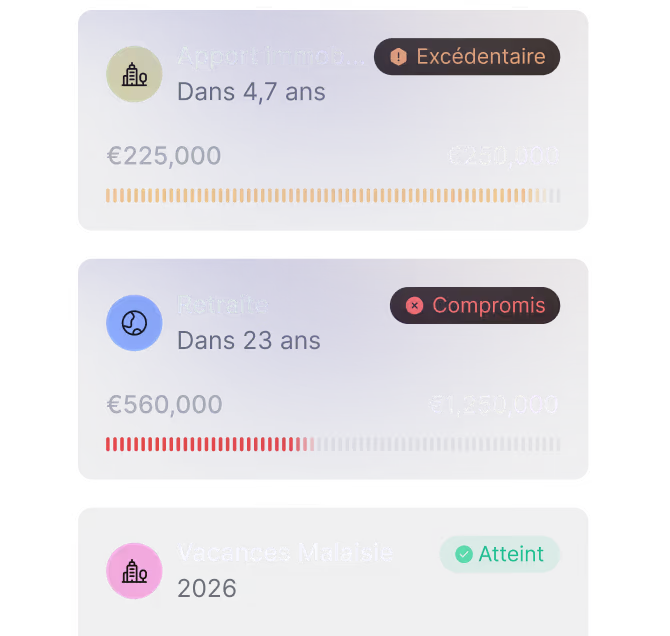
Track how your net worth evolves with Finary.
- 30-year simulation: our advanced algorithms run 5,000 scenarios to project how your net worth will evolve and estimate your age of financial independence.
- Personalised goals : Set your own wealth goals.
- Tracking and suggestions: See how your investments bring you closer to your goals and get suggestions from Finary.
Frequently asked questions
How can you get a €100 monthly income from €10,000?
To get a €100 monthly income from an initial €10,000 investment, you first need to work out the required return. €100 a month is €1,200 a year; against €10,000, that implies an annual return of 12%. A return at that level generally requires taking on substantial risk (equities, investment funds, structured products) and is never guaranteed. It is advisable to consult an authorised wealth management adviser to define a strategy suited to your profile and risk tolerance.
How can you get a €200 monthly income from €10,000?
To generate a €200 monthly income from €10,000, the required annual return is 24% (€200 a month, or €2,400 a year). A return at that level is not realistic on a sustained, long-term basis and carries a very high risk of a total loss of capital. It is more prudent to target an income consistent with a sustainable return, or to increase the capital invested.
Which investment should you choose to grow €10,000 risk-free?
Regulated savings accounts (Livret A, LDDS) are the only investments with no risk of capital loss: they have paid 1.5% since 1 February 2026, a rate due to rise to 1.7% on 1 August 2026, with respective caps of €22,950 and €12,000. For a capital guarantee on a more flexible wrapper, life insurance euro funds are an alternative, with an average return of 2.6% in 2025 according to France Assureurs.
How long does it take to double €10,000 through compound interest?
Under the rule of 72, you divide 72 by the annual rate of return to estimate the doubling time. At 7% a year, €10,000 doubles in around 10 years; at 4% a year, it takes about 18 years; on a Livret A at 1.5%, close to 48 years, before tax and inflation.
Sources
Regulatory disclaimers: Marketing communication. Investing carries a risk of partial or total capital loss. Past performance is not a reliable indicator of future performance. This article is provided for information and educational purposes only; it does not constitute personalised investment advice, a buy or sell recommendation, or tax advice.
Before investing, read the Key Information Document (KID) and, where relevant, consult an authorised adviser.
Finary SAS, an investment firm authorised by the ACPR (no. 19283), member of AMAFI. Insurance broker registered with ORIAS (no. 21001279), member of the CNCGP (association approved by the AMF). Crypto-Asset Service Provider (CASP) authorised by the AMF under the MiCA regime, references no. A2026-026 and no. N2026-008.